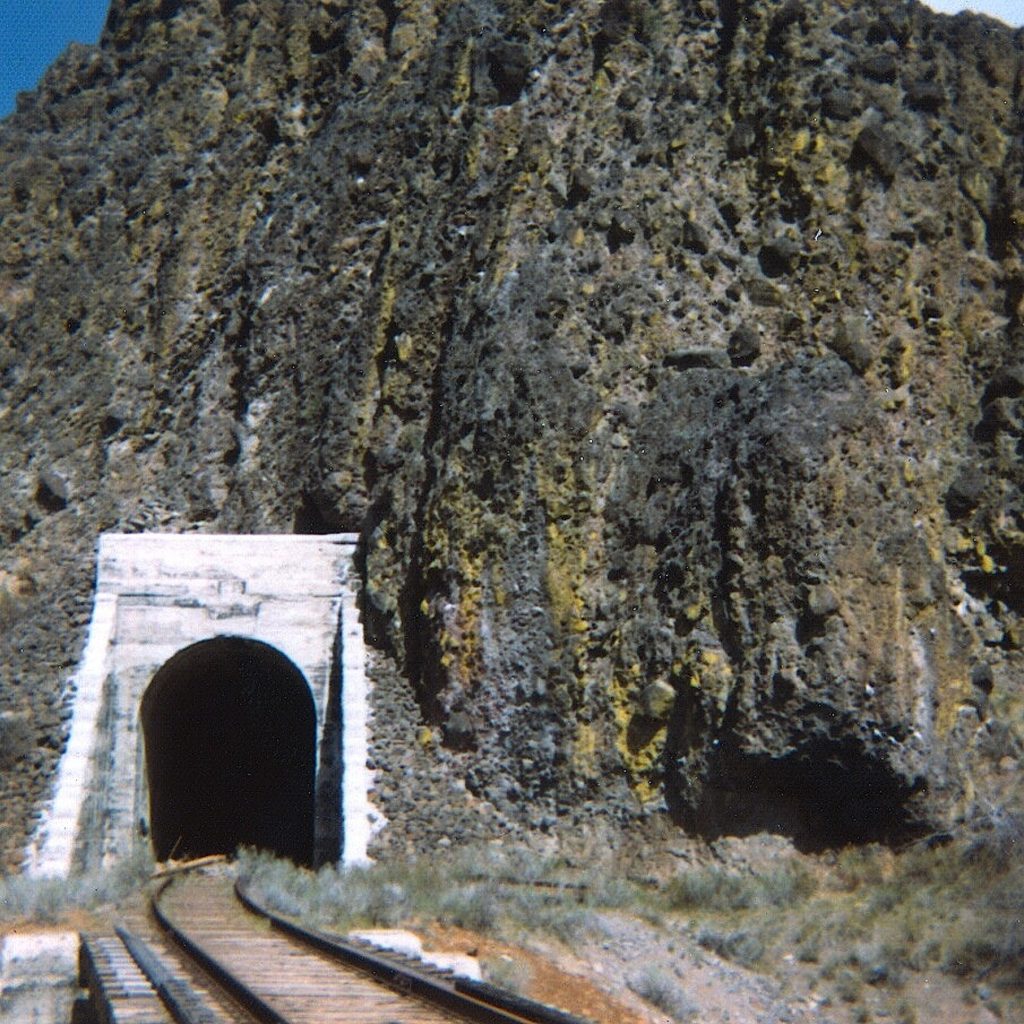
Chilcoot Tunnel, December 2, 1906. Courtesy of Marge Foster
In the fall of 1903, Western Pacific Railroad surveyors invaded the Honey Lake Valley and the region west of Susanville. This led to speculations regarding a new route to bypass Beckwourth Pass. If that was the case, the railroad would not have to build the 6,002 foot-long Chilcoot Tunnel under Beckwourth Pass, but even an additional longer tunnel at Spring Garden towards Quincy. It was decided on the Beckwourth Pass route, though the Susanville route would later gain traction.
On May 28, 1912, a fire broke out on the west end of the Chilcoot Tunnel. The heat was so intense WP crews were unable to suppress it. Newspapers, both local and regional, were quick to attack the WP over the costly Chilcoot and Spring Garden tunnels. It would take nearly a year before the Chilcoot tunnel could be repaired. To keep the trains moving, an expensive shoo-fly (temporary track) was constructed over Beckwourth Pass.
The Susanville route, now referred to as “cut-off” was debated. On September 13, 1912, Susanville’s Lassen Advocate wrote: “The Chilcoot Tunnel is still too hot that men cannot work in it. That tunnel will yet make it so hot for the pocketbooks of the Western Pacific.” It took nearly a year and a half before the tunnel reopened.
The north shore of Eagle Lake, 1920, where Udell proposed to build a dam. Courtesy of Lola L. Tanner
In late April, 1899 L.S. Greenlaw, special correspodent to the Reno Gazette traveled north to Lassen and Modoc to search out the conditions. There was, after all, a lot of interest being generated with the NCO Railroad’s extending its line north from Amedee to the Madeline Plains.
The following is an excerpt of one of his observations. “Valley of Eagle Lake. One would scarcely expect to see fine farms and fine farm houses in such a place. On the eastern shore are large grain fields and grassy meadows. We pass nearly halfway around this beautiful body of water and when we were driving along its northern shore the road is so near the lake that when the wind blows as it did that day white spray is blown into the buggy. Some of the finest trout are caught from this lake.”
One of popular local attractions is the Bizz Johnson Trail. It is a Rails to Trails Project to convert the abandoned railroad line between Susanville and Westwood. Like many projects it did not happen overnight. When it was first proposed in 1978, there was some local opposition.
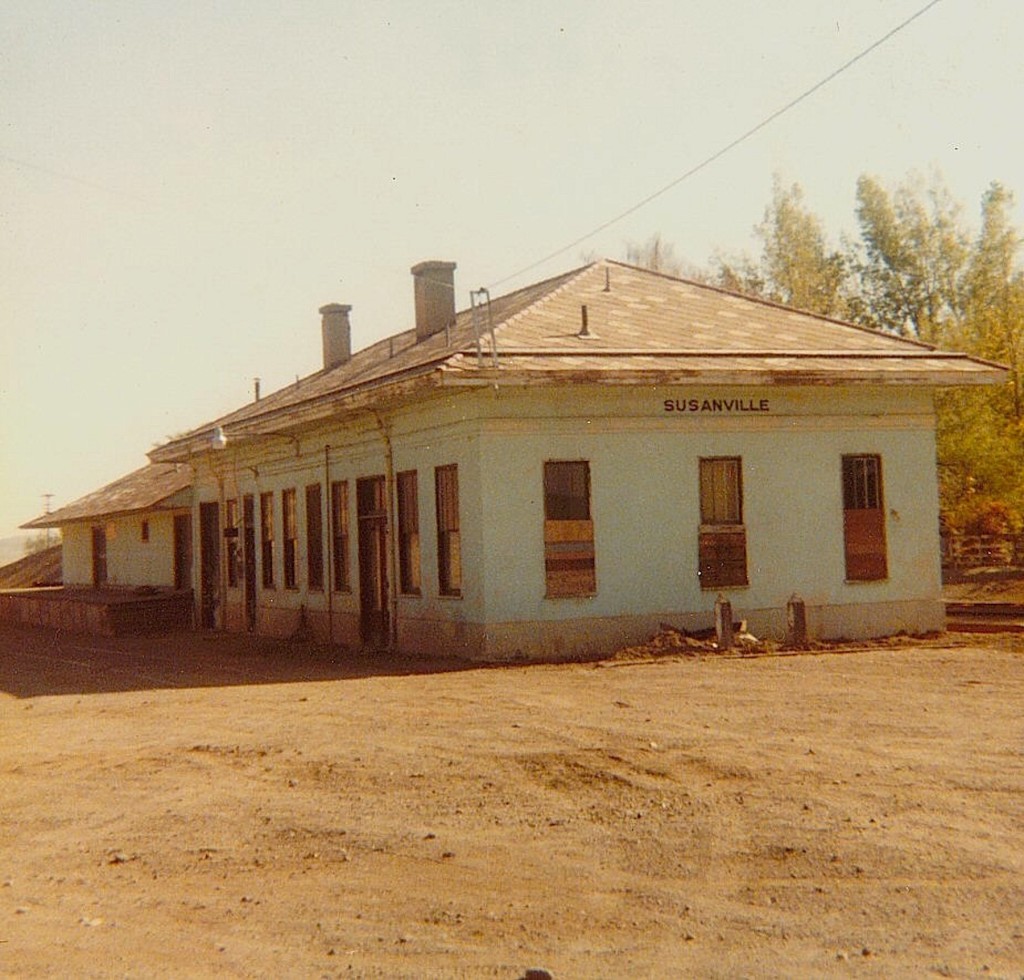
Anyhow, the project moved forward. There was a lot of work to be done to make the conversion a reality—like the removal of the rails and ties. In the summer/fall of 1981, Jim Dobbas of Truckee, a salvage operator had the job to remove the said rails and ties. For a time there was an impressive site of stacked rails and ties at the Susanville Depot. A portion of the re-usable rails were donated to the Virginia and Truckee Railroad.
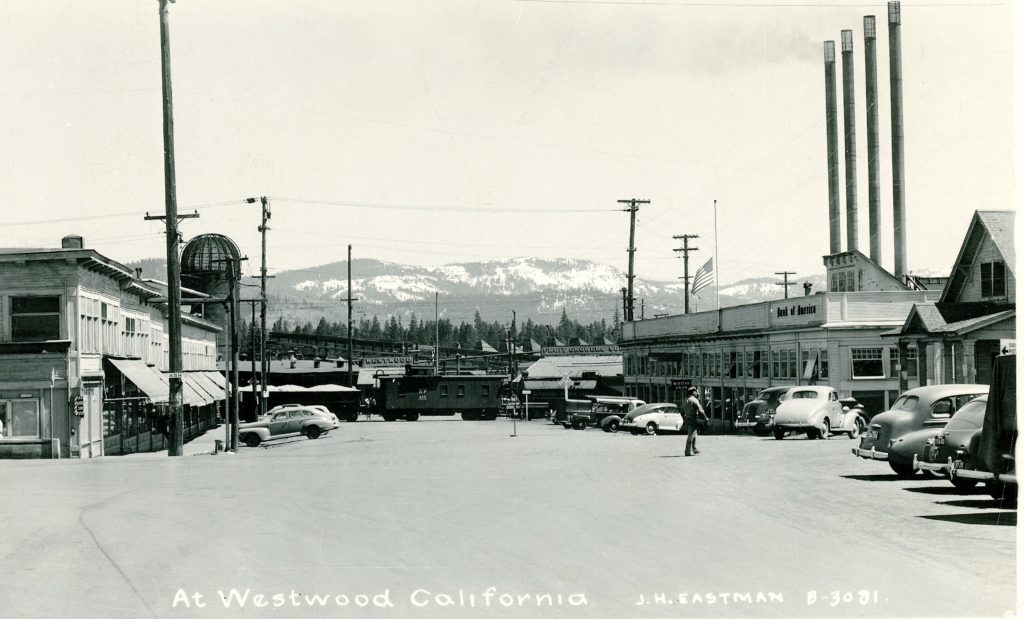
It just a few short years after Red River Lumber Company established Westwood in 1912, it became for awhile Lassen County’s largest town. This title would be short lived when Fruit Growers and Lassen Lumber established mills in Susanville, the greater Susanville region rivaled Westwood.
It was not until the summer of 1916 when an accurate head count was done to ascertain Westwood’s population. The Lassen County Board of Supervisors ordered a special census be conducted for Westwood to fulfill a requirement by California Political Code Section 4055. Westwood resident, Leo H. Donnelly, was commissioned by the Board take the census. On September 5, 1916, Donnelly reported to the Board that Westwood had a population of 2,319. Red River officials had estimated there were only 1,600 residents. The town continued to grow.
The 1920 United States Census indicated there were 3,300 inhabitants in the Westwood Township. This included a small group of people residing on ranches in Mountain Meadows who were not associated with Red River. In 1921, Frank Graham, who held a variety of positions with Red River over the years, prepared a list of interesting statistics concerning Westwood. Graham stated it was not sawmill camp or sawmill town, but “ a little city that that has sprung up in the woods during the last few years.”
Graham duly noted the town’s population at 3,638 that another 800 inhabitants lived in logging camps making for a grand total of 4,438. Among other items, Graham observed there were 700 dwelling houses, 350 telephones and 400 cars. In summation, Graham remarked, “Not bad for a lumber jack town.”
Westwood still had more growing pains. In July 1924 in order to have a better understanding how many people were in the community, Fletcher employed the services of Mrs. Sherwood (Winnie) Zinn to conduct a special census. In her findings she reported a population of 4,647. This included those who resided at the Goodrich Dairy, company ranches and Town Camp. In relaying this information to Willis, Fletcher wrote: “This count, along with absent and unfound citizens would justify a reckoning that we have over 5,000 people here.” Over the years, folklore of imaginations run amuck held that in Westwood’s heyday it boasted a population of 10,000. However, the Zinn census portrays an accurate record. The 1930 U.S. Census indicated a population of 4,602 and a similar number in 1940 before the population began a slow decline. In the meantime, while the population stabilized, production from the plant continued to increase. Innovations with machinery made the operations more efficient, thus no need to increase the workforce. In 1956, with the pending mill closure the population plummented to 600.
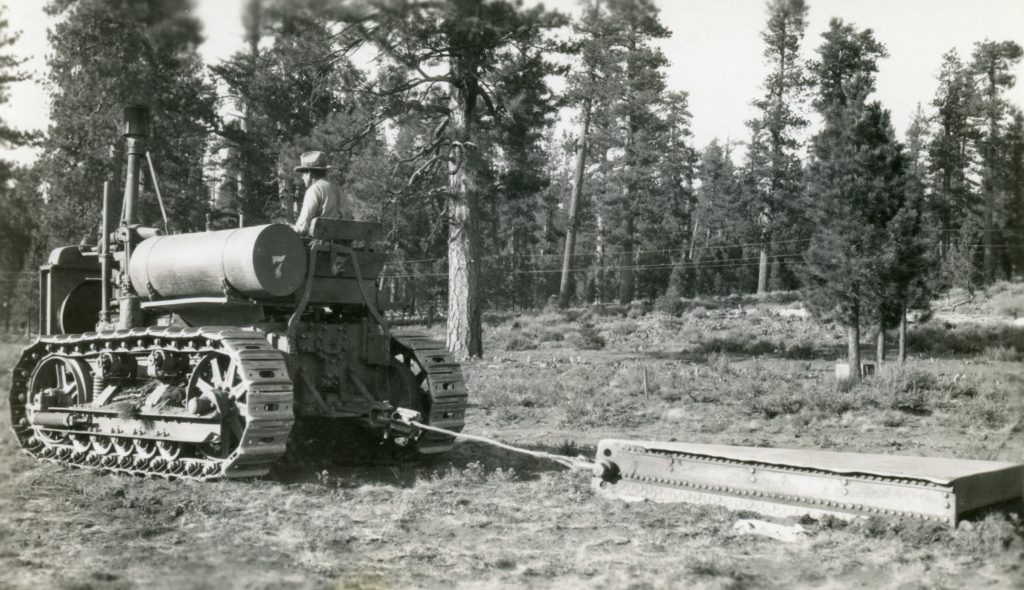
Fire trail V-drag plow, 1929. Courtesy of Fruit Growers Supply Company
After the 1924 fire on Antelope Mountain, west of Eagle Lake, Fruit Growers Supply Company (FGS) revaluated thier standard method of fire prevention. At that time they piled brush and slash (tree limbs and tops left behind once the logs were removed). They adopted a new method, building a series of fire lanes. The fire lanes were 100 feet wide and completely void of vegetation, each encircling 100-acre sections of timber. They were formed by a special V-drag plow hooked to a Caterpillar tractor which could clear up to six miles of fire lanes a day. The lanes not only served as firebreaks, but also provided quick access in case of a emergency.
After each 100-acre area was logged, all the dead trees, or snags were felled, because left standing, they deemed them a fire hazard. Once the snags were felled, however, they again became potential fuel, this time on the forest floor. After the first substantial snowfall, the fire crew burned the snags and slash.
During the fire season, two crews of eight to ten men work as a fire prevention team. It was their job to build fire lines, oversee brush and slash piling, remove dead snags and maintain the telephone lines. The telephone “boxes” were attached throughout the forest, to allow for daily monitoring between the logging camps and the mill. The telephone system was also used to report a fire or an accident when medical aid was required.
From time to time the local health officials raised concerns about swimming in the Susan River. Take for example of an incident that occurred in 1945. In early June, Dr. J.W. Crever, Lassen County Public Health Officer issued a polio alert. By mid-August, Crever noted that there was a decline of people using Roosevelt Pool and an increase of the same in the public using Susan River. Crever stressed swimming at the pool was much safer than the Susan River. Shortly thereafter he declared the polio threat over and only one case reported.
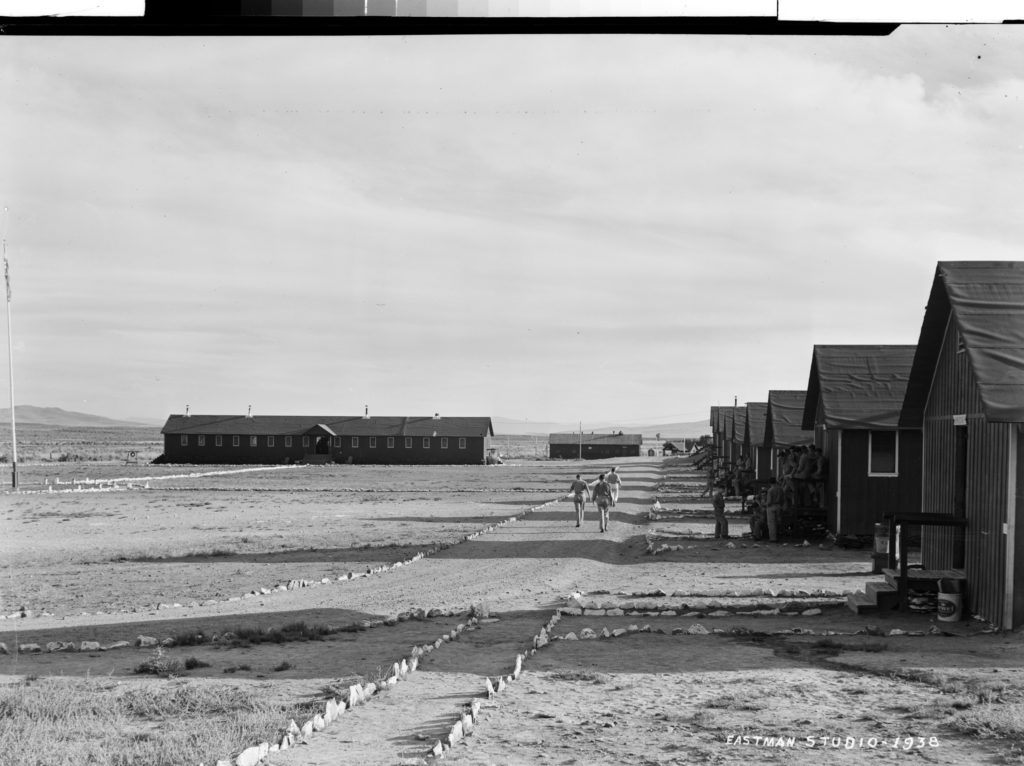
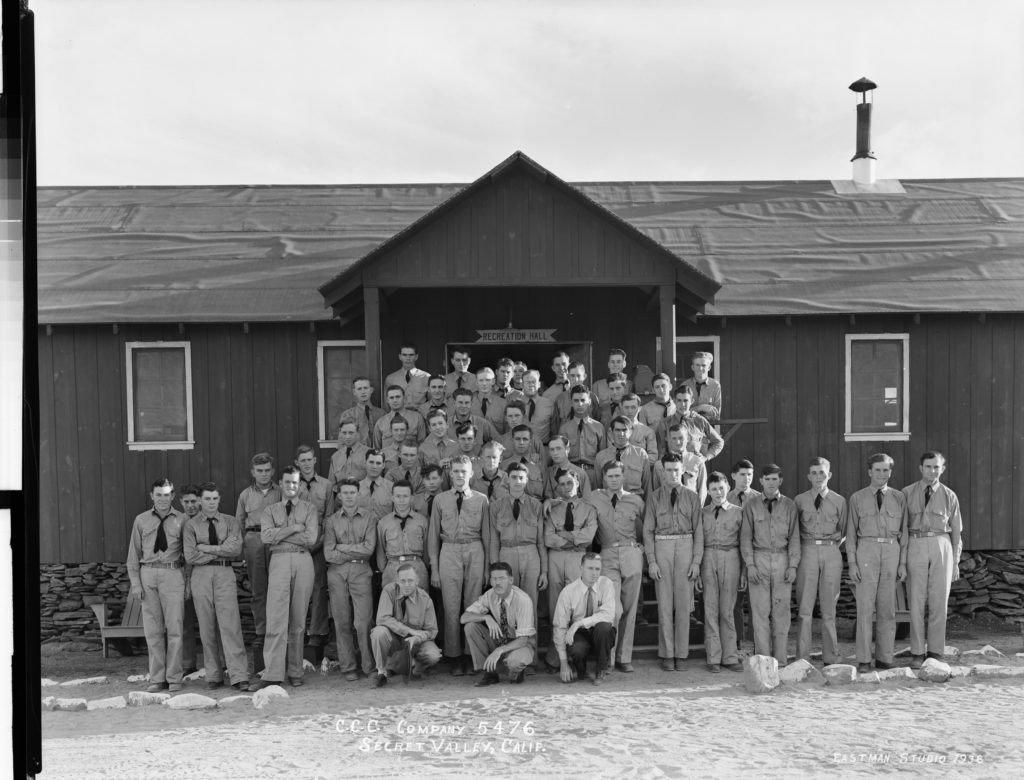
Secret Valley CCC Camp, 1938—Courtesy Special Collections, UC Davis
There were two Civilian Conservation Corp camps (CCC) in Lassen County—Halls Flat and Secret Valley. The Secret Valley camp was also referred to District Grazing Camp No. 13. It functioned a bit differently than other camps. Of course, a lot of the work done by men there focused on range mangement, whether building stock ponds, putting in wells to even water siphon repairs for the Baxter and Tule Irrigation Districts. It also operated temporary spike camps for certain projects. One opened in 1936 in Ash Valley and the project was to build a road from Ash Valley to the town of Madeline.
Secret Valley CCC Camp, 1938–Courtesy of Special Collections, UC Davis
In many respects the case of Manuel Cardenas versus the Red River Lumber Company appeared to be like so many others before seeking damages from injuries sustained. In 1936, Cardenas sued Red River for $50,000 from loss of his right eye due to an attack by him by Deputy Constable David Bohannon, a Red River employee. Thomas C. Ryan, a San Francisco attorney who represented Cardenas stated at the opening of the trial “Red River owns and controls Westwood.” Many folks thought that way, but feared publicly to say it. The Susanville business community had a code name for Red River—the Red octopus. It was a reference Red River’s tenactles were everywhere in Lassen County. Anyhow, Red River’s attorney, Hardin “Finn” Barry of Susanville retorted, “Every commercial business is operated by private business.” This was a recent event, as part of a reorganization of the company. Had this event occurred ten years ago, Ryan’s words would ring true. In the end, Cardenas was awarded $3,000.
This, I could not resist. As retailers seem to push holiday merchandise earlier and earlier, I stumbled across something that was way before its time. In August 1925, Susanville’s Lassen Advocate newspaper started advertising their selection of Christmas cards and taking orders for the same.
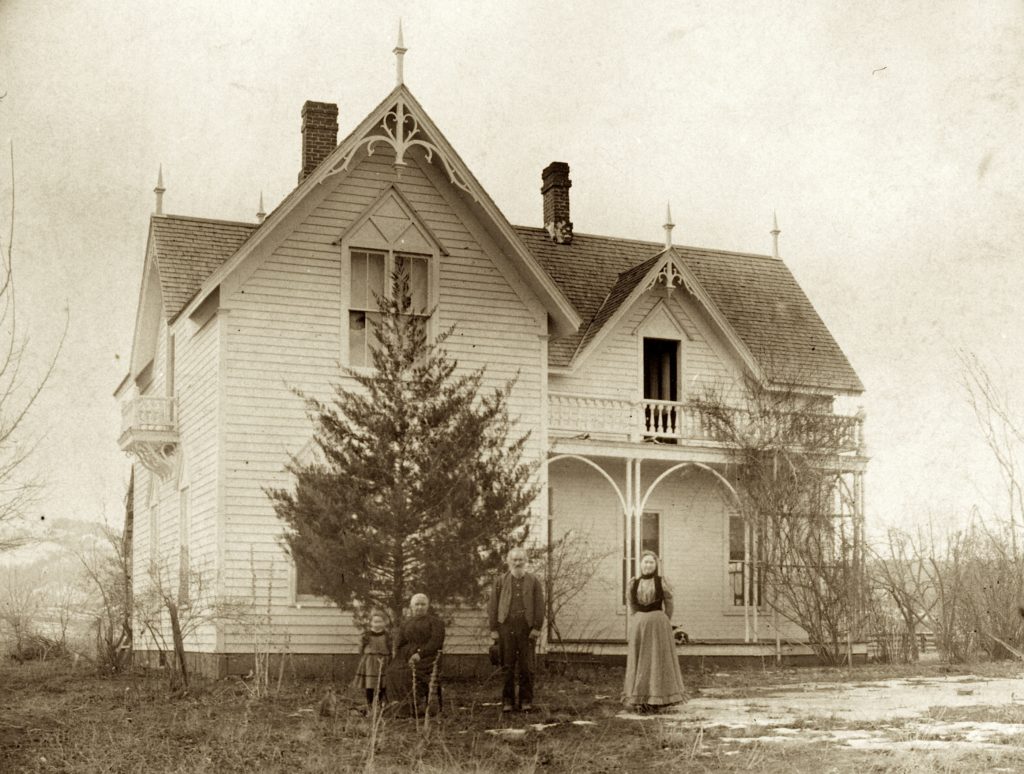
L.D. McDow Residence. Courtesy of George McDow, Jr.
It would take nearly a half century for Susanville, as a municipality, before it was able to expand its boundaries. Of course, politics played a pivotal role and the city’s most formible opponet was the Red River Lumber Company which owned the Milwood Tract east of the city limits.
Annexation efforts tried and failed with Red River’s influence. In the summer of 1928, the residence of J.A. Metz, who lived in the original McDow home in the Milwood Tract was destroyed by fire. Since it was outside the city limits there was no fire protection in Milwood and adjoining subdivisions. The fire prompted a petition drive for annexation. It was met with opposition and they were able to stop the movement in its tracts.
In 1930, an annexation campaign was resurrected. A committee was appointed to investigate the many issues and report back to a public meeting scheduled for March 10. It was decided to take a poll in the Halltown and Milwood Districts to obtain the residents’ pulse on the measure. For the proponents it was not good news. The initial poll showed 156 against annexation to 47 for it. End of discussion and remained that way for nearly a decade.