Category Archives: History

Pullen Museum Update

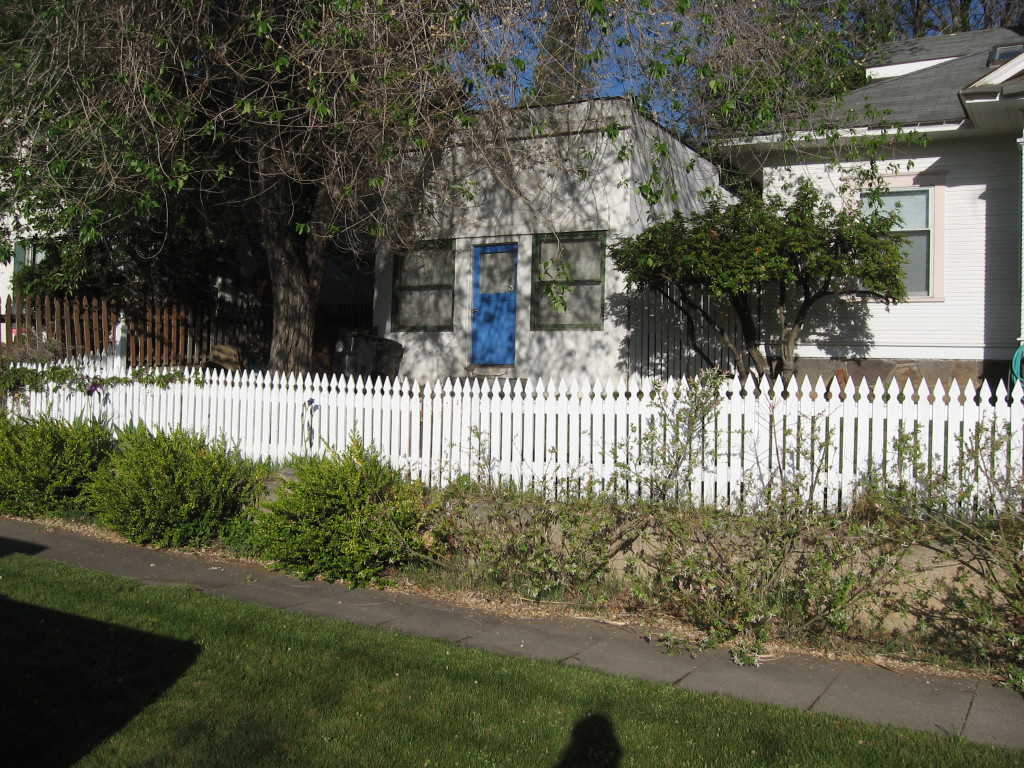
Pullen Museum
The Pullen Museum, May 3, 2015

A little background for those not familiar with the topic, that I wrote about in the spring of 2015. Granville Pullen first came to Lassen County in 1870. He moved around, and in 1901 he bought a ranch near Janesville. In 1914, at the age 76, he retired from the ranch and bought a home in Janesville. It should be noted that Pullen had been collecting various artifacts and curious for forty years. Upon his retirement he opened a small museum to display his collection. People were fascinated and donated items to him.

In 1920, Granville and his wife, Mary, bought a home on South Roop Street in Susanville. Next to his new home, he had a small concrete building constructed to house his museum and it opened to the public on June 18, 1921.

When Pullen passed away in 1926, his wife did not share her late husband’s possession for his artifacts. In early 1927, Mary donated the bulk of the collection to Lassen County and many items were put on display in the new Veteran’s Memorial Building. At the December 5, 1927 meeting of the Lassen County Board of Supervisors a discussion was held regarding the Pullen Museum. Mary Pullen offered the museum building on Roop Street to county on the condition it would be moved to another location. County Purchasing Agent E.F. Koken informed the board that it would be too difficult to move the building and the county declined the offer.

Support

Reforestation

Diamond Mountain, circa 1940. Courtesy of Margaret A. Purdy

It is interesting to note that before the Red River Lumber Company and the Fruit Growers Supply Company harvested a single tree, the two companies stated with their sustained harvesting practices they would operated into perpetuity. While both companies no longer operate sawmills, they own large swaths of timberland, which is routinely harvested. However, large swaths of territory the companies would log contained a great deal of volcanic rock, not the best soils for second growth trees. In addition, when they did a tremendous amount of logging in these areas, it coincided during a twenty year drought cycle from 1917-37, that until this time the region had never experienced since the Anglo settlement of the 1850s.
On the other hand, they had a positive outlook. Take for instance during the dedication ceremony of Fruit Growers sawmill in Susanville in 1921. Charles Emerson, a well known merchant and rancher was one of many dignitaries to speak. Emerson told the crowd of his own reforestation locally. Emerson recalled that as a child [he was born in Susanville in 1868], forty years ago, he helped plant a tract of pine trees on the family ranch just south of Susanville on Diamond Mountain. Those seedlings, he said, had become a fine stand of pine timber, many of which were 22 to 24 inches in diameter.

Subscribe

Lassen Youngster Shoots Freak

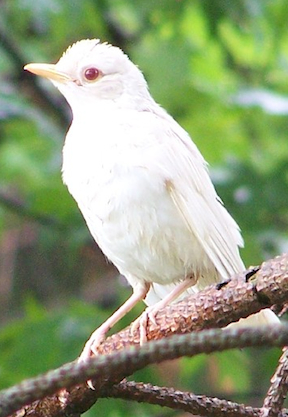
An Albino robin. Courtesy of seeds-solutions.com

That was one of the front page headline stories of Susanville’s Lassen Advocate newspaper of April 1, 1927. The following is what the newspaper reported:

“James Madison, the young son of Mrs. Jessie Madison, saw a strange looking bird flying on the Hulsman Ranch about a week ago. After several attempts to get near enough to see what it was, he shot it. Nobody seemed to be able to tell what it was, so John B. Christie sent it to the University of California Berkeley for any information they might be able to give.

“During the past week a reply has been received that the bird was a Albino robin and that it is a very rare specimen for this section of the country.”

Subscribe

Clarence Falegar, A Tragic Tale

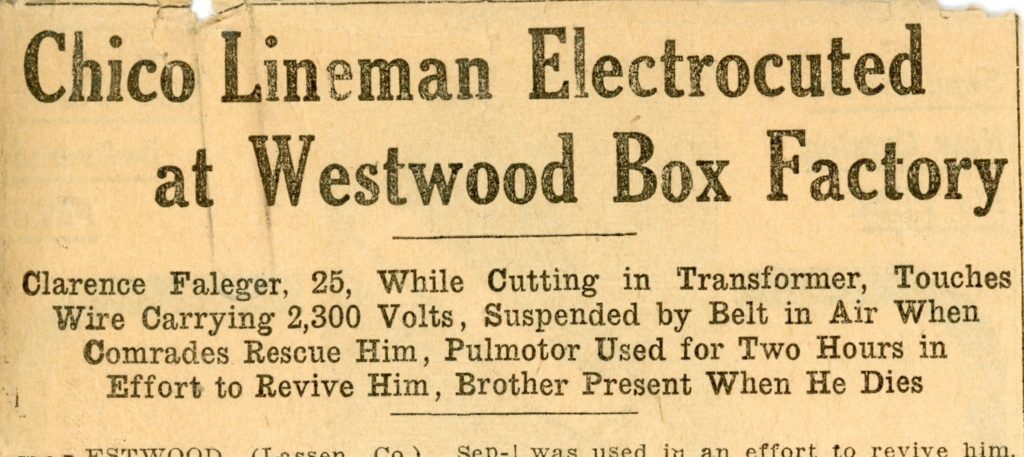
Chico Newspaper headline

The Red River Lumber Company archives in Minnesota provides a wealth information on so many topics. Of note, the kept interesting records and observations about logging/sawmill operations throughout Northern California and Oregon.

One area where company officials “Whitewash” is that of industrial accidents. After all, it should be duly noted especially in that era, logging and sawmill operations were very dangerous occupations. Of course, in company records, invaribly the employee was at fault.

A perfect example is that case of Clarence Falegar. On September 7, 1916, Fletcher wrote: “Day before yesterday while one of our electricians was at work on a high voltage line, 2300 volts, he got a hold of a live wire in each hand causing a dead short through his body, killing him instantly. He was a young fellow by the name of Clarence Falegar who was raised on the Falegar Ranch in Falegar Gulch of Mountain Meadows, had had been at work for us a couple of years. He was 23 years old, single, has a brother working here and his Father lives in the Sacramento Valley, I believe. This make, as I recall, the 13thman to be killed on the construction and operation of this plant in three years, which is a pretty heavy price for the lumber and development of the plant, but I do not know how any one of the accidents could have been avoided as long as we have the element of heedlessness, carelessness and disregard for ordinary precaution along with the element of accident.”

The P.P.I.E, 1915

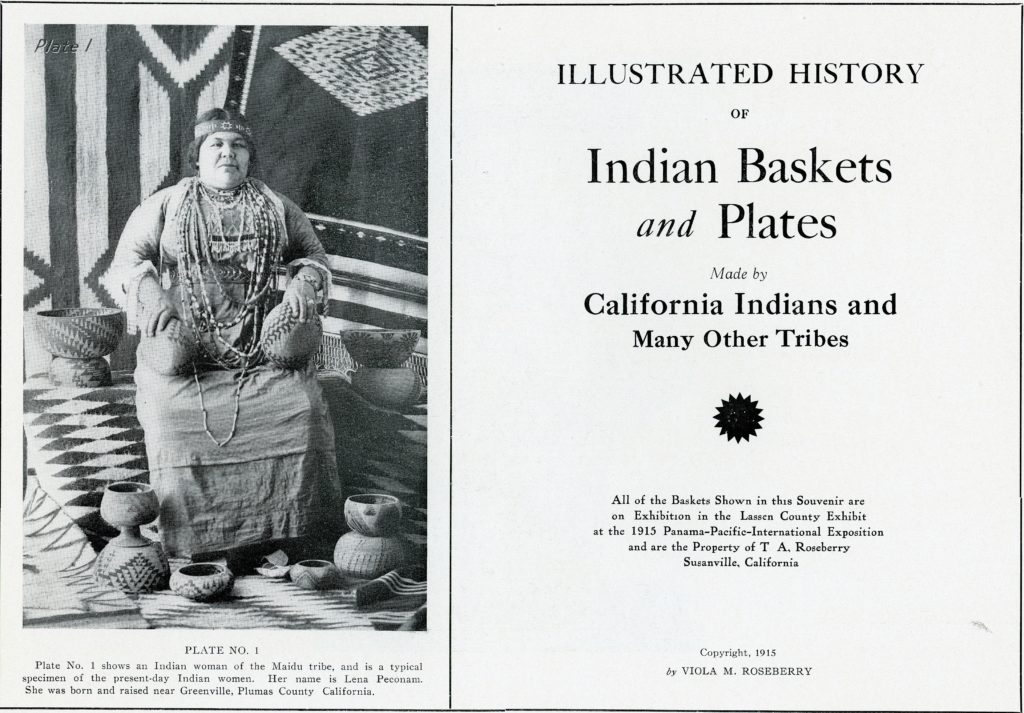
Viola Roseberry published an illustrated history of California Indian Baskets for the Exposition

The Panama Pacific International Exposition (PPIE) held in San Francisco during 1915, was a very big deal for California. Not only would it show case the Golden State as a whole, it went the further step that each of California’s 58 counties would be recognized. Not only would each county would have to maintain a manned exhibit, that every county would have a designated day at the Exposition. Before his passing, John DeLaHunt gave me an original panaroma print of Lassen County Day at the PPIE.

Lassen County retained the services of Russell Brownell to handle the county’s representation and exhibit. He entered into various contracts for the year long event. One of his first contracts was with Pittville resident George Louks. Louks would provide the exhibit with some fifty stuffed animals ranging from a bear, a bald eagle, two skunks among the various list. He was paid a total of $150 at increments of $12.50 a month.

Brownell’s next contract was with Susanville resident, Viola Roseberry, for her collection of some 300 Native American baskets to be displayed. She, too, like Louks, was paid the same amount. However, she was also hired at $27.50 per month to work at the exhibit. Just think how times have changed. After all she could live in San Francisco on less than $30 a month.

Support

The Stacy Post Office & Its Mayor

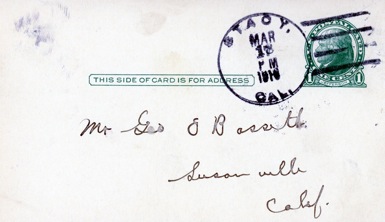
A Stacy postal cancel

Stacy was a small agricultural community in eastern Honey Lake Valley and serviced by the Fernley & Lassen Railroad. The post office was established on July 11, 1912 and named for Stacy Yoakum Spoon, a wife of one of the town’s promoters. Of note, the Yoakum name may not be familiar to many. Stacy’s father in the early 1900s was the manager of the San Francisco Ranch in Willow Creek Valley, known today as Five Dot. Her sister, Eulalee, married Robert Trussell, a well known Johnstonville family back in the day.


Once upon a time, many years ago, when I was with my Dad, we met an elderly gentleman, who my father introduced me to him as the “Mayor of Stacy.” At that time, to be quite honest, I am not even sure if I knew where Stacy was. Anyhow, that man’s name was Allson Newman, a native of nearby Sierra Valley. In 1916, Newman’s parents, Ferdinand and Jennie located to Stacy, where is father operated a store and the post office. After his father’s death in 1942, Allson took over the family business and postal duties, too. As the region continued to de-populate, the Stacy Post Office closed on June 30, 1951. In the course of time, the Mayor of Stacy, would finally retire to make his home on South Spring Street, Susanville.

Stacy Depot
Stacy Depot. The town was named for Stacy Yoakum Spoon, wife of Grover Franklin Spoon, one of the town’s developers and its first postmaster.

Support

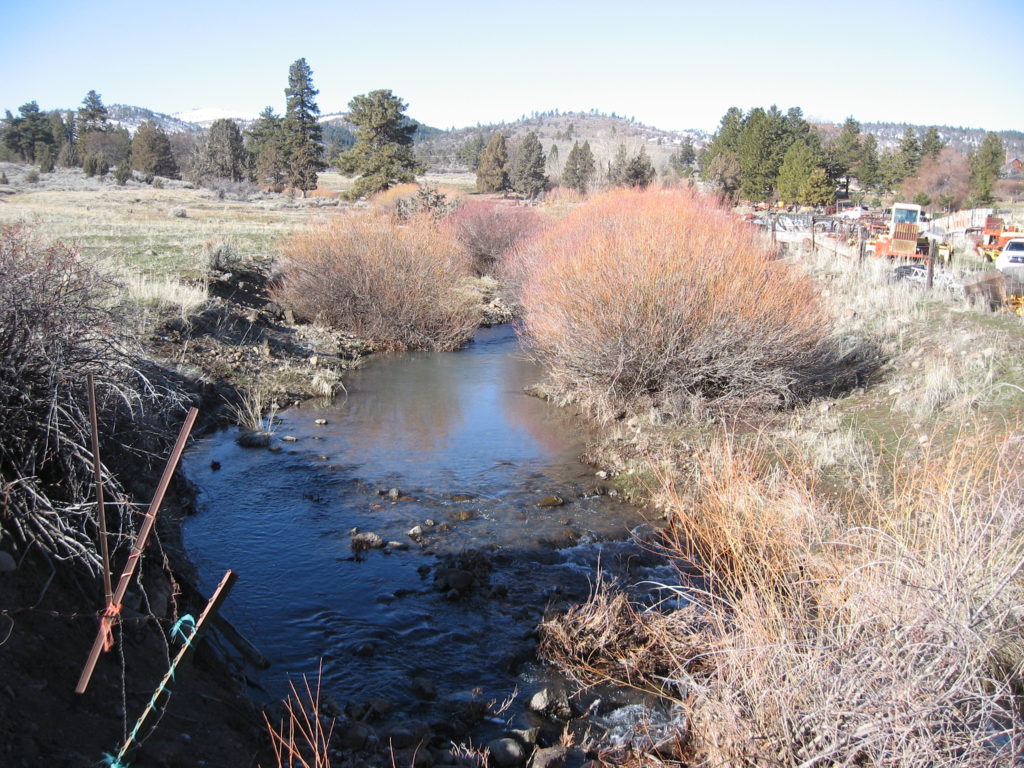
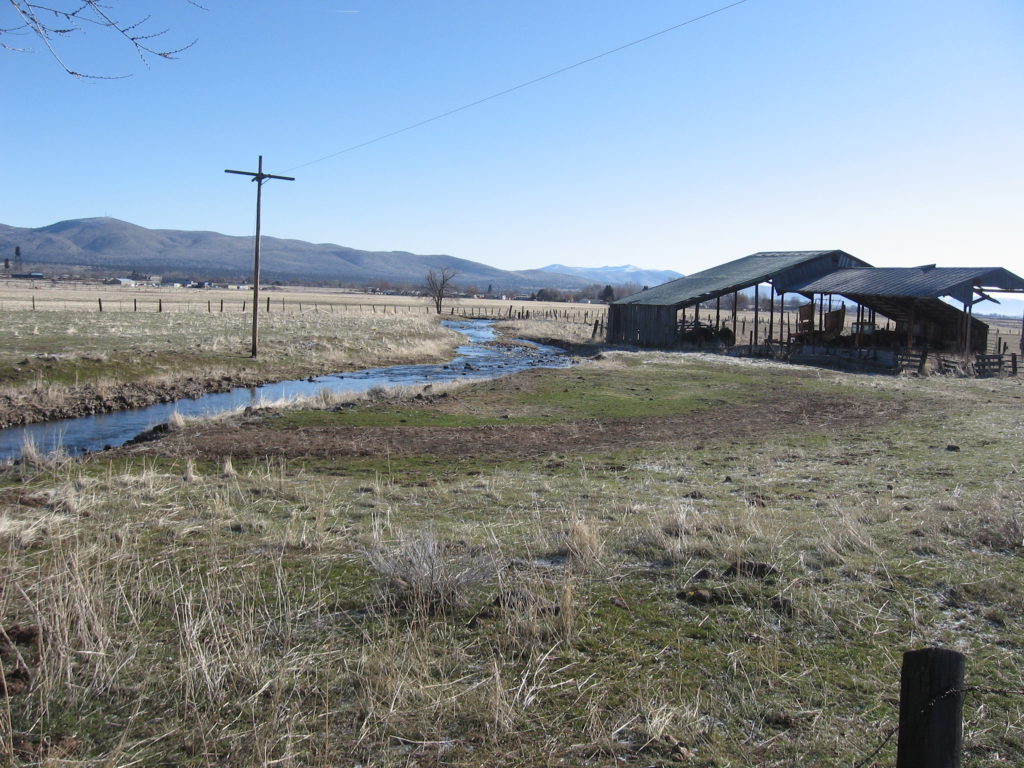
Ruf Creek

March 11, 2019

Named for German immigrant John Ruf (1843-1904) who came to California in 1866 and to Lassen County in 1874. For several years, he worked at Adam Jakobs sawmill in Willow Creek Valley. In 1883, he married Mrs. Pauline Hulsman, and they had eleven children. In 1885, he purchased the Cyrus Myers place, just south of Susanville where he lived the rest of his life.

March 11, 2019

Support

A Peter Lassen Inquiry

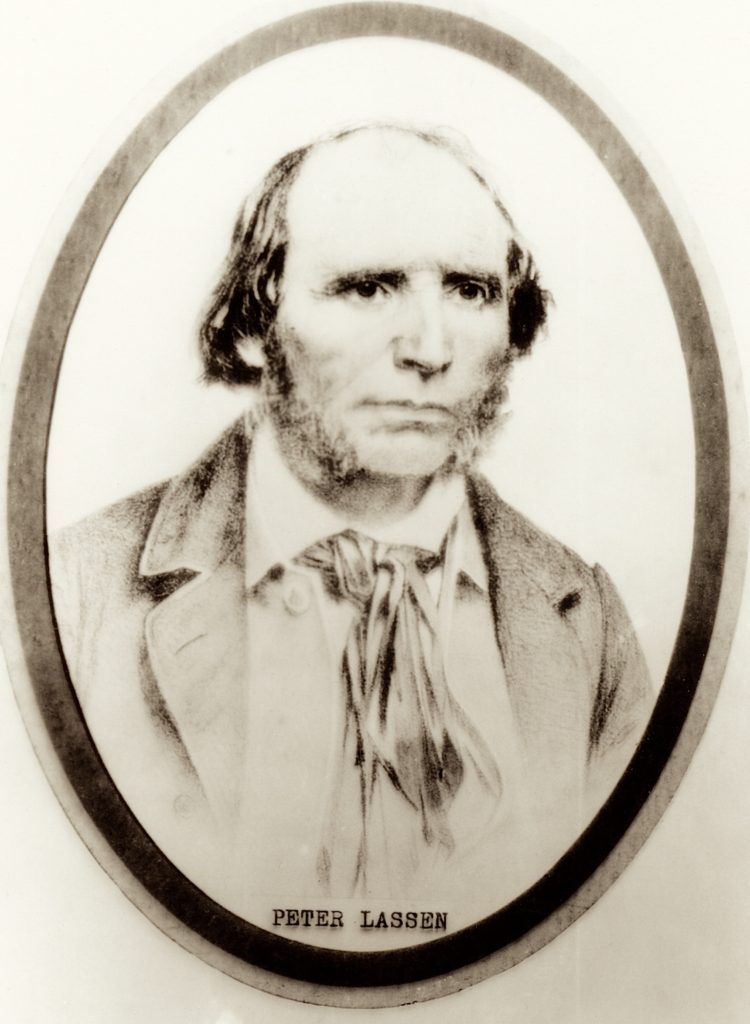
The infamous Peter Lassen, a name well known throughout Northern California

A subscriber inquired about a topic concerning Peter Lassen after reading the Lassen Monument Rehabilitation project. It had to deal with Lassen’s new settlement of Benton City, the area better known today as Vina, Tehama County.

Lassen was impressed with that country.   Lassen obtained Mexican citizenship, allowing him to own property and was subsequently granted five Spanish leagues (22,000 acres) at Deer Creek.  In February 1845, Lassen established Bosquejo Ranch at Deer Creek and it became the northernmost settlement in California. Lassen established Benton City on the Bosquejo Ranch.  In the summer of 1847, Lassen along with Commodore Robert Stockton went to Missouri to recruit settlers, though during their absence events changed and recruitment would no longer be necessary.  In the spring of 1848, Lassen brought back a small group of emigrants and they were the first to cross over the infamous Lassen Trail.  When Lassen arrived at Benton City he found it nearly vacated as the inhabitants had moved to Sutter’s Mill and other points following the discovery of gold. That was only the beginning of problems that Lassen encountered with Benton City.  Prior to his departure to Missouri he had deeded over one-fifth of his ranch to Daniel Sill. In May 1850, Lassen deeded over one-half of his ranch to Joel Palmer to finance the purchase of a small steamboat, the Lady Washington.  The steamer was to be the easiest method to transport supplies from Sacramento to Benton City.  The boat encountered numerous problems with sand bars and snag trees on the Sacramento River and was sunk.  That disaster and other financial problems forced Lassen to sell the remainder of his ranch to Henry Gerke.  

Support


Halls Flat CCC Camp

Halls Flat CCC Camp
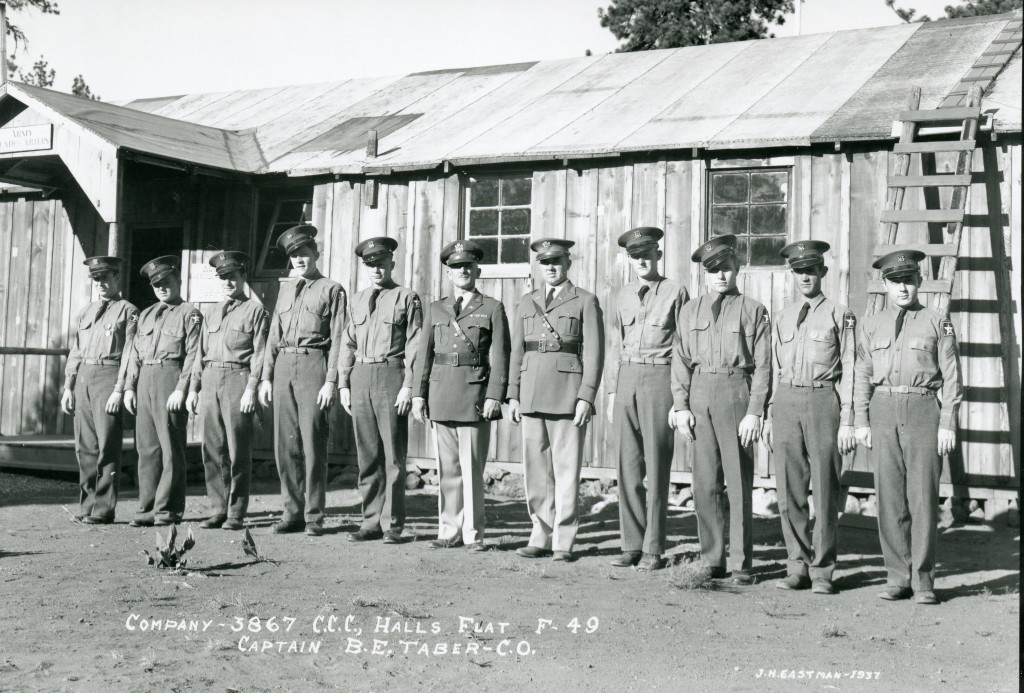
Halls Flat CCC Camp, 1937 courtesy of Hank Martinez

During the Great Depression of the 1930s, Lassen County would have two Civilian Conservation Camps, better known as the CCC. One was located at Halls Flat in western Lassen County, just north of Poison Lake. The other was Secret Valley, thirty-five miles northeast of Susanville, which one can see remnants from Highway 395 when driving north.

The Halls Flat CCC camp was established in 1933 and shut down in 1942. The camp provided a lot of manpower for the Lassen National Forest. Among the work done was grazing studies, range habitat improvement and some logging of pine beetle infested trees in the nearby Blacks Mountain Experimental Forest.

Subscribe

Honey Lake Paiute Ethnography

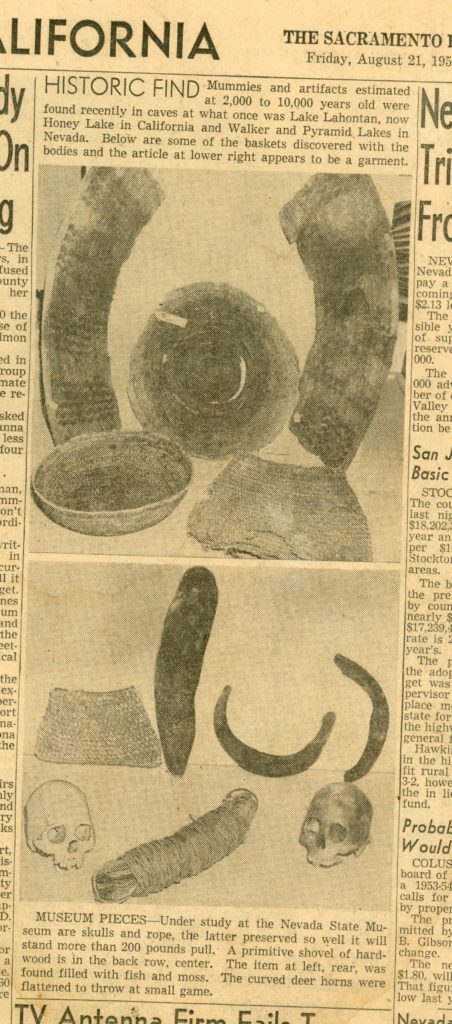
Sacramento Bee

In May 1978, the Honey Lake Paiute Ethnography was published by the Nevada State Museum. It was the work of Francis A. “Fritz” Riddell (1921-2002). Riddell was a well known archeologist and was first professional archeologist to work for the State of California.

Riddell’s father, Harry, came to Lassen County in the late 1920s to assist with the troubled plague Bly Tunnel at Eagle Lake. In the early 1930s, Francis attended the Missouri Bend School near Janesville. There he found arrowheads on the school grounds, that he was so intrigued by that led to his future career. By the late 1930s, the family had relocated to Sacramento. His older brother, Jim remained in Susanville and spent a career as a mail carrier in Susanville. Francis returned to the area on a regular basis to visit his brother, but he a special fondness for the local Native American community. Francis was involved in excavation of Tommy Tucker cave near Wendel, from 1949-1951. He also did extensive field work at Secret Valley.

Support