Category Archives: History

The Original Amedee School

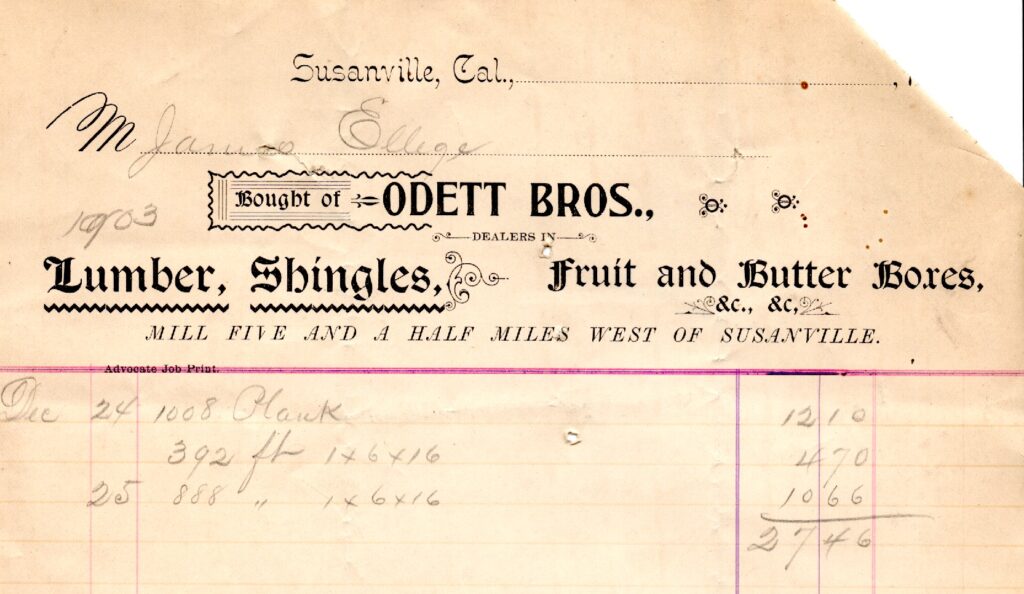
Invoice to Lassen County for the failed Amedee School Bond Election

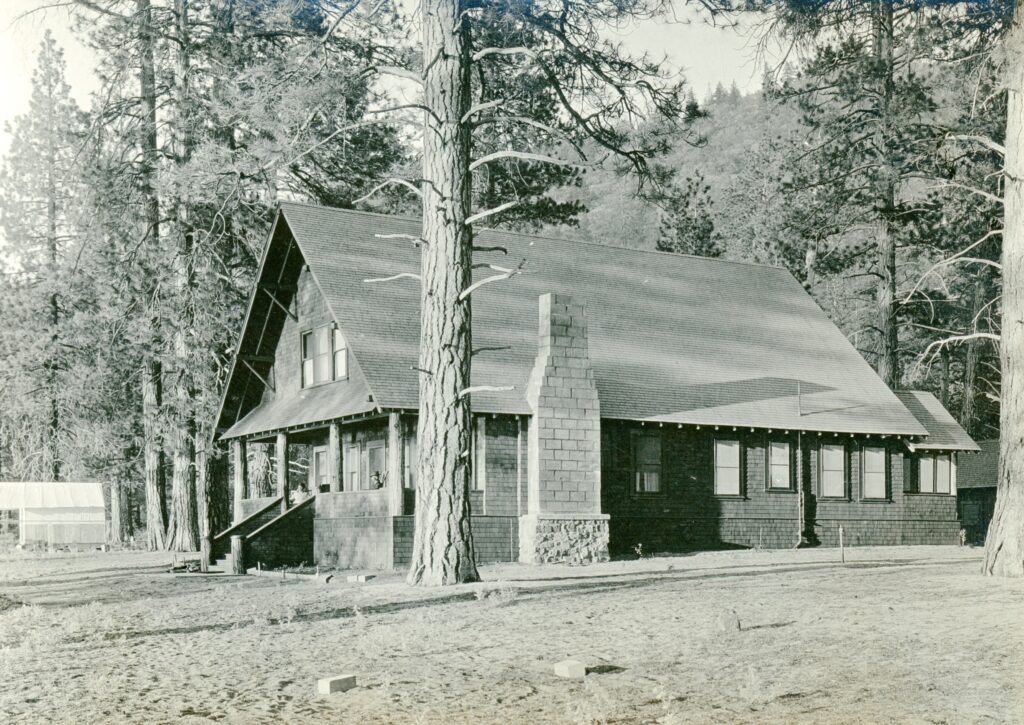
In 1890, when NCO railroad’s terminus to be known as Amedee, no one knew, that initially it would become boom town. With the influx families, in the spring of 1892, residents of Amedee petitioned the Lassen County Board of Supervisors to establish a school. The Board denied it. Not to be defeated, the residents opened a private school in September with an enrollment of eighteen students. The residents again petitioned the Board to approve a new district. The Board granted it on January 27,1893, and appointed L.W. Brubeck, E.C. Brown and C.D. Hemmenger as trustees. Continue reading The Original Amedee School

The tale of two Susans

Susan Arnold and Anna Hall
Susan Roop Arnold and Anna Hall at Constantia-Courtesy of P.S. Hall

While it is fairly common knowledge that the City of Susanville was named for the town founder’s daughter, Susan Roop, who later married Alexander T. Arnold. Many assume that the Susan River that flows through the community would also be named after Susan Roop.  However, that is not the case, because the river was so named, prior to Isaac Roop’s arrival on the scene.

Susan River, February 1972

During the years 1851-1852, William H. Nobles located a new emigrant road from Shasta, California to Lassen’s Meadows, Nevada. This road passed through the Honey Lake Valley. Nobles named the Susan River for his wife, Susan Parker Nobles.  While we know a lot about Susan Roop Arnold, very little is known about Susan Parker Nobles. She resided in Minnesota for the majority of her married life, moving to California when her husband, Nobles, died in 1876.

Support this site and Subscribe today!

A Prattville Question

Prattville, 1908–Sue Pratt

This falls under the category of Why They Came Here Recently, Jeanne Baldwin sent me this inquiry:

“I found your name on a list as I was looking for information about Prattville. I am researching a family that was located in Prattville in the beginning of 1903 and wondering what the community would have had to offer to a small family that had been living in San Francisco. The man was a merchant and not a miner so some business opportunity must have been made available to have him move his family to Prattville. What was Prattville like?  Do you have any thoughts about this?

“Patrick Lalor and his family ultimately settled in a rural community in El Dorado County where he lived for over 50 years.”
Thank  you for considering this, and I appreciate your time.
Jeanne Baldwin
Why people locate where they do, is a multi-pronge question. Some are obvious and others, like the writer pose, not so. Since Prattville was a small mountain resort community job opportunities were minimal and for the most part seasonal.  Since the inquirer did disclose any background information, it is mere speculation on my part as to the justification of the move. However, that is my option, and I invite readers share their views.
Tim

The Origin of Hallelujah Junction

H Junction
Hallelujah Junction, 1940s

Since the 1850s, the region has always been referred to as a junction to Beckwourth Pass and the Sierra Valley. It has been told that emigrants in the 1850s, when they arrived at this spot, shouted “Hallelujah” whey they saw Beckwourth Pass—at 5228’ its the lowest pass over the Sierra. In 1932, Orville Stoy took up an 80-acre homestead there. Stoy built a gas station and it became a popular stop, known as Hallelujah Junction. In time, a bar, restaurant and motel were constructed. There was even the “Hallelujah International Airport” that consisted of a couple of airplane hangers and a runway that was an abandoned stretch of Highway 70. In 1973, the State of California purchased Hallelujah Junction. It was obliterated for the construction of the four-lane freeway from there to the Nevada State line. In 1991, a gas station and convenience store was built at the junction of Highway 395 and 70.

Hallelujah Junction
Hallelujah Junction

Subscribe!


Homeless by Sunday, April 12

Miller Road Residenc

If this post is disjointed, because my thoughts are out of control. However, I was served eviction notice yesterday, to leave the premises by Sunday night, April 12. Long story, for another  time.

The old Baxter property on Miller Road, next to the cemetery, sound appealing, it being cozy. The agent, Cheryl Holmes,, unfortunately we have not been able to contact

If you have any short term and or either long term housing please contact as soon as possible.

If you do not hear back me, I have jury duty duty today.

Tim


Lassen County Militia

Militia Card
Tro Emerson’s Militia Card

Twice in Lassen County’s history there have local militia units of the California National Guard. The last time was during World War II. Initially, there was to be one large unit for Lassen and Modoc counties. That plan was neither feasible or practical and was dropped.

A new strategy was drafted. Inside each county, especially in large rural counties like Lassen, several local militia units would be formed. There duties were to protect the area in case of enemy invasion. Their involvement was confined to the boundaries of the county. Uniforms, guns and ammunition would be provided to each unit. They would also be trained in guerilla warfare. In Lassen County it fell upon the Farm Advisor (T.S. Brown) to organize these units.

On May 20 1942, the first organization meeting was held in Susanville. Local units were created for Susanville, Bieber, Doyle, Janesville and Standish. By the first of June, the Susanville Militia had 70 members. It became known as Thomas Tucker Militia—named after Thomas Tucker the first casualty from Susanville in World War I. Fortunately, this volunteer force never had to be activated. At the conclusion of the war, each individual’s enrollment in the militia was automatically cancelled.

Militoa card

Don’t forget to look at the Subscribe feature.

P.S. – Still in search of a  home.

Easter Sunday

Susanville’s Methodist Church, circa 1896. Courtesy of Philip S. Hall

It being Easter Sunday, I thought it would only be appropriate to provide some of the early history of religion in our region. The Methodist Church had a profound influence on the Honey Lake Valley. In 1860, this church held their first service in Susanville. By 1905, there were Methodist Churches in Janesville, Johnstonville, Standish and, of course, Susanville, more than any other denomination. 

Sacred Heart Altar
The altar at Sacred Heart Church, circa 1911

The Roman Catholics first made its appearance in 1868, holding Mass at the home of Ned Mulroney a short distance south of Susanville, near Gold Run. The Catholic population in the region was small, so in many instances they may only see a priest one or two times a year. In 1892, they built their first church on Richmond Road. In 1909, it was moved to the site of the present church on Nevada Union Streets.

Other religious affiliations slowly made their presence known such as the Church of Latter Day Saints who first made their presence in Big Valley in the 1880s, before slowly drifting south towards Susanville. The Baptists, Lutherans, Presbyterians and others followd suit.

Tim

P.S. – Still in search of a  home.


Smoke Creek Ranch, 1982

The site of the former ranch house, 1982

Things do changes and some times rapidly. When I was out to the Smoke Creek Ranch, in 1979, the ranch house was still there and three years later it was gone.

Smoke Creek Ranch, September 29, 1979

For those who did know where this place is, it is located just across the Lassen County line and In Washoe County, Nevada.  Actually, the upper portion of where the reservoir is located, a portion is located in Lassen County.

The bunk and cookhouse, Smoke Creek Ranch.

There is no longer public access to the ranch property.

A corral at  Smoke Creek Ranch

Tim

P.S. – Still in search of a  home.


An Early Day Johnstonville Enterprise

Lassen Flour
The Lassen Flouring Mill, 1901. Courtesy of the A.J. Mathews family.

Back. in its day, it was a notable landmark. It was the second flour mill constructed in the Honey Lake Valley. Work began on the mill in the spring of 1864 near Johnstonville, approximately where the defunct Gables is located. The machinery came from a mill located on Cow Creek, Shasta County, which belonged to John Briceland. The operation was leased to various individuals and it was not until the 1870s that stability of the ownership came to be. In 1875, William Hall and Henry Snyder became partners and remained until it closed.

In 1907, Snyder desired to retire and move to a milder climate. Hall purchased Snyder’s interest, but he too, decided to retire and by 1908, the mill shut down. The mill sat idle for over a decade, and in 1919, as part of the liquidation of Hall’s Estate the mill was sold to M.A. Taylor of Oakland. Taylor attempted to sale it, but there was no interest. He gutted the machinery and took it to the Bay area. Sam Alexander of Standish, salvaged some of the lumber from the building which he used to build a barn at his place.

Support this site and Subscribe today!

Westwood’s First Train

First Train
First train to Westwood, February 21, 1914

When the decision was finally made by the Red River Lumber Company to locate a mill at Mountain Meadows, there was still the obstacle of a railroad. Actually, the selection process was a volatile one, which one can read in Red River: The Early Years. On January 29, 1912, Red River entered into a contract with the Southern Pacific Railroad to construct a 125 mile railroad from Fernley, Nevada to Mountain Meadows, to the town that would be named Westwood. As an incentive, Red River guaranteed the Southern Pacific that all their freight would be handled by this line for a period of five years. In addition, it was understood that once Red River was ready to expand north, the Southern Pacific would extend its line to Klamath Falls, Oregon. However, that is another story, though Red River gave serious consideration to build a second mill near Lookout. Continue reading Westwood’s First Train