A Short-Lived Knights of Columbus Council

A portion of the local Knights of Columbus assembled at the Elk’s Lodge, 1924. Courtesy of Jean Kern

Any one who has ever been involved  with a organization, whether community oriented or fraternal, knows full well that they have a tendency to have peaks and valleys. However, there times when the organization reaches a low point and never recovers.

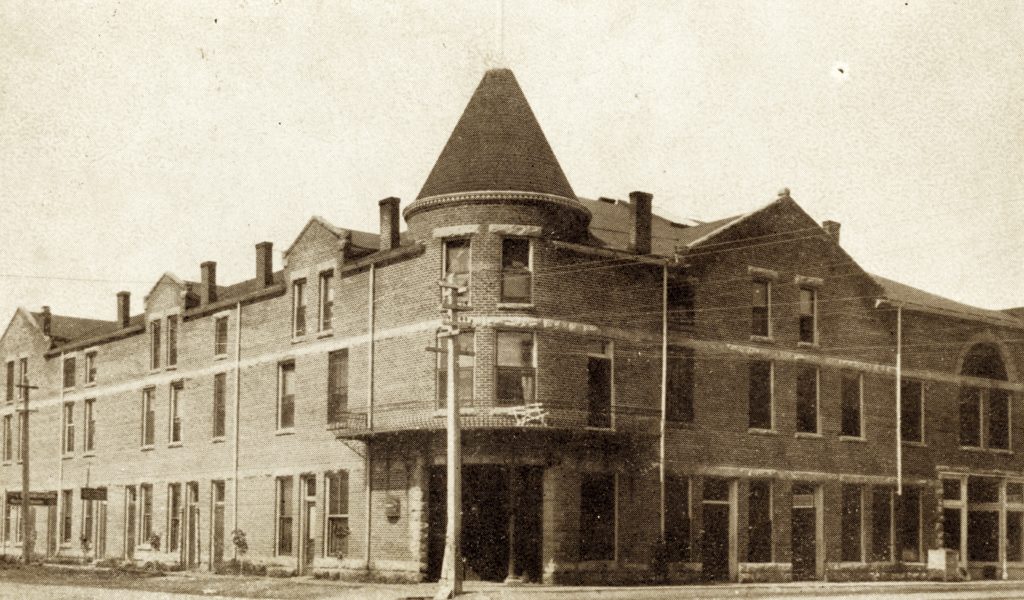
This was the case with Mount Lassen Council #2549 of the Knights of Columbus—Susanville’s first catholic organization.  Unfortunately, there is not a lot of records about this particular organization.  Its initial membership was 70, with men recruited from Susanville, Westwood, Quincy and Portola. Delegates from Chico, Los Angeles and Reno were on hand with the formation of Mount Lassen Council #2549 of the Knights of Columbus.  It was instituted on March 26, 1924.  After Mass was celebrated, the members paraded up Main Street from the Sacred Heart Church to the Elks Lodge to have their photograph taken. From there they went to the Knoch Hall were various degrees were conducted, and to organize the new council. The day was topped off with a banquet at the St. Francis Hotel.

Initially meetings were rotated between Susanville and Westwood. However, by 1930 interest in the organization had waned, and on the eve of its tenth anniversary of formation the chapter was dissolved.

Support

Lassen National Park—Thinking Outside the Box

Cinder Cone and Lassen Peak, 1911

When Lassen Volcanic National Park was established in 1916, Congress only approved an annual budget of $5,000. This meager funding was a far cry from what was needed for basic improvements in a park that had none.

Yet, Lassen Park advocates were a persistent bunch and they explored a variety of avenues. Whatever the case may be, their lobbying tactics, however, were unsuccessful..One of the park’s boosters came up with an interesting idea upon the passing of  former U.S. President Theodore Roosevelt who died in 1919, It was suggested to rename the park after Roosevelt. Not only would it be a memorial in his honor, but it was considered a venue to overcome its financial dilemma with Congress. An interesting thought that went no where.

Subscribe!

Tuesday Tidbit – T&A Update

Lassen County Fair Parade, with the T&A in the background—Margaret Purdy

Note: I did come across this picture of the T&A, so I wanted to share.

Some one wanted to know about the history of Susanville’s T&A Lounge located on the corner of Main and Sacramento Streets. In 1939, my grandparents, Ira and Margaret Purdy bought the Main
Street frontage between Sacramento and Spring Streets. My grandfather had a gas station and garage on the corner of Main and Spring Streets. Ira sold the vacant lot on the corner of Main and Sacramento to Tony Tonin and Al Surian—hence the name T&A. It was a short lived partnership, but Surian’s son, Gino, still owns the establishment.

Tim

Those Late March Snowfalls

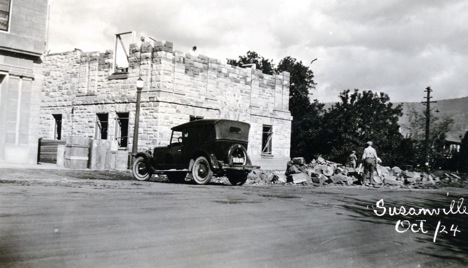
Main Street, Susanville, 1927. Note you can see where the fire burned above the Elks Lodge in 1924.

Late spring snowfalls are not unusual. Just like their counterparts of early fall snowfalls, they share a common trait—the snow melts quickly.

On March 25,1924 the Susanville area received anywhere between 18 inches to two feet of snowfall. Within twenty-four hours there was not a trace of snow. The local farmers rejoiced over their short-lived bounty, it being the driest winter on record to date. Spring rains were practically non-existent. It was a prelude of thigs to come. California would experience its worst forest fire to season to date.An interesting tidbit, the region did receive any measureable precipitation until September 15.

Tim

The Richmond Hotel

Richmond School
Richmond School, 1916. Courtesy of D.M. Durst

Richmond was a very short-lived mining community of the late 1850s and early1860s south of Susanville. Today, its best known for the Richmond Elementary School and the Diamond Mountain Golf Course.

In 1859, Frank Drake built a story and half log structure used as a store and hotel. The following year, with business booming, he built a two-story frame structure 30’x60’. The good times did not last long. By the end of 1862 with diminished gold from Hill and Lassen Creeks, along with the mining discoveries on the Humboldt and Comstock decimated the town. The hotel found a new life as a hay barn. On March 24, 1908 it was toppled over by a windstorm.

Tim

Gone, But Not Forgotten

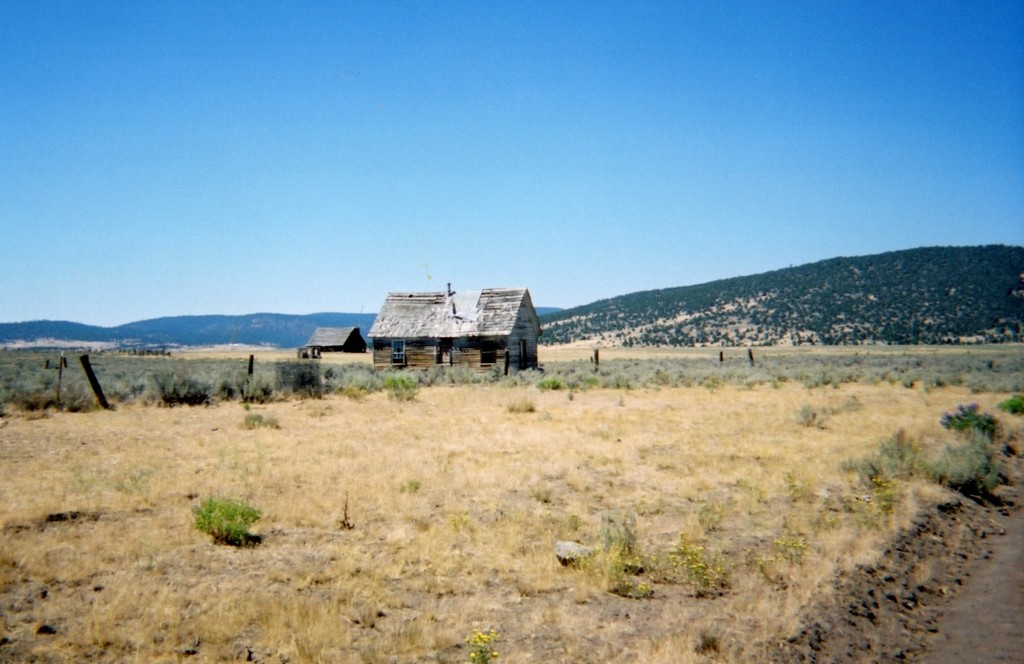
Abandoned homestead near Stacy, eastern Honey Lake Valley, 1987

There was a time, not so long ago, that an expedition exploring the desert, one could examine old homesteads. Many of these structures were of modest means. But, while people attempted to reclaim the sagebrush plains, they eventually failed. Nature in the meantime, reclaimed the abandoned properties.

The Zarbock homestead. Carl R. Caudle Collection

Today, there is hardly a trace of these by gone homesteads. Sometimes remnant remains in the form of a smoke tree, a hardy plant that requires no care. In fact, the Bonham ranch house site in Smoke Creek Desert is now covered with smoke trees.

A smoke tree, October 25, 2017

Tim

A Westwood Independent Business

Taylor’s Advertisement, Westwood Independent, 1918

While many are aware of when Red River Lumber Company’s mill town of Westwood first came into operation in 1913, it was a true company town. All the housing was owned by company, and about 99 percent of businesses were too. There are exceptions to the rule.  There were some tasks the company did not want to undertake, such as the mortuary. Of course, that business needed Red River’s approval to operate. The featured illustration provides another example.

In. 1918, WesleyTaylor advertised in the Westwood Independent his services as insurance agent and notary public. How long he remained in business there is not clear. However, in 1920 with the formation of the Westwood National Bank, that institution provided notary services. It should be noted since Westwood was initially a company town, there is little public documentation of the coming and goings of the town’s residents.

Tim

Ad from Westwood Independent April 2, 1918

Cove School District, Lassen County

Cove School District Petition, 1901

The Madeline Plains historically is not the easiest place to make a living.  Raising a family with children and to provide for their educational presents another challenge, whether yesteryear or today.

On the eastern Madeline Plains when the Moulton School District was abolished in 1898, it was succeeded by Cove School District.  It took several attempts to get the district established due to problems associated with the proposed boundaries. It was finally approved on April 4, 1901. The petition was signed by nine families who, on the average, resided 25 miles away from the nearest school—though M.L. Millsaps’ three children resided 45 miles from the nearest school, at the old Tuledad station next to the Nevada border. According to Madeline Plains historian, Don Garate, the residents built the first school on the west side of Cold Springs Creek.  The region experienced a record population growth with the influx of homesteaders and the school building needed to be enlarged and placed in a more central location. On October 16, 1908, the voters approved a $100 bond measure to build a new schoolhouse—the smallest bond measure ever to appear on a ballot in Lassen County. Just as quickly as the population increased, it dwindled.  The school closed in 1916, as there were only four students, one shy of minimum requirement of five.  The school never again opened its doors to students.  In 1918, it was annexed to Ravendale. On November 24, 1924, Elinor Coldren offered $25 for the Cove schoolhouse, but it was rejected.  In 1927, the Board of
Supervisors offered the schoolhouse for sale, but no bids were
received.

Support by subscribing.

Nurses Strikes End, 1987

Lassen County Hospital, circa 1925.

It was on March 20,1987, the nurses at Lassen Community Hospital, then affiliated with St. Mary’s reached an agreement ending the eight week strike. Stephanie Kruse representing St. Mary’s stated, “Everhting went very well. It is over.” While union spokeswoman, Noreen Frieling added, “The ink is on the paper. It’s done.”

Tim

2024 Western Pacific Historical Convention

The Portola Depot. Notice the rails had been recently laid, no ballast.

The Feather River Rail Society will be holding a Western Pacific Convention celebrating the 75th Anniversary of the California Zephyr. It is scheduled for April 11-14 at the Feather Falls Casino and Lodge at Oroville. Some of the featured items are Historic and Modeling Clinics, as well as  Archive and Photo Exhibits. For more information visit http://Wplives.org

In October there will be a Southern Pacific Historical Convention to be held in Sparks, Nevada. I will provide more information on that event when it becomes available.

Tim


Exploring Lassen County's Past