Lassen’s Most Influential Person

railroad
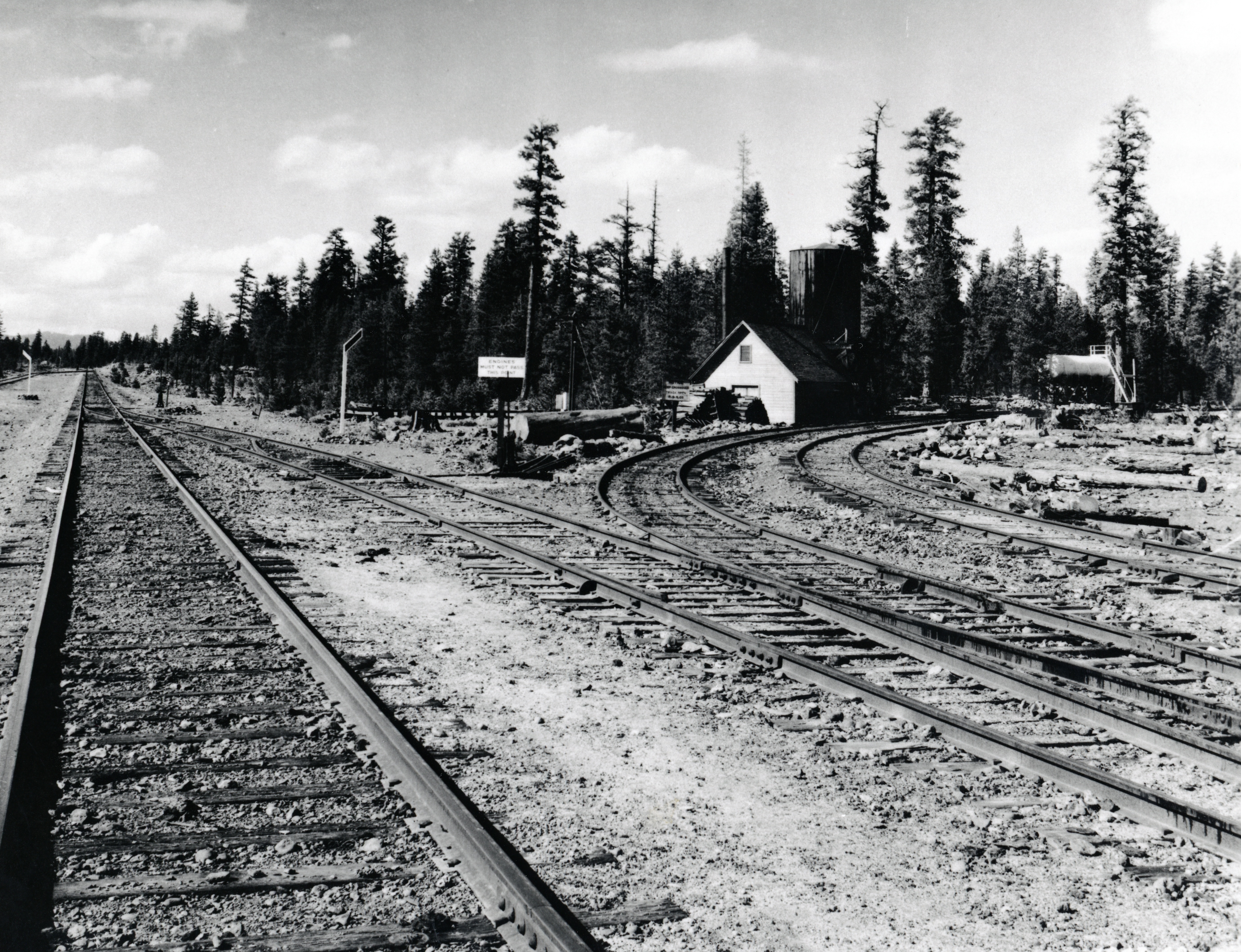
The Fernley & Lassen Railroad under construction, February 1914.

On January 29, 1912 a contract was signed in San Francisco that would forever change Lassen County. On that historic date, T.B. Walker signed an agreement with the Southern Pacific for the construction of the Fernley & Lassen Railroad.

T.B. Walker with his need for a railroad transformed Lassen County in countless ways. It brought an era prosperity that has seen before or since. The huge influx of population provided a huge market for the local farmers and ranchers. Take for instance, there was not a single dairy, by 1920 there fifteen.

Of course, if opened the door to the timber industry, and transformed Susanville in a major lumber manufacturing center. What was thought with sustained yield and other forestry practices it was believed that it would remain the dominant industry for well over a hundred years if not more. Within fifty years, the writing was on the wall, and Lassen County’s citizens sought a new industry—prisons.

In future posts we will explore those exciting times, as well as T.B. Walker.

Support this site, Subscribe today!

A Main Street Problem

Main Street, 1909
Main Street looking west from Lassen High before the fill, circa 1909. Courtesy of the A.J. Mathews family.

In 1914 Susanville’s uptown business district went through a major transformation when such buildings as the Del Mar and the Star Hotel were constructed along with other properties. There was a byproduct from this construction. The buildings had basements and the problem was what to do with all the dirt piling up in the streets. It should be duly noted that the city ended at Weatherlow Street. In the winter months it could be rather hazardous to get to the east entrance. This was due to the fact that between Weatherlow and Grand it was mainly bottom land where Piute Creek flowed. At least for pedestrians an elevated wooden plank bridge spanned the creek crossing. So all the excess dirt from the excavations was used as a fill for that segment of Main Street.

Support this site and Subscribe today!

Lassen Flouring Mill

Lassen Flour
The Lassen Flouring Mill, 1901. Courtesy of the A.J. Mathews family.

Back in March 2015 I wrote about the first flour mill built in Lassen County at Milford. As promised, I would follow up with the other ones. The second mill was constructed in the spring of 1864 near Johnstonville, approximately where the defunct Gables is located. The machinery came from a mill located on Cow Creek, Shasta County, which belonged to John Briceland. The operation was leased to various individuals and it was not until the 1870s that stability of the ownership came to be. In 1875, William Hall and Henry Snyder became partners and remained until it closed.

In 1907, Snyder desired to retire and move to a milder climate. Hall purchased Snyder’s interest, but he too, decided to retire and by 1908, the mill shut down. The mill sat idle for over a decade, and in 1919, as part of the liquidation of Hall’s Estate the mill was sold to M.A. Taylor of Oakland. Taylor attempted to sale it, but there was no interest. He gutted the machinery and took it to the Bay area. Sam Alexander of Standish, salvaged some of the lumber from the building which he used to build a barn at his place.

Support this site and Subscribe today!

Alexander Howell

Alexander Howell
Alexander Howell, courtesy of Donna Howell

Photographers, of course, is a favorite topic of mine. After all, thanks to their work we have a visual record of our past. It has been important to document the photographers of the late 1800s, so as to know the time frames when they chronicled the events. Due to a small population many photographers only remained a year or two, and even then they rode the “circuit” traveling to Modoc and Plumas counties to drum up business.

Alexander Howell came to Susanville from Oregon where he learned the photography trade. On April 15, 1891 he opened his Susanville studio. The following year he was lured to Amedee, with the prospects afforded by this boomtown. After a two-year stint, he traveled throughout Northern California and finally settled permanently at Auburn, California. Very few of his Lassen County works remain, but there is one of the Golden Eagle Mine at Hayden Hill, another topic for another time.

The current issue of the Lassen County Historical Society features an article of another photographer, Jervie Eastman.  The article has a number of flaws, so just be be aware.

Support this site and Subscribe today!

Edsel Dealership

80 N. Roop St.
80 N. Roop Street, Susanville, May 3, 2015

A wide variety of people read the daily posts, and that is a good thing, in the sense for everyone to become more familiar with the region’s heritage.

Of course, while researching one topic, invariably I come across other items, that I was not seeking. Some days it can be hard not to get sidetracked. In a recent instance while researching the Theodore brand, I came across the Susanville Edsel dealership of yore. It was located at 80 North  Roop Street, now home to Lasco and Rooptown Bicycles What many people may not realize that the building was constructed in 1957 for the dealership. Of course, Ford’s Edsel automobile was a failure and it soon closed. Many a seasoned resident will recall this building housed the California Department of Motor Vehicles for many years.

Support this site and Subscribe today!
 

The Gold Rush of 1907

Mining

The winter of 1906-07 was a fairly went one, though not a record breaker. It was remember most for the brutal month of March. The Honey Lake Valley region witnessed heavy rains and snow that month—12 to 18 inches worth depending where one was located.

All that precipitation brought about a few side effects. First there was a lot of soil erosion. This exposed a lot of minerals never seen before. With a mining bonanza under way throughout Nevada, local prospectors went in search of a new mother lode. Gold was being found in the most unusual places. The Indians panned for gold on Bass Hill in a what is normally a dry ravine that feeds Sugro Reservoir (located across the entrance of the Bass Hill Landfill in case you were not aware it has a name). Gold mining was done at the head of Rice Canyon, as well as Shafffer Mountain. As a matter of fact it was reported that nearly all of Shaffer had been claimed for mining. However, when summer arrived and with no major discoveries, the mining excitement faded as quickly as it had begun.

Support this site and Subscribe today!

McKinley School

McKinley School
McKinley School, 1950

The first McKinley School was built in 1920 and located on Cottage and South Gay Street, on the same lot that the former Washington School, nee Credence was located.

Yet, it was the Washington School that was built in 1900 that time had taken a toll on the structure. In 1947, the Susanville School District were concerned that it would not pass a number of safety codes. The following year the building was condemned and the district was concerned McKinley, too, would suffer the same fate. The District now had the daunting task to find funds to replace the two schools. The State of California determined that the District was determined “distressed” and was eligible for $341,065 in funds. It was decided to create two neighborhood schools, and McKinley was located to Fourth Street. The new school building opened its doors in May 1950.

Support this site and Subscribe today!

And away we go . . .

Belfast
A unique historic district

Final preparations are underway for the June Adventure.  Subscribers have received their packet to visit to an internationally known ancient solar observatory, which is minutes from Susanville and practically unknown by locals.

What is that saying,  its not the destination, but the journey, or something like that.  The above photograph was taken by the late Bernard McCallister, in attempt to replicate the 1897 Dunham photograph that featured a racetrack. All these things are intertwined.  This little area is home to prehistoric (dinosaurs); Native American; Nobles Emigrant Trail; Military ( Dragoon Bridge); Commerce, the 2nd store in the Honey Lake Valley; and a lot more.

For those who want to partake, there is a window of opportunity to be part of the experience for a mere five dollars to subscribe to this site.  There is a June 9 deadline, due to planning logistics. Upon subscribing one receives a packet of the details and literature. After all, you do not want to miss the the forthcoming Inspiration Point Tour.

Painters Flat

Painters Flat, 1914
Painters Flat, 1914

After the murder of Peter Lassen in the spring of 1859, tension between the settlers and the Indians became intense. Within a year the region experienced the Pyramid Lake War. On June 17, 1860, Horace Adams was murdered by the Indians at his ranch near Lathrop’s Station in the Honey Lake Valley. Two days laters, Col. Frederick W. Lander and Captain William Weatherlow gathered a group of men together to locate the Indians responsible for Adams’ death. They followed the Indians’ tracks north to the Madeline Plains. From there, they headed east through a canyon. Just before entering a valley there, they were ambushed by the Indians, Alexander A. Painter was mortally wounded. Painter’s body was moved a mile northeast from where he died. He was buried there beneath a cedar tree.

Support this site and Subscribe today!

Future Posts

Bucks Bay
Bucks Bay, Eagle Lake, 1921

Here is a preview of the forthcoming topics for the first half of June. In addition, take a moment to review the Subscribe feature.

Gold Rush of 1907 6/1/15
Edsel Dealership 6/2/15
Alexander Howell 6/3/15
Jensen Barn 6/4/15
Lassen Flour Mill 6/5/15
Main Street Problem 6/6/15
Richmond Times 6/7/15
Lassen’s Most Influential Person 6/8/15
Amedee Lime Kiln 6/9/15
Order of Camels 6/10/15
Camp Harvey 6/11/15
Camp Harvey Gallery 6/12/15
Gold Run Road Toll Co. 6/13/15
Lassen Eruption 6/14/15
Oh My! 6/15/15
St. Mary’s Chapel 6/16/15
Exploring Lassen County's Past