Subscribe!
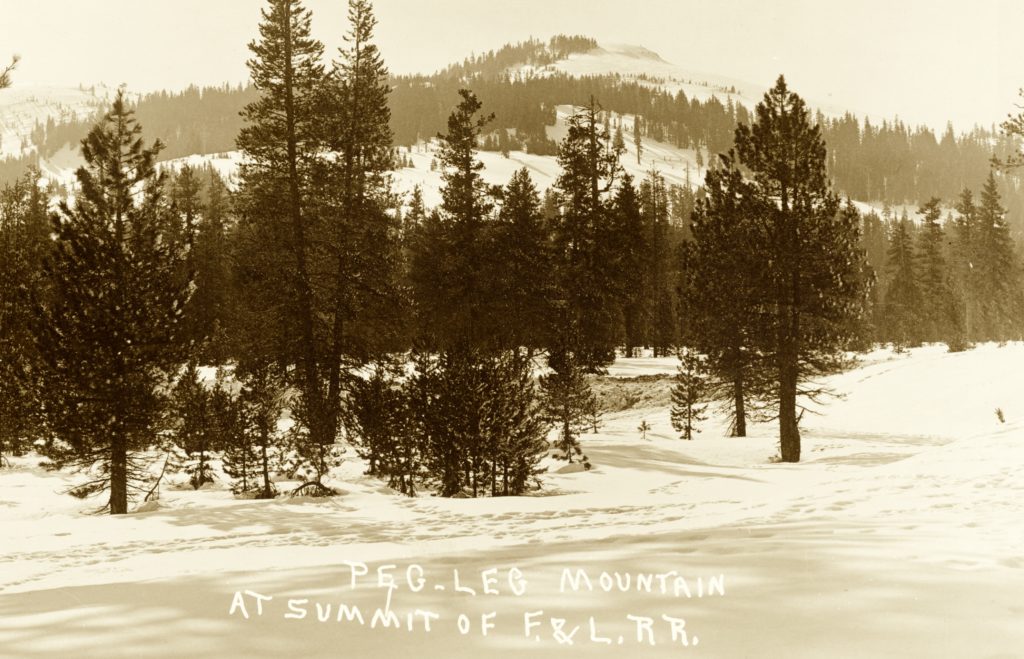
Peg leg was known as an old time mountain man who spent his summers in this region and wintered with his family at Red Bluff. In March 1903, his son, John W. Johnson was granted guardianship of Peg leg, who had been declared insane by the Court. Peg leg had two daughters, Mrs. Elizabeth Howard and Mrs. Mary Heckle. John had filed a request to sell the Mountain Meadows property for $800. The sisters contested the sale, as they cited the land was worth at least $1,400. The court approved John’s petition. Peg leg’s property was sold to W.C. Lucas and J.A. Virden for $800. On April 5, 1904, David “Peg Leg” Johnson died at the Napa Asylum for the Insane. His family brought his remains to Mountain Meadows in June and interred them next to his wife, Martha, and their twenty-nine year old son, Ralph, who died in 1884.
Support!
Subscribe!
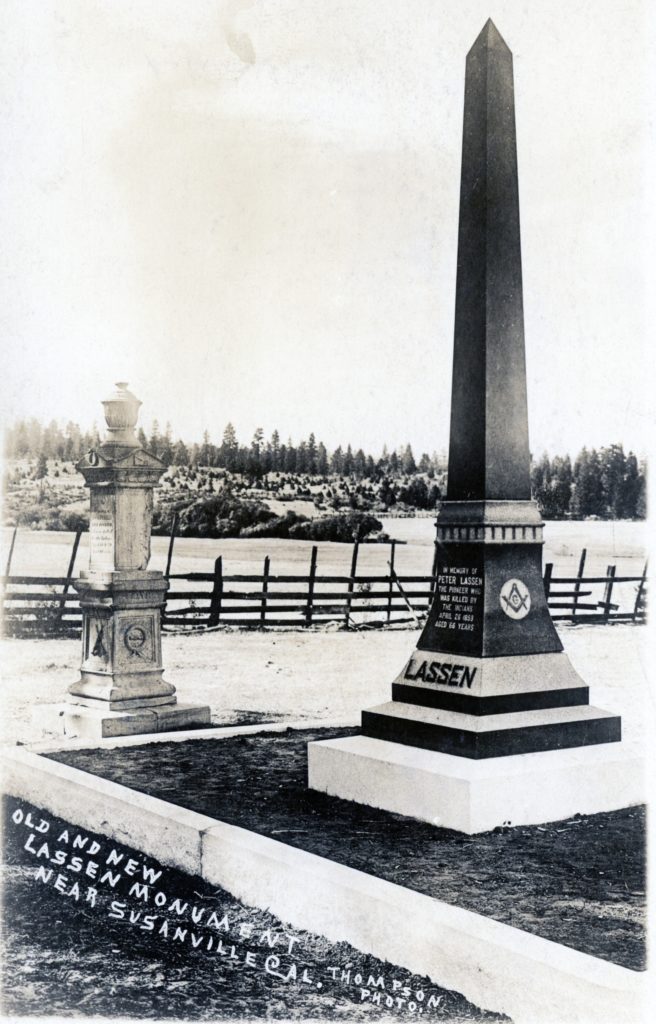
Robert M. Cook, of the Lassen Weekly Mail wrote that more was needed to be done with the new monument: “The location is one of great scenic beauty and it is hoped that it can be made an official cemetery and thus secure the care of the county in keeping the grounds in first-class condition. There is no fund at present for this purpose and it will be a shame to allow the beautiful stone that has been erected to become the center of unkempt and neglected grounds.”
Subscribe!

Subscribe!
“Every week I see something in your paper about some “ville”—Susanville, Oroville, Marysville, Janesville—but I never see anything about Merrillville. Perhaps you do not know that there is a Merrillville. For your benefit and that of the traveling public, I will describe and locate it as best I can, or at least the business portion of the town.
“At the upper end of Main Street, is the Post Office kept by P.D. Hurlbut, a very sociable businessman, who unlike most government officials, does not try to make a fortune out of his office. When not employed in his official duties, he attends to and runs his sawmill, and keeps on hand a fine assortment of the best lumber.
“From the Post Office down Main Street about two miles is the next place of business, or such I think it is to be. This is the fine new barn, the property of Ben Neuhaus and from all appearances it is to be used as a livery stable as soon as the business will pay. Ben is one of the first settlers in this town, is a fine, jovial, liberal gentleman, and I think will make a good livery man. There is nothing small about Ben—nothing whatever—and that is not his fault.
“The next place of note, one and a half miles down Main Street is the school house, a neat and well furnished building, with a stable and a board fence around the playground. On the northeast corner of this fence I am sitting as I write this. It is a very convenient place to take notes and affords a good view of the surrounding country. The schoolhouse is used for a variety of purposes, town hall, polling place, church, etc. We have church here in two weeks and everyone attends regularly. If you should visit our schoolhouse after we have had a school election, from the empty bottles around the door you would take it to be a country saloon—if you should enter you would take it for the town spittoon.
“Two miles north of the school house, or Swamp Street, is the blacksmith shop and there you will always find Orman Folsom ready at any time. A fine gentleman and one of the best mechanics in Northern California.
“From the school house down Main Street about five miles, you will find Frank Fluery’s saloon, and for ten cents he will give you enough “make you happy” to cause you to forget all your trials, troubles and tribulations for a time.
“Merrillville is situated twelve miles north of Susanville, in Willow Creek Valley and was laid out and named by Capt. Merrill after himself—leaving off the Captain and adding the “ville.”
Subscribe!

Support!