The recent snowstorm did not live up to my or the National Weather Service expectations. I do have to admit at my abode, its an ideal snow for skiing, etc. It would have been nice if Mother Nature was a bit more generous.
One of the annual challenges at Lassen Volcanic National Park each spring is snow removal on the park’s highway. The 1941 road opening provides a glimpse of the work involved. On May 19, work started on the snow removal where the crew literally worked around the clock until the job was completed. In this instance, due to heavy snows, the job was not done until July 9. During those eight weeks, 21 million cubic feet of snow was moved.
Main entrance to the Susanville Cemetery, February 8, 2015, after the windstorm.
Today, marks the fourth anniversary of the launch of this website. It had a rocky start, when an extremely severe windstorm hit the region, knocking out the power. For some, the electricity was out for eight hours, for others nearly three days. In any case, since then, it has been an interesting learning curve for me.
Member Login has been the most frustrating feature, that has a mind of its own, and has not wanted to work. A perfect example occurred on September 1, 2015. That particular post, I had blocked from the public, so subscribers would have to login to view. Lo and behold, the post remained blocked, but the login feature did not work, so it was blocked from everyone. I set up the experiment a few weeks earlier, though when the day arrived I was in the hospital with a fractured hip, and was in Nevada hospitals long enough that I could have applied for residency! Anyhow, I have spent the last several weeks tinkering with it, to no avail.
Why the Member Login is important, in my opinion. It is the paid subscribers whose support helps maintain the site, and certain features should only be available to them. Once the Walking Guide Page is up, it will be a members only feature, thus to provide an incentive for non-subscribers to join. There are some historic films that I would like to make available, which again would subscribers only.
Then again, I could just scrap the Member Login, and just continue as is. Of course, I am open to any suggestions you might have.
Alexander Avenue came into existence in 1912 as part of the Lassen Townsite subdivision. It was named for Jules Alexander who came to Susanville in 1877 and eventually became a successful merchant. He left that field, and became involved in banking until his death in 1935. Alexander was also a major investor in the Lassen Townsite Company.
Alexander Avenue is one of those handful of city streets that witnessed a major realignment. In the early 1970s, the street was straightened between Main and Cornell, thus moving Sherman’s Texaco Station to the other side of the street, as Alexander had separated it from Walker’s.
Then there is the lingering issue, will Alexander Avenue be extended all the way to Richmond Road, as has been suggested in previous planning documents.
Last week, we featured the Horse Lake Siding on the abandoned Modoc Line, now a recreational trail. One of the favorite segments of the Modoc Line is that from Karlo to Snowstorm. One of the many interesting features along the route is Biscar Reservoir, as this water oasis standouts among the high desert countryside.
The reservoir was so named for Secret Valley rancher, Pierre “Pete” Biscar, (1881-1947) a native of France who settled there in 1904. In 1909, he constructed the first reservoir at the mouth of Snowstorm Canyon. In 1915, it was washed out by a flood and subsequently rebuilt. Today there are two reservoirs that are a part of the 550-acre Biscar Wildlife Area. It was initially purchased in the late 1940s by the California Department of Fish and Game as part of a long range plan to obtain water for the department’s Honey Lake Wildlife Area.
In 1982, the park granted California Guest Services a twenty-year concession to operate Lassen Ski Area, as it was formally known. This time there was a surprising catch. The contract carried a stipulation that when expired, downhill skiing would be phased out. The termination of downhill skiing came sooner than expected. In the spring of 1993, John Koeberer of California Guest Services contacted the park and asked if it would consider canceling the contract. Koeberer cited financial losses over the previous nine years. A contributing factor to the situation, was for the last five years due to low snow falls. The few cases of heavy storms arrived on weekends, discouraging use by the skiing public. The park obliged, although many regional ski enthusiasts were upset with this abrupt closure. Continue reading Ski A Volcano – Part II→
Lassen Volcanic National Park is known for many things, whether be its wondrous hydrothermal features or that a large segment of park is left in its primitive wilderness state. Lassen Peak and its surrounding territory is known for its tremendous snowfall. After all, it should be noted that Lassen has an average of over 600 inches of snowfall annually and has some of the highest snowfall accumulations in California.
The 1920s witnessed some dramatic changes to the American lifestyle. Two contributing factors were the affordability of the automobile and development of highways to promote travel. By 1930, Lassen Park was a benefactor of those factors. The first and foremost saw the completion of State Highway 36 that skirts the southern entrance of the park. Equally important came the announcement from the State of California that this route would remain open during the winter months. In the past it was closed whenever it snowed. Continue reading Ski A Volcano→
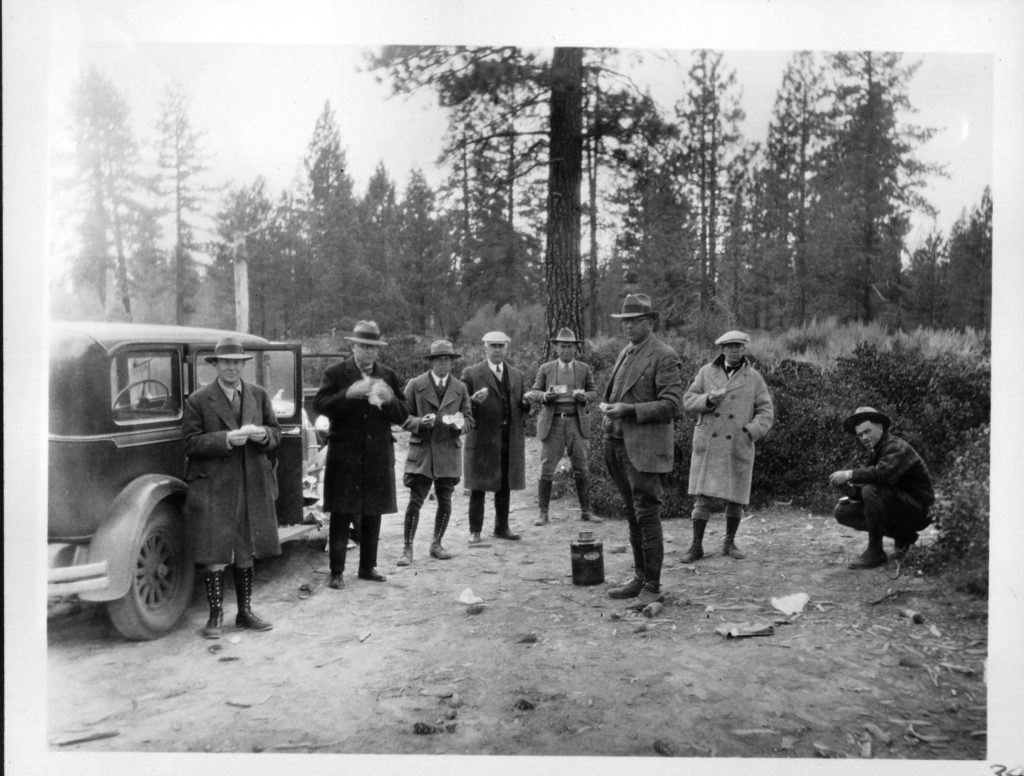
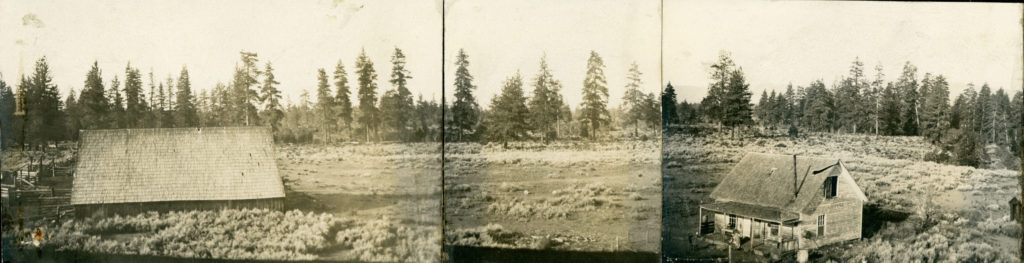
This is kind of cruel . . . I do not know the answer! The level terrain, with abundant trees alludes to the fact that it is west of Susanville, but where? What the photographer’s definition of “near” is not clear. Any thoughts where it might be?
Horse Lake Station, 1915. Courtesy of Nevada Historical Society
In 1996, the Union Pacific Railroad received permission to abandon an 85 mile segment of railroad from Wendel to Likely. Since then it has been converted into another “rails to trails.” It should be duly it was the NCO Railroad that initialy constructed the line and in the 1920s it was acquired by the Southern Pacific Railroad.
The Horse Lake Station later siding was established in the early 1900s by the NCO. It was so named after Horse Lake, located five miles to the west. An interesting footnote in its history. In 1913, the Shumway Post Office at Horse Lake was closed. In 1916, Horse Lake residents attempted to re-establish the post office and have a mail drop off at the NCO’s Horse Lake Siding. The postal authorities denied the request. They stated they did not need a mail drop off as there were only four permanent families residing in the area. In addition, it was cited, the NCO was an unreliable operation, with irregular train service, and since there was no attendant there, there was no way the mail could be protected. In 1961, the Southern Pacific abandoned the siding.
Foundation remains of the Horse Lake Siding, January 27, 2019. Courtesy of Anna Stewart
During World War I witnessed an increased demand for airplanes for the war effort—a first. The preferred wood was the Sitka spruce found along the coastal regions of Oregon and Washington. There were numerous problems associated with not a only a limited supply, but problems with labor unions in that region.
In January 1918, a representative from the war department arrived in Westwood for purpose of selecting sugar and/or yellow pine timber for building a fleet of government airplanes. Early tests indicated that California pine was superior to Oregon fir for the purpose intended. The government official was to select 300,000 board feet of Lassen County timber to be processed by the Red River Lumber Company. Whether this transpired, the record is not clear, due in part of the censorship of certain types of news during the War.