The Roop Land Register

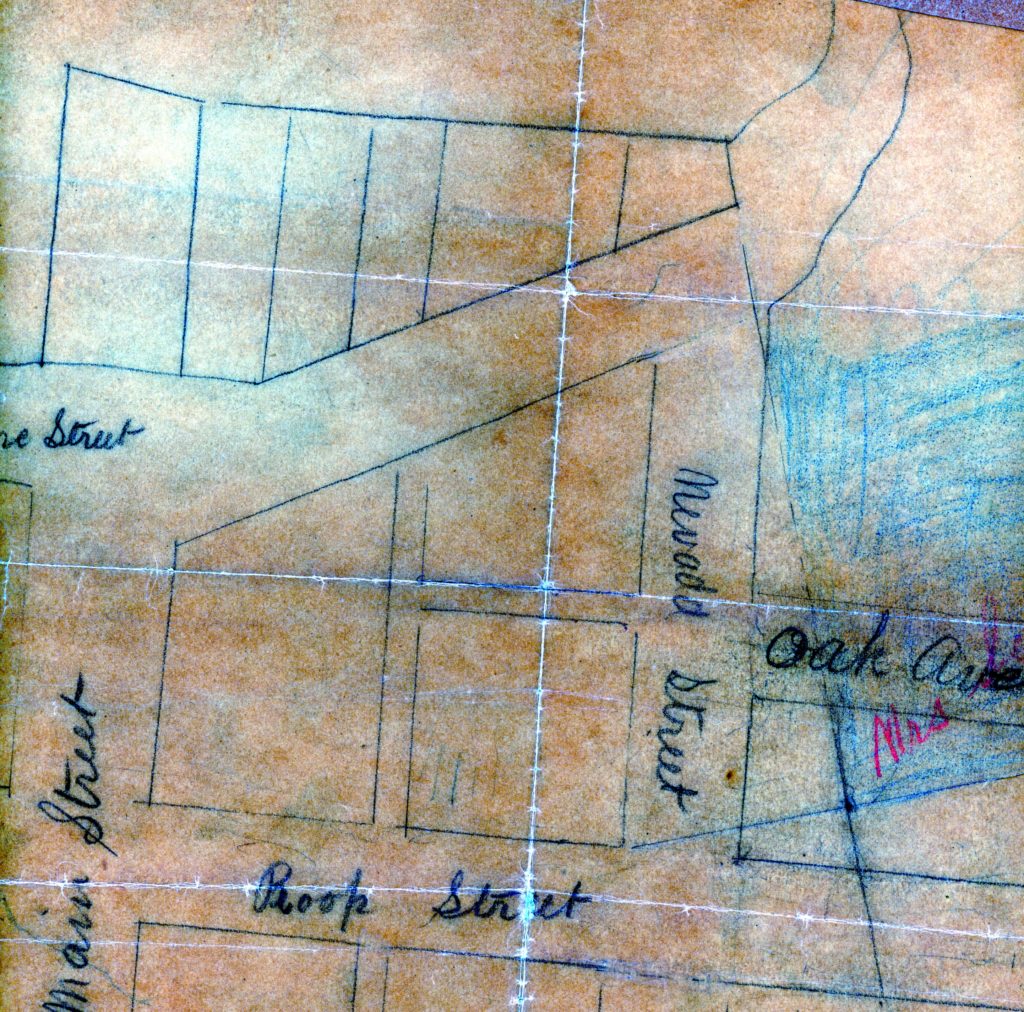
Moses Mason was the second claim recorded in Roop’s Land Register. He settled on present day Susanville Ranch Park and referred to Piute Creek as Smith’s Creek.

In the spring of 1856, with settlers arriving in the Honey Lake Valley they realized they needed to form some type of self-government. They did not believe they were part of California and did not want to be a part of the Utah Territory, there was no Nevada then. On April 26, 1856 a group of twenty-men assembled to form the Territory of Nataqua.

As to land matters, any male twenty-one years or older could claim 640 acres of land to be recorded with the Recorder, which Isaac Roop assumed that role. A number of claims had vague descriptions. Whatever, the case may be, it worked for them. In 1857, some individuals began documenting their claims or the sale of such in the form of a deed with the Plumas County Recorder. By 1859, a few hardy souls ventured all the way to Marysville to file a claim with the United States Government Land Office, the nearest one available. By 1861, the Roop Land Register was rarely used.

When Lassen County was formed in 1864, the original County Board of Supervisors did something unique. They paid Plumas County to transcribe all land transactions of Honey Lake and Long Valleys prior to the formation of the county.  This is why Book A. Deeds, Lassen County starts in 1857.

Subscribe

A Third Susan. . .

Buffalo Meadows Cemetery, Smoke Creek, Nevada
Buffalo Meadows Cemetery, Smoke Creek Desert, Nevada, 1984

After reading yesterday’s post, I realized that I neglected a third Susan for whom some thought Susan River was named for. According Asa M. Fairfield he noted that an immigrant girl by the name of Susan DeWitt died near the Buffalo Meadows Salt Marsh in the Smoke Creek Desert. She was buried near there, but whether her grave was incorporated into the Buffalo Meadows Cemetery, I do not know.  Fairfield went on that some thought that it was this Susan for whom the Susan River was named for.  By the way, if anyone has information on this particular cemetery, I would certainly appreciate it.

Support by subscribing.

Susan Who?

Susan Arnold and Anna Hall
Susan Roop Arnold and Anna Hall at Constantia

While it is fairly common knowledge that the City of Susanville was named for the town founder’s daughter, Susan Roop, who later married Alexander T. Arnold. Many assume that the Susan River that flows through the community would also be named after Susan Roop.  However, that is not the case, because the river was so named, prior to Isaac Roop’s arrival on the scene.

Susan River, February 1972

During the years 1851-1852, William H. Nobles located a new emigrant road from Shasta, California to Lassen’s Meadows, Nevada (Rye Patch Reservoir). This road passed through the Honey Lake Valley. Nobles named the Susan River for his wife, Susan Parker Nobles.  While we know a lot about Susan Roop Arnold, very little is known about Susan Parker Nobles. She resided in Minnesota for the majority of her married life, moving to California after her husband died in 1876.

Tim

Paul Bunyan Days

Log Rolling contest at Willard, 1970. Couresy of D.B. Martin

In the late 1940s, Paul Bunyan Days  was a logging competition held not only at Lassen College, but other community colleges that had forestry programs.  Tom Gilfoy who graduated from Lassen in 1951, said it was Ralph Throop who was instrumental in starting Paul Bunyan Days at Lassen. At that time it was held behind the high school, since the college was located on the same property. Tom stated they made an impromptu dam on the Susan River for log pond events that included log rolling. Other contests involved burling, pole climbing and two-man bucking saw.,  In 1950, Rex Coalson was the overall winner, followed by Ted Pankey in 1951.

Some time in the late 1960s, no doubt due in part with Lassen College separated from Lassen High School, Paul Bunyan Days was moved to Willard Creek. It was rather fitting since in 1938, it was the forestry students who developed the Willard Hill ski area, later converted into a sled hill.  Mike Moyers who later taught at Lassen stated that around 1981 or 1982 was when the last Paul Bunyan Days was held. In 1984, the forestry program at the college was terminated due to lack of students.

Subscribe

A New Railway Organization

The NCO Depot, Alturas, 1921

This is something that definitely slipped underneath my radar. Last fall a historical railway society was organized for the preservation of the history of the Nevada-California-Oregon Railroad, more commonly referred to as the NCO. What was even more intriguing its headquarters is that of Alturas. In one sense it is a logical choice that Alturas is home to a NCO depot and also was railroads’s headquarters during its final days, after its departure from Reno.

For the un-initiated the NCO was one of the 20th century’s longest narrow gauge railroads that ran from Reno, Nevada to Lakeview, Oregon. As one observer put it, it was a railroad that went nowhere. Its original intent was to extend all the way to Columbia River with a terminus at The Dalles, Oregon. During its fifty year existence from 1879-1929, there were a lot of interesting characters involved in its operation.

For those who would like to learn more about this organization see their website at: NCO Railway

Tim

Hot Springs Station, Lassen County

Hot Springs Station would later become Wendel. This scene is dated 1899–Tom Armstrong

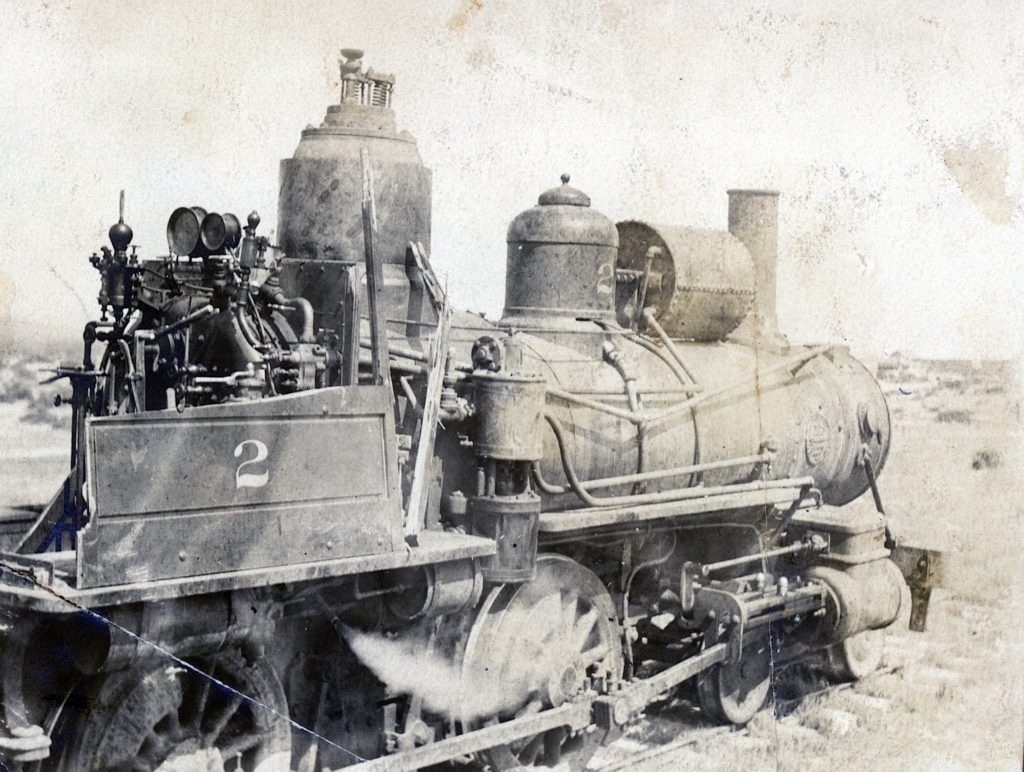
No one would have ever thought that Amedee would be the terminus of the Nevada-California-Oregon Railroad (NCO) for nearly a decade.  It certainly was not the railroad’s plan. However, the nation’s financial crisis of 1893 coupled with a national railroad strike brought a lot of activities to a screeching halt.

In January 1899, without any fanfare the NCO finally jump started its northern extension. Five miles to the north the railroad established its Hot Springs Station, known today as Wendel. Some had aspirations that it might become a new “Amedee.” However, that would not be the case. What Hot Springs did receive was a bunch of camp followers. This rag-tag group peddled alcohol, gambling and prostitution. By the time, the Lassen County District Attorney could crack down these activities, not only had the railroad continued to build north and the followers fled to more profitable locations. Hot Springs Station heyday did not arrive until after it became Wendel and the demise of the NCO. In 1927 the Southern Pacific Railroad began the conversion of the NCO from narrow to standard guage.

Support

Lassen Park Road Partially Opened

The Snogo clearing the Lassen Park road, 1940.

On March 3, 2021 work began clearing the park road from snow, starting from the Manzanita Lake side. On April 28 the road was cleared of snow, yet work still needs to done on shoulder repair etc. However, the road is open to hikers and/or by bike. Vehicle traffic is probably a week away.  Due the lighter than normal snowfall, it will be a long season for the park. Make plans to visit this year.

Support

A Transformed Residence

Dr. Leonard’s residence when completed, 1913–Frances Swain

When William Greehn took possession of Dr. J.G. Leonard’s residence he decided to make it a rental. The exterior had a very dilapidated appearance. It had never been painted. The windows on the top floor were never installed, so they were boarded up. Greehn had no intention to make improvements to the building.  The residence rented for $10 a month, and it was rarely vacant. In 1906 Greehn passed away leaving this and numerous other properties to his two daughters—Fannie Asher and Hattie Grunauer.

A side view of the Swain’s residence, 1913—Frances Swain

On April 11, 1908, during the liquidation process of the Greehn Estate, Joel Henry Swain purchased Leonard’s residence for an undisclosed amount. In 1888, Swain, along with other members of his family originally located in Dry Valley between Grasshopper and the Madeline Plains. In 1903, Swain decided to switch careers from farmer to saloon keeper and moved to Susanville. Swain found the bar business to be very lucrative. This provided him with the means to finish residence that Leonard had started. In just  a short time it became one of the most prestigious homes of Susanville. In an interesting side note, his wife, Annie, somewhat disapproved her husband’s line of work, she being a staunch tea-toler, but she enjoyed the finer things of life that the saloon trade provided. An awkward situation to say the least.

In 1917, J. Henry Swain’s health declined. No treatments seem to improve his condition. He passed away on May 3, 1918. Besides his wife, he left four small children, Frances, Fitzhugh, Blanche and Nellie. In 1922, Annie Swain sold the residence to the Antlers Club, which would in turn become the future home of the Elks Lodge.

Support

An Architect Turned Dentist

Main Street, 1894. You can see the condition of the house—Ivor Lanigar

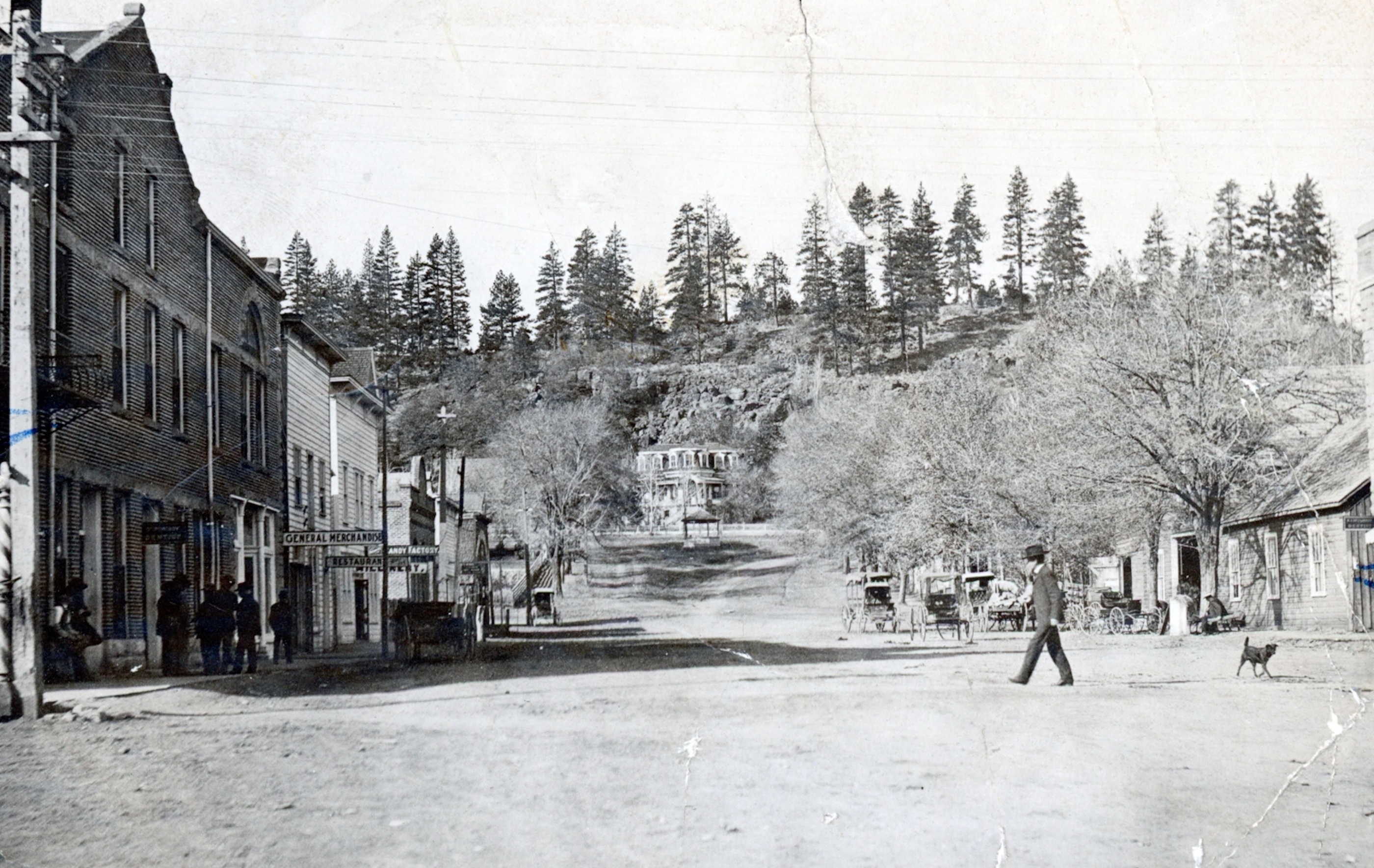
Susanville’s iconic Elk’s Lodge located at the west end of the town’s Main Street, had a humble origin. The story unfolds when Michigan native Dr. J.G. Leonard (1843-1916) opened a dentist office in Susanville on March 1, 1884.  A large vacant lot at the west end of town caught his attention, especially since it was so centered to have an excellent view looking down through the center of main street. He approached the owner, Sarah Hosselkus about its availability. On March 22, 1884, she sold the lot to Leonard for $450.

Leonard then proceeded to design a unique residence on this unique lot. The instincts came naturally for him, since for a time he studied to become an architect.  Dentistry or Architect are noble positions, such professions, even in cities, during the late 1800s could be financially challenging.

Main floor plan sketch by Frances Swain

In November 1884 work was underway to clear the homesite. The proposed two-story home, contained twelve rooms, many of which were octagonal. Leonard hired local contractor Charles Odette to build it, though no record exist as to its cost. In February 1885 Leonard moved his family into their new home, though it was far from finished.

Top floor sketch by Frances Swain

Leonard quickly learned that there was not a sufficient enough  population in Susanville, as well as the Honey Lake Valley to sustain his practice. Like others before him and after him he rode the circuit to provide his services in neighboring counties, with an emphasis on Modoc County. The other financial obstacle Leonard faced, was his patients would provide goods and/or services rather than paying in cash. After five years of eking out a living, Leonard, filed for bankruptcy on April 17, 1889. One of his main creditors, was Susanville merchant William Greehn who he borrowed money to construct his home. Greehn secured the promissory note with Leonard by attaching a mortgage to Leonard’s home. At the conclusion of the bankruptcy proceedings Greehn was awarded the property. Leonard moved on and by 1898 established a practice in Reno where he lived the rest of his life.

Tomorrow: The residence transformed

Support

Answer to Some of Your Questions

An abandoned Diamond Mountain mine, 1977.

Within the next ten days or so I should have answers to questions from April 15th’s Ask Tim segment. These include two mining questions, how land was originally filed on in the 1850s and an attempt to tackle some of the dairy history. Stay tuned.

Tim

Exploring Lassen County's Past