Dodge Reservoir, Lassen County

Dodge
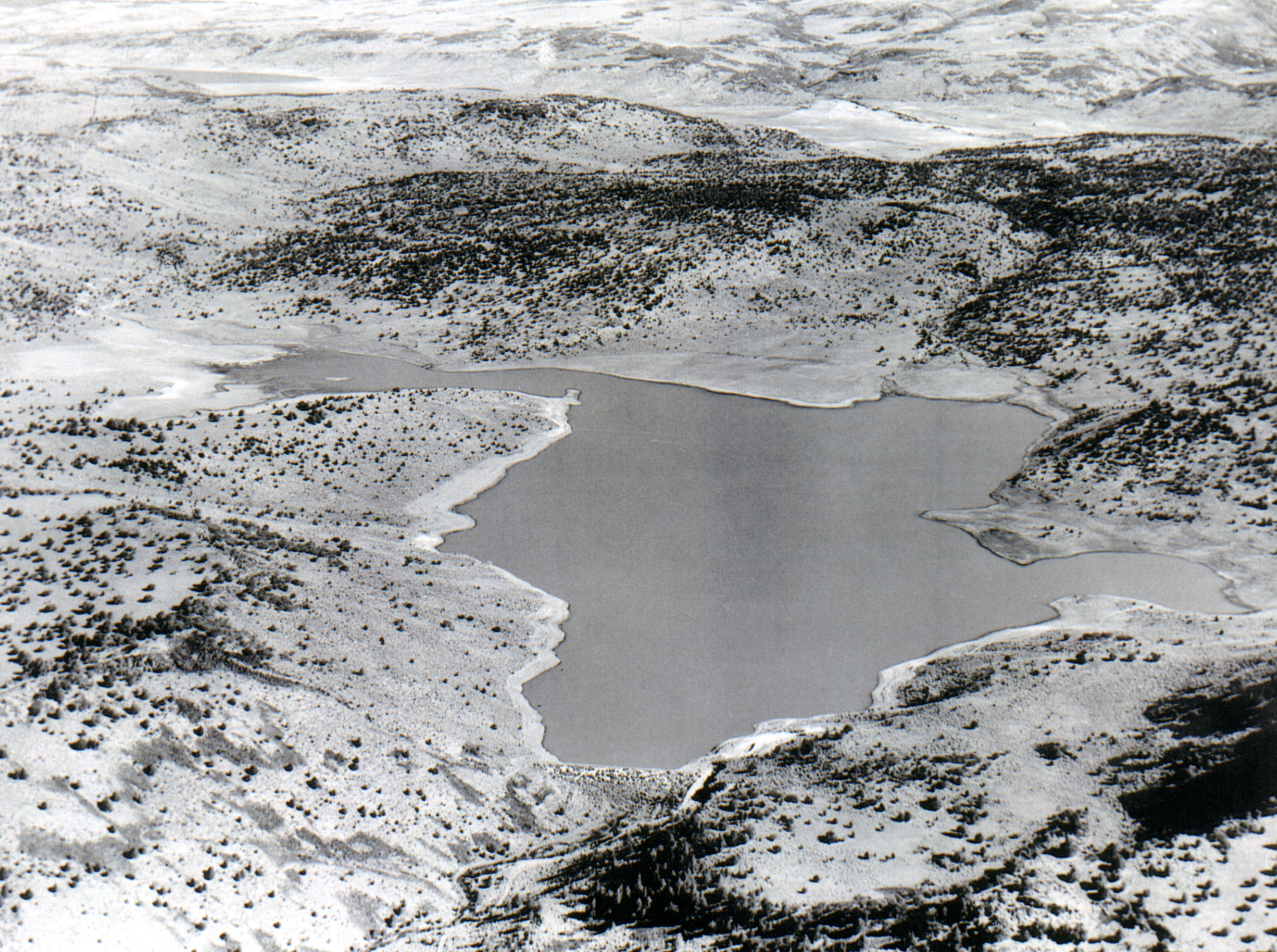
A 1950s aerial of Dodge Reservoir.

Dodge Reservoir located in the northeastern part of Lassen County and has an interesting tale in its development. It would take twenty years from its inception to its completion. It began in 1889, when Albert L. Shinn* formed the Union Land & Stock Company. Shinn proposed that the water from Red Rock Creek could provide irrigation for the entire eastern Madeline Plains. The reservoir was originally named Lake Lockett, for the Company’s Civil Engineer, H.M. Lockett. In the early 1890s, the Union Land & Stock Company started the irrigation project but eventually construction ceased because of lack of funds and other problems. On December 9, 1907, Henry C. Dodge acquired an option to buy the Union Land & Stock Company’s failed Red Rock irrigation system. In 1909, Dodge formed the Madeline Valley Land & Irrigation Company to undertake this enterprise. In the fall of 1909, the Company contracted with August and Alfred Anderson to build the system. In December 1909, Dodge Reservoir was completed. In 1912, Henry C. Dodge died during an altercation in Reno, Nevada. Dodge’s two sons, Carl and Dana, continued with the family enterprise on the eastern Madeline Plains. On January 14, 1949, Bernys M. Dodge, the agent for the Dodge Brothers, sold the Dodge Ranch and Reservoir to George and Jean Smith.

When the fishing is good there, its really good and worth the trek.

*Shinn was part of the Shinn Ranch family,  became a well known attorney in the region and later Sacramento.
Subscribe

Sugru Hill and Reservoir

Haying on the Sugru Ranch, with Sugru Hill in the background, 1900–Robert E. Trussell

Most maps have incorrect spelling as Shugru. Few people know the name of this very visible small reservoir on Bass Hill opposite the entrance of the Bass Hill Landfill along Highway 395.

In 1874, Michael Sugru a native of Ireland, settled at the base when this area south Johnstonville was known then as Howard Flat. In 1909, Sugru’s son, James constructed a reservoir to hold run off water from Bass Hill to irrigate the family farm, directly below it—today it is the Egan Ranch. In 1943, Sugro sold the ranch to A. Simonson.

Tim

Hay Derricks

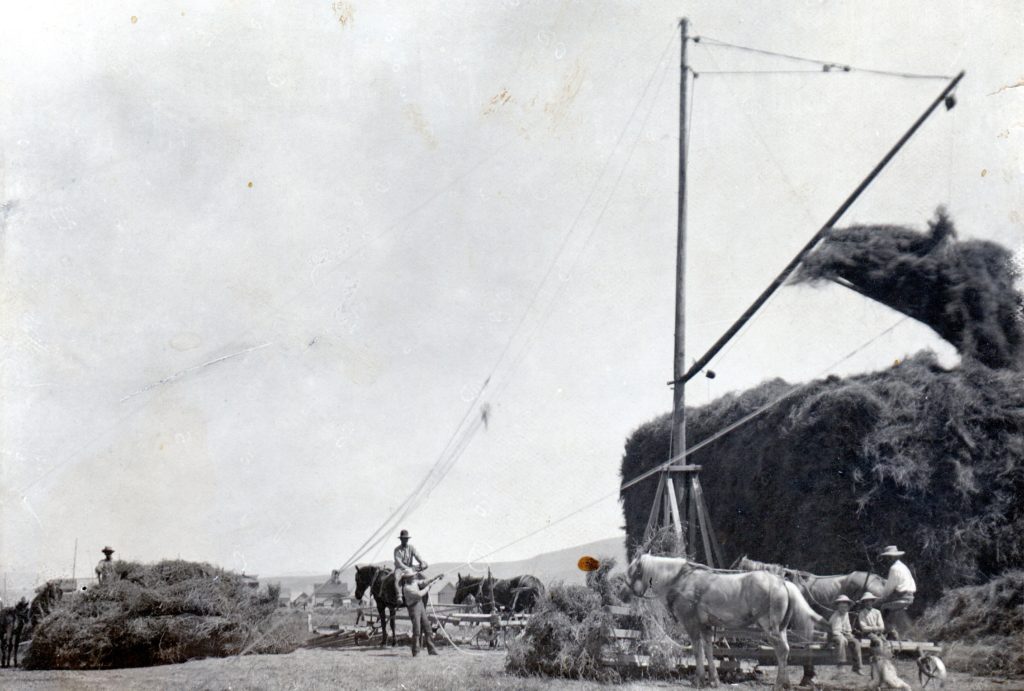
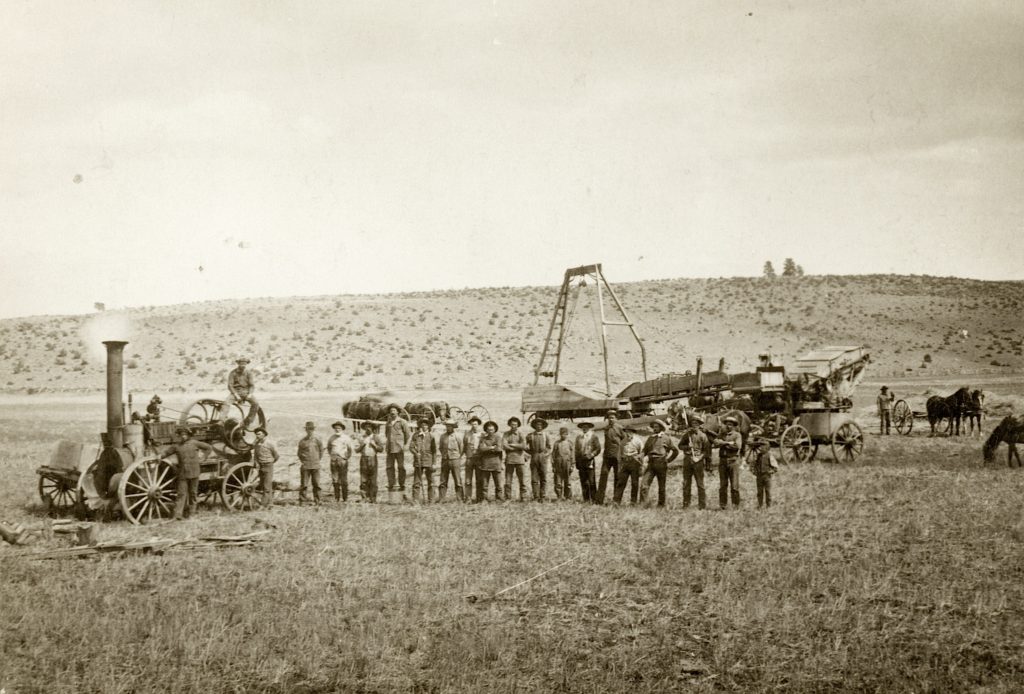
Haying at the Elledge Ranch, near Standish, 1900. Courtesy of Camilla Moody

One of the most unique and distinct pieces of agricultural equipment in the Intermountain West was the hay derrick. There were no standardized derrick. They were either hand made by the farmer’s or a neighbor. Besides the derrick, a buckrake, net settlers and derrick cart were utilized.

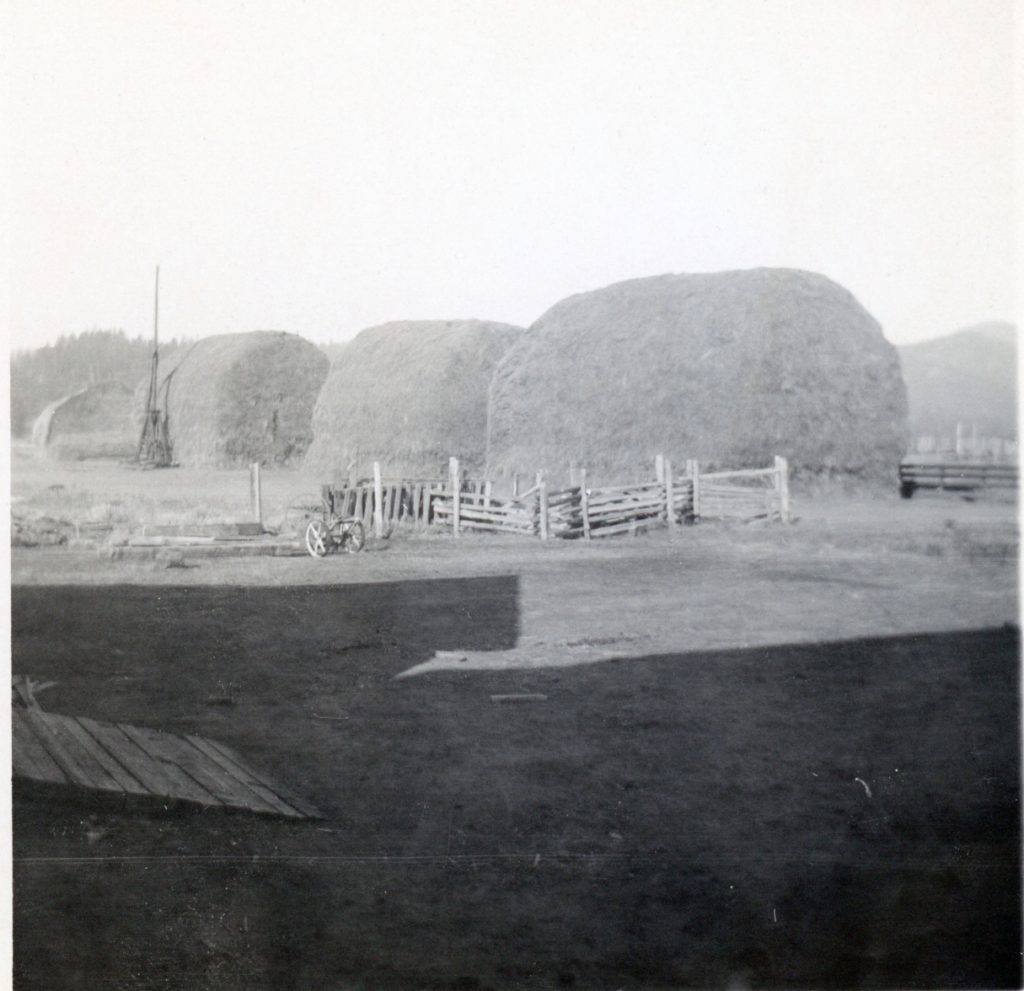
The stacker required talent, to make sure each corner was kept square. Keeping the hay stack uniformed was a must. If not, if one side became overloaded, the whole stack would collapse. Then there was the final touch. The top of the stock was rounded off to resemble a loaf of bread. This was an utmost necessity. The rounded top repelled rain and snow.

Hay stacks at the Lonkey Ranch, 1911. Today the ranch is known as Five Dot in the Willow Creek Valley.C.R. Caudle Collection

Support

Juniper Mine, Hayden Hill

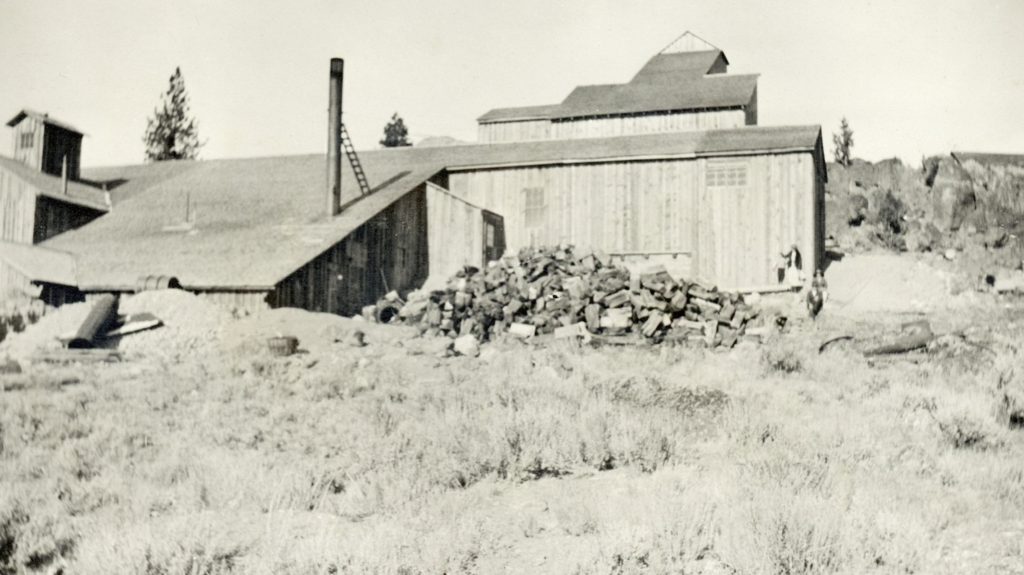
Juniper Mine, 1920–Lola Tanner

Hayden Hill’s second largest producing mine is an interesting one. In its first four years, it had yielded some $400,000 in gold. Then the mine struggled encountering china clay deposits. The mine persevered over the years and in the early 1920s had a revival of sorts.  In all, it produced some $600,000 in bullion, about half of the Hill’s largest producer, the Golden Eagle Mine.

By 1930 the Juniper Mine had been abandoned. The building remained intact until 1956 when it was struck by lightning and burned down.

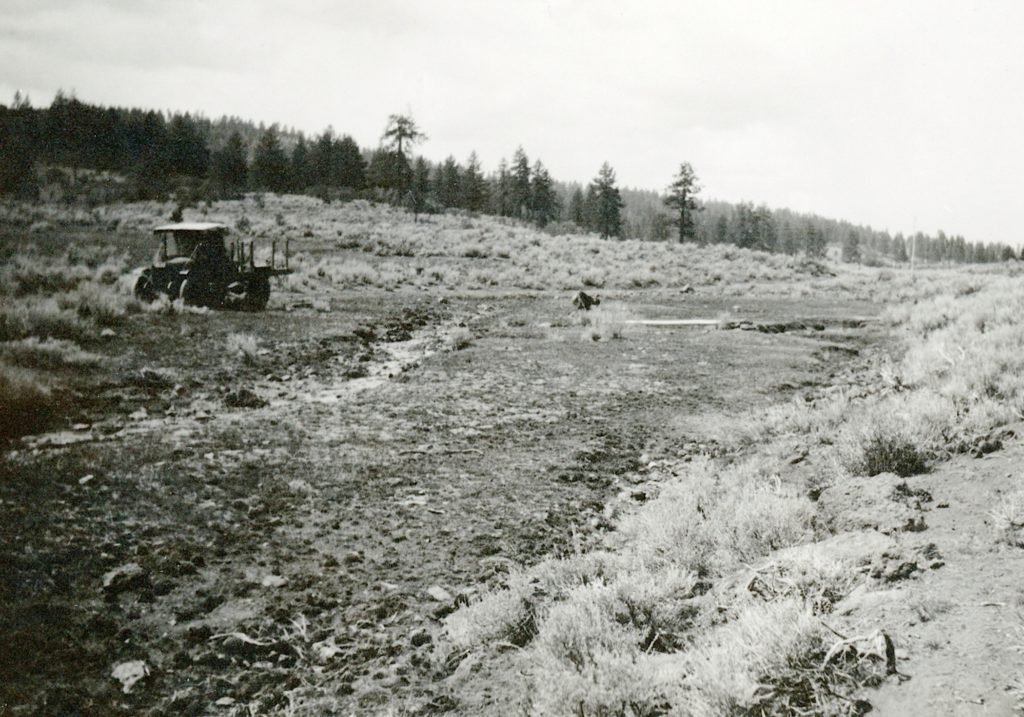
Juniper Mine truck, 1920–Lola Tanner

Tim


Susanville’s Brick Building Boom

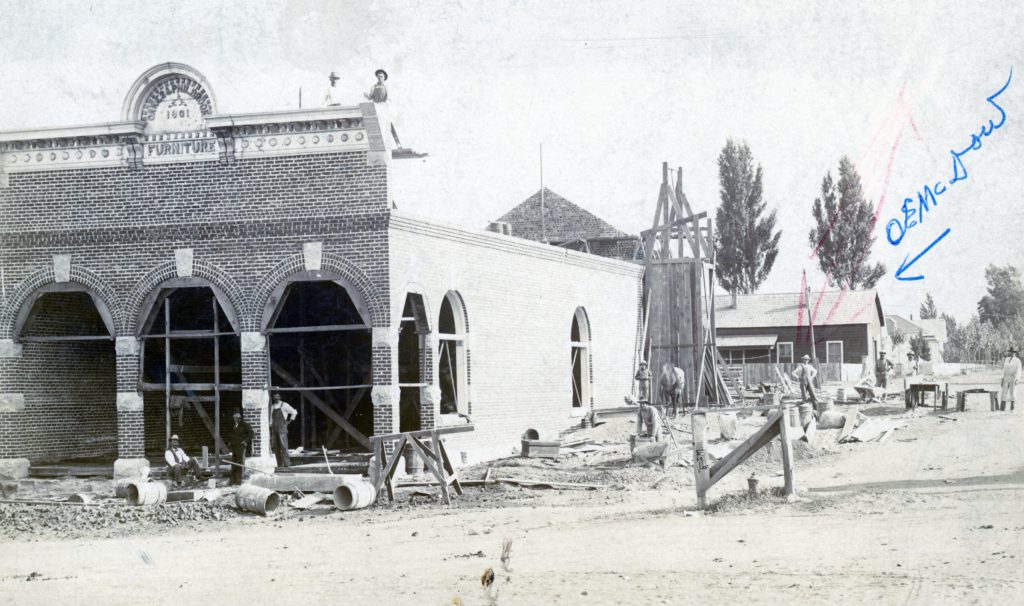
Oakes and Philbrook’s furniture store under construction at 800 Main Street.

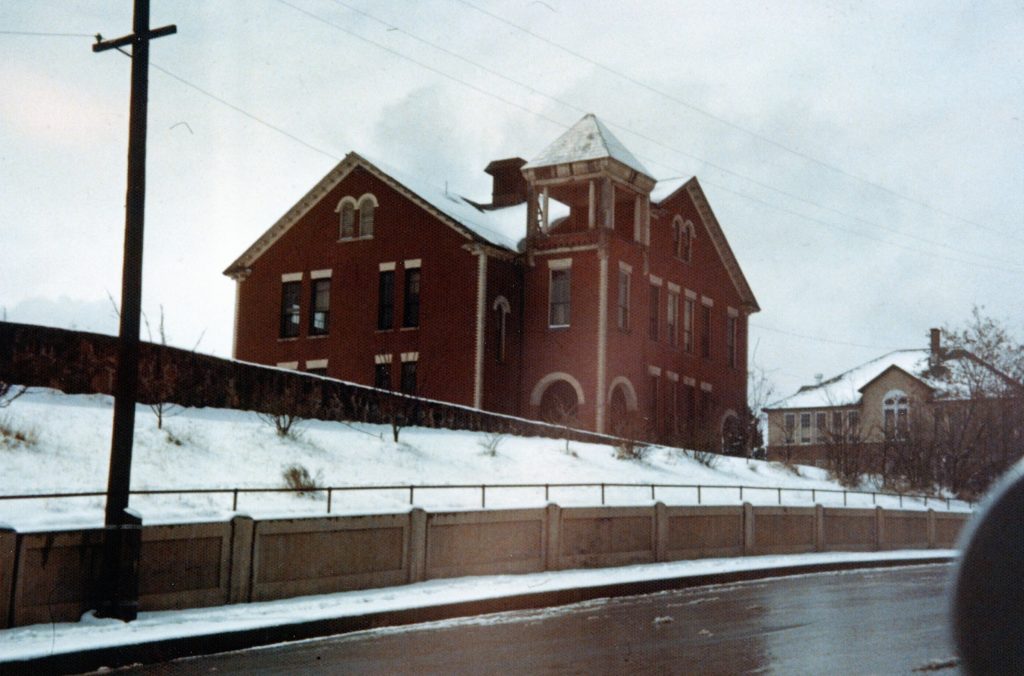
On June 6, 1900 a destructive fire wiped out a major portion of Susanville’s business district on the south side of Main Street from Roop to Union.  But prior to fire, the Susanville School District had hired Reno contractor C.E. Clough to construct a two-story brick school to replace the wooden one on Cottage Street at a cost of $12,500.

As noted yesterday, was the construction of Emerson’s three-story brick hotel. Clough kept really busy. On August 29, 1900 the Methodist Church hired him to build a brick church for the wooden destroyed earlier by fire at a cost of $4,739. Next up was Oakes & Philbrook Furniture Store at the southeast corner of Main and Gay Streets. That building along with the Methodist Church are the only two still remaining.

The Susanville Grammar School, nee Washington, as it appeared in 1948.

Donate

Susanville’s Emerson Hotel

Emerson Hotel
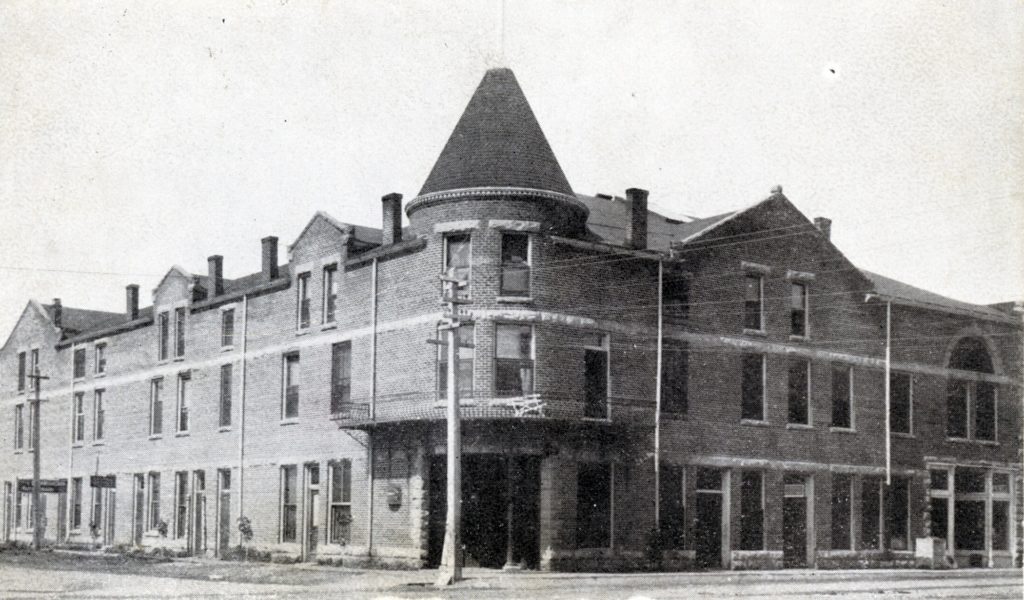
Emerson Hotel under construction, 1901. Courtesy of Mary Dale Folsom

After the devastating fire of June 6, 1900, a new Susanville would arise from the ashes. In addition, the town witnessed a substantial use of brick for the preferred building material.

On July 31, 1900 groundbreaking ceremonies were held for the largest most expensive building to be constructed in town to date. It was Charlie Emerson’s three-story hotel, encompassing a quarter of a block on the southwest corner of Main and Lassen Streets. Emerson invested some $300,000 to construct and furnish  the brick building that contained 27,576 square feet. The ground floor was devoted to commercial and the upper two floors contained 76 guest rooms. A grand opening was held on June 3, 1901, and The Emerson became the town’s premiere social hub.

Emerson Hotel

The Emerson Hotel was destroyed by fire in 1915. Ten years later, it was replaced by the Hotel Mt. Lassen at a cost of $300,000.

Support this site and Subscribe today!


Visit Drakesbad

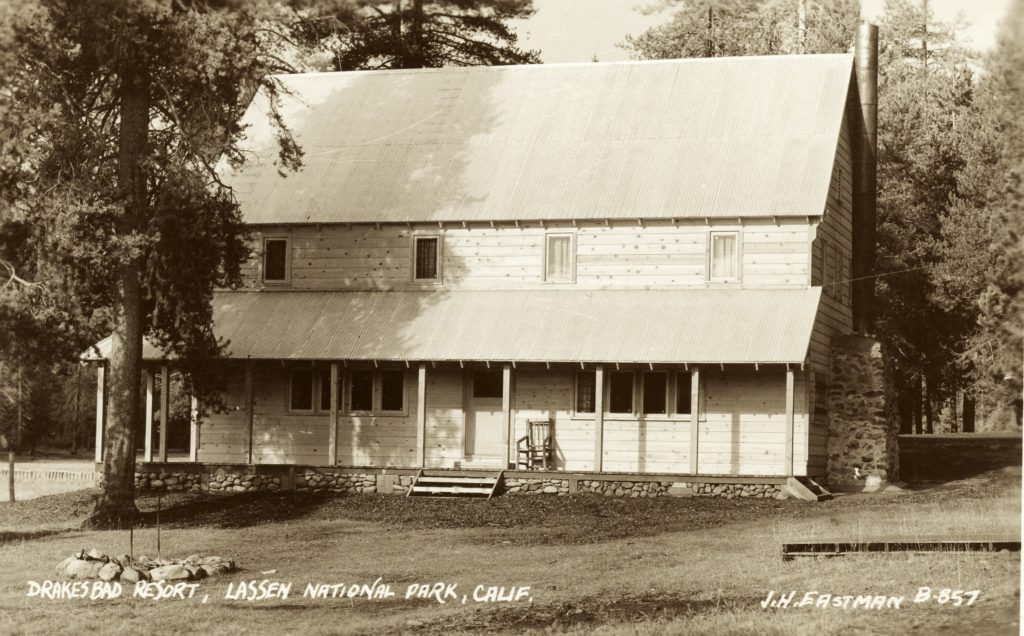
Drakesbad, 1939

Note: It has been relayed that Lassen Volcanic National Park has closed portions park, including Warner Valley and Juniper Lake.

Here we are in the middle of summer. While I never run out of ideas of places to see, I do have some recommendations—one being Drakesbad. If you are not familiar with Drakesbad it is an old resort located in Lassen Volcanic National Park which access is via Chester and Warner Valley.

Why Drakesbad? First it is unique. It provides an excellent launch for day hikes to such points as Boiling Springs Lake and Devils Kitchen, to name a few. The food is really good, too. Personally, I like to call ahead an order a sack lunch to go. It can not be stressed enough to dine there, though you need to make reservations. There are many benefits in doing so. For more information see Drakesbad Guest Ranch.

Tim

Twenty Miles From A Match

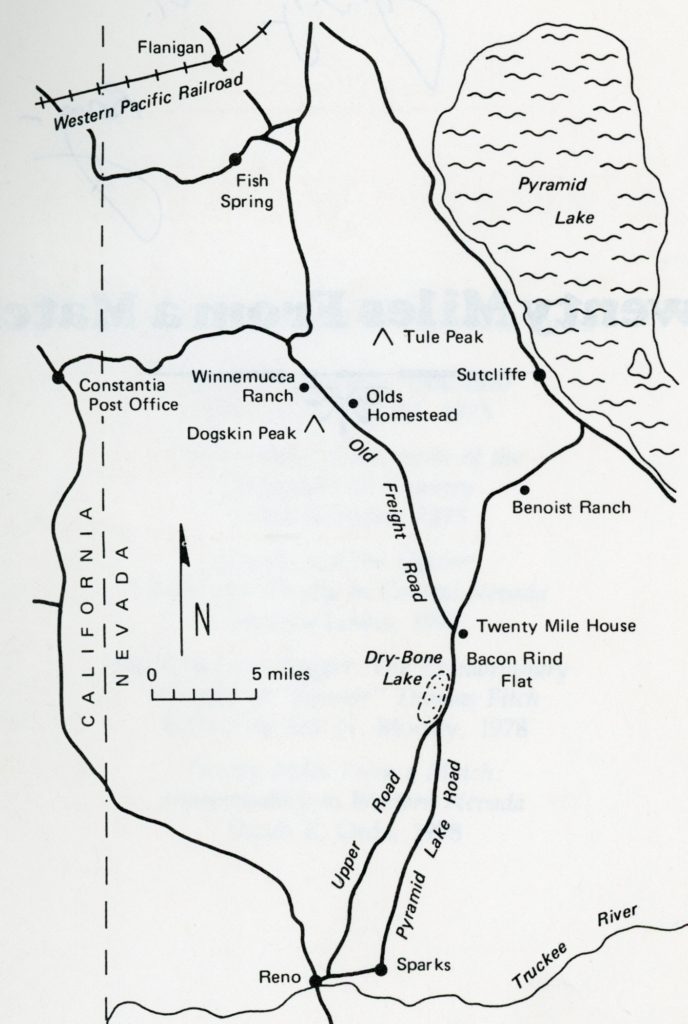
The map from the book indicating the region.

Twenty Miles From a Match by Sarah Olds was first published in 1978 by the Bristlecone Press of the University of Nevada. It is still in print today, which speaks volumes as to this entertaining book.

In 1908, Sarah Olds packed up her family of five children, along with her ailing husband and settled on a desert homestead north of Reno. It is a remarkable tale Sarah wrote about her shear determination to make a go it. It was her husband’s nephew, Hiram “Hi” West who planted the seeds of homesteading and more particularly that of Tule Mountain, some thirty-five miles north of Reno. Of course, Hi, would benefit if the Olds family settled there, as he would have nieghbors.

Sarah wrote, “After my homesteading talk with Hi, I didn’t let the idea get out of my mind. He told me Tule Mountain was the greatest game country ever laid out of doors. There were droves of deer, literally thousands of sage hen, coveys of mountain and valley quail, doves galore, some cottontail and of course, the much despised jack rabbit. All this added fuel to the homesteading scheme which was fast developing in my mind. My biggest problem was in getting A.J. [her husband] interested enough to file papers on a homestead. I could just hear him saying, ‘Why old lady, you’re crazy. It simply can’t be done.’”

Thus, the stage was set for a twenty year experience of homesteading.

Support

Tule/Pyramid School

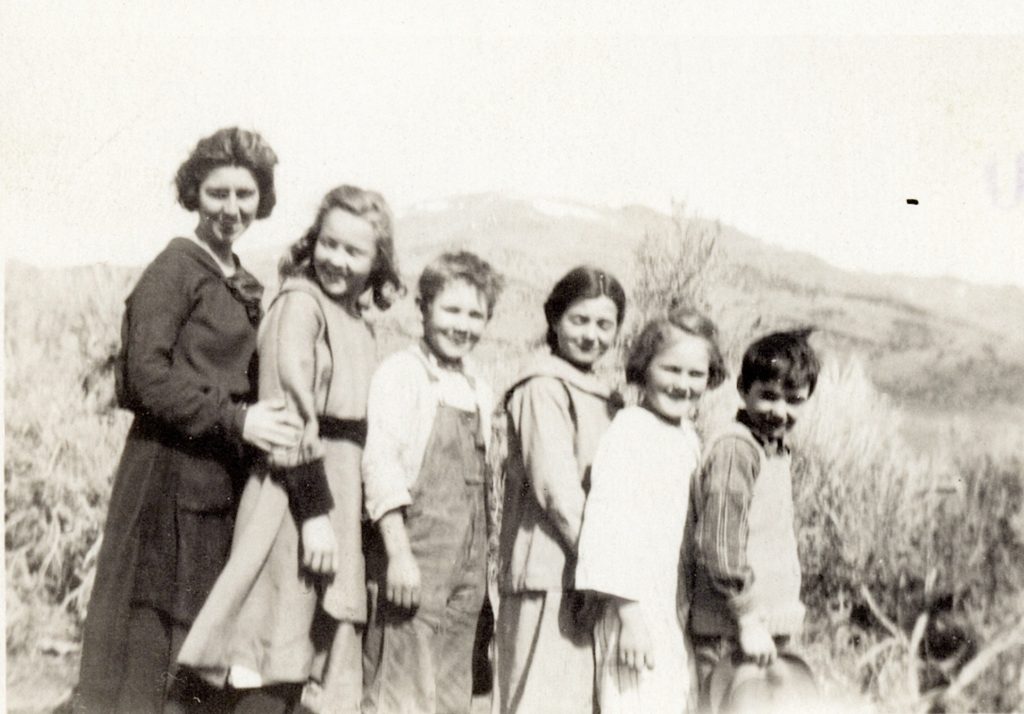
Tule Mountain School-Left to Right: Teacher from Winnemucca Ranch, Leslis Olds, Albert Olds, Jennie Guichu, Martha Olds and Steve Guichi—Caudle Collection

This is an introduction to tomorrow’s post. The Pyramid School District in Washoe County was for a simple way to describe its location was between Constantia and Pyramid Lake. Tule Mountain a natural dividing barrier separating the two families that had children—Benoist and Olds.

When A.J. & Sarah Olds took up a homestead there with a brood of five young children, a school was going to be a necessity. However, the nearest the school was on the other side of Tule Mountain at the Benoist Ranch and Mrs. Benoist was not going to budge about relocating the school.

I can not do the story justice as to how Benoist and Olds came to terms. Sarah Olds in her book Twenty Miles From A Match provides such an entertaining account. Tomorrow, I will provide an introduction to this delightful book.

Support

Eagle Lake Ice Caves

Ice Caves
The ice caves was featured on the cover of Susanville’s weekly TV guide, August, 1965

Exploring lava beds, which there is plenty around Northeastern California, there is no telling what a person might find. The Brockman Flat Lava Beds on the west side of Eagle Lake is no exception.

In the early 1950s the Chico State Biological field study set up operations at Spaulding Tract, Eagle Lake. It was in the summer of 1951, that several students explored the lava beds to the south of Spauldings and made their initial discovery of a ice/lava cave. Continue reading Eagle Lake Ice Caves

Exploring Lassen County's Past