Fruit Growers’ Snag Pusher

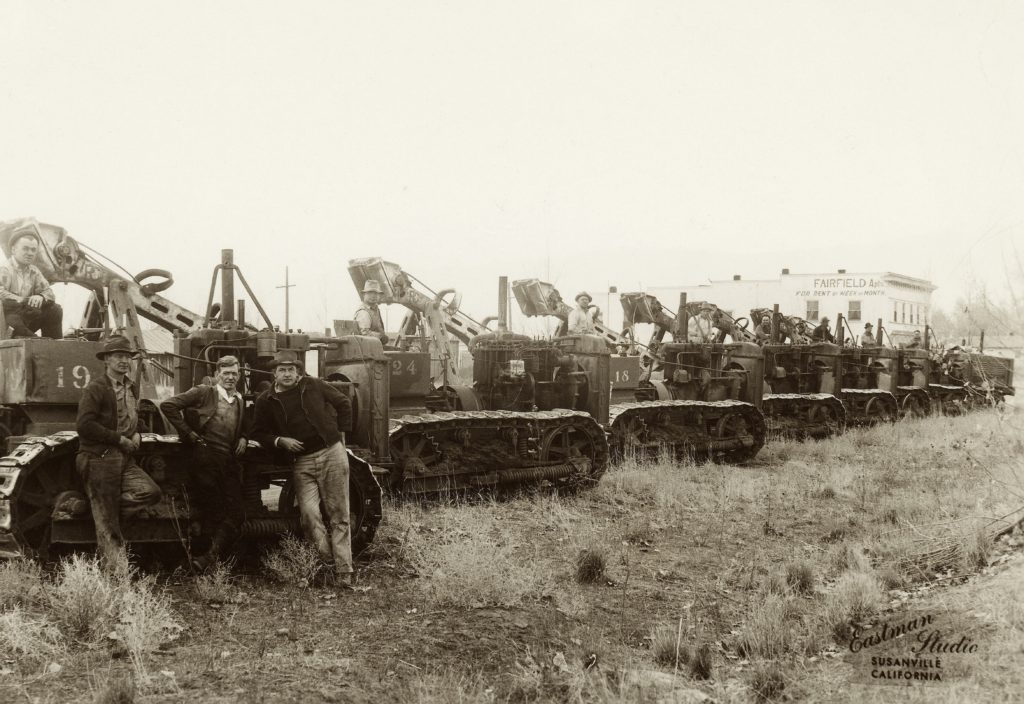
The snag pusher, 1947—FGSCo.

During the 1930s, between bark beetle infestation and a long term drought witnessed a large number of snag (dead) trees on Fruit Growers Lassen Operation. Then came along World War II, which created new challenges due to employee shortages. Yet, it is those kind of conditions where creativity comes to the forefront.

Even after the conclusion of World War II in 1945, there were still labor issues. Since the late 1920s, Fruit Growers, as well many lumber companies turned to machines to do the work more efficiently thus cutting down on labor at the same time.

In 1945, with Fruit Growers acquisition of Westwood from the Red River, did have some perks. The machine shop there employed some very talented people, who over years with creative talents improvised equipment best suited for the company’s needs. Their task to design and modify a caterpillar tractor that could knock down a snag tree—a snag pusher. The major advantage was it eliminated timber fallers from doing the job.

In its first year of operation Fruit Growers reported that 6,929 snags were felled by the snag pusher. How long the snag pusher was used, the record does not indicate.

Subscribe

That Darn Boulevard Stop Sign

Main Street looking west towards the intersection of Weatherlow, 1937–Margaret Purdy

In the fall of 1926, Susanville installed stop signs at the intersection of Main and Weatherlow Streets, citing safety concerns and to control speeding somewhat. It was by and large ignored. That was going to change. City Police Chief, Lannie Long made it known that  beginning on November 21, it would be enforced and tickets issued.

Motorists for the most part obliged and those who did not yield to a full stop were initially given a warning. However old habits are hard to break, and soon motorists started going back to their old ways and and breezing through the stop signs. A crack down had begun and tickets issued.  During the week of December 16, 1926 nineteen  tickets were issued for failure to stop, including well known local attorney Hardin “Finn” Barry. The fine $5.00. By spring motorists were generally in compliance, and tickets became less frequent.

Support

Hill’s Market Update

Lassen Mail Advertisement

This is to correct a major blunder on my part. It was on December 5, 1931, when Hubert Hill  opened Hills Market in the Knoch Building, and was a very popular grocery store for decades to come. What I omitted was his wife, Mildred Long Hill. When Hubert passed away in 1946, Mildred carried on with the business. She passed away in 1967, I am not sure who took over the ownership. There seems to be some confusion over the latter. Stay tuned, while I research this.

Tim

Last Call for 2022 Calendars

This calendar is unique in a different kind of way. Four of the photographs featured I purchased on Ebay. One of the most unique is that of Homer Lake taken in 1918. Where the photographer took the photograph was impressive. As usual it is an interesting collection of historical photographs of the region.

One has three options to purchase calendars:

1) Locally, you can purchase them at Margie’s Book Nook.

2) You can purchase direct online by clicking  here

3) You can also email me to place your order, and it will be sent with an invoice.

Tim

Westwood Gets Spruced Up

Westwood, circa 1940.

In late November 1940, Susanville painter James Daugherty landed a very big job. Maybe the largest paint job ever in Lassen County. Red River Lumber Company hired him to spruce up downtown Westwood with paint. Company towns were drab affairs and Westwood was no exception.  After all in the company’s mind, paint cost money.

Daugherty had the task to the paint the main office building, pearl white; Physicians building ivory and green; fire hall, brown and gray; cafeteria, tea green and the post office as well as the Big Store, buff.

While some Red River officials wanted to paint the residential houses, the majority did not.

Subscribe

The Arrival of Father Patrick J. Moran

Sacred Heart Church
Sacred Heart Church, 1910

On December 2, 1938, Father Patrick J. Moran became the fourth priest at Susanville’s Sacred Heart Church.  A dynamic figure, he would leave an indelible mark over the next twenty-eight years.

Father Moran’s first crusade would be a vigorous campaign to raise funds to build a new church to replace the existing church that had been built in 1892. The existing church could no longer accommodate a flourishing parish.

Another problem with the old church it was cold and drafty in the winter months—with its only source of heat and ornate pot-belly wood stove.

The original altar at Sacred Heart, circa 1910. Courtesy of Milton Mallery

After Moran’s first winter, enough was enough. Father Moran had the following notice published in the Lassen Advocate on November 26, 1940:  “That weekday Masses will be celebrated each morning at the parish house during the cold months as it is impractical and unnecessary to heat the church each morning for the services. However, Sunday services would be held in the church.”

It would not be until 1949, when the new church was completed.

Subscribe

Will It Be A Blue Snow Winter?

Red River’s snow roller in action. Courtesy of Calvin Sharp

Any weather prognosticators out there? Meteorologically speaking December 1 marks the first day of winter. The winter of 1915-16 was brutal. Snowfall was heavy throughout the region, and it was unusually wet. One storm in January dumped over four feet in Susanville. It was necessary for the Southern Pacific Railroad to bring in a rotary snow plow to keep the rail line open between Susanville and Westwood. In Westwood, Red River came up with a contraption they called a snow roller to compress the snow. Once all the snowstorms subsided in early January, it turned bitter cold with long periods of below zero temperatures. Because of the water content in snow, Red River officials dubbed the condition as “Blue Snow.”

Support

Pigeon Cliffs Update

Pigeon Cliffs
Pigeon Cliffs, 1972

Terry Cobb provided a bit more insight on this topic. While he did not name the game warden,  that person was well known. . Seasoned residents, especially those fishermen and hunters, already know the identity of the game warden then—Elmer Doty. This man had an uncanny ability to detect anything suspicious and out of nowhere appear on the scene.

This is what Terry relayed to me: “In the fall of 1956 a friend and myself were fishing the Susan River above Hobo Camp when we were approached by a game warden. He asked us if we had seen someone shooting at the Rock Pigeons in the area. We remembered hearing gunfire earlier but had seen no one but we had at other times seen what we believed to be Pigeons flying to and from the river bottom and rail road tracks up to the rocky cliffs above our location.”

Tim

The Eagle Lake Road Challenge

Heartfailure Grade, Eagle Lake, 1921. Courtesy of Lola L. Tanner

By 1920, Westwood residents made up a large segment of visitors to the south shore of Eagle Lake during the summer season. What they desired was the ability to drive to the north shore of the lake. There was a crude wagon road, between the south shore and Spaulding Tract, but it was not in any condition for automobile use.

Enter the Westwood Auto Club. This was an unusual organization created by the Red River Lumber Company. In many ways it served as a de-facto chamber of commerce. The auto club were  true to their name in road development and played an important role during the construction of Highway 36.

Eagle Lake trail to Gallatin Beach, 1914. Courtesy of Dolores Gasperoni

In the summer of 1921, the Westwood Auto Club led a group of Lassen County and Red River Lumber Company officials on a reconnaissance survey for a road to connect the north and south shores of Eagle Lake. All agreed that the obstacles could be easily overcome, with the only major outlay for a bridge to cross Pine Creek. On the other hand the over all cost would be minimal and Red River would assist with its equipment to make it possible. They all stressed the benefit of people to have access to various features along the lake, and shortly after this outing, work was slowly undertaken. In the 1940s, the road between the south shore and Spaldings was greatly improved when the Paul Bunyan Lumber Company was logging the west side of Eagle Lake.

Support

Spread the Word

Standish Water Company’s pumping plant on the east side of Honey Lake, 1911. C.R. Caudle collection

First of all, I am not a very good prostitute when it comes to self promotion whether it books or this website. As subscribers know well, I do not push subscriptions, and they are also voluntarily. This is just a simple request, if you know some one who might be interested, spread the word and with a little nudge encourage that friend to subscribe.

Thank you, and tomorrow, will resume the regularly scheduled programming.

Tim

Exploring Lassen County's Past