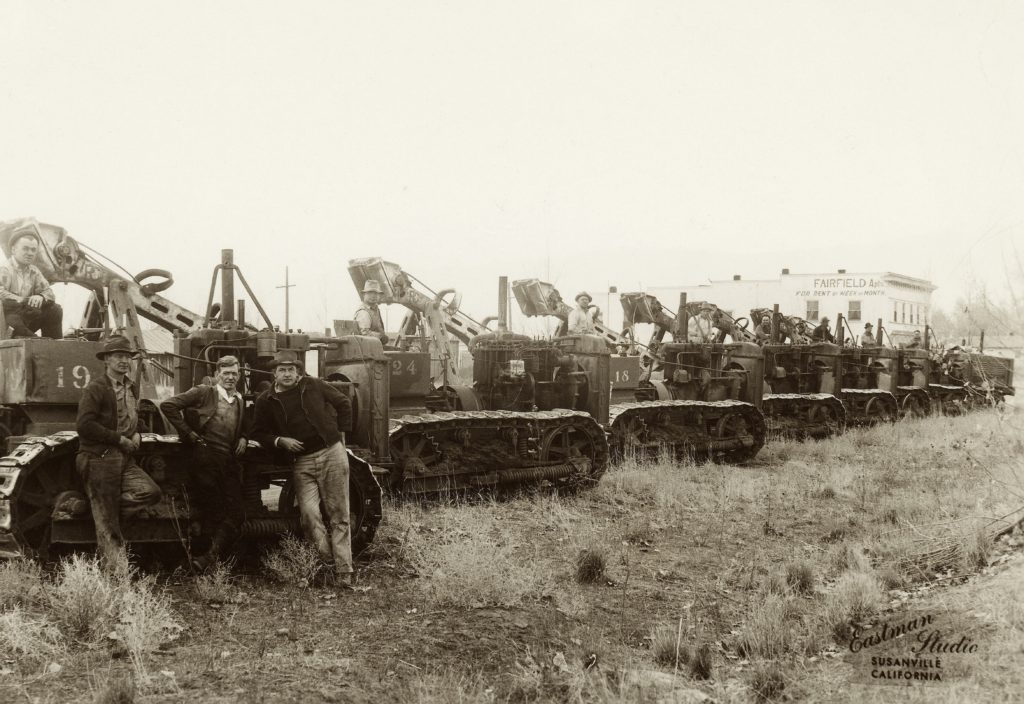
Fruit Growers Supply Company show casing their latest Caterpillar tractors, with the Fairfield Apartments in the background.
When the two large lumber mills were established it created a housing shortage. While both Fruit Growers and Lassen Lumber did construct some residential housing and apartments, there was still a need for more. There was one group in particular that needed some form of housing—loggers. Many of these men were single, so there was building boom for apartments and boarding houses.
Constructed in 1922, the Fairfield Apartments (aptly named it was located on South Fairfield Street) was one of the largest. It initially contained twenty-two rooms. It was destroyed by fire on July 29, 1941. While it was fully occupied, every escaped without injury. The building valued at $20,000 was only partially insured at $6,000.
A week from today, if all goes well, I should be cast free—one more step towards recovery.However, history never stops. Two interesting items surfaced this month. I will just highlight them, and they will appear in posts of their own.
The first came from Calvin Farris who located a most interesting 1959 BLM Christmas tree permit. The other is from Kevin Corson, whose grandfather, C.W. Corson worked at Lassen National Forest’s Durbin tree nursery—the current site of Diamond View School on Richmond Road, Susanville. Kevin has offered to share some vintage photographs of the nursery.
Finally, a computer crash update. It was suggested to do a “forced restart” It seemed to work, though it will not hurt to be proactive and explore future options.
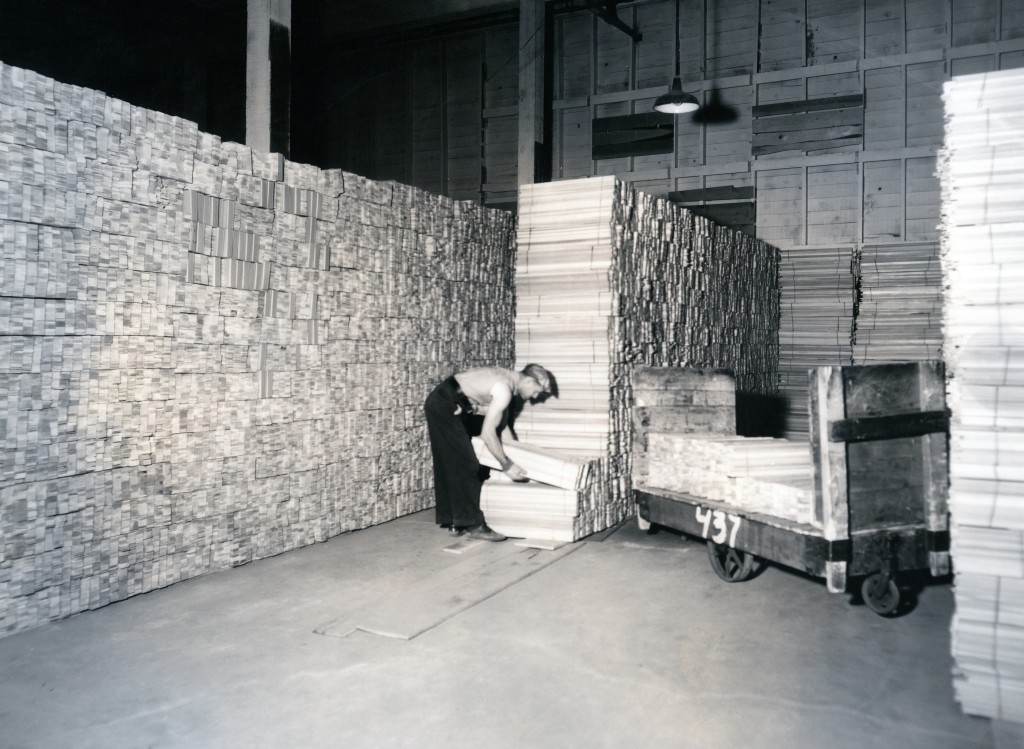
In 2022, it may seem hard to fathom how wooden boxes were vital to the nation’s commerce. There was an era when the nation’s fruit and vegetables were shipped by the humble wooden box. The demand for wooden boxes, played an important role in the lumber industry. For instance, any major sawmill also had a box factory on the premises. What they manufactured was box shook—the wooden slats to make the box. The shook was shipped to fruit and vegetable growers packinghouses were the actual box was assembled.
While Red River Lumber Company’s Westwood mill was known for its massive scale, many may not be aware that its box factory manufactured 16 million boxes a year. As the nation grew, so did the need for wooden boxes. Fruit Growers Supply Company provides an interesting glimpse into the demand. In 1907 their growers needed 6 million boxes annually, by 1917 18 million and in 1941 40 million boxes. During the Great Depression of the 1930s, it was the need for wooden boxes that kept many sawmills in operation. In fact, during that era, nearly half of all the lumber produced went to making wooden boxes.
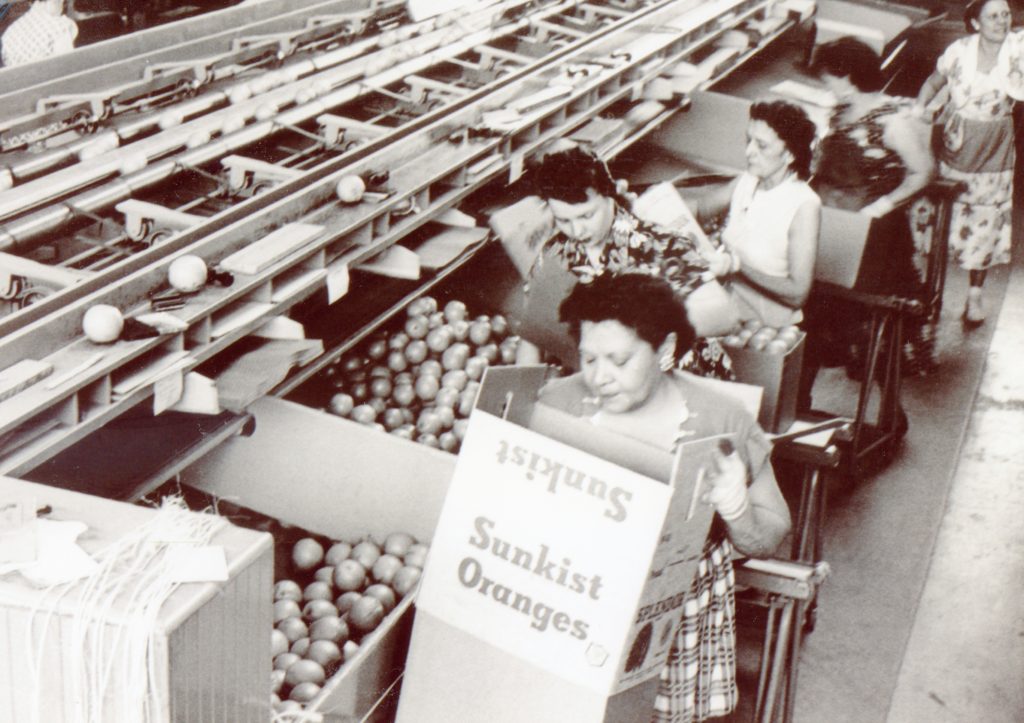
A packinghouse using cardboard boxes—-Sunkist Growers, Inc.
While cardboard boxes had been around since the early 1900s, they were never deemed practical to the growers. Some of the biggest complaints were bruising and mold of the produce. It was not until after World War II, with improvements to the cardboard that the conversion from wood to the former began. On a side note, grocers liked the cardboard box. They were half the size of a wooden box, and they could used to put a shopper’s bagged goods in to take home.
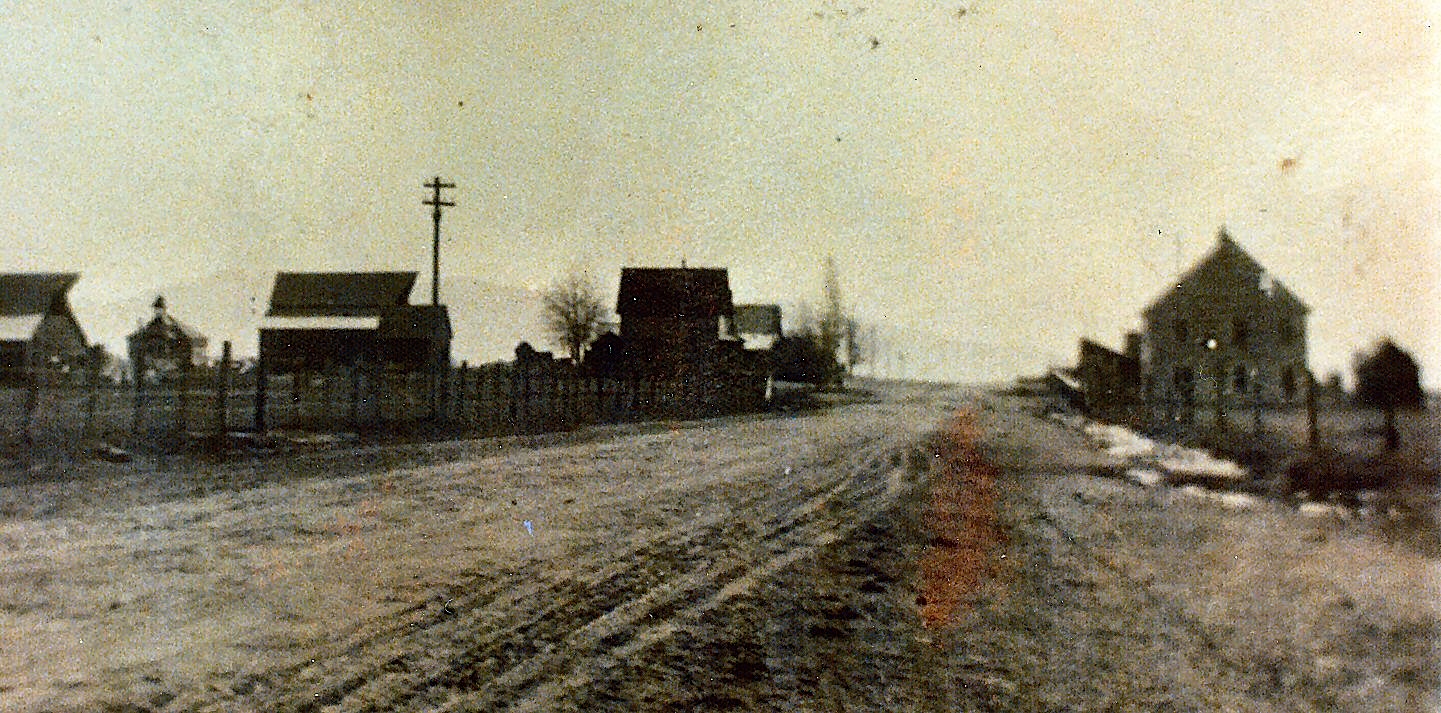
Unfortunately, not the best photograph of Spoonville.
There was a time that small towns thrived throughout the region and elsewhere. The automobile had a profound impact on these communities, but that is another story. Spoonville was a small town located several miles northeast of Janesville on the way to Standish. Its development was different than most, while many had their origins as a stage stop, that was not the case with Spoonville. Its origins began with the creation of the Missouri Bend School, so named because many of the original settlers there came from Missouri.
In 1897, William E. Spoon established the Honey Lake Creamery near the Missouri Bend School. Spoon would eventually establish a general store and, for a time, it was operated by the Christie Brothers. Thus the nucleus of a town was formed. In 1903, Robert Dunn built the 20-room Spoonville Hotel. On May 29, 1905, Spoon sold his remaining interests there to Ebenezer Cooley Brown, for an undisclosed amount. Though a small town, with less than thirty inhabitants, it was the “corporate” headquarters of the Lassen Mill & Lumber Company, Baxter Creek Irrigation Company and the Pacific Coast Bear Club. Members of the Pacific Coast Bear Club included such dignitaries as President Theodore Roosevelt and Nevada Governor John Sparks.
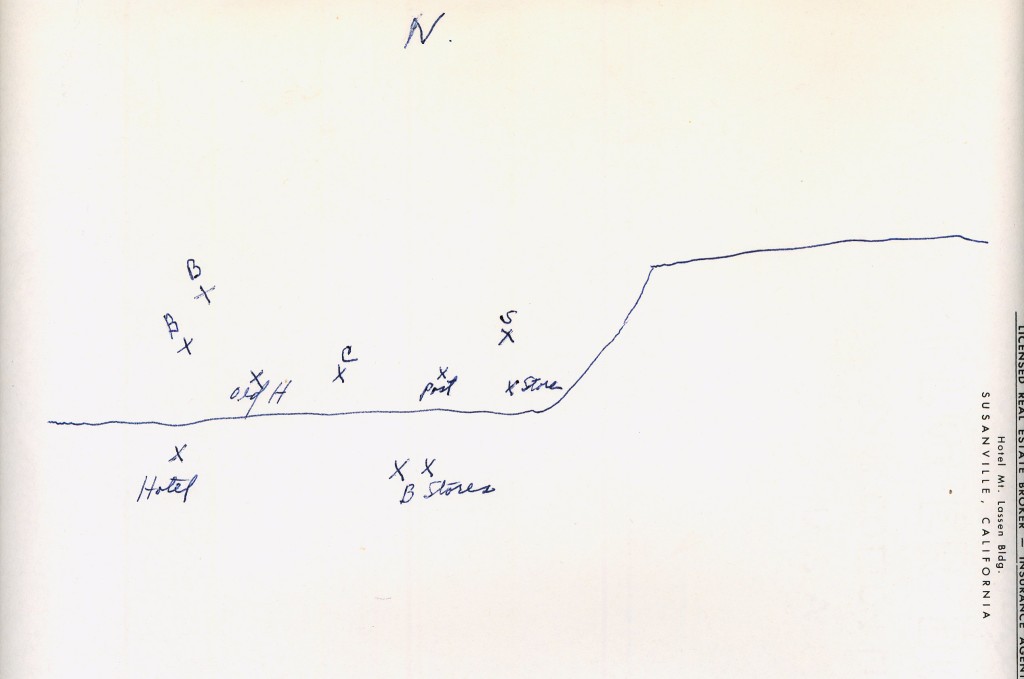
One afternoon, many yeas ago, Mul Mulroney and I sketched a rough map of Spoonville. B=Barn, C=Creamery and S=School (Missouri Bend)
In 1913, the town’s name was changed to Edgemont, as part of a real estate promotion scheme. After all, with the arrival of the Fernley & Lassen Railroad in the Honey Lake Valley, realtors thought towns that ended in “ville” conceived the impression of some kind of “hick” outpost. M.E. “Mul” Mulroney, a native of Spoonville, recalled the town was already in decline before the name change which did nothing to correct the situation. In addition, Mul stated that in the early 1920s the second story of the Dunn Hotel was removed and the building was converted into a dance hall. He further stated it was torn down sometime in the 1930s.
Today, not much is left except for the abandoned two-story residence of E.C. Brown and the defunct Missouri Bend School.
In 1955, Fruit Growers Supply Company announced its closing of the Westwood mill. Over the hill in Susanville, many pondered when Fruit Growers might do the same there. The Susanville mill would receive a brief reprieve.
In 1957 six paper companies were interested in Fruit Growers cutover lands in Lassen County. While California ranked second in the nation for lumber production, there was only one paper/pulp plant in the state. Fruit Growers had debated at one time to convert the Susanville mill into such a facility, but it was just not going to happen.
On November 7, 1962 the beginning of the end was announced with the closure of the Susanville mill. The woods employees were permanently laid off. The mill would remain in operation until the logs on hand were processed. On May 13, 1963 the last log was sawn. Shortly afterwards the remaining employees terminated and the mill closed. There being no buyers it appeared the mill was destined to be dismantled. It did receive a last minute reprieve with negotiations of Crook & Emmerson, but that is another story. On April 30, 1964, Homer Vincent closed Fruit Growers” Susanville office.
After World War I lumber companies began implementing modernization of logging methods. The adaptation of caterpillar tractors proved to be efficient and cost effective. As advances were made on different fronts, one area was lacking—the falling of timber.
An electric saw powered by a D-2 cat. Courtesy of Fruit Growers Supply Company
World War II created all kinds of shortages and labor was one of many. Fruit Growers Supply Company’s 1946 Annual Report provides an interesting glimpse in regards to timber fallers and labor.
”One place in the lumber industry where the use of mechanical equipment has not improved costs is in the falling and limbing of trees in the woods. Until the power saws came along, all of this work was done with hand tools on a contract basis where increased production meant increased earnings to the worker. With the advent of power falling saws, this work changed from a piecework basis to a straight-time basis and as a result costs actually increased. There is no valid reason why power falling saws should not result in lower costs than hand falling and also result in higher earnings to the man on the job. One factor in this change is that skilled help was drawn away from the woods by high wages offered elsewhere and by the military services. Hand fallers are highly skilled, but the substitutes for hand fallers who operated power falling equipment did not require much skill for the job and most of them have not attempted to acquire speed with the power equipment. There has grown up considerable resistance to piecework methods in recent years. Efforts are being made by the industry to get back to a contract basis for this type of work.”
Bucking a log—FGS Co.
For a little bit of clarification about the contract work. Timber fallers for years were paid by the scale of the board feet felled. These men made very good money, considering the size of the trees then. As late as the 1970s, timber fallers were still being paid by the scale.
When Honey Lake is full, it has found many uses such as boating, fishing and ice-skating to name a few. One of the more unusual usages of the lake was baptisms. On Sunday, March 8, 1914 the Janesville Baptist Church held services at the Lakeview School. After the services, the congregation went to the shores of Honey Lake, where the Rev. L.D. Howard baptized several new candidates into the flock. Unfortunately, I have not been able to find a record as to who they were.
In 1919, Honey Lake went dry and would remain so until the winter of 1937-38. So baptisms as the lake was no longer an option. On April 2, 1932, the Rev. Bond of the Seventh Day Adventist Church o Susanville found an alternative—the Wendel Hot Springs—which thirteen members were baptized there.
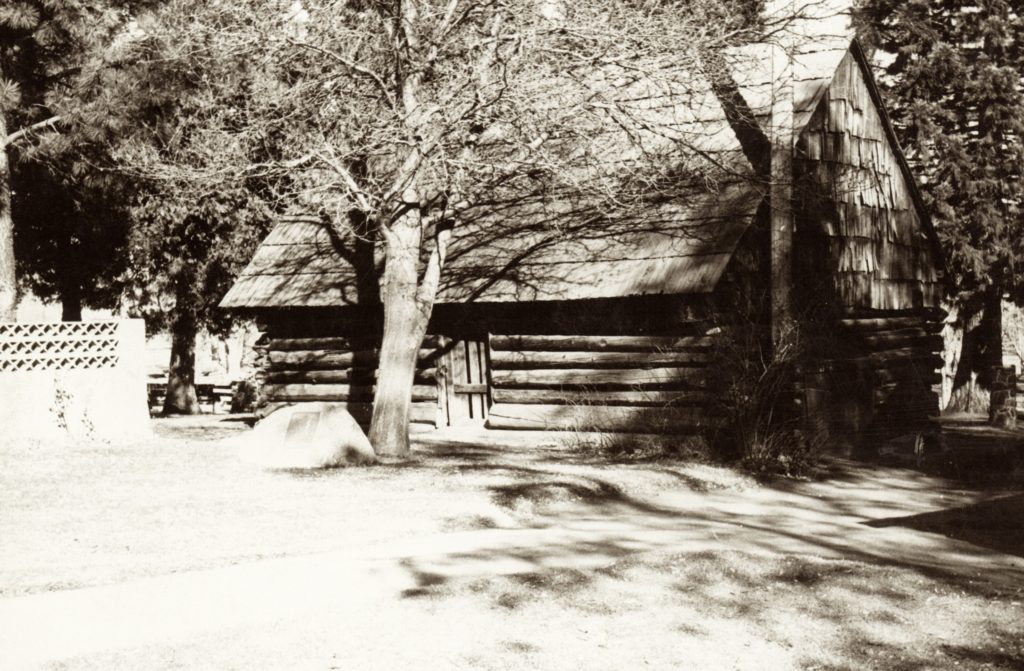
This Susanville landmark, which is more a less a replica of the original structure built by the Roop Brothers in 1854 was never intended to be a fortress. Its purpose was that as a trading post along the Nobles Emigrant Trail. It was in 1863, the abandoned trading post was were Honey Lakers barricaded themselves in a conflict with Plumas County officials dubbed the Sagebrush War. That is another story. Thus, the appellation of fort was added to the structure. It has also been known as Fort Defiance.
In May 1974, Northern California Congressman Harold T. (Bizz) Johnson announced that Roop’s Fort and Trading Post had been entered into the National Register of Historic Places.
This originally appeared back in 2019. A recent post about the occupants of the Knoch Building, a reader thought I neglected the B&B, a popular place back in the day. Without further adieu here it is.
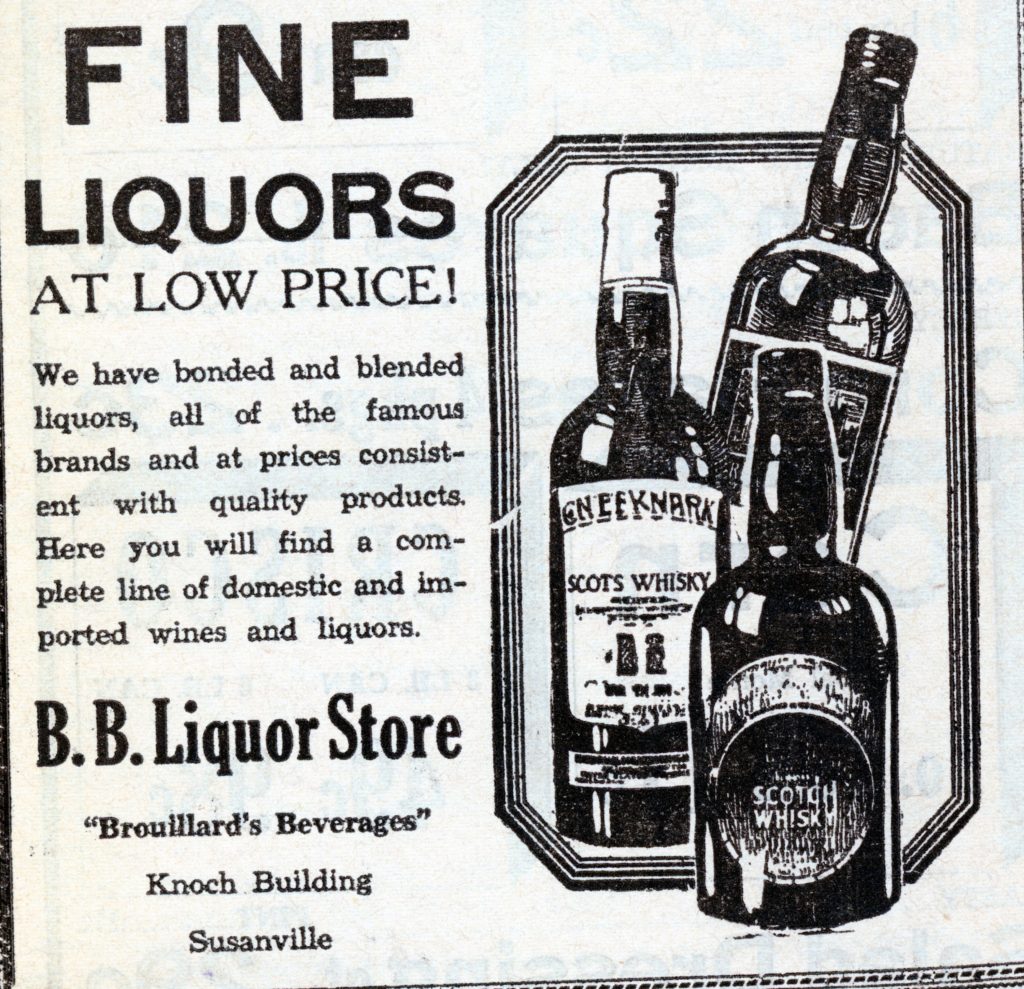
1935 Advertisement for B.B. Liquor Store
Seasoned residents will remember with fond memories of the B&B, a fine restaurant and bar located in the Knoch building. Before it became the B&B it as the B.B. Liquor Store. The B.B. stood for Brouillard’s Beverages, after the owner, E.H. Brouillard.
Some may recall in the banquet room, there was a rather large canvas mural 6’ x 20’ of Mount Lassen. It was painted by J.E. Lane, and the mural still exist, it being in storage. It should be noted that two other works of Lane have graced the walls of the Lassen County Courthouse since 1917. One is of Susanville as it appeared in 1864. The other is of Warner Valley, with Lassen Peak in the background. Why the County Board of Supervisors selected the latter has always confused me. First Warner Valley is in Plumas County. And, secondly, Lassen Peak is in Shasta County.
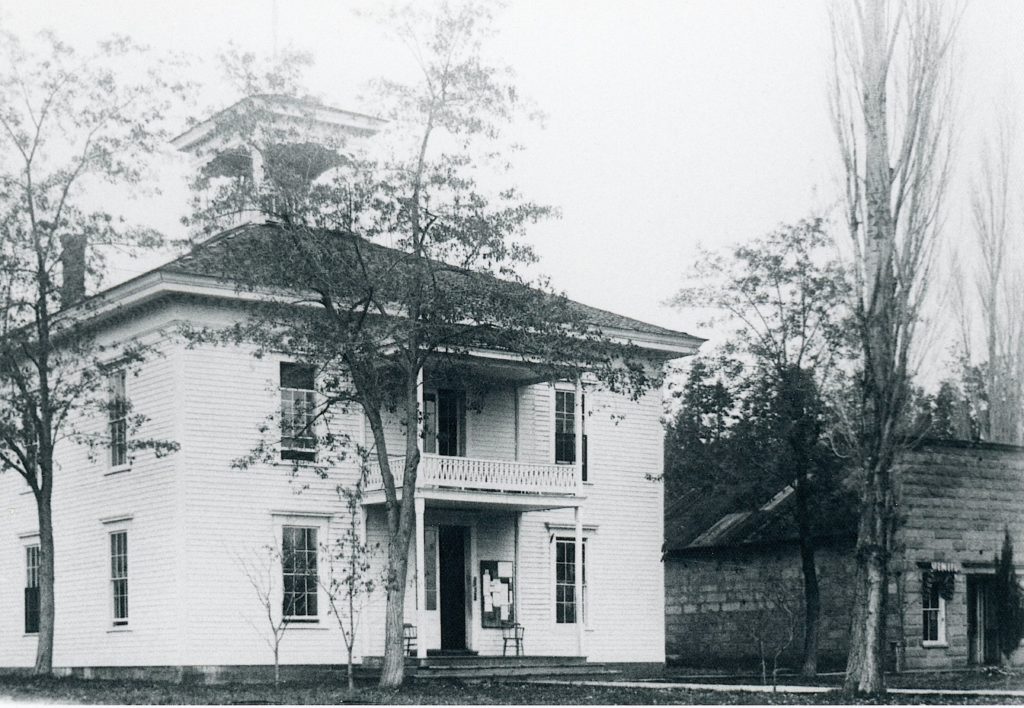
Lassen County Courthouse and Hall of Records, 1907. Courtesy of Gil Morrill
When the Lassen County Courthouse was constructed in 1867, in certain ways it was a multi-purpose facility. It would be awhile before any houses of worship would be built in Susanville. The County allowed the courthouse to be used for religious gatherings charging $3.00 a day.
The original courthouse did not have a second story balcony. It was constructed in 1892 by L.D. Arnold and George Harrison for $150.
I was going to include some other tid-bits, but my wrist recovery decided otherwise.