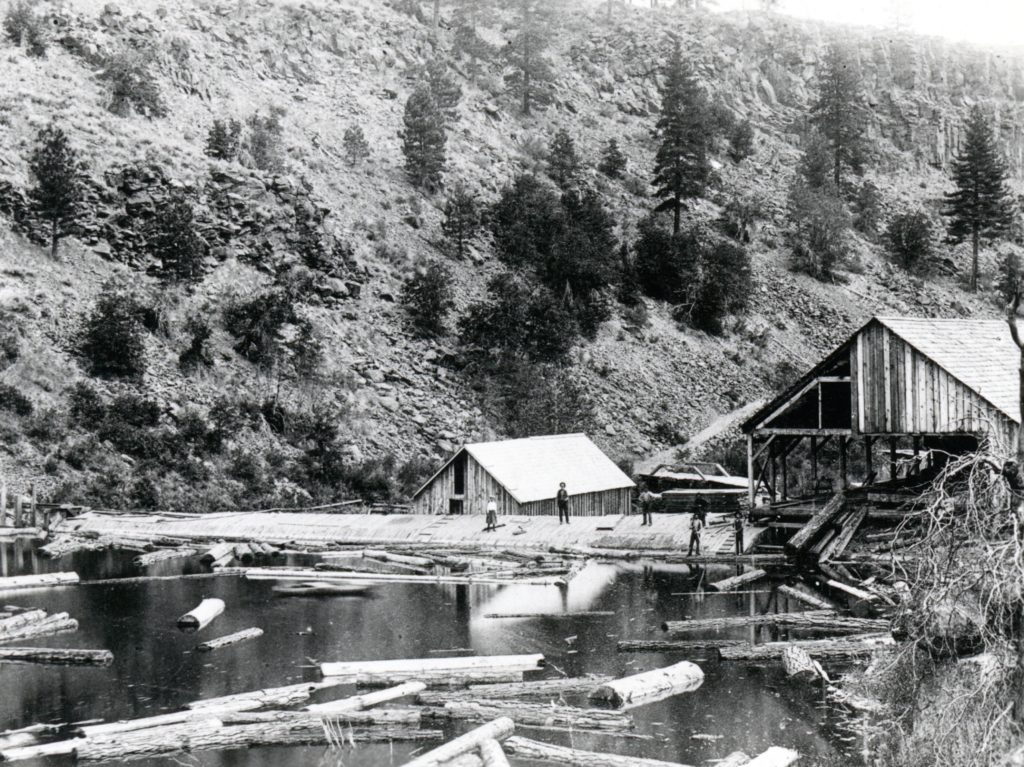
Bremner sawmill, Susan River Canyon, 1891. Courtesy of Betty Barry Deal
When the Bremner sawmill and dam was constructed on the Susan River, a short distance above today’s well known Hobo Camp, not much thought then was given how it would affect the river’s fishery. It took a little while before the local anglers noticed the trout population below the dam was greatly diminished.
On June 15, 1892, Bud Heap and Ben Hunsinger went on a fishing expedition, traveling by wagon going up the grade west of Susanville for several miles. The ambitious men, then hiked down from the canyon rim and found the fishing par excellent, returning with some twenty pounds of trout. It was from that episode, that had been an ongoing discussion, for the need of a fish ladder at Bremner Dam, gained traction. In the fall of 1892, a fish ladder was installed.
An interesting footnote about that fish ladder. The Bremner mill was destroyed by fire in 1894, along with a major portion of the dam. The fish ladder remained intact until it was damaged by spring floodwaters in 1915.
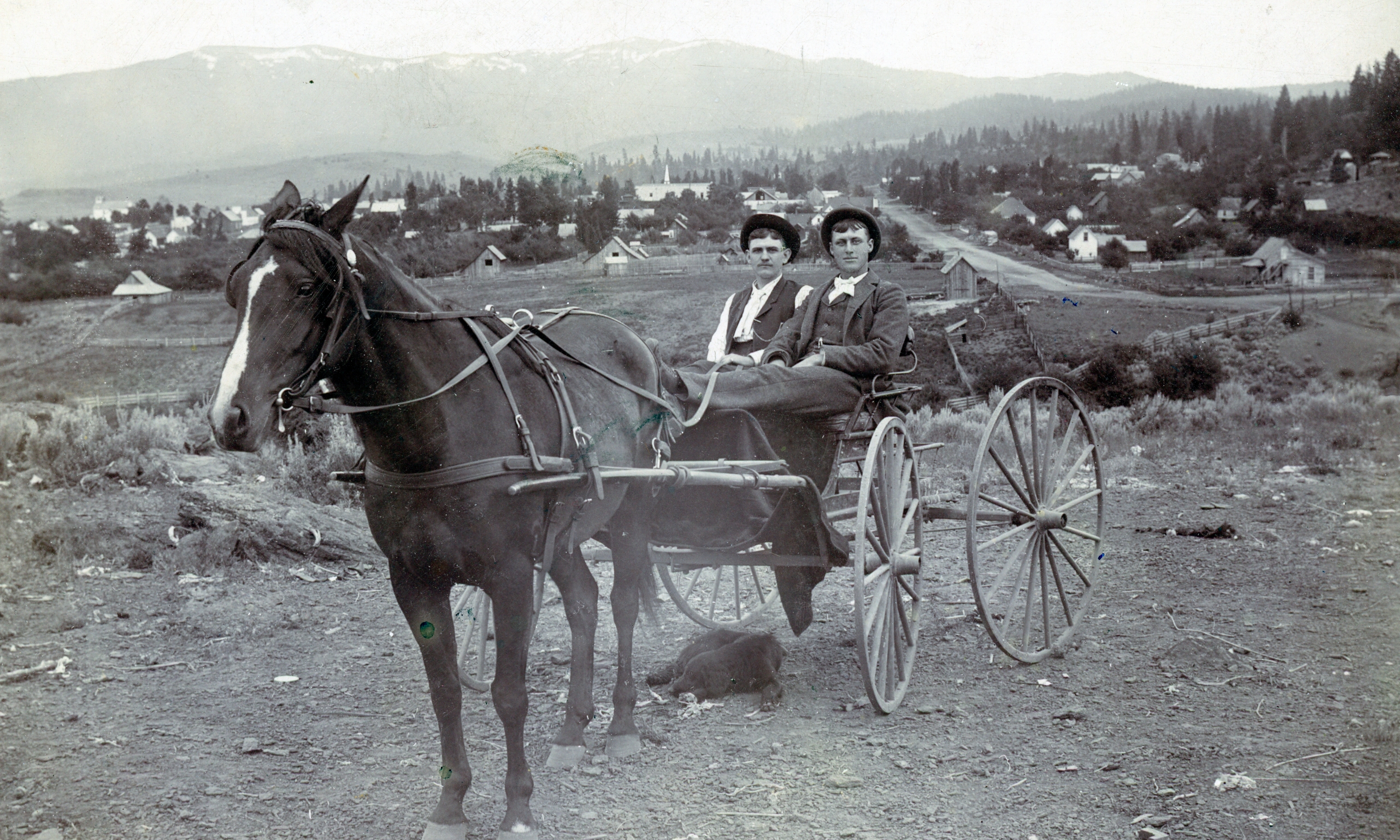
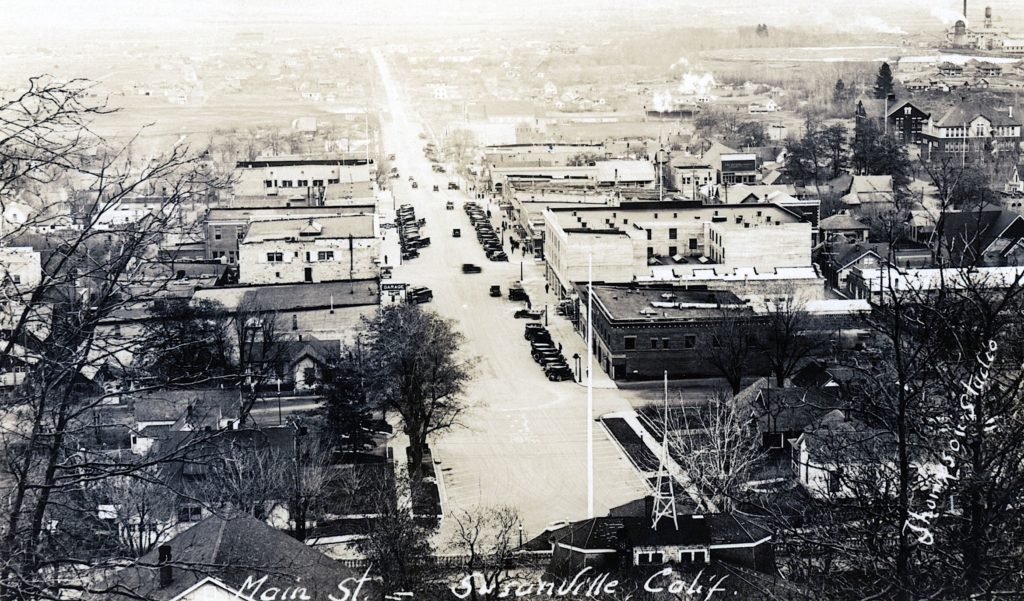
Susanville’’s Roop Street in the background from Rooster Hill. Seated, Frank League, Charle’s only son and Tom Long, circa 1895.
To be a teamster in the region during the 1850s and 1860s one encounter many hazards. While poor road conditions was one item one of worst was the conflicts between the Indians and the Anglo settlers. In Fairfield’s Pioneer History of Lassen County e devotes nearly a quarter of its content about these conflicts.
In October 1867, Susanville merchants Griffin and Williams hired Charles League to take a load of merchandise to Summit Lake is far northwestern Nevada. After League unloaded his wagon, he began to make the journey back to Susanville. He stopped at Flowing Springs Station for the night operated by two Honey Lakers, L.M. Crill and C.P. McClelland. During the night the dogs barked continuously, a good indicator that Indians were around. With that in mind, Crill and McClelland tried to convince League that he should stay as a matter to safety precaution. It did not work, and League hitched up his team and wagon and started for Honey Lake Valley. It was not too long after, Crill and McClelland spotted smoke on the horizon. Crill and McClelland mounted their horses to follow League. They had only travelled a little over a mile, when they spotted some Indians going up the hillside with League’s horses. Near the wagon they found League’s dead body. The authorities at Camp McGarry were notified and a crude coffin was made, and League’s body brought back to Susanville for burial. This would be one of the last conflicts in the region.
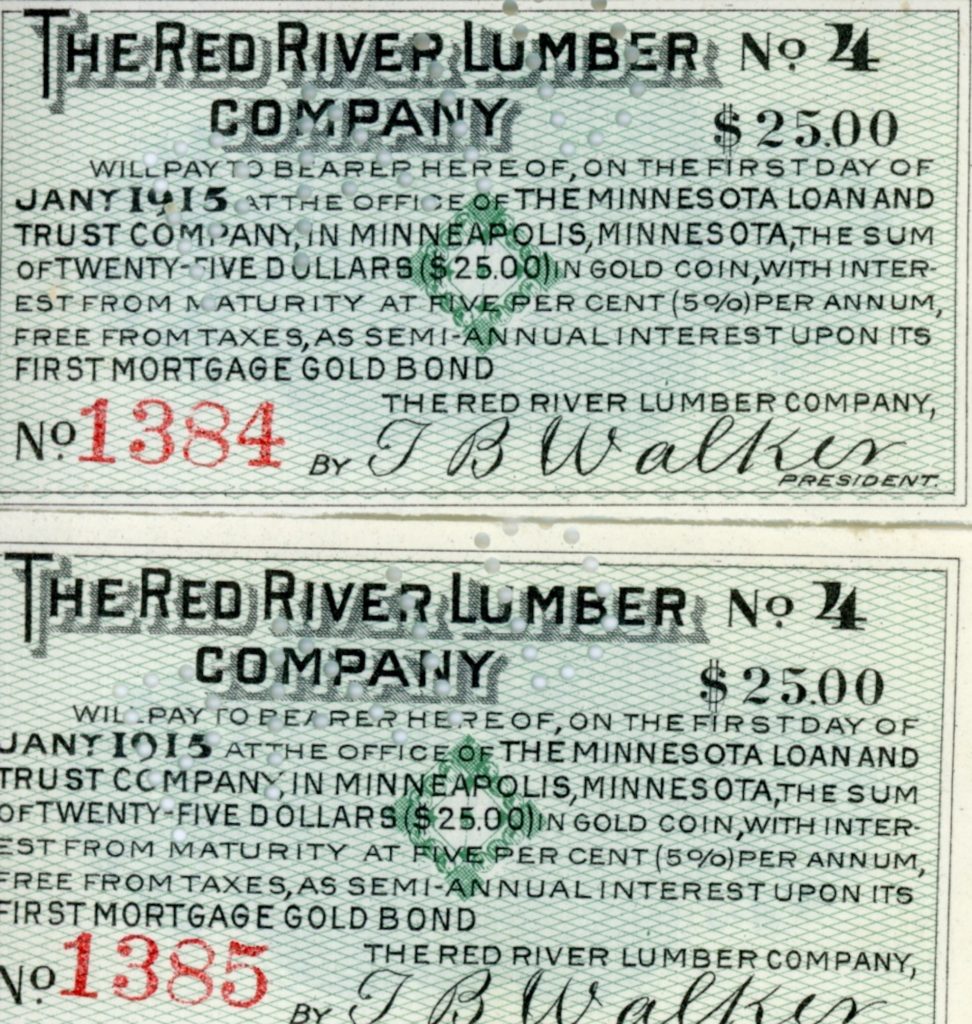
Coupons from Red River’s Akeley, Minnesota Bonds—C. Derek Anderson
Red River Lumber Company’s California expansion was a very costly endeavor. While its founderT.B. Walker had amassed a great fortune, like many successful businessmen, he was constantly investing his profits in new enterprises, some good and others not. To purchase the California timberland conservative estimates place the cost at $3.7 million. However, not all of this came out of Walker’s pocket. To finance his cause, he enlisted the aid of a New York investor, Doctor John E. Andrus. Together, the two men formed the Waland Lumber Company—its name a derivative combining the names of Walker and Andrus. When Red River made the final decision to build its first California mill at Mountain Meadows, the Waland property was used as a collateral for bond issuance.
The initial cost to build Westwood was $3,528,300, nearly equal
as to what was spent on timberland acquisition. This only covered the costs incurred in 1913 and 1914, and the town and mill plant were far from being complete.
In 1913, Red River sold two million dollars in bonds to help pay for Westwood. The bonds were secured with a mortgage on 90,000 acres of Waland timber in Tehama and Shasta counties and experts placed a value on that timber at $6,100,000. The first payment of $50,000 was due on January 1,1916. The bonds had a life span of fifteen-years, but in 1928 a balloon payment of $950,000 was due! That obligation that would not be met, that was one of the dominoes of the downfall of Red River.
Susanville’s The Big Store as it appeared in 1916. Photograph courtesy of the Worley family
In 1866, David Knoch purchased a lot on Main Street for $1,400. This address would later become known as 722 Main Street, the current home of Margie’s Book Nook since 1995. For the next 76 years three generations of the Knoch family operated the store. The current building was constructed in 1893, though it did received substantial damage from the 1900 fire.
In 1912, Fehr & Worley took over the helm of the general merchandise store, which they renamed the Big Store. Times were rapidly changing with the arrival of the railroad and lumber mills. In 1919, Fehr & Worley did the first remodel of the building changing its exterior and interior. They also opened a new department inside the store, and a first for Susanville—a delicatessen.
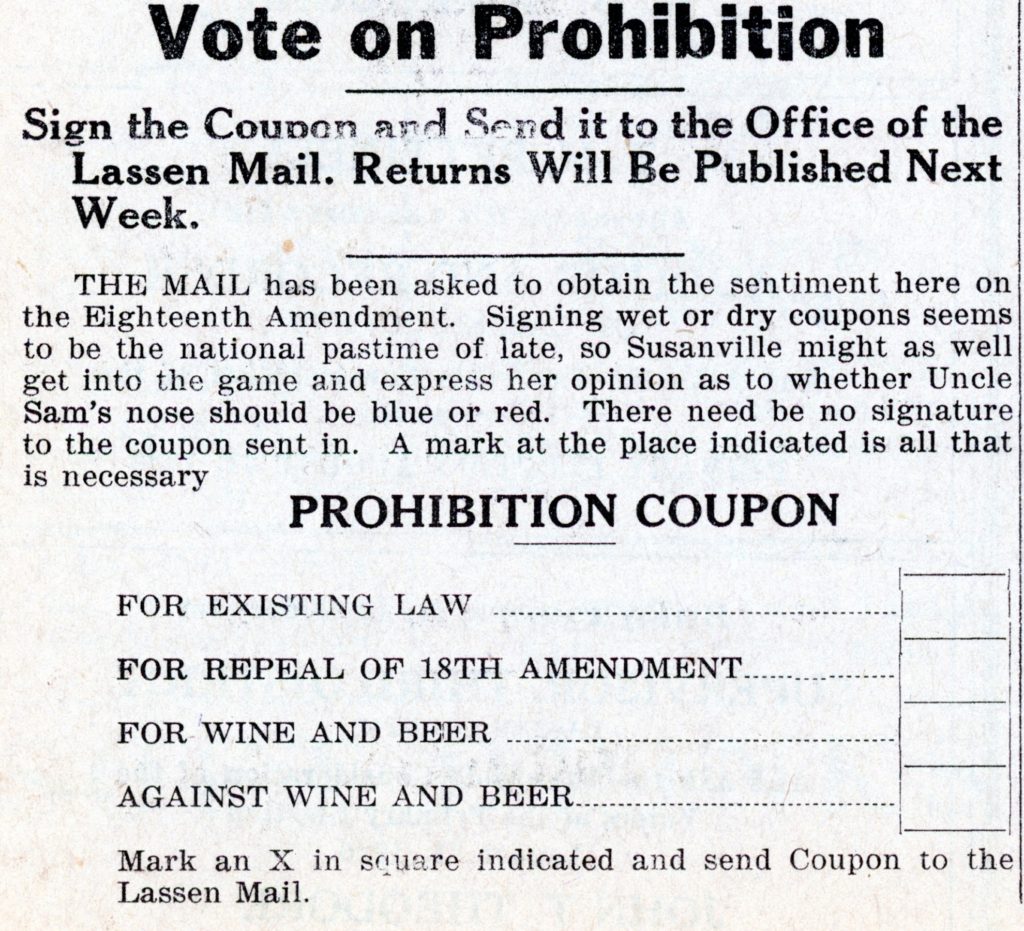
With the passage of the Volstead Act aka Prohibition there would be countless polls taken on whether it should be repealed. Robert M. Cook, editor/publisher of Susanville’s Lassen Mail newspaper decided to take an informal straw poll vote from the readers of the newspaper in the spring of 1926.
The results were not surprising, since bootleg operations were widespread throughout the region. Only 12 votes were cast to keep the existing law, while 401 wanted it repealed. A second question was whether to allow just wine and beer, which 110 said yes and six no.
Some readers sent in comments. One wrote “Voluntary abstinence always, compulsory prohibition, never.” Another “Bear in mind that the organized bootleg ring does not want the present law repealed. If it were the country would have fewer millionaires.”
It should be noted that earlier in the year a national poll was taken wherein California only 525 voted to keep the law, while 12,637 were against. What was surprising was Utah only 61 yes to keep the law, while 1,323 wanted it repealed.
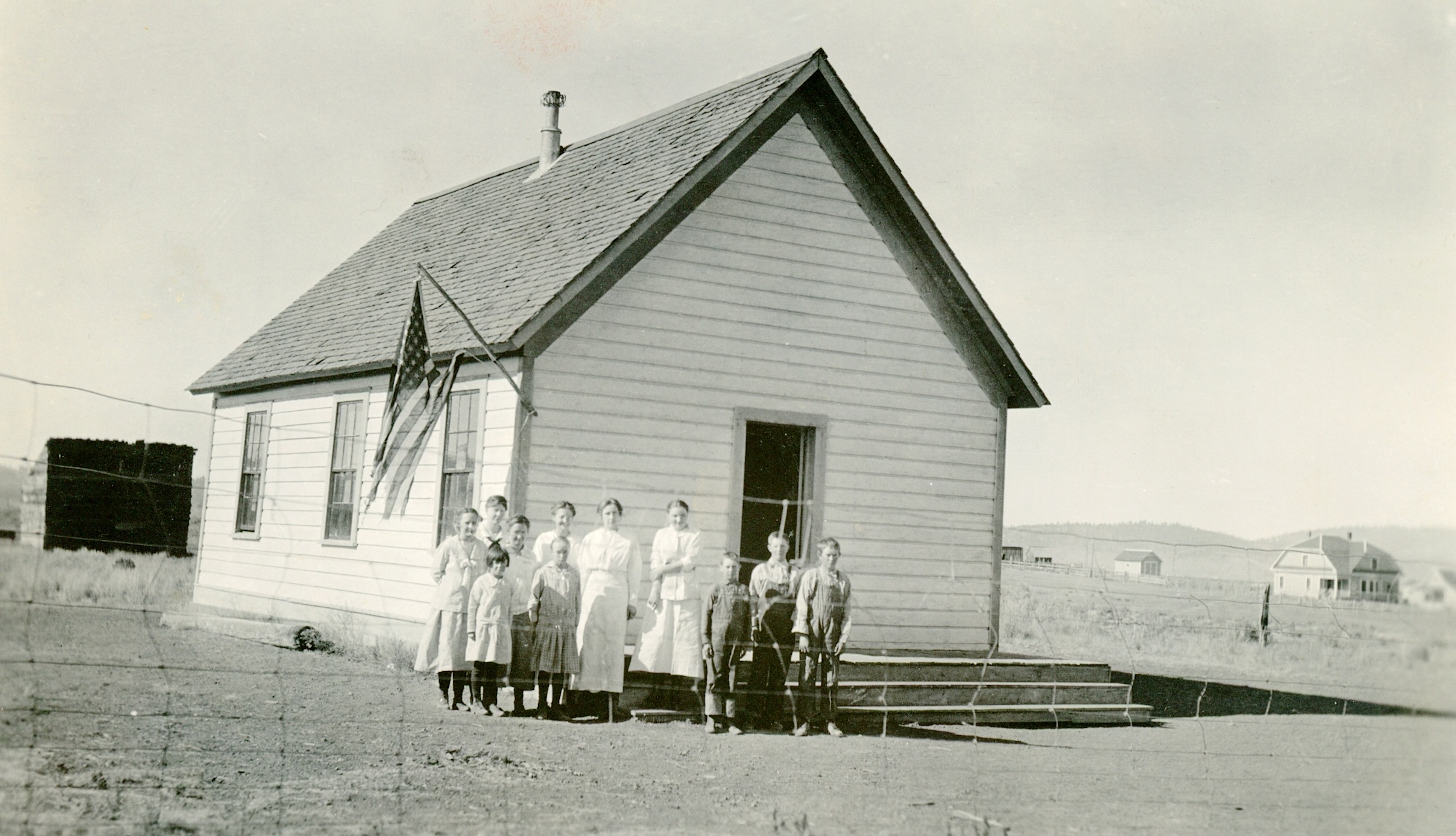
In July 1875, eighteen Ash Valley residents petitioned for the formation of a school district. The Board of Supervisors tabled it. The petition failed to enumerate how many children resided in the valley. Of note, the majority of the petitioners were bachelors. A year later, a new petition was submitted that informed the Board there were fifteen children in the valley—the petition was approved.
Sometime in the late 1870s, the residents worked together to construct the schoolhouse. Records are not clear, but between 1917 and 1919 the school was closed. In July 1920, the residents requested the school be re-established and the request was granted. In 1923, the school closed again, as Julia A. Norwood, County Superintendent of Schools stated there was not a sufficient number of students. Norwood, on an optimistic note, ordered that the school’s fixtures and equipment remain in tact. The records, again, do not indicate when the school re-opened. At the County Board of Supervisor’s meeting of August 20, 1929 the minutes state: “Mrs. Mary Bath, Mr. & Mrs. J.T. Bath of Ash Valley appeared before the Board in the interest on emergency school at Ash Valley. It appearing that the proper showing had been made for this school, Mr. Bath is advised that a teacher would be designated.” This problem occurred again in 1934, when the school trustees were not able to secure a teacher and it was designated as an “emergency class.” The Board hired Jessie B. Madison for its teacher. The school closed for a final time in 1941. The last students to graduate were John Bath and Martha Bath in 1938. In September 1946, the Board of Supervisors declared the school as surplus property and ordered its sale, yet no buyers came forward.
Ash Valley School, as viewed from the cemetery, 2002.
It should be noted the school is located on a 40 acre parcel that also contains the Ash Valley Cemetery.
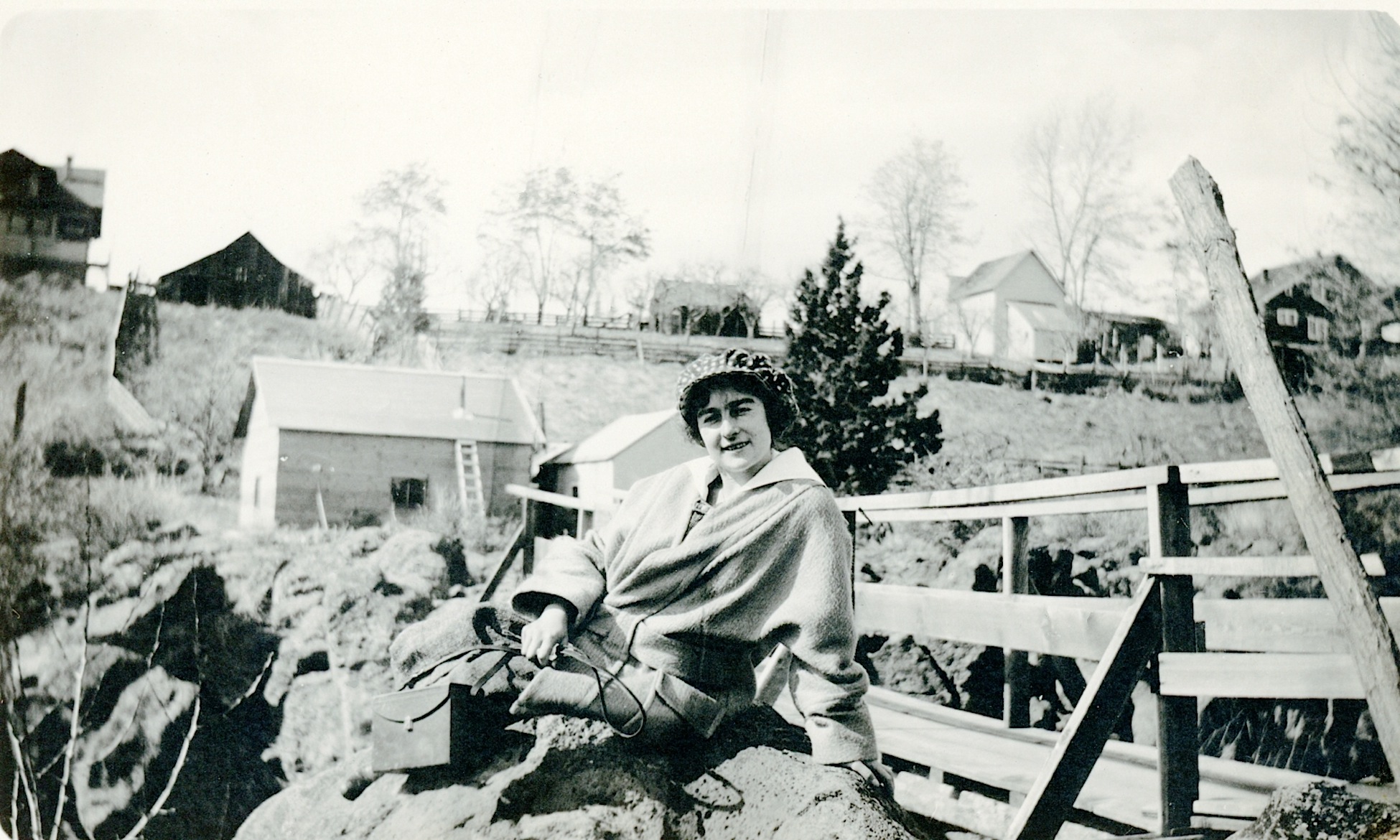
Mary Fern Long at the Carroll Street bridge, Richmond Road circa 1917—Leona Byars
While this photograph may not be distinct in the scene displayed, it still has some significance. The photographer, Leona Jackson Byars, daughter Rose Murrer Bagin, was best friend with Mary Fern Long who married Jim Nutting, an attorney and one time Lassen County District Attorney.
In the background on top of the hill is the 200 block of South Gay Street. Many of today’s existing homes have not been built.
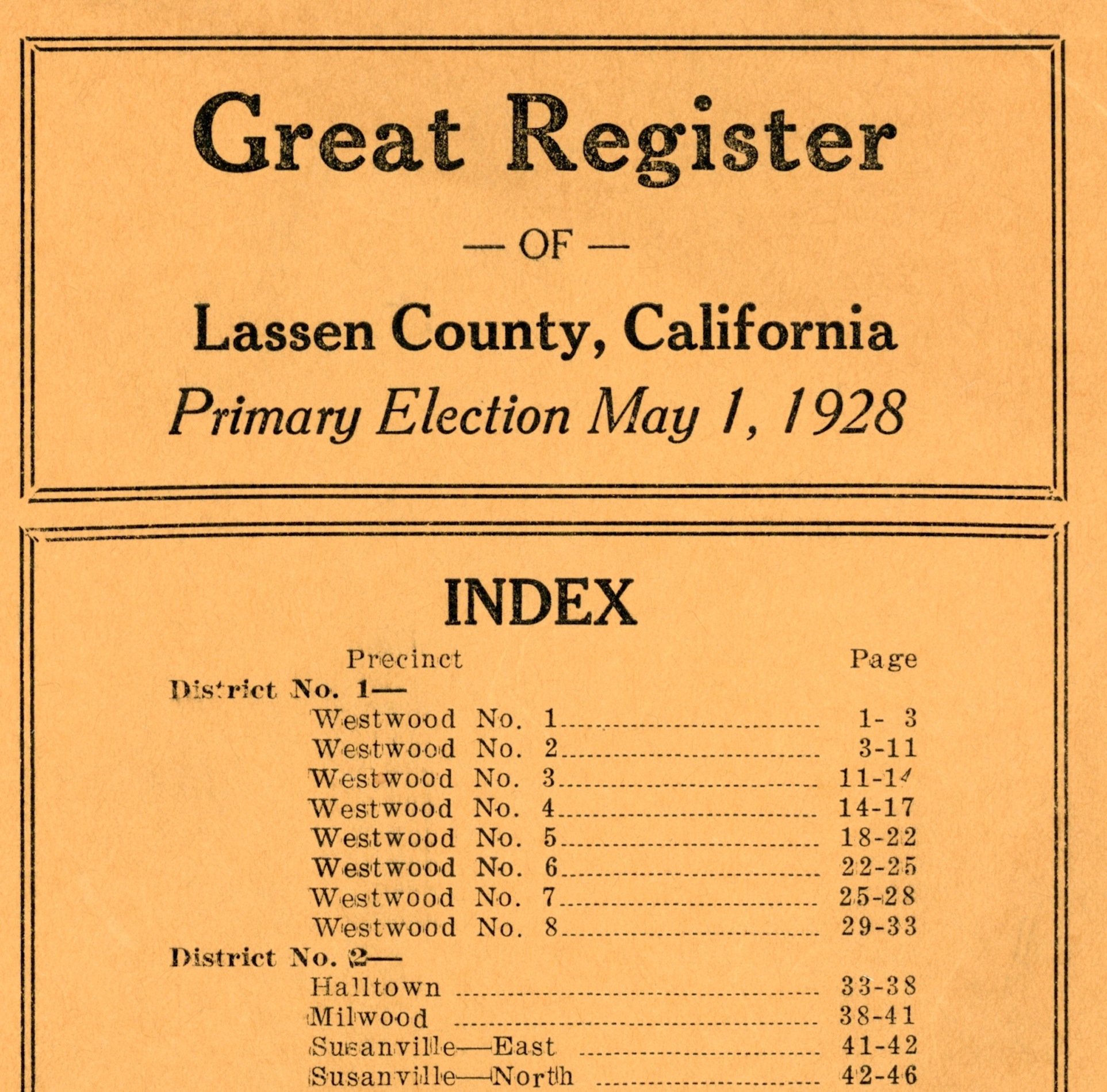
Partial Cover of the 1928 Great Register, since I do not have one for 1926.
In a by gone era, the Lassen County Great (Voter’s) Register was printed and distributed to the poll workers. In 1926, Lassen Mail printed the primary election register. The newspaper published a story about some of the odd data found— there were 4, 989 names.
“Our town may be in Susanville, but it don’t mean a thing to the ladies, as there are but two Susans and one Susie registered here, while there are some score or more in the county.
“The principal occupation of the men seems to be farming, with clerk and laborer running close seconds. Very few woodsmen, loggers or woods workers in proportion to the importance of our primary industry.
”One wonders how the dishes get cleaned in the restaurants, as there is not one dishwasher registered. While there are quite a number of “sheepmen” in the county, there were apparently only three “sheep herders.”
“Politically, Lake Greeno is the most overwhelmingly democratic precinct, with 14 democrats and 11 republicans, while Ravendale redeems the republican prestige with 42 republicans and 6 democrats. Pittville seems to be the most socialistic precinct with 11 registered of this affiliation and a number who refuse to give their political belief.
“Westwood precinct No. 1 is the largest precinct with 556 names and Secret the smallest with but 10. North and South Susanville are most evenly divided with 361 names each.
“Cox, Cyr, and Orr and several others vie for the honor of having the shortest name, while Schoenberger wins in a walk with the longest name of 14 letters.
“Providence precinct is unique to that every one of its 20 voters gives their post office address as Adin, which is outside of the county. in which they reside in and vote.”
The following editorial appeared in the Lassen Mail on July 9, 1926. It is interesting in a few aspects. There is a story, inside the story about elections/politics, and is only fitting since Tuesday is Election Day.
Buy Where You Earn. There is much talk these days of boosting Susanville and there are many activities that are making it better known, wealthier, bigger. The American Legion Convention will bring it state wide attention and will undoubtedly cause many people to make this their home.
But with all this there are many people who talk Susanville and act elsewhere. What of the man who talks of the great future of Susanville on the street corner and buys his clothes, his automobile, his printing and even his groceries in another city? His words are mere bombast but his buying his needs in other places is one of the worst blows that civic industry in this place can sustain.
A candidate for office approached a business man in Susanville and asked for his support in the coming election. The business man, after explaining that there was nothing personal in his refusal, told the candidate to go to Montgomery Ward for his political support. The candidate did his buying from the mail order house and the mail order house should support him in the election.
A man supports those who support him. You cannot expect business or co-operation if you are not willing to give the same thing in return.
Susanville goods are of the same quality and Susanville prices are just as cheap as those of other cities. The person who is mislead by cheap prices is losing out in the long run. The man who is buying his goods out of town is not gaining either financially or otherwise. If he does this he cannot expect local people to trade with him.
Local trading, of whatever nature, is beneficial to everyone. It increases industry and will increase population. A bigger and better Susanville is the aim of every public minded citizen and the best way to realize that ideal is to encourage home industry and stamp out the man who makes his money in Susanville and spends it in some other city.
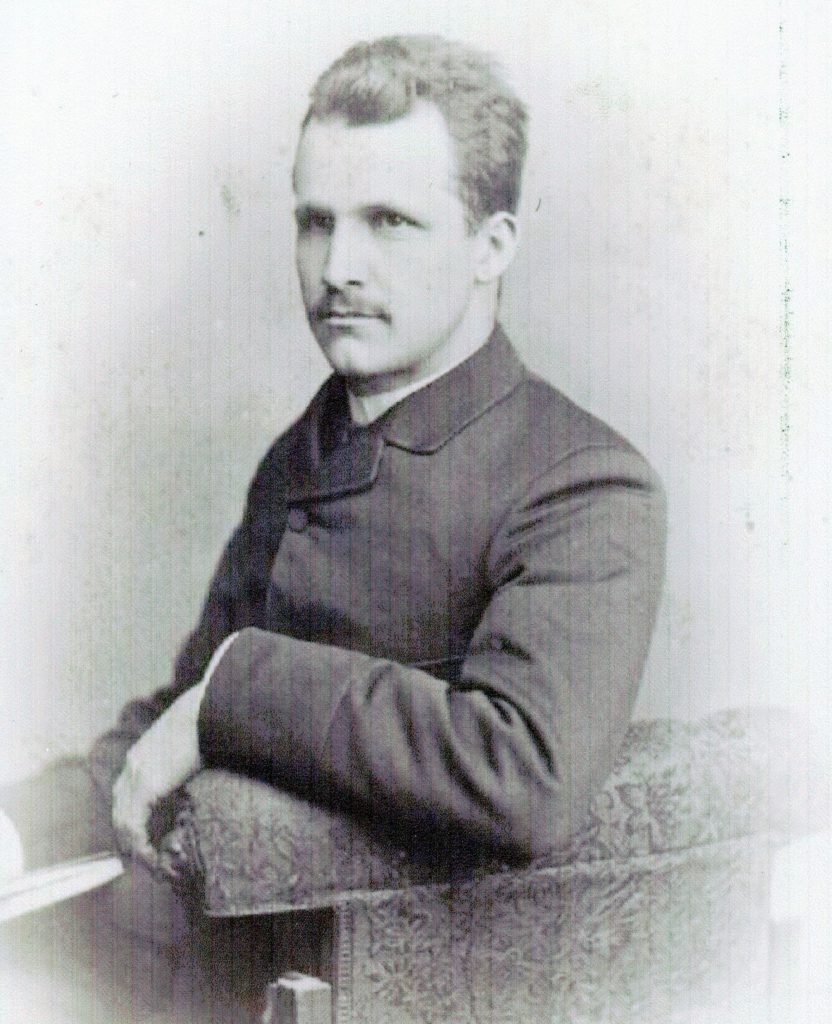
In 1882, Julius M. Howells, a civil engineer for Agassiz & Shaw, was hired to study the geological features of the Feather River country. The region left a lasting impression on him. First, there was the abundant watershed found at Big Meadows (now Lake Almanor). Then there was the dramatic elevation once the Feather River left that basin, descending some 4,350 feet in a distance of some seventy miles. Two years later, Howells left the region to work on other projects.
In the 1890s hydroelectric power was coming to the forefront. In 1895 his brother-in-law, J.J. Seymour, was a co-founder of the San Joaquin Electric Company in Fresno. In 1899 Howells accepted the position of consulting engineer for that power company to construct the Crane Valley Dam.
In 1901, in Los Angeles, Howells affiliated himself with noted engineer James Dix Schuyler. In November, Howells returned to Big Meadows to compile facts and figures for the potential development of a hydroelectric system utilizing the Feather River. Upon his return, with data in hand, Schuyler arranged a meeting between Howells and Edwin T. Earl—the latter had done very well in the citrus packing industry and was branching out into other endeavors.
Earl consulted with his brother, Guy C. Earl, an Oakland attorney. They concluded that Howells’ venture was worth pursuing. It was deemed that secrecy was the order of the day, so as not to alert the competition, as Plumas County resident George Cornell had a similar proposition in the works, but lacked financial capital.
Nevis Dam under construction, that was later abandoned, and the dam moved upstream to today’s current location.
Fast forward to the spring of 1913, after numerous hurdles and one failed dam attempt, Julius Howells went to work for the Earl Brothers who had formed the Great Western Power Company. By the summer of 1913 work was in full progress and the newly constructed reservoir known as Lake Almanor was completed in the summer of 1914.
Due to financial issues the original proposed dam was scaled back by half. In December 1924, Great Western Power announced its intention to raise the dam by forty-five feet. Julius Howells was brought back as consulting engineer.
In December 1926, the raising of the dam was complete. On April 22, 1927, Julius Meriam Howells passed away in San Francisco.