Eagle Lake Ice Caves

Ice Caves
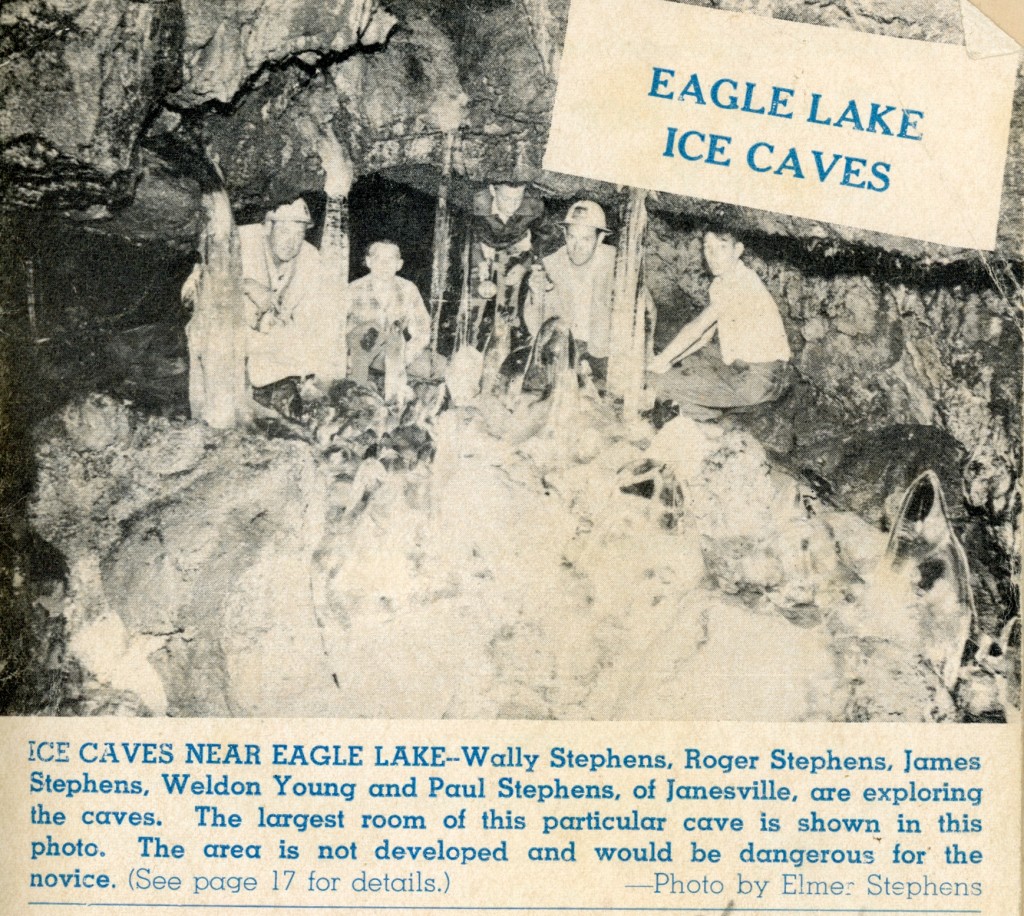
The ice caves was featured on the cover of Susanville’s weekly TV guide, August, 1965

Well, it is the middle of summer, and there have been a lot of searches about the ice caves at Eagle Lake. Without further ado, here is a prior post on that topic for your Tuesday Tidbit.

Exploring lava beds, which there is plenty around Northeastern California, there is no telling what a person might find. The Brockman Flat Lava Beds on the west side of Eagle Lake is no exception.

In the early 1950s the Chico State Biological field study set up operations at Spaulding Tract, Eagle Lake. It was in the summer of 1951, that several students explored the lava beds to the south of Spauldings and made their initial discovery of a ice/lava cave.

In 1954, John Wesley Noble penned an article in Collier’s Magazine, The Lake That Time Forgot. The article featured many peculiarities found at Eagle Lake. Noble wrote: A group of Chico graduate students were exploring a huge shore side cavern where Indian tribes hid from avenging white men. Suddenly the biologists’ flashlights flickered on a buff colored insect crawling over the icy black rocks. They captured it, but neither their biology professor nor local 0ld-timers could tell what it is.
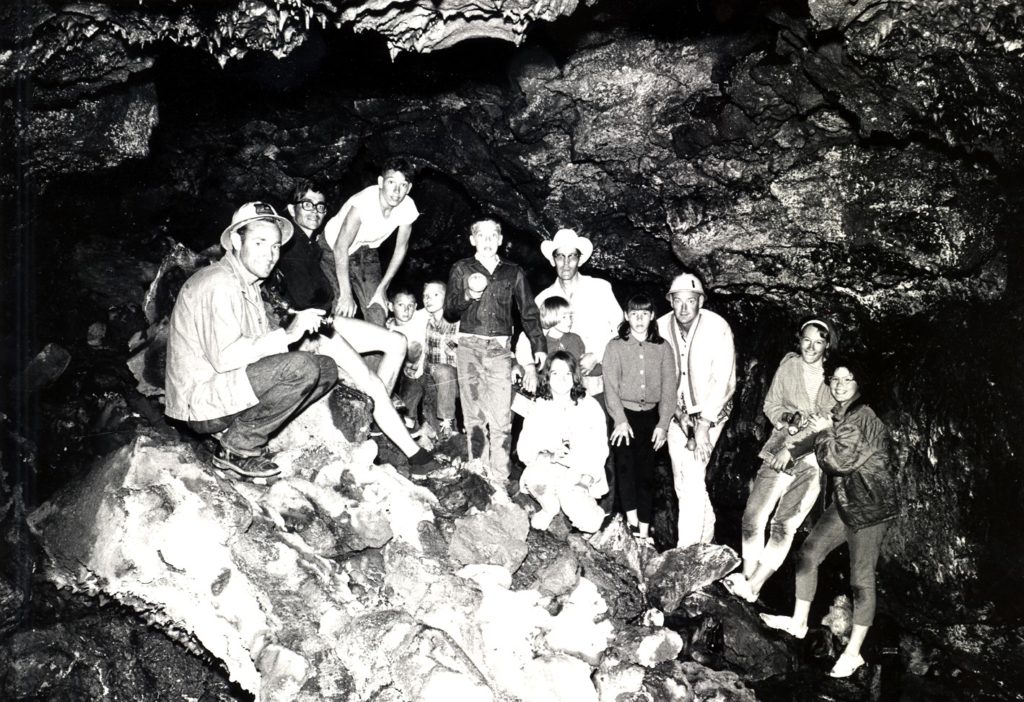
Interior view of an Eagle Lake ice cave, 1966.

“Weeks of research finally identified the insect a member of gryllobottoda, a rare ice age cricket-cockroach which lived in America when Pleistocene ice sheets covered more than half the continent. No one seems to know what the insects eat in the icy dark caverns. They should have been sensible and departed when the glaciers receded 20,000 years ago. But here they are, living their refrigerated lives in the caves near the lake.”

Tim
It Is Lassen County Fair Week

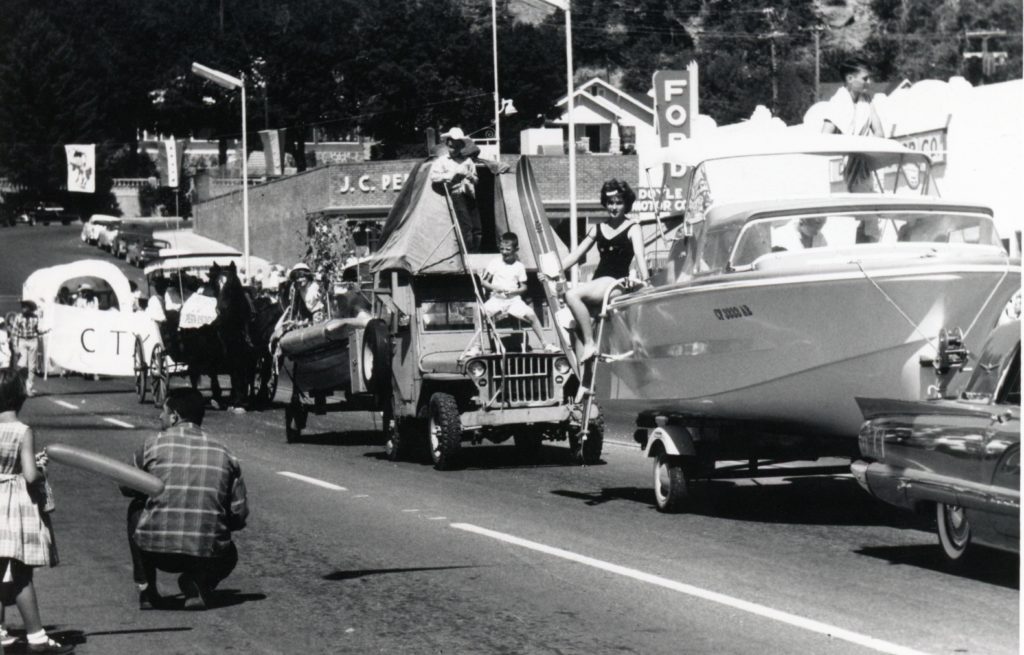
Lassen County Fair Parade, 1965

Quite honestly, I have never been a fan of the county fair when it was moved to the third week in July.  When the annual county fair was established in 1922, it was held in late September. By the 1930s, the date was moved up closer to Labor Day Weekend. After World War II, changes were on the horizon. Neighboring counties worked in a concerted effort on scheduling. Thus, Plumas County would hold their fair the second week in August, the third week would be Lassen and the fourth week would be Modoc. Plumas and Modoc still hold onto their traditional dates. Alas, due to non-agricultural influences, Lassen moved to the third week in July to appease those folks. While I am civic minded and support many events by attending, the annual fair has lost its appeal for me.  And that is my two cents worth.

Tim

Those Summer Cloudbursts

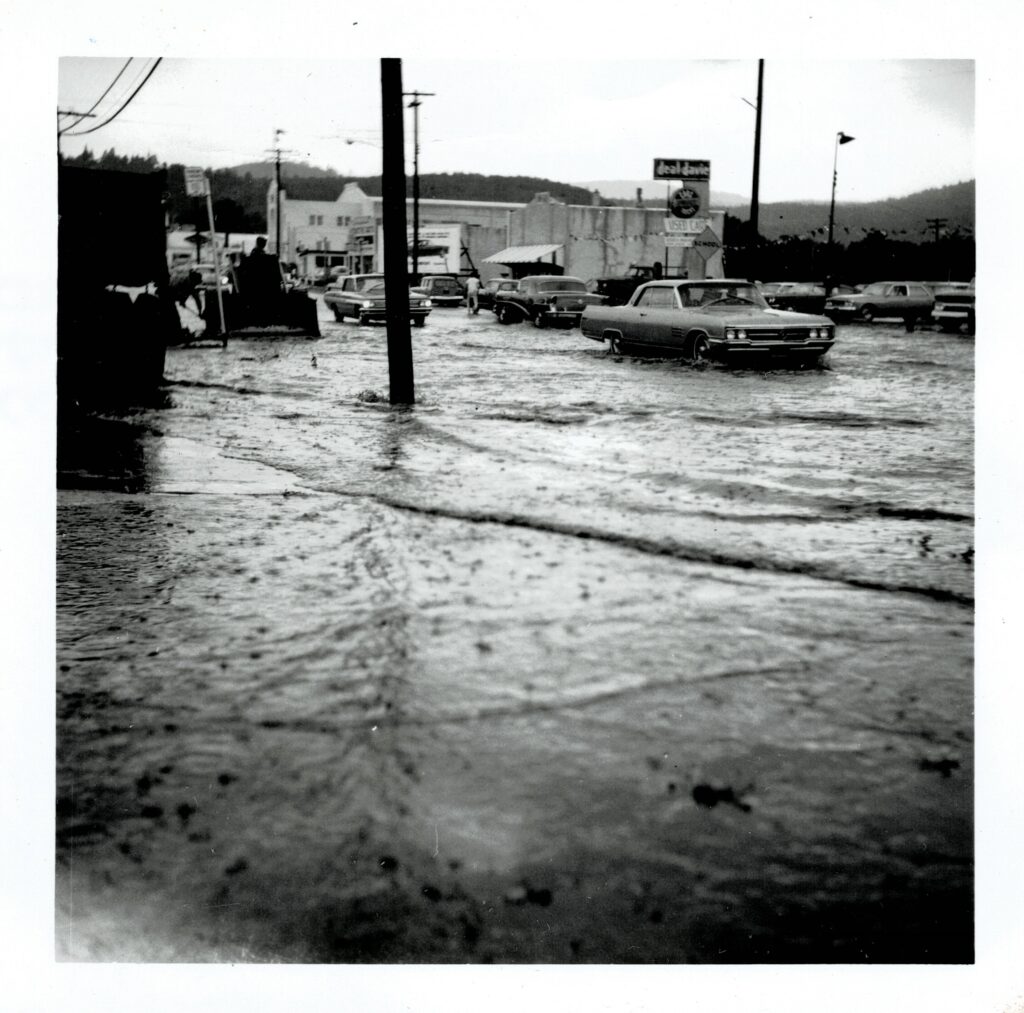
Main Street near Grand Avenue, Susanville, July 16, 1963—Calvin Farris

Some years these cloudbursts are more frequent than others, just like every winter is different. A particular cloudburst of July 16, 1963 was recorded by Susanville resident George Farris. On that afternoon, as Farris duly noted three inches of rain fell upon Susanville in a one hour period. Thankfully, George was a good record keeper. Up until 1969, weather records were duly noted, high, low and precipitation at the Lassen County Courthouse. When George’s son, Calvin, sent me the scanned photograph, I went to those weather county weather logs, only to find that whoever was on duty to record the same, there was a two week gap. However, on July 28, 1963, the Lassen Advocate newspaper reported George’s findings and published the above photogaph.

Tim

Ask Tim

Hartson Barn, Tanner Ranch, Honey Lake Valley, July 26, 2019

On a quarterly basis, I ask you the reader, if there is something you would like to learn more about or maybe its something you heard, but question its validity. So here is an opportunity to participate. I will do my best to answer any questions. It should be noted, it may take awhile for the answer to appear as a post. The primary reason, many of the daily posts are done nearly a month in advance. So by the time you read this I am already working on posts for the middle of August, or at least I should be. Whatever the case may be, I look forward to hearing from you. Of course, it should be noted that paid subscribers requests receive priority. In addition, you can always send a request at any time.

Tim

The Secret Valley CCC Boys and Willow Creek Valley

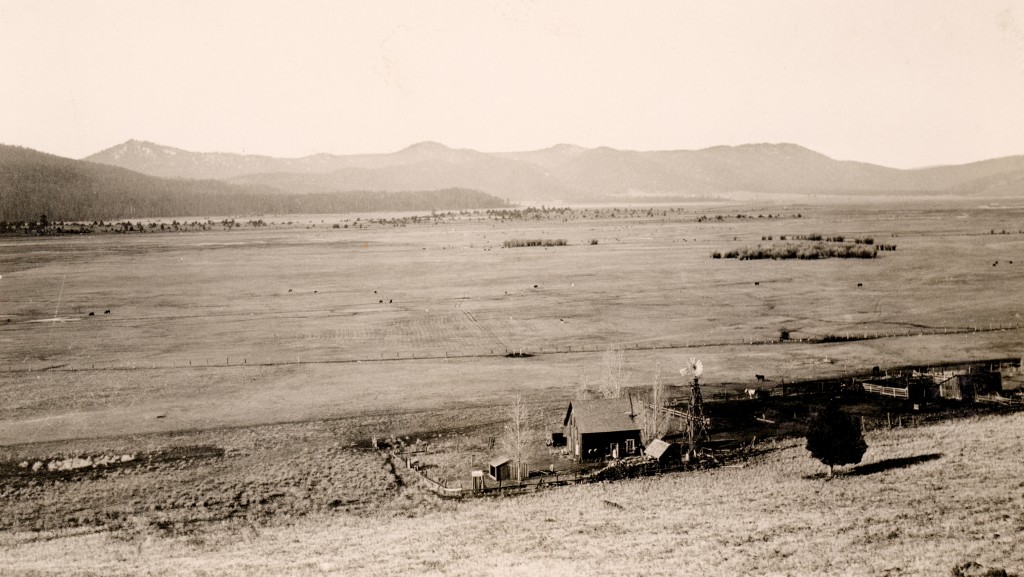
Lower portion of Willow Creek Valley, 1926. Courtesy of Lola L. Tanner

The Civilian Conservation Corp camps generally had a population of roughly 200 men. For some outposts, such as one of Secret Valley, they encompassed a lot of territory. It was not uncommon to establish a seasonal spike camp, comprising between 40-50 men. In In May, 1936, one of these spike camps was located in the Willow Creek Valley, some twelve miles north of Susanville.

This Willow Creek Camp had three main objectives—rebuild the existing telephone line, 20 miles road work and spring development. Work was done on three springs, Hagata, Morgan and Pete’s. They. noted that Hagata Spring had a flow of seven to ten gallons per minute. Of a somewhat interesting footnote, woodpeckers caused great damage to the telephone poles.

Tim

Another Forest Reserve Opinion

A stand of ponderosa pine.

Susanville, was not alone in their opposition of the forest reserves. In November, 1902 T.B. Walker of the Red River Lumber Company had in a few years acquired some 200,000 acres of timberland in Northern California and addressed some of those concerns. Walker stated:  “These lands could be handled to better advantage for the general interest through the agency of private ownership than to have them tied up in the department at Washington. From a general knowledge of the case I am sure that the people of Lassen, Modoc, Plumas, Shasta and Siskiyou counties will regard this reservation move as extremely detrimental to their interests. Private ownership will better protect the timber against destruction by fire, will handle the timber cutting to better advantage to the commonwealth, will make a more continuous or perpetual timber supply, and protect equally as well the water supply and rainfall. There are a few townships and only a few along the Lassen range and in the mountains on the west side of the Sacramento Valley, running perhaps into the upper Trinity mountain country, that might reasonably be put into a forest reserve. Beyond that I think it would be unfortunate to carry out the forest reserve project.”

Support by subscribing.

Susanville’s First Political Stance

Main Street, 1901
South side of the 700 block of Susanville’s Main Street, 1901

In 1891, Congress passed the Forest Reserve Act, the beginning of today’s national forest. It was a slow process to create individual forest reserves and even to change name to national forests.

At the December 29, 1902, the City Council (known as trustees then) meeting they took their first political stance and passed its first resolution, after all the city had only been existence less than two years. At issue was the federal government’s establishment of the Lassen Butte and Diamond Mountain Forest Reserves. The council, as was in the case of many municipalities and counties where large tracts of public timberlands were located, opposed the reserves for fear they would be detrimental in the case of future economic needs. The resolution stated in part: “Whereas the establishment of said Forest Reserves will be fatal to the prosperity of this Town; in that they are calculated: 1, to defer the investment of capital in this vicinity for the manufacture of lumber and other products; 2, to prevent the building of any railroad to connect this place with markets of the county; 3, to cause the surrender of all title lands within their limits to the Government, thereby greatly reducing the assessable property and public revenue there from.” 

Never miss a story, click here.

Tuesday Tidbit – Hudson’s Gas Station

Hudson’s Service Station, 504 Main Street, Susanville, California.

Some one wanted to know if I had a photograph of the gas station located at Main and South Roop Street, Susanville. Well, here it is. I remember it, but it had been closed for a long time. The site is now a vacant lot.

Back in 1950s and 1960s there gas stations galore, then referred to as service stations. Back in the day, at the same time, there were plenty of bars, too.

Tim

A Shaky Experience

Thompson Peak, 1911.
Thompson Peak, 1911. It should be noted that Thompson Peak, and the Diamond Mountain Range is a part of the Honey Lake Fault Zone.

During the 1860s and 1870s earthquakes in the Honey Lake Valley were a common occurrence.  In 1874, Sylvester Daniels arrived from Iowa and spent time with his sister, Polly Parks, who resided just east of Buntingville. He kept a journal of his experiences that he wrote specifically for his daughter, Viroqua and the rest of his family who remained in Iowa. The following is his account of the first earthquake he experienced.

“Sunday, January 24, 1875 – Well, we are all alive yet. Now, I will tell you why I started as I did. You have heard of earthquakes I suppose. Well, I will tell on the sly that there was a live one came along here this morning early about 4 o’clock. It awoke me very suddenly, then such a crash. I thought the house was all breaking to pieces and it seemed to roll  back and forth in bed. At any rate it shook things up pretty lively, while it lasted. But it was not near as long as I have written about. It seemed to roll back and forth and jar terribly. It seemed to pass towards the Mountain from the Valley.

Sylvester Daniels. Courtesy of Jean Gorzell

“The hens flew and cackled and the pigs squealed. Polly Parks said it shook every bottle and everything in the house. She said the cream was disturbed on every pan. So you see there was quite a commotion for a time. All the damage that I have heard of as of yet, is some chimneys are slightly rent and some were frightened. I have not heard anyone express themselves to wish it repeated.  Polly and Elisha Parks say they are not as near as afraid of them as they used to be of thunderstorms and tornadoes in the East.”

Never miss a story, click here to subscribe.

Big Valley Toll Road Company

Big Toll Road
This hand drawn map, was made part of the company’s Articles of Incorporation.

Toll roads in this part of California were never successful enterprises. It did not prevent folks from trying to make it a go. In 1870, when the gold rush to Hayden Hill was in full throttle, it was only a matter of time for some enterprising entrepreneurs to come up with plan to make money on this scenario. In this case it was John Watts, David Watson and Benjamin Neuhaus. On April 24, 1871, they incorporated as the Big Valley Toll Road Company. The road would begin at the Neuhaus ranch (Murrer) in Willow Creek Valley, then north along Eagle Lake, Grasshopper Valley to Hayden City, then to Hayden Hill with a terminus near Adin. These “dreamers” hoped to raise $40,000 in stock to finance their endeavor. While the concept on paper had merit, in reality it was doomed to failure, as it was already an established road. In 1875, the Lassen County Board of Supervisors declared the route as a public thoroughfare. Portions of the original route would eventually become part of State Highway 139.

Subscribe and support this site for as little as five dollars a month.

Exploring Lassen County's Past