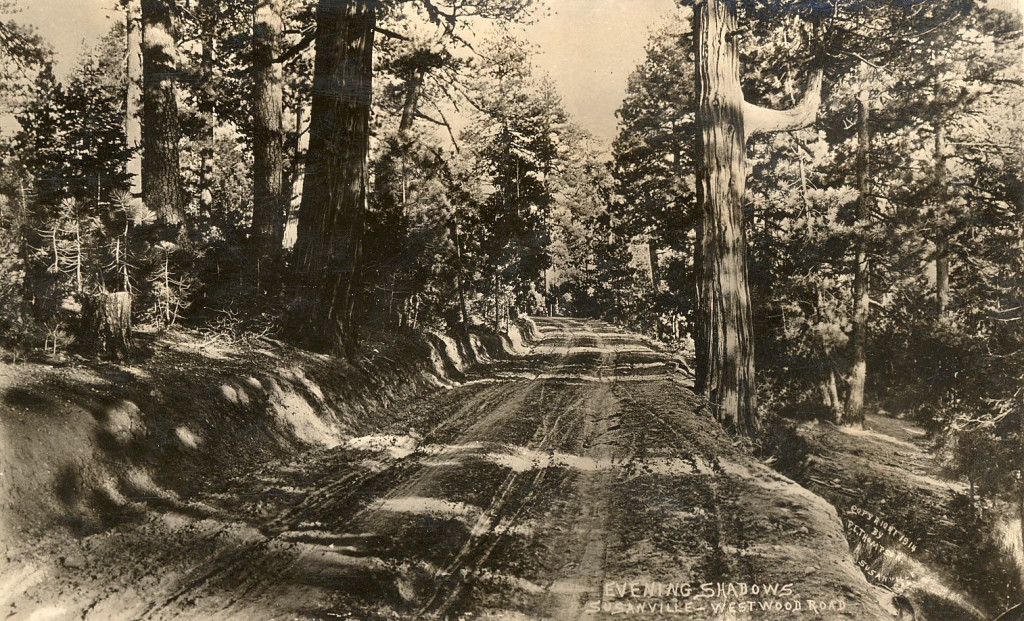
In the spring of 1916, California State Highway Commissioner, H.S. Cromley, announced that convict labor from Folsom State Prison would be used for the initial construction of a state highway between Susanville and Red Bluff. Cromley made it clear the inmate labor was not forced and those who wanted to do such work was voluntarily. In the meantime, Lassen County officials lobbied hard that initial construction be done to connect the communities of Susanville and Westwood. They were successful.
On August 25, 1916, 54 convicts (the term used then) from Folsom State Prison set up a camp just west of Susanville, it being. the site of today’s California Division of Forestry headquarters for the region. When not working the inmates were allowed to roam freely, such as hiking down the canyon to the Susan River to swim. They were, however, prohibited, to go into Susanville.
The inmates worked two eight hour shifts. The main focus was work on the entrance into Susanville, a new survey route would enter the town connecting with South Pine Street, versus the old route of Prattville Road and North Pine Street. One other accomplishment was the survey of a new route over Fredonyer Summit. The camp remained opened longer than usual, due to weather conditions, and shut down on December 15, 1916.
Spread the word, and encourage a friend to subscribe
Awhile ago, Nena McKinzie of Sacramento wrote to inform me as a native of Westwood she was glad to find this website, which I share what she wrote below. It is because of circumstances like this, I do not block access to any portion of the site. When I asked if I could share what she wrote, she replied: “ How nice to hear from you Tim. Of course you can share what I wrote. Thank you so much for your research. I would not have been able to fill in the blanks for my granddaughters without your information. Be well, Nena ”I just found your website and information about Westwood which I am happy to have. I just wanted to thank you for your research. I was born in Westwood in 1934 when my dad went to work there at the Lumbermill during the depression. So at 86 I am trying to gather my life history to write it for my identical twin granddaughters who are 13. I’ve had some health scares in the last few years so it is time for me to finish my life history. At any rate I just wanted to thank you it was nice to find such accurate information. I was born in the little hospital there in Westwood and I always thought it must be a huge place from the photo that my mother put in my baby book. I stopped in Westwood perhaps 30 years ago when I was working in Humboldt and met a few people. They told me the hospital was very small. Thanks for your well written articles and information.”
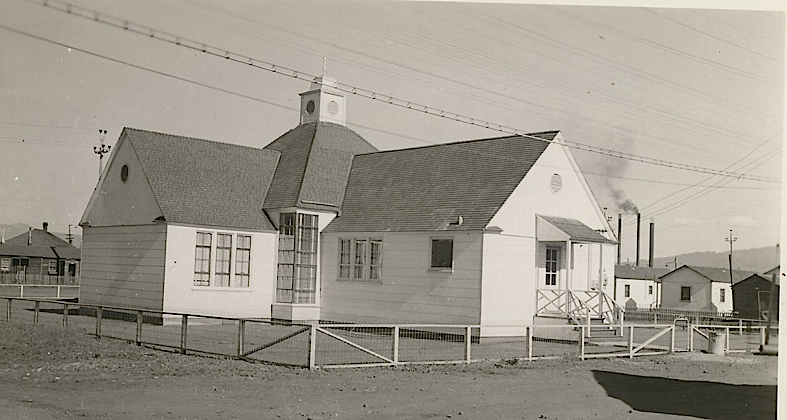
Church of the Latter Day Saints, Westwood, June 14, 1943
Then another reader wrote : My name is Craig Olson. My family lived in Westwood, California in 1953-54. My father was the music teacher at the combined Junior High School/High School and my mother taught first grade at the Fletcher Walker Elementary School. I was six-seven years old.
I am now 73 years old and have terminal cancer. At the request of my children, I am writing a personal history of my life. I noticed some images on the internet that are attributed to your website. I am looking for a way to get permission in to use the two attached images in my personal history. I downloaded them as screenshots. One is of the hospital. The other is the chapel of the Church of Jesus Christ of Latter-day Saints where we worshipped.
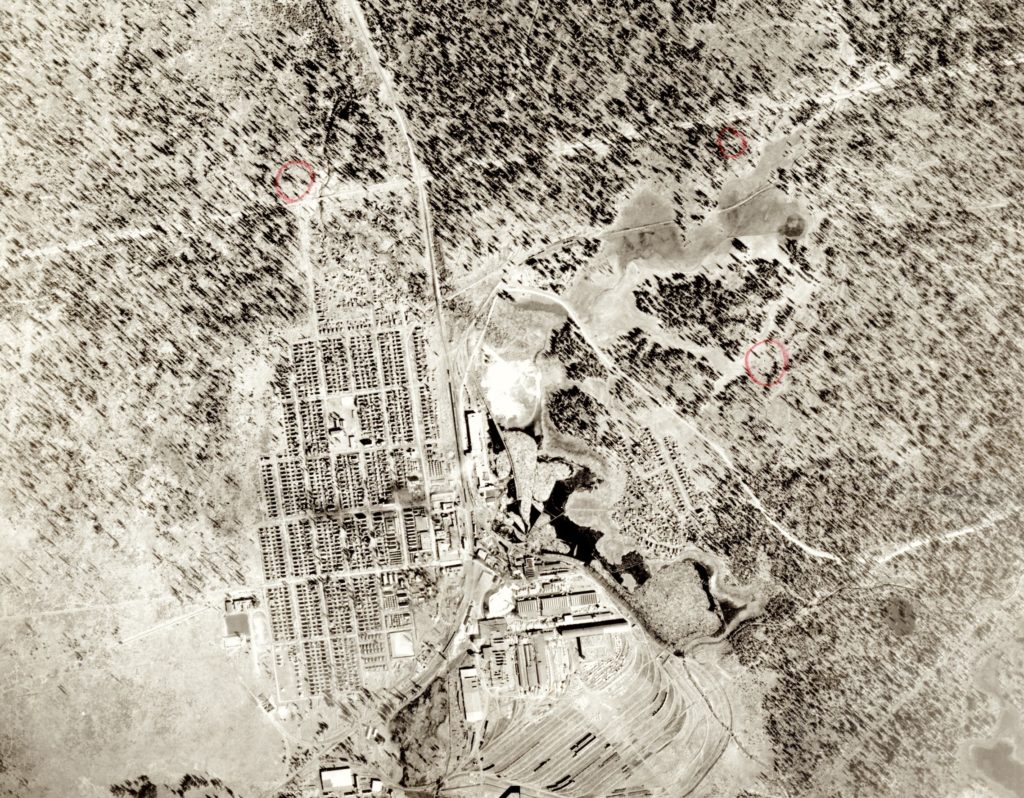
Red River operated numerous logging camps from 1913 through 1944 when it sold to Fruit Growers. The camps were assigned numbers, though in no particular order. The majority of the camps were short lived and only had a span of one to maybe three years. One of the more interesting camps was Camp 33, but referred to as Town Camp, as it was located less than a mile west of Westwood. What made it unique was that Red River’s company town of Westwood would experience from time to time a housing shortage for its employees. On occasion, this camp was used to house mill workers instead of loggers.
Spread the word, and encourage a friend to subscribe.
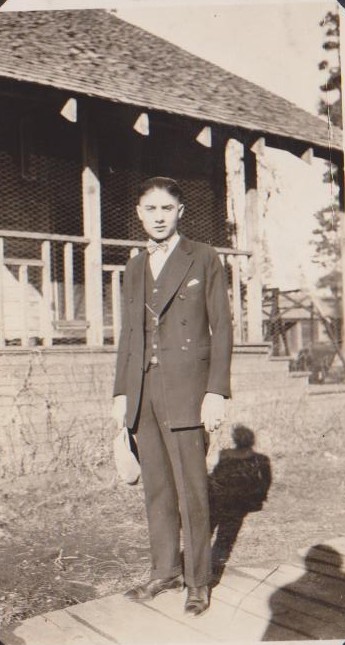
Unknown gentleman in front of the Old Town General Store, circa 1930s. Courtesy of David Zoller.
In 1922, the Red River Lumber Company announced that Westwood was to become a permanent town. Additional investments in community buildings commenced, such as a American Legion Hall and Masonic Hall. Across the log pond was Old Town home to large immigrant population. The residents of Old Town felt left out with no hall of their own. They, too, had their own fraternal organization the Centro Hispano Americano Society and desired to have a place to hold their functions.
In 1926, the residents of Greenville built a modest community hall for $2,100. This inspired the Old Town to do the same. They contacted Fletcher Walker, Red River’s resident manager, with a proposal to build a hall similar to Greenville’s and offered to pay half the costs. Fletcher took the matter of under consideration and on August 20 wrote to His brother, Willis Walker, part of the local management, about the topic: “The Mexicans and wops want a recreation hall similar to the one recently built in Greenville. The Old Town bunch are willing to dig up $1,300 which will cover the labor cost, and they have $1,000 of it in the Bank, if you are willing to build a building on this basis. “The way it stands they cannot take part in the recreations on this side of the Pond as the majority of them do not speak English. A Hall of this sort would make a place for their parties, dances, a Movie occasionally, and a general social center and they have a Fraternal Society organized so they feel competent to police, janitor and generally conduct the building so it will make a better place for them all to live, and as this common labor is quite essential to the Plant as they do work that the short staked Americans will not stay long enough as to become sufficient in it has a commercial value to us that it is hard to measure dollars and cents, but I believe is a good proposition to go ahead with.”
Willis was agreeable and wrote back, “If for amusement only and thus we could do this much to retain men and helps on labor turnover.” Archie Walker who constantly watched Red River’s bottom line wanted to know if they would receive any rent for the building, or were they just donating the use of it? What is rather remarkable while the Walkers quibbled about spending so little money to build this hall, they did not blink an eye when in the previous year they had spent over $100,000 to build and furnish the halls for the American Legion and Masons, as well as the Westwood Theater.
For the residents of Old Town, they were just pleased to learn that their request for a hall was approved. When completed they referred to their hall as the El Centro.
This post nearly slipped through the proverbial crack. Some may recall the initial piece on Red River Facts. Those two articles were done prior to my fall from grace so to speak and and thus some things were sidelined.
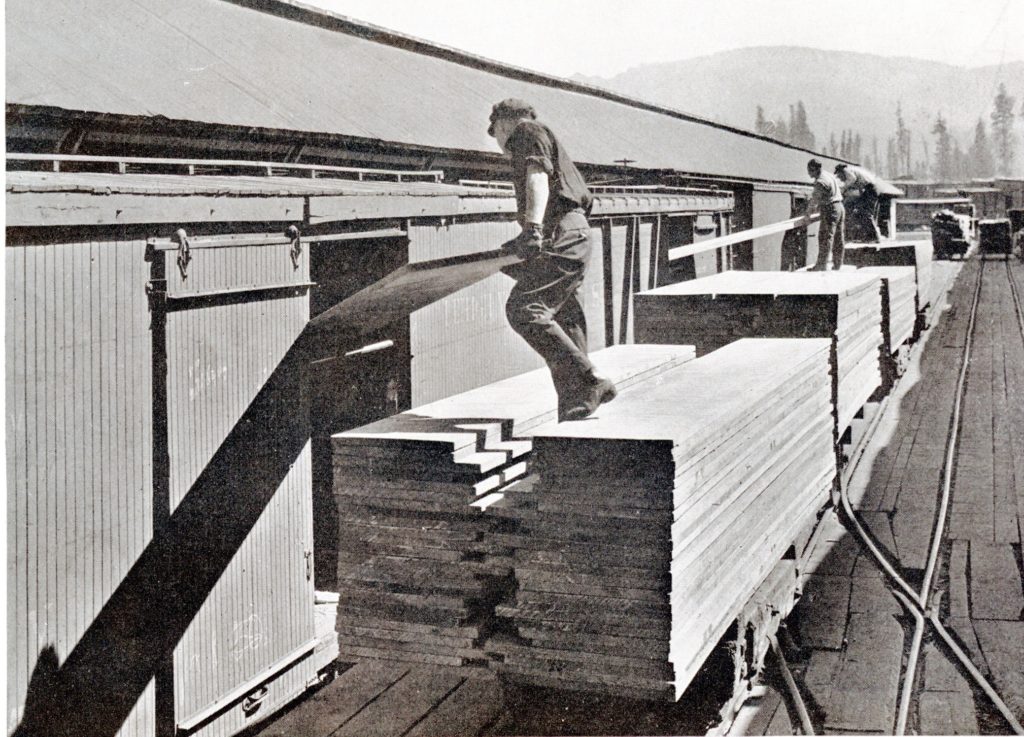
As some may recall, the 1916 publication extolled the many virtues of Red River Lumber Company’s plant at Westwood. In the end not only did it inform the perspective customer that they would receive a superior product at the lowest cost. Satisfaction guaranteed. One statement that caught my attention: “Special items can be cut to order at Westwood with unusual promptness. Even should it be necessary to fell trees and cut logs, every operation from stump to car moves without friction or delay.”
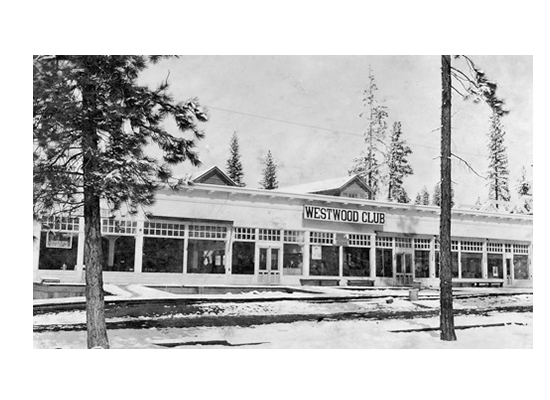
When the Red River Lumber Company established its company town of Westwood in 1913, it had to provide numerous amenities due to its remote location at the time. It was necessary to not only attract employees, but to retain them, as the lumber industry experienced a high turn over rate in labor. The Westwood Club was one of several facilities designed to meet the recreational needs of its employees. It included a restaurant, lunch counter, soda fountain, cigar and newsstand, barbershop, reading room and a billiard room.
On early Friday morning, March 31, 1944 a fire broke out in the Westwood Club though the cause, was never determined. Within twenty minutes the whole building was engulfed in flames. The heat so intense, that Nick Kannier’s automobile which was parked in front of building, burst into flames. Even neighboring buildings from across the street were smoking, on the verge of spontaneous combustion, which with quick action by the fire department prevented the same.
The J.R. Bartlett Company were the concessionaire of the Westwood Club, which included the clubhouse, cafe, pool hall, bar and lounge. There were four other tenants in the building—Ehorn’s Pharmacy, Quitman’s Apparel, Westwood Market and Kilpatric’s Used Furniture department. Estimated loss for all parties was placed at $125,000.
South Lassen Street, Susanville, March 1907 – Courtesy of Gil Morrill
There were several topics in the local news for March 1924. One was a constant raiding of bootleg joints during prohibition. Then, Lassen County issued a quarantine, not for humans, but livestock due to an outbreak of Hoof and Mouth disease in other parts of the State.
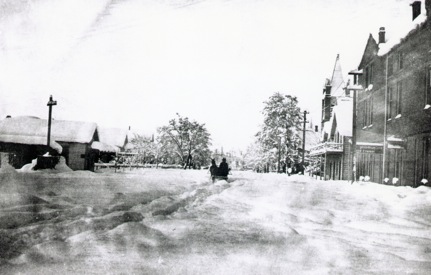
It was on March 24, 1924 that a snowstorm dumped 18 inches of snow in Susanville and a similar amount in Westwood. It melted rapidly. Such storms are not uncommon. What made this event remarkable, was it was the only storm for the winter of 1923-24, one of the driest since Anglo settlement.
Note: I am not sure what Big Valley received, because a portion of those archives are off site and currently not easy for me to access.
Spread the word, and encourage a friend to subscribe
This article, originally appeared two years ago. However with current coronavirus pandemic, I thought it would be worthwhile to bring, after all for some readers this will be a new material, thus a special Tuesday feature, with an end note not in the original article.
One hundred years ago witnessed the worldwide flu pandemic. It caught many by surprise, and Lassen County, like so many others were not prepared how quickly it spread, nor how deadly it was. In early October 1918 the flu made its presence in the communities of Susanville and Westwood. On October 10, forty-year-old Lassen County Surveyor, Thad McKay, became the first victim. A week later, Dr. F.H. Shanks, Lassen County Health Officer issued a statement that yes, the flu was prominent, but a mild one, and citizens to take the necessary precautions of any health crisis. Everything changed quickly with the death of Stephen F. Watson on October 17, shortly followed by two more members of the Watson family. By early November there were over 300 cases of flu in Susanville, roughly one-third of the town’s population. On November 11, 1918, the City held a special session and ordered the closure of the town’s saloons and other public gathering places. The ban was not lifted until November 20, after a decrease in new flu cases.
It is difficult to determine how many Lassen County residents died from the flu. This is due in part many deaths were not recorded with the Lassen County Recorder. If pressed, I would estimate that nearly 100 deaths occurred in Lassen County that were attributed to the flu during 1918-19.
Westwood, October 13, 1941 —Courtesy of Hank Martinez
This was an exciting era for the residents of Westwood. While the United States had not entered into the global conflicts, the nations economy was in high production to meet the nation’s allies. Lumber was a high priority commodity, and Red River Lumber Company’s operation at Westwood was put into high gear.
The installation of the Hammerhead Crane at Westwood, was one of many improvements to entice buyers.
Red River not only went into a full production mode, the first time since World War I, it went on a major modernization campaign. Not only where there substantial upgrades in all the mill equipment, but its logging department saw major changes as well—among other things its own fleet of logging trucks.
While the casual observer or Westwood resident thought all these improvements was just a sign of prosperity from the recovery of the nation’s Great Depression of the 1930s. Behind the scenes, Red River was busy putting its Westwood operation on the market, to sell, nothing different what a current homeowner does prior to listing their house on the market.
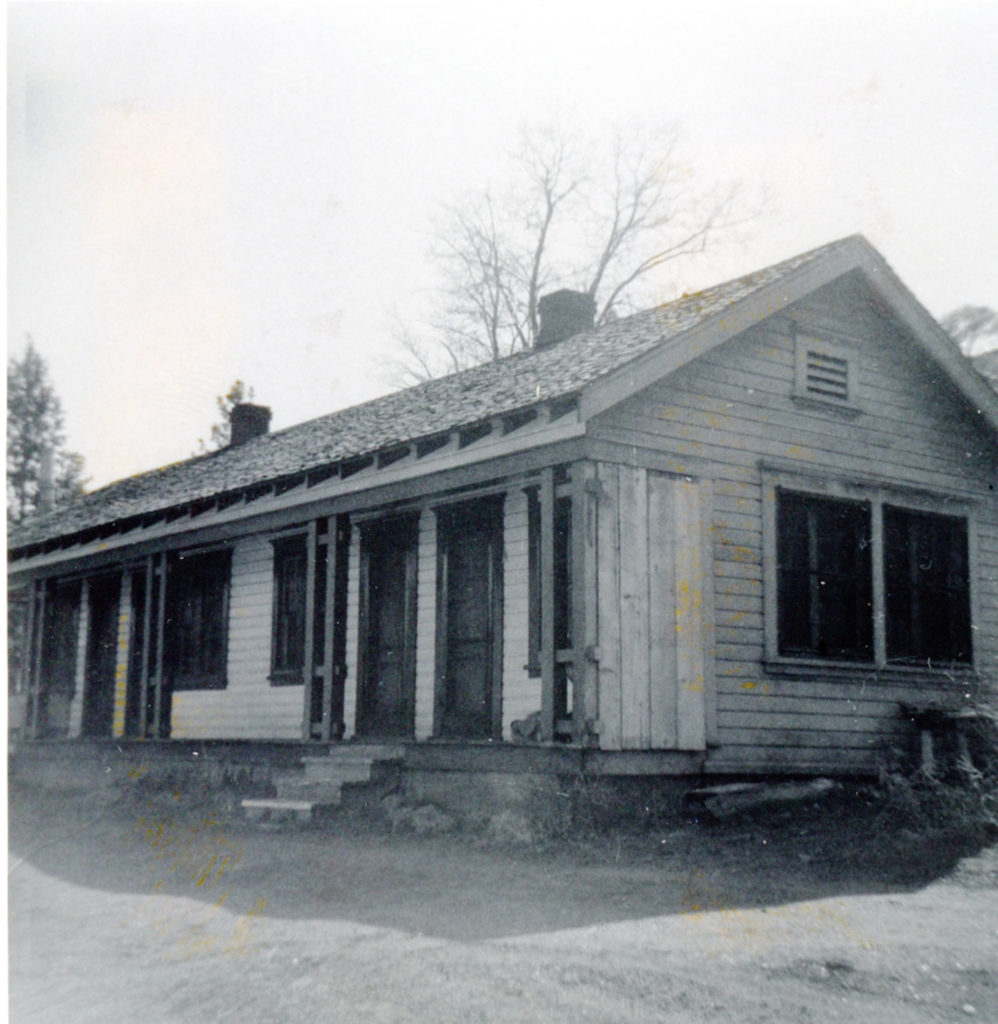
The Westwood Hospital had a small building adjacent to it, that was used to quarantine patients who had highly infectious virus. This was a common practice many years ago to have a small separate facility to quarantine patients. Some of these buildings were a bit sketchy and less than desirable accommodation. This you can easily see with the above illustration of the isolation ward of the Lassen County Hospital in 1947. When the first hospital was built in Lassen County, it was far removed from Susanville proper, so it was not necessary for a separate facility.
Back to the matter at hand. Does any one have, or knows some one who has a photograph of the quarantine building of the Westwood Hospital.