Tag Archives: Susanville

Susanville’s Main Street snow berms

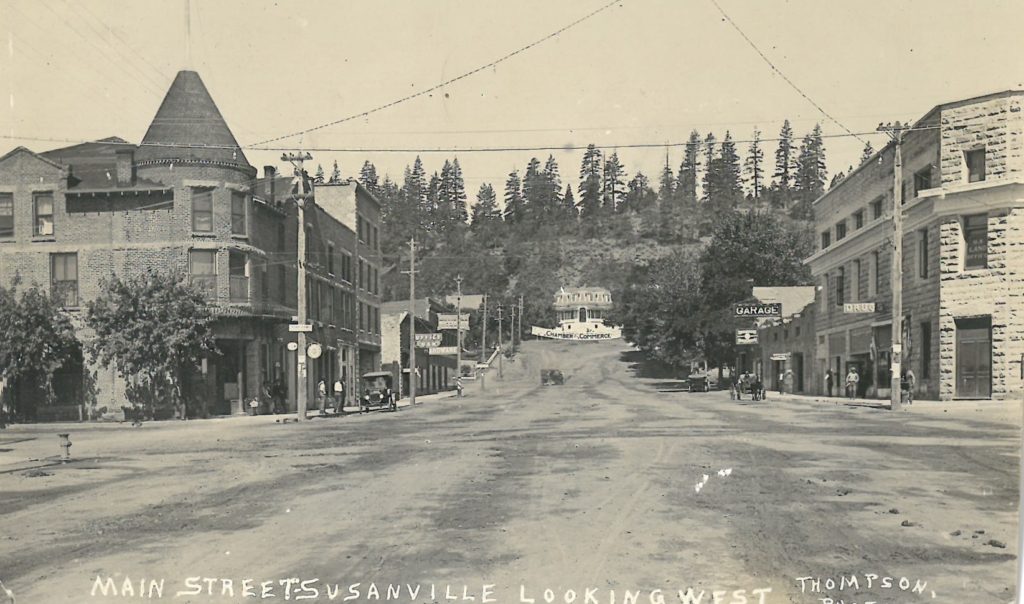
Main Street, Susanville, 1922.

Prior to 1922, there was no snow removal in Susanville. There were several factors at play. One most people were not dependent on an automobile for transportation, there were still an abundant of horse drawn sleighs to navigate any deep snow. On the other hand, Susanville had experienced a major transformation with paved streets, curbs, gutters and sidewalks. This was paid for with a special tax assessment with the property owners, many of whom were not happy with the situation. The citizens demanded some form of snow removal.

The city had a slight problem to comply with the request of its inhabitants—they had no equipment. Luckily, the county road department came to the city’s aid and plowed Main Street pushing the snow to the center of the street. In 1933, the city turned over Main Street to the State Highway Department, who continues with the same snow plowing practices.

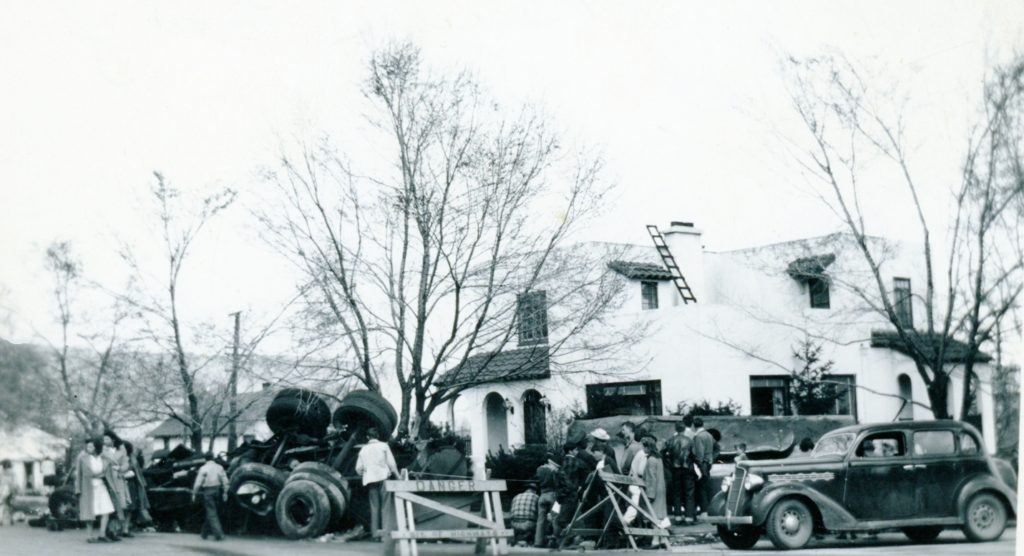
Main Street, Susanville, 1952.

McKinley School

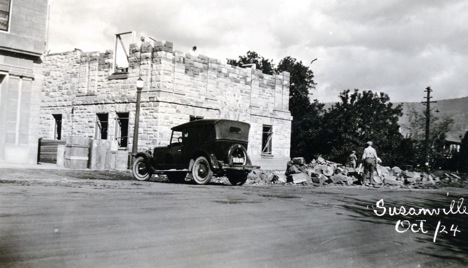
McKinley School, 1924

Most people assume that McKinley School has always been located on Fourth Street, but that was not the case. First a little background history. By 1920 the growth created by the arrival of the railroad and subsequent establishment of the lumber mills was more than Susanville’s one school could handle. That year the voters in the school district were asked to pass an $83,000 bond measure to build a second school. The school district trustees were stymied on the issue of where to build the second school. It was finally decided to build next to the current school. The district bought the Nathan residence on the corner of Cottage and Gay Streets and the house was moved across the street, which is now Elise’s Barbershop. In 1947, the Susanville Grammar now known as Washington was condemned and officials thought it was a matter of time McKinley would suffer the same fate. In 1950 a new McKinley school was built at the Fourth Street location.

Schools
McKinley School (left) and Washington School (right) as seen from Richmond Road, 1935.

Never miss a story, click here to subscribe.

Not a pleasant anniversary

January 7, 2005

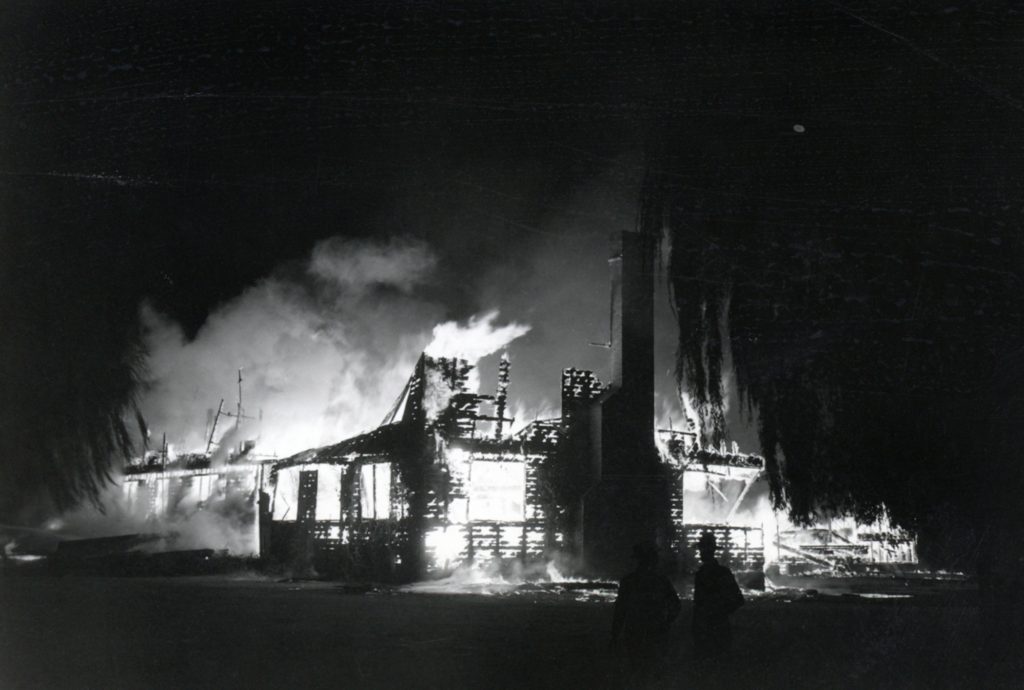
On January 5, 2005, Susanville’s uptown district lost one of its iconic buildings from fire. For seasoned residents, they will know the place as Spalding Drug—where many recall having their first “cherry coke” at the store’s soda fountain. What many people do not know, is that six months prior to the fire, I resided on the second floor of that building. Had I not moved, a large portion of my historical photographic archives would have been destroyed among other priceless documents. Among things in the basement, not being able to retrieve anything is my cross country skis for a future archaeologist to discover.

Subscribe

Roop Street versus Weatherlow Street

North Roop Street, circa 1914. Courtesy of Phil Long

This is just one of those random thoughts to invade my mind during my recovery. It has to do with when a town plat for Susanville that was made in 1863. Roop and Weatherlow Streets need to be reversed. This has to do with logic. Captain William Weatherlow lived at what became the end of North Roop Street. On the other hand, Isaac Roop who laid out the town originally resided on what became North Weatherlow Street.

Never miss a story, click here to subscribe.

Susanville Stone Quarry

The headstone of Daniel Brannan made of rhyolite tuff has not weathered well. Susanville Cemetery, July 26, 2019

Located at the west end of Susanville is Quarry Street, so named for a stone quarry there that was discovered in 1860. The bluff at that part of town, better known as Inspiration Point, is fault block caused by volcanic upheaval. That upheaval created a deposit of rhyolite tuff. This was an ideal material in which was used in many of town’s native stone buildings.

However, during the mid-1860s the rhyolite tuff was used to make headstones. It appears that H.F. Thompson was the only stone mason to make the headstones. Some are quite elaborate such as Capt. William Weatherlow’s monument and others quite modest such as John Anderson. Thompson also made stones that are found in the Janesville and Long Valley cemeteries.

Never miss a story, click here to subscribe.

Four Long Blasts

Riverside Drive, Susanville, December 1955

The City of Susanville, even before it became a municipality, always sought ways to alert the residents of a disaster. In the late 1800s, the most effective means was the ringing of the bell at the Methodist Church. Fast forward to January 19, 1938 at a special meeting of the City Council to devise a new plan when disaster strikes, as what had recently happened with a surprise flood. It was members of the Thomas Tucker Post of the American Legion who sought to address the issue. After some debate, it was decided that four long blasts from the city’s fire siren would be used to alert the citizens of a disaster.

Subscribe

Susanville Safeway Opens, 1928

T.H. Long Building aka The Telephone Building. Courtesy of Phil Long

In the 1920s, Susanville’s retail community was undergoing many changes, due to a number of factors. Slowly creeping in where chain stores, many who thought they were a menace to the community. One of the many concerns with chain stores, that there would be a loss of individuality. Whatever the case may be, there was nothing any one could do to prevent the chain stores encroaching in the community.

It was on December 15, 1928, that Safeway opened a grocery store in Susanville. They found a place readily available in the Telephone Building, located on the northeast corner of Main and Gay Streets. It had recently been vacated by Stones Cash & Carry, another chain grocery store. To manage the store, S.F. Christensen of Carson City took over the reins and T.R. Mitchell from Sacramento was in charge of the meat department. The company made sure that it was duly noted that Skaggs’ Safeway boasted that it had 1500 stores in 15 western states, so they could stock more items than any store in town.

Support

The Good Old Days

Lassen Mail, May 24, 1935

That was good news In 1935, but the city officials of 2019 are dealing with their day of reckoning with a financial meltdown.

During an audit of the city’s finances in 1935, it found that city officials showed fiscal restraint. The city in fiscal year 1933-34 had an income of $47,640.36. At the end of the fiscal year, the city’s total expenditures were $40,359.17. Thus, the city had in reserves a balance of $7,281.19! They city had only three full time employees: W.O. “Lannie” Long, Chief of Police with a monthly salary of $200 per month; Perle Long, Nightwatchman at $150 per month and H.S.Riddell who wore multiple hats as City Clerk, Engineer, Fire Chief and so forth at $150 per month.

Never miss a story, click here to subscribe.

Susanville’s State Cafe

The State Cafe was located on South Gay Street, Susanville.

Seasoned residents of the region may recall this restaurant on South Gay Street. What many may not realize when it opened its doors on July 3, 1936 it was on the corner of Main and Gay. Its first proprietors consisted of E.L. Elskamp, Paul Dedick and Jack Tilton, best known for their bootleg joints during prohibition. In the course of time, the restaurant moved from its prime Main Street location to the rear of the building to be replaced with the State Bar. In the center of the building between the two establishments was a laundromat—all interconnected. One could easily eat, drink and do laundry all at the same time, never leaving the premises.

Excavation of the State Building, next to the Grand Cafe., May 1935. Courtesy of Helen Sargent

Never miss a story, click here to subscribe.

City Pharmacy aka Spalding Drug

Interior of Spalding Drug, circa 1910. Courtesy of George McDow Jr.

Seasoned residents of the area will have fond memories of a one time inconic local instutition, Spalding Drug. It was established in 1865, by Zetus N. Spalding. In the 1890s, his son, John B. Splading took over the business. To give it a more cosmopolitan flair, he renamed it the City Pharmacy. The basic operation remained the same. Members of the Spalding were avid sportsmen and it was reflected in the merchandise they stocked. Not only was there a wide selection of fishing tackle, but guns and ammunition as well. By the time, City Pharmacy moved into its new stone building on the 700 block of Main Street, the name reverted back to Spalding Drug.

Subscribe