Tag Archives: Susanville

The flood of 1952

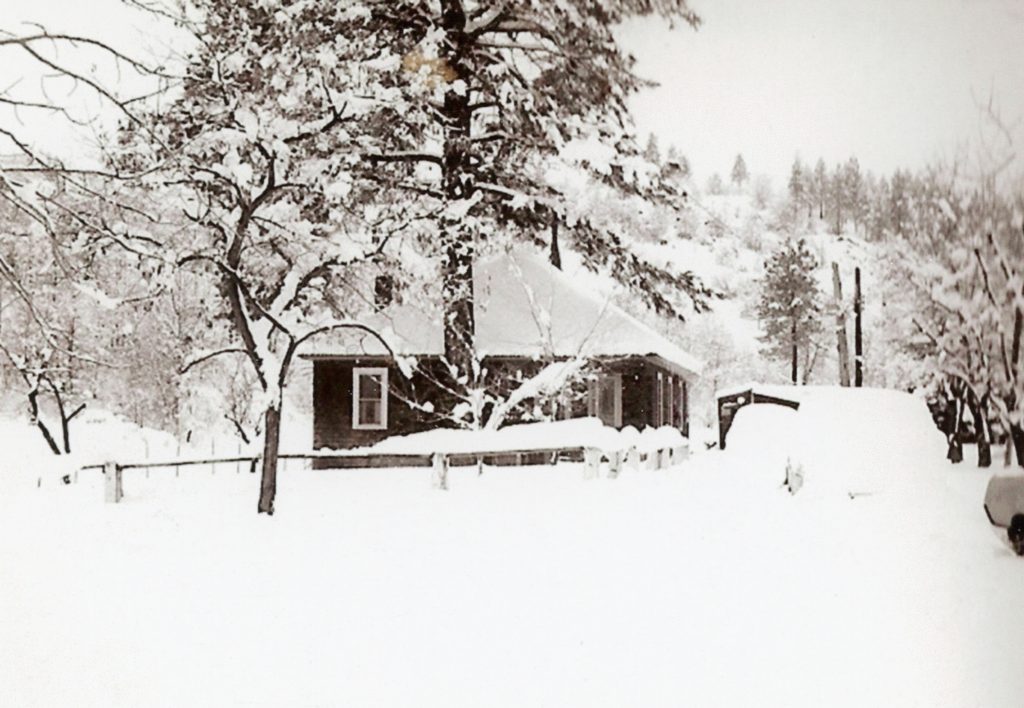
500 South Lassen Street, Susanville, April 5, 1952–Courtesy of the Uptegrove Family

Seasoned residents refer to a January snowstorm in 1952 as the “big snow.” In three days, Susanville was covered with five feet of snow and on the other side of the mountain in Westwood eight feet of snow blanketed the town. With all that precipitation from a single storm, it was far from the wettest year on record.

By late March officials were concerned with the spring run-off. A snow survey taken late that indicated there was eleven feet of snow at Silver Lake with over a fifty percent water content. By the first of April stream flows were quickly rising, especially on Piute Creek. By April 4, that creek was transformed in a raging torrent—Memorial Park now a lake and homes further down on Foss and Cornell Streets received substantial flood damage.

Flooding near Standish, 1952. Courtesy of Betty Barry Deal

Susan River through Susanville caused minor damage, with the exception at the railroad trestle that spanned the river at South Lassen Street, trapped debris backing up flood waters. Downstream was another matter with tributaries to the river increasing water flows causing widespread flooding in the Standish district.

Donate

Riverside Hospital Sold

Construction of Riverside Hospital, 1920. Courtesy of Ed Standard

On July 27, 1944 Dr. George S. Martin made the stunning announcement that he sold the Riverside Hospital located at 2005 River Street, Susanville. He sold it to two Susanville physicians Dr. Clair Burnett and Dr. J.W. Crever for a whopping sum of $825,000. It had been a profitable venture for Martin who came to Susanville in 1920 to establish the hospital. He had a lucrative contract with the Fruit Growers Supply Company to provide its employees with all their medical needs. At the time of the sale, Martin noted that over 12,000 patients had been admitted to the hospital in a twenty-three year span.

Riverside Hospital, courtesy of Betty Barry Deal

Subscribe

Susanville, 1923

MaIn Street, Susanville, 1922

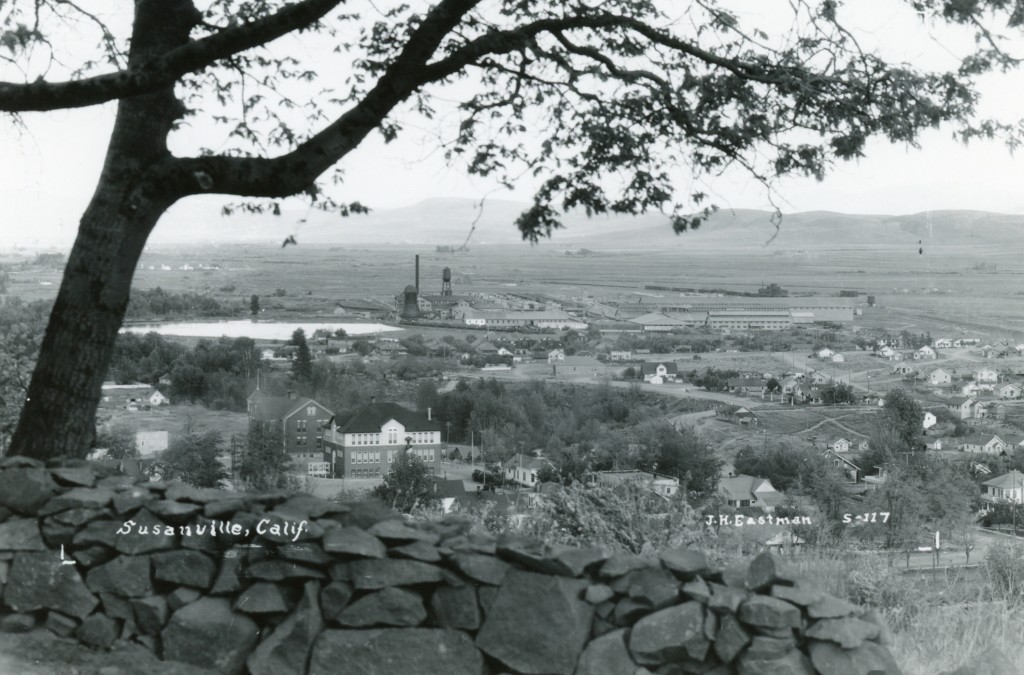
Susanville, the Lassen County seat, is beautifully located at the base of a mountain range where the timber line meets the great expanse of Honey Lake Valley. The Susan River flows down its canyon from the west and through Susanville. Highways enter from four directions and the Southern Pacific railway runs east and west through the town and up the Susan River canyon. The population is 5,000.

The big lumber mills of the Lassen Lumber & Box Company and Fruit Growers Supply Company are located in Susanville employing 2,000 men between them and giving the community a big payroll. Several other smaller industries flourish. The farmers of the Honey Lake Valley and surrounding valleys bring their products to Susanville for sale or shipment and buy their merchandise.

The town has two miles of paved streets and other improvements that would be a credit to communities three times the size. There is an electric light system furnishing cheap power and the water system takes it water from a large spring several miles from Susanville in the mountains. A modern sewage disposal plant as just been built by the city to replace the old method of draining into the river.

Susanville has an excellent high school, three grammar schools, county library, five churches and several active fraternal groups and societies.

The above material was from a Lassen County Chamber of Commerce brochure.

Never miss a story, click here to subscribe.

Model Laundry—The Wife Saving Station

Model Laundry’s Certificate of Co-Partnerhsip

My how times have changed. Take for instance this 1923 advertisement for Susanville’s Model Laundry:

“Men do all the washing at this Laundry. No woman could do the job. We would not let them. They’d break down in a hurry. The work is too hard—too heavy—too continuous—too tiresome. Sheets, bed spreads, pillow cases, so on, that weigh only a couple of pounds when dry come out of the tub ten times heavier and it takes a pretty husky woman to pull loads like this back and forth. Let Men and Machines do the RUBBING and SCRUBBING.”

435 Roop Street and the remains of Model Laundry., September 3, 2018

Never miss a story, click here to subscribe.

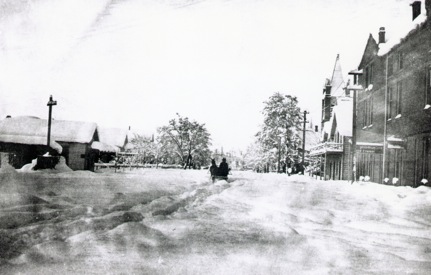
Susanville’s Main Street snow berms

Main Street, Susanville, 1922.

Prior to 1922, there was no snow removal in Susanville. There were several factors at play. One most people were not dependent on an automobile for transportation, there were still an abundant of horse drawn sleighs to navigate any deep snow. On the other hand, Susanville had experienced a major transformation with paved streets, curbs, gutters and sidewalks. This was paid for with a special tax assessment with the property owners, many of whom were not happy with the situation. The citizens demanded some form of snow removal.

The city had a slight problem to comply with the request of its inhabitants—they had no equipment. Luckily, the county road department came to the city’s aid and plowed Main Street pushing the snow to the center of the street. In 1933, the city turned over Main Street to the State Highway Department, who continues with the same snow plowing practices.

Main Street, Susanville, 1952.

McKinley School

McKinley School, 1924

Most people assume that McKinley School has always been located on Fourth Street, but that was not the case. First a little background history. By 1920 the growth created by the arrival of the railroad and subsequent establishment of the lumber mills was more than Susanville’s one school could handle. That year the voters in the school district were asked to pass an $83,000 bond measure to build a second school. The school district trustees were stymied on the issue of where to build the second school. It was finally decided to build next to the current school. The district bought the Nathan residence on the corner of Cottage and Gay Streets and the house was moved across the street, which is now Elise’s Barbershop. In 1947, the Susanville Grammar now known as Washington was condemned and officials thought it was a matter of time McKinley would suffer the same fate. In 1950 a new McKinley school was built at the Fourth Street location.

Schools
McKinley School (left) and Washington School (right) as seen from Richmond Road, 1935.

Never miss a story, click here to subscribe.

Not a pleasant anniversary

January 7, 2005

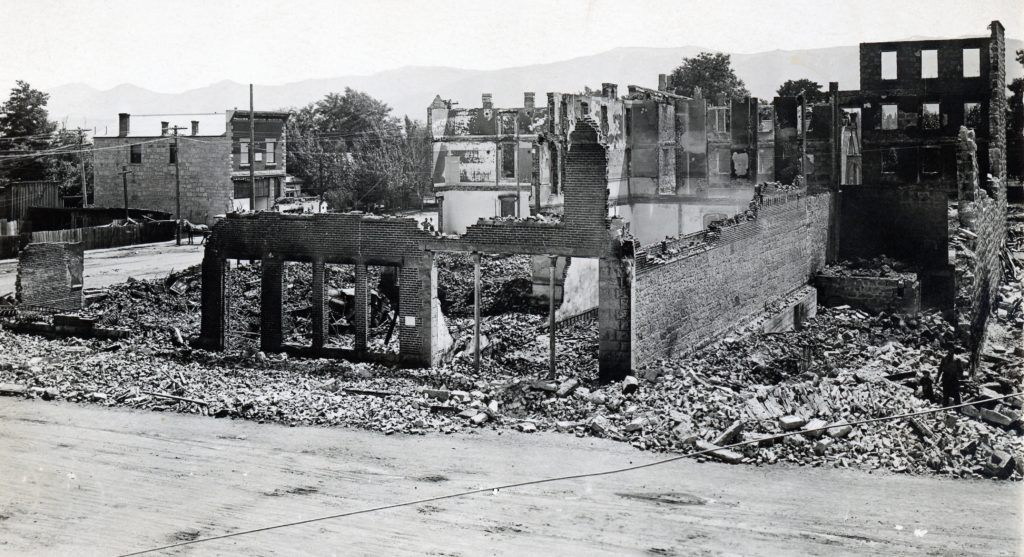
On January 5, 2005, Susanville’s uptown district lost one of its iconic buildings from fire. For seasoned residents, they will know the place as Spalding Drug—where many recall having their first “cherry coke” at the store’s soda fountain. What many people do not know, is that six months prior to the fire, I resided on the second floor of that building. Had I not moved, a large portion of my historical photographic archives would have been destroyed among other priceless documents. Among things in the basement, not being able to retrieve anything is my cross country skis for a future archaeologist to discover.

Subscribe

Roop Street versus Weatherlow Street

North Roop Street, circa 1914. Courtesy of Phil Long

This is just one of those random thoughts to invade my mind during my recovery. It has to do with when a town plat for Susanville that was made in 1863. Roop and Weatherlow Streets need to be reversed. This has to do with logic. Captain William Weatherlow lived at what became the end of North Roop Street. On the other hand, Isaac Roop who laid out the town originally resided on what became North Weatherlow Street.

Never miss a story, click here to subscribe.

Susanville Stone Quarry

The headstone of Daniel Brannan made of rhyolite tuff has not weathered well. Susanville Cemetery, July 26, 2019

Located at the west end of Susanville is Quarry Street, so named for a stone quarry there that was discovered in 1860. The bluff at that part of town, better known as Inspiration Point, is fault block caused by volcanic upheaval. That upheaval created a deposit of rhyolite tuff. This was an ideal material in which was used in many of town’s native stone buildings.

However, during the mid-1860s the rhyolite tuff was used to make headstones. It appears that H.F. Thompson was the only stone mason to make the headstones. Some are quite elaborate such as Capt. William Weatherlow’s monument and others quite modest such as John Anderson. Thompson also made stones that are found in the Janesville and Long Valley cemeteries.

Never miss a story, click here to subscribe.

Four Long Blasts

Riverside Drive, Susanville, December 1955

The City of Susanville, even before it became a municipality, always sought ways to alert the residents of a disaster. In the late 1800s, the most effective means was the ringing of the bell at the Methodist Church. Fast forward to January 19, 1938 at a special meeting of the City Council to devise a new plan when disaster strikes, as what had recently happened with a surprise flood. It was members of the Thomas Tucker Post of the American Legion who sought to address the issue. After some debate, it was decided that four long blasts from the city’s fire siren would be used to alert the citizens of a disaster.

Subscribe