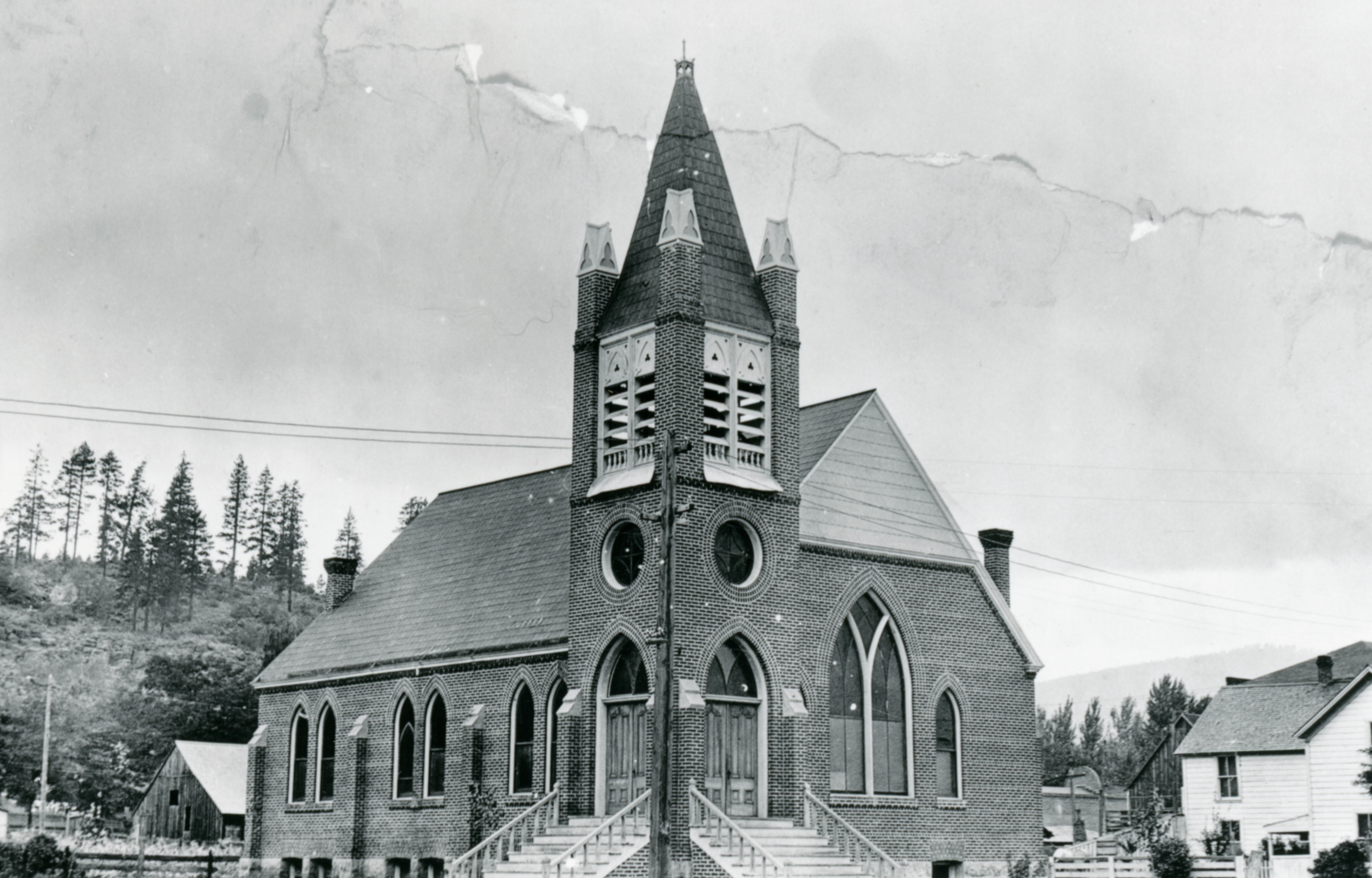
It being Easter Sunday, I thought it would only be appropriate to provide some of the history of religion in our region. The Methodist Church had a profound influence on the Honey Lake Valley. In 1860, this church held their first service in Susanville. By 1905, there were Methodist Churches in Janesville, Johnstonville, Standish and, of course, Susanville, more than any other denomination. Continue reading Easter Sunday→
Granville Pullen first came to Lassen County in 1870 and worked at various jobs. In the 1880s he located to Sonoma County, but made frequent visits to Lassen County to see his sister, Susan Goumaz. In 1901, he moved back to Lassen County and bought a ranch near Janesville. In 1914, at the age of 76, he retired from ranching and bought a house in Janesville.
Pullen had been collecting various artifacts and curios for over forty years. Not to be idle he opened a small museum in Janesville to display his collection after he had sold his ranch. People fascinated by his collection began donating items to him. In 1920, Granville and his wife Mary, moved to Susanville and bought a home on South Roop Street. Next to his new home, he had a small concrete building built to house his museum. On June 18, 1921, he opened the museum to the public. When he passed away in 1926, his wife kept the museum open for awhile, but she did not have the same passion as her husband. Over the years, she donated a portion of the collection to Lassen County. The items were displayed for a number of years in the Veteran’s building, and over time slowly disappeared.
When the trustees of Lassen Union High School made the decision to a build a new school, time was of the essence. Glenn Wemple, who was on the board, informed me that they did not want to make the same mistake as what happened to the Orland High School. These types of school hold a tremendous amount of emotional attachment in their respective community. Orland moved slow and it created a great deal of anger and resentment.
Akol & Associates of San Francisco were hired as the architects for the new school. The estimated cost to construct a new campus on site of the existing was $2,317,410. It would be done in two phases. For Phase One, bids were required to be submitted no later than April 12, 1967. Five bids were received and initially the trustees took no action. A week later, the trustees rejected all bids. New bids were solicited for no later than May 15. On May 16, 1967 the trustees accepted the bid of C&J Construction Company of Reno, Nevada. On Friday afternoon, June 23, 1967 a groundbreaking ceremony was held behind the main school building.
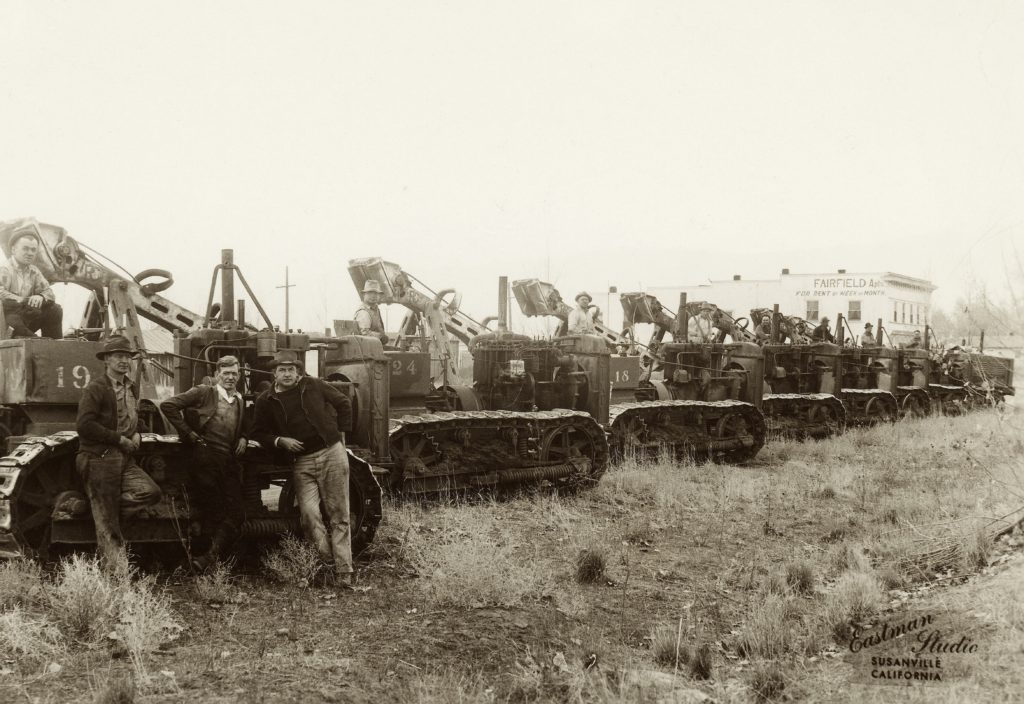
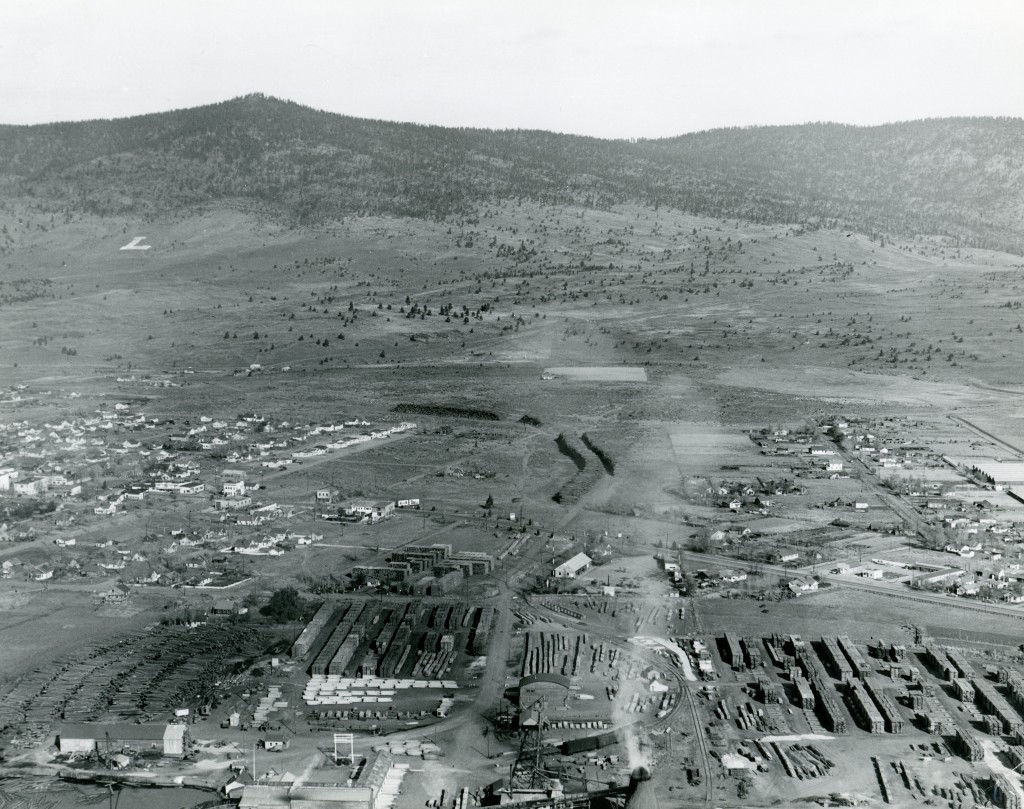
Fruit Growers Supply Company show casing their latest Caterpillar tractors, with the Fairfield Apartments in the background.
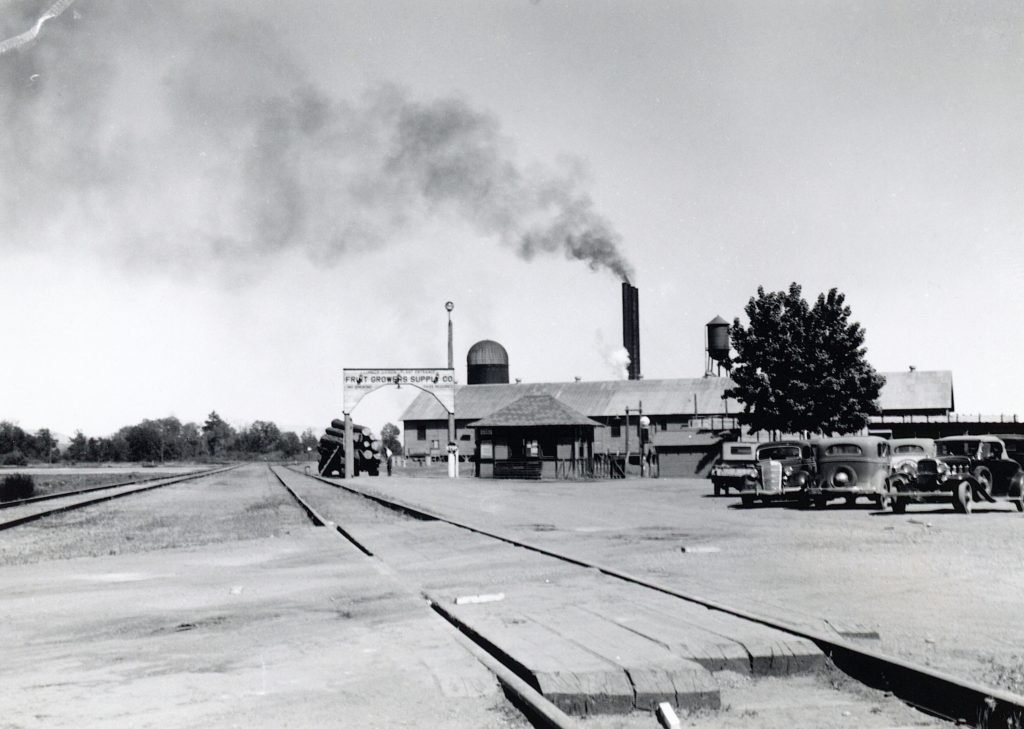
When the two large lumber mills were established it created a housing shortage. While both Fruit Growers and Lassen Lumber did construct some residential housing and apartments, there was still a need for more. There was one group in particular that needed some form of housing—loggers. Many of these men were single, so there was building boom for apartments and boarding houses.
Constructed in 1922, the Fairfield Apartments (aptly named it was located on South Fairfield Street) was one of the largest. It initially contained twenty-two rooms. It was destroyed by fire on July 29, 1941. While it was fully occupied, every escaped without injury. The building valued at $20,000 was only partially insured at $6,000.
In 1955, Fruit Growers Supply Company announced its closing of the Westwood mill. Over the hill in Susanville, many pondered when Fruit Growers might do the same there. The Susanville mill would receive a brief reprieve.
In 1957 six paper companies were interested in Fruit Growers cutover lands in Lassen County. While California ranked second in the nation for lumber production, there was only one paper/pulp plant in the state. Fruit Growers had debated at one time to convert the Susanville mill into such a facility, but it was just not going to happen.
On November 7, 1962 the beginning of the end was announced with the closure of the Susanville mill. The woods employees were permanently laid off. The mill would remain in operation until the logs on hand were processed. On May 13, 1963 the last log was sawn. Shortly afterwards the remaining employees terminated and the mill closed. There being no buyers it appeared the mill was destined to be dismantled. It did receive a last minute reprieve with negotiations of Crook & Emmerson, but that is another story. On April 30, 1964, Homer Vincent closed Fruit Growers” Susanville office.
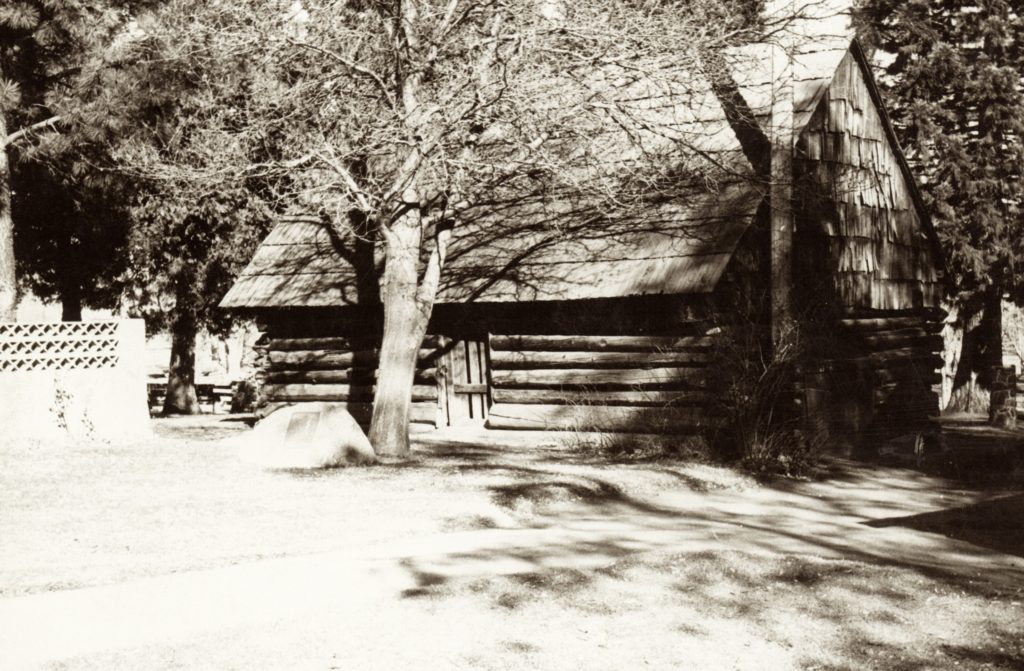
This Susanville landmark, which is more a less a replica of the original structure built by the Roop Brothers in 1854 was never intended to be a fortress. Its purpose was that as a trading post along the Nobles Emigrant Trail. It was in 1863, the abandoned trading post was were Honey Lakers barricaded themselves in a conflict with Plumas County officials dubbed the Sagebrush War. That is another story. Thus, the appellation of fort was added to the structure. It has also been known as Fort Defiance.
In May 1974, Northern California Congressman Harold T. (Bizz) Johnson announced that Roop’s Fort and Trading Post had been entered into the National Register of Historic Places.
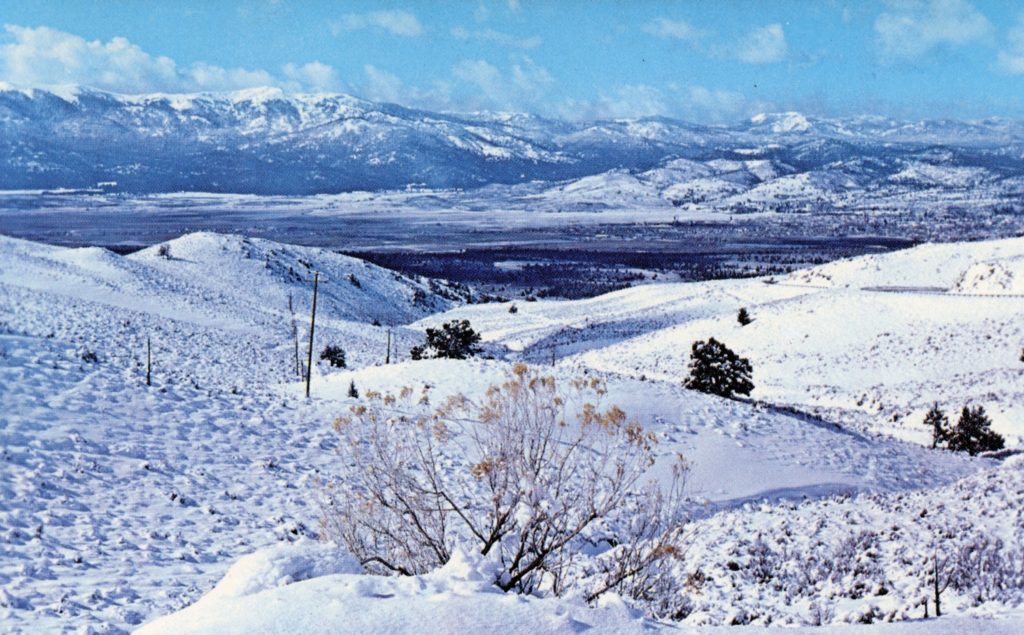
A view of Diamond Mountain from Antelope Grade, January 1975
Exactly who and when mountain was named, is not clear. By the early 1860s it was referred to Diamond Mountain. There are pockets of crystal quartz that can be found along the range, hence “diamond.”
In February 1910, Lassen County historian and retired school teacher, Asa M. Fairfield wanted to name the highest point on Diamond, Mount Roop. It went over like the proverbial “lead balloon.” Fairfield’s quest to have a feature named for Isaac Roop did not end. Fairfield consider Roop the father of Lassen County, while Peter Lassen received all the name recognition.
In 1921, Fairfield petitioned the United States Board of Geographical Names to rename Worley Mountain, to the west of Susanville. In 1922, the Board agreed and changed the name from Worley to Roop Mountain.
Susanville Peak, 1947. Courtesy of Fred Lendman
Personally, Susanville Peak would have been more fitting to the name designation. In Susanville’s historic core, one cannot see Roop/Worley Mountain. Yet, Susanville Peak is highly visible throughout the community. I still refer to Worley by its given name because when I was growing up that is what everyone referred to it as.
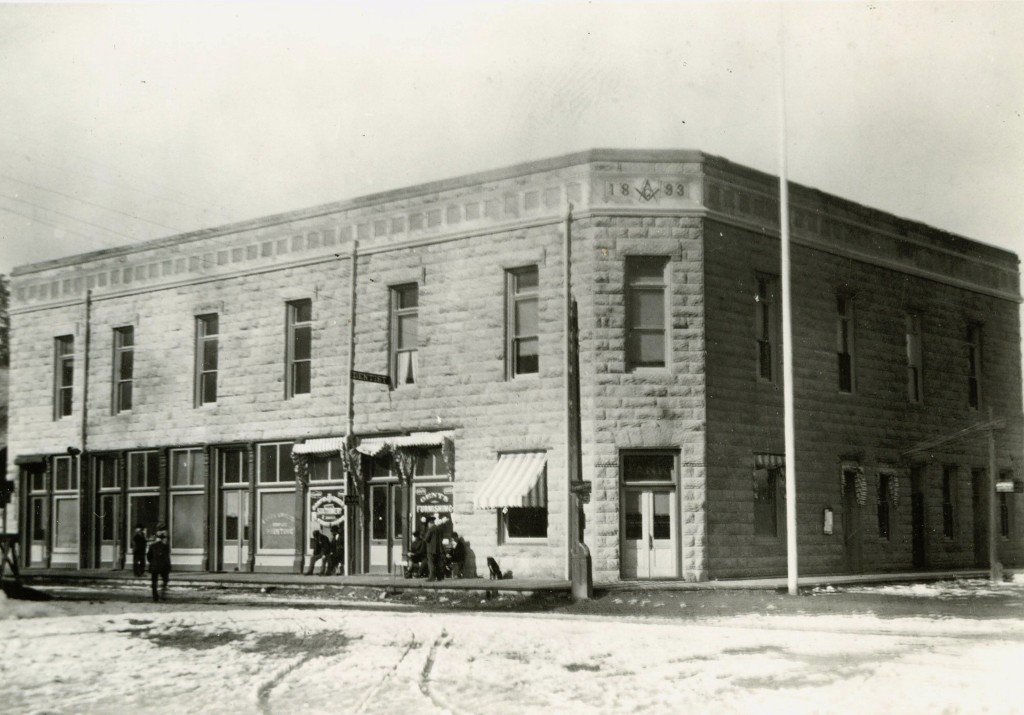
Knoch Building, circa 1900. Courtesy of Philip S. Hall
One of Susanville’s oldest commercial buildings, located at the intersection of Main and North Lassen Streets, has had a wide variety of occupants since it was built in 1893. Among the early occupants was the Susanville Post Office, Bank of Lassen County and the Government Land Office.
Susanville’s Knoch Building.
In 1913 and 1914 two major changes transpired. One was the addition of a third floor. On the Lassen Street side a smaller one story building was constructed to be known as the Knoch Annex.
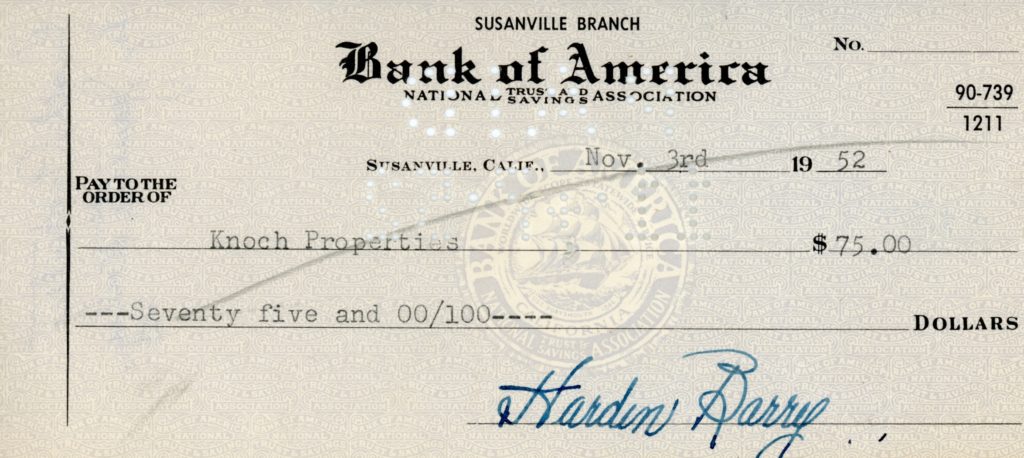
One of the occupants on the second floor of the Knoch, was well known local attorney, Hardin “Finn” Barry. In 1921, Finn passed the California Bar and opened his office in the Knoch. He may have been the longest tenant. Finn remained there at that location until his passing in 1969. Once his office was vacated, another attorney Dawson Arnoldrented that space, only to eventually relinquish it when he closed his practice and went to work full time as Lassen County Counsel.
Finn Barry’s rent check
Of course, it should be noted that on the ground floor was another long term tenant—Fred’s Barber Shop. Fred Borghi’s establishment was an old fashioned barber shop with a loyal clientele who would drop in to visit in between haircuts, to “shoot the breeze.”
Piute Creek at Grand Avenue, April 1938–Betty B. Deal
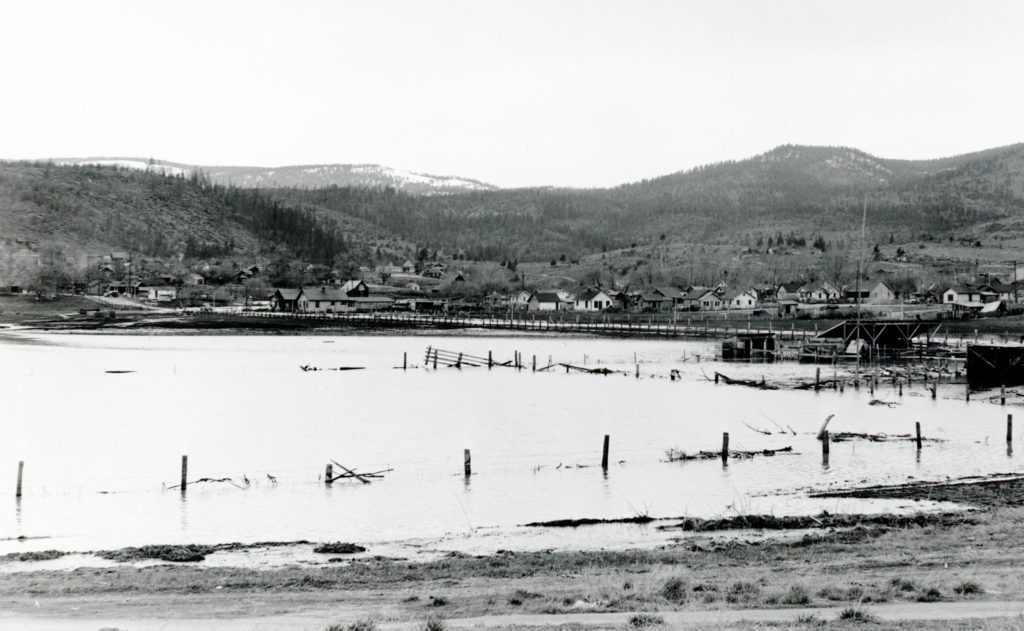
On March 13, 1983, Susanville’s Memorial Park was once again flooded, transforming it into a lake. It was the third consecutive winter in which the event transpired. The perennial flooding of Piute Creek was due to an inadequate culvert under Main Street, which allowed the water to back up and flood the park. It was not until 1998, that the problem was rectified.
The Susanville Coca Cola Plant as it appeared in the 1950s, during the Lassen County Fair Parade. Courtesy of Margaret A. Purdy
Season residents may recall there was a time that Susanville had its very own Coca Cola Plant. The original bottling works was established around 1914 by H.W. “Pop” Wharton. It was located at 906 South Alley between South Weatherlow and Union Streets. The building, painted a chocolate brown, is still there and converted into apartments.
In 1923, Howard L. McMurphy took over the complete operation. It was an interesting and lucrative time to be in soda business with Prohibition. It saw not only the local production of Coca Cola, but a local line of the Mt. Lassen brand of sodas.
Sometime in the late 1920s a new plant was constructed at Main and S. Sacramento Streets. For many the star attraction was the large picture window on Main Street, where people on the street could watch the assembly line of the sodas being bottled.
In 1967, Phyllis McMurphy Beard dissolved the Susanville Coca Cola Plant and the local production of sodas ceased.