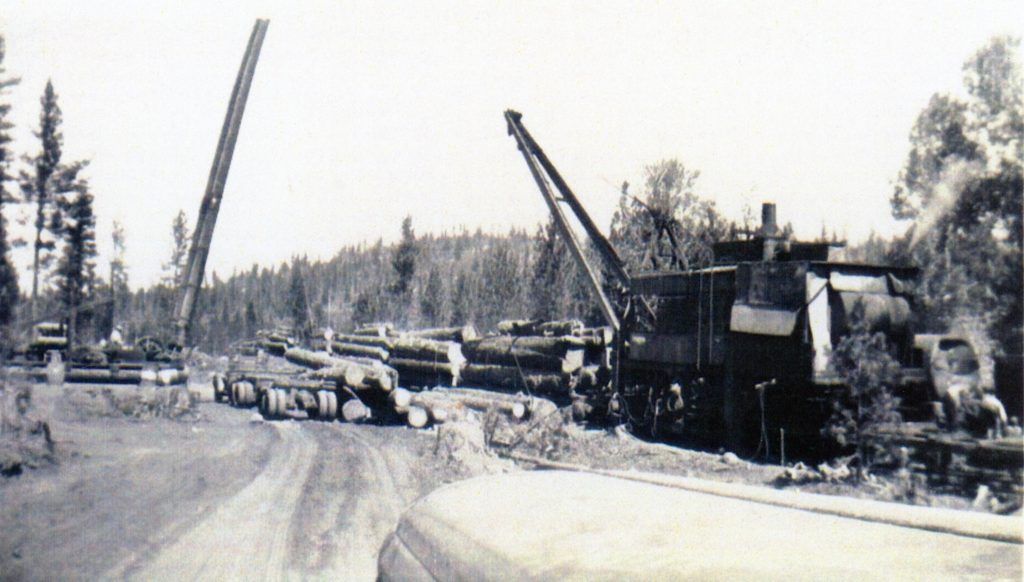
A McGiffert Loader at Camp Poison Lake—Gordon Thelander
This was a short-lived railroad logging camp, located near Poison Lake. It was established in 1944 by the Red River Lumber Company and then taken over by the Fruit Growers Supply Company. There is a scant information about it. Since this was World War II, and the timber industry deemed “essential” coverage by news outlets were censored. In July 1946, the camp at Poison Lake was closed, as well as Camp Bunyan to the north at Halls Flat. The rails from the Poison Lake line were removed to build a twelve-mile extension of the Harvey line that started at Halls Flat and went eastward.
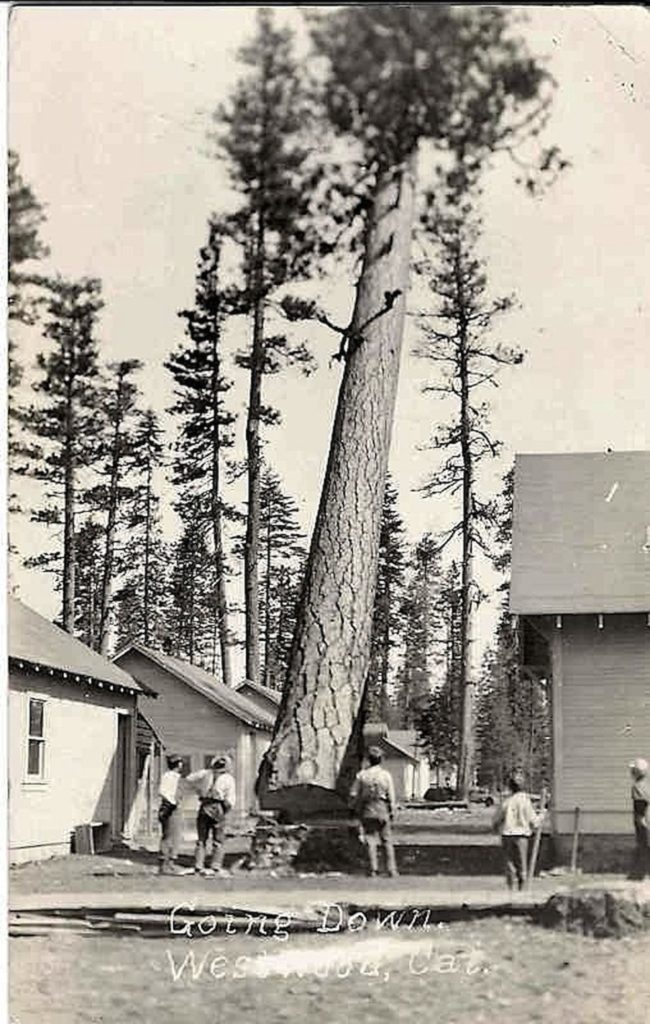
With the initial construction of Westwood in 1913, Fletcher Walker, Red River Lumber Company’s Resident Manager referred to the new community as the “City of Trees”. At that time, an order was issued not cut down any trees than necessary, just enough to clear building sites and streets. As one visitor to Westwood in 1913 noted, “The cottages are being built right among the pine trees, and the only clearance is where the trees have been cut to make way for the streets. The trees are so close together that one can only see a few houses at a time. Hence it is a city among the pines.”
No one was aware that the lofty pines would present a hazard until January 25,1914. The stormy weather began shortly after midnight and from all appearances was no different than any other storm the residents had endured. This all changed shortly before eleven o’clock in the morning. A ferocious windstorm struck the community. The gale force winds, while only lasting about five
minutes, wreaked havoc on Westwood and rattled the nerves of its
inhabitants. Over one hundred lofty pine trees snapped like kindling. One tree crashed on the roof of the cookhouse whose occupants were preparing the noon meal. A ten-room cottage under construction fell victim as well when a tree crashed into it, the force so great it tossed one of the carpenters into a snow bank. Several other cottages were destroyed, but luckily there were no other injuries. At two o’clock in the afternoon the residents gathered en mass at the Opera House to discuss what happened. A committee of three was selected to confer with Red River management to request all standing trees be removed immediately, as they felt threatened by them. So serious was their plea, should the company take no action many would quit and move elsewhere. Red River obliged and next morning removed a number of trees that they deemed posed a hazard.
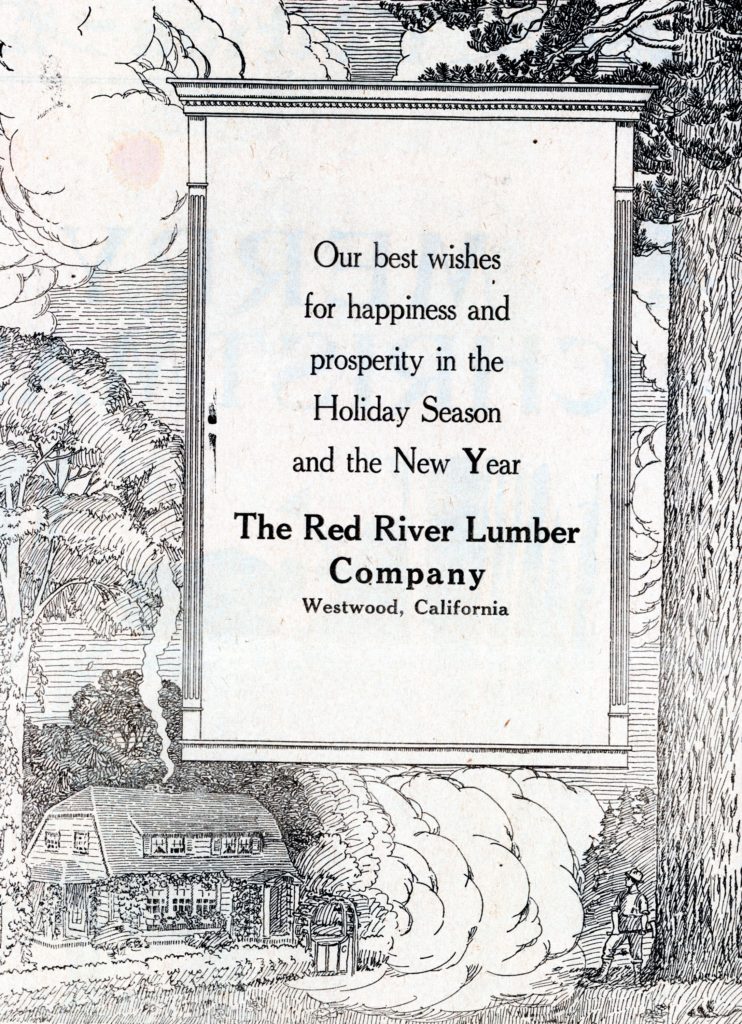
Lassen Mail’s Christmas edition, December 11, 1931.
During the 1920s and early 1930s, Lassen County’s three big lumber mills, Fruit Growers, Lassen Lumber & Box and Red River placed full page advertisements in the local newspapers. These companies were the biggest industries, thus the biggest employers. In addition, the newspapers of that era printed a special Christmas edition—26 pages.
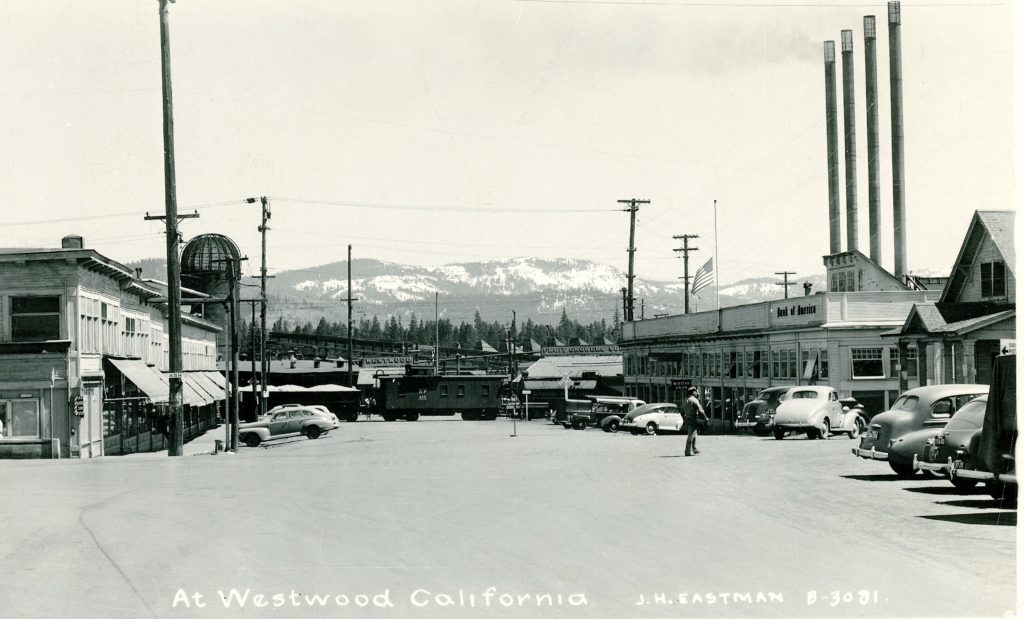
In late November 1940, Susanville painter James Daugherty landed a very big job. Maybe the largest paint job ever in Lassen County. Red River Lumber Company hired him to spruce up downtown Westwood with paint. Company towns were drab affairs and Westwood was no exception. After all in the company’s mind, paint cost money.
Daugherty had the task to the paint the main office building, pearl white; Physicians building ivory and green; fire hall, brown and gray; cafeteria, tea green and the post office as well as the Big Store, buff.
While some Red River officials wanted to paint the residential houses, the majority did not.
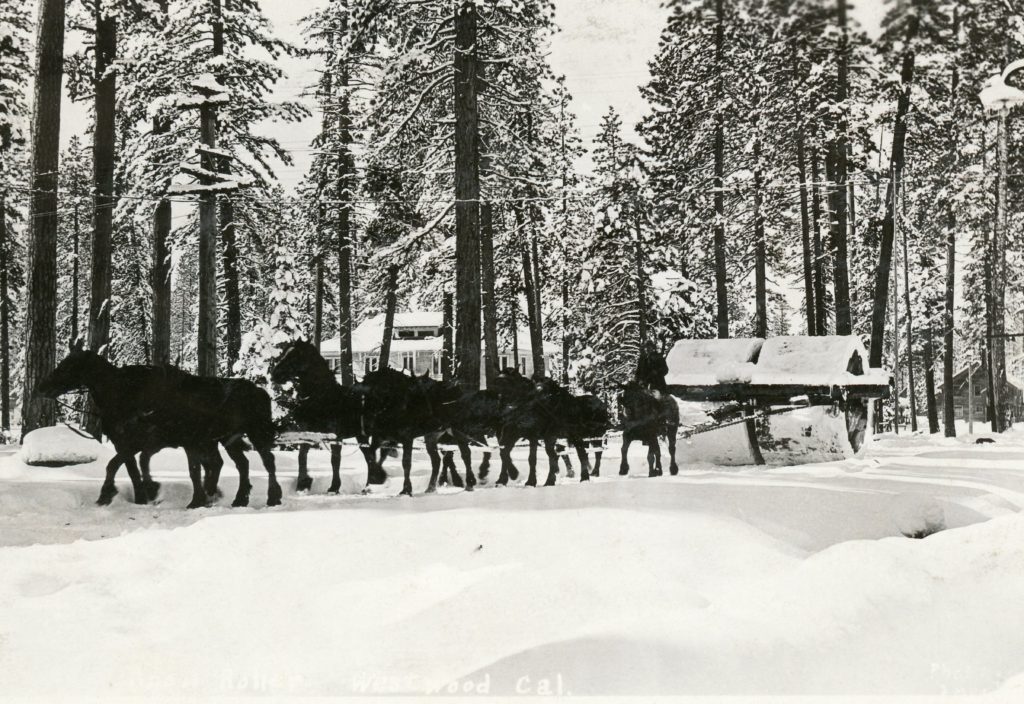
Red River’s snow roller in action. Courtesy of Calvin Sharp
Any weather prognosticators out there? Meteorologically speaking December 1 marks the first day of winter. The winter of 1915-16 was brutal. Snowfall was heavy throughout the region, and it was unusually wet. One storm in January dumped over four feet in Susanville. It was necessary for the Southern Pacific Railroad to bring in a rotary snow plow to keep the rail line open between Susanville and Westwood. In Westwood, Red River came up with a contraption they called a snow roller to compress the snow. Once all the snowstorms subsided in early January, it turned bitter cold with long periods of below zero temperatures. Because of the water content in snow, Red River officials dubbed the condition as “Blue Snow.”
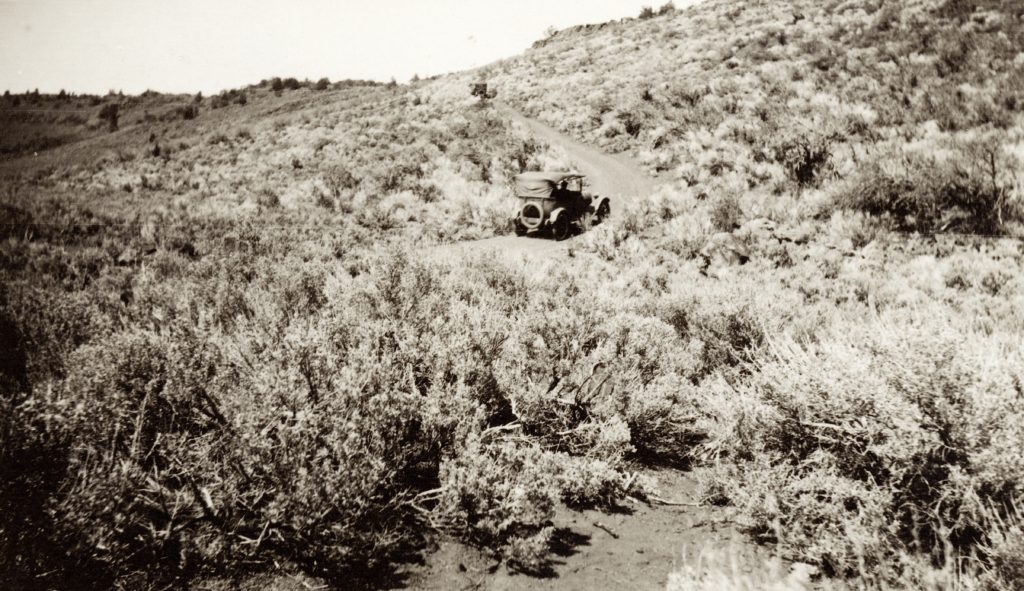
Heartfailure Grade, Eagle Lake, 1921. Courtesy of Lola L. Tanner
By 1920, Westwood residents made up a large segment of visitors to the south shore of Eagle Lake during the summer season. What they desired was the ability to drive to the north shore of the lake. There was a crude wagon road, between the south shore and Spaulding Tract, but it was not in any condition for automobile use.
Enter the Westwood Auto Club. This was an unusual organization created by the Red River Lumber Company. In many ways it served as a de-facto chamber of commerce. The auto club were true to their name in road development and played an important role during the construction of Highway 36.
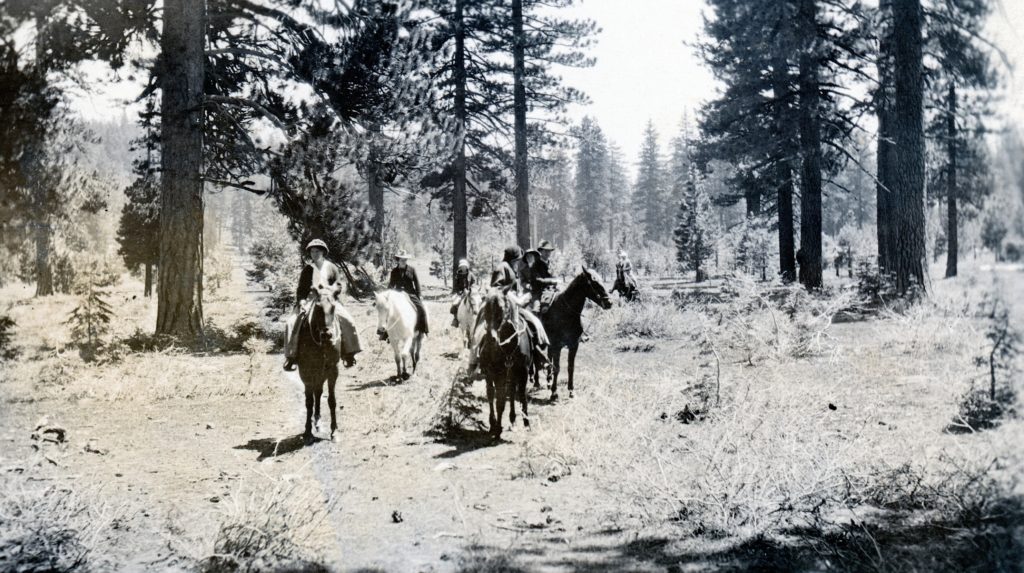
Eagle Lake trail to Gallatin Beach, 1914. Courtesy of Dolores Gasperoni
In the summer of 1921, the Westwood Auto Club led a group of Lassen County and Red River Lumber Company officials on a reconnaissance survey for a road to connect the north and south shores of Eagle Lake. All agreed that the obstacles could be easily overcome, with the only major outlay for a bridge to cross Pine Creek. On the other hand the over all cost would be minimal and Red River would assist with its equipment to make it possible. They all stressed the benefit of people to have access to various features along the lake, and shortly after this outing, work was slowly undertaken. In the 1940s, the road between the south shore and Spaldings was greatly improved when the Paul Bunyan Lumber Company was logging the west side of Eagle Lake.
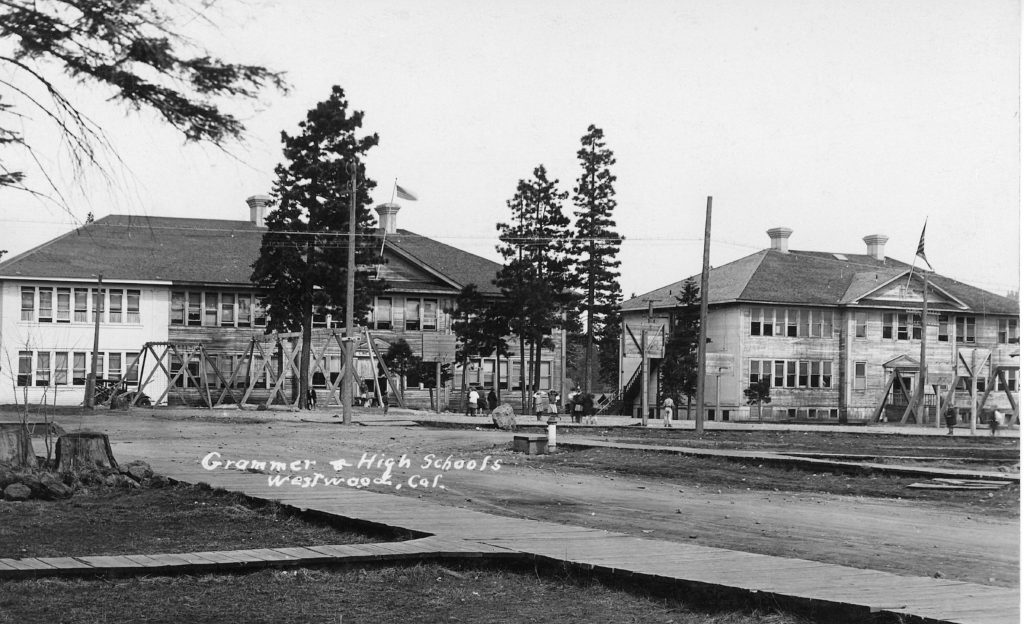
In 1914, Red River Lumber Company opened a private high school, that even included night courses for the benefit of the employees. In the fall of 1916, the high school was converted into a public one with an enrollment of forty students. Initially, the grammar and high school shared the same building, but with increasing enrollments it was determined the high school have a building of its own. In the fall of 1918, a new two-story high school was built adjacent to the grammar school. Dedication of the new high school did not occur until March 8, 1919. Red River paid for the construction of the high school, which normally residents of the school district would have passed a bond measure to do so. However, the State of California paid the teacher’s salaries.
The two largest mills, Fruit Growers and Red River maintained two type of winter log decks. Usually, normal logging operations ceased in November. Yet, to keep the mills operating throughout the winter, required to have a substantial amount of harvested timber. There was the log deck at millpond, and then a second one out in the woods. The latter was not brought into the mill until spring, since the winter mill supply was nearly exhausted. The log decks in the woods provide enough logs during the transition, since it would take some time when the logging camps opened in the spring, to provide a steady supply to the mill.
It should be noted the decked logs in the woods, were protected with heavy snows, thus preventing checking or blue stain.
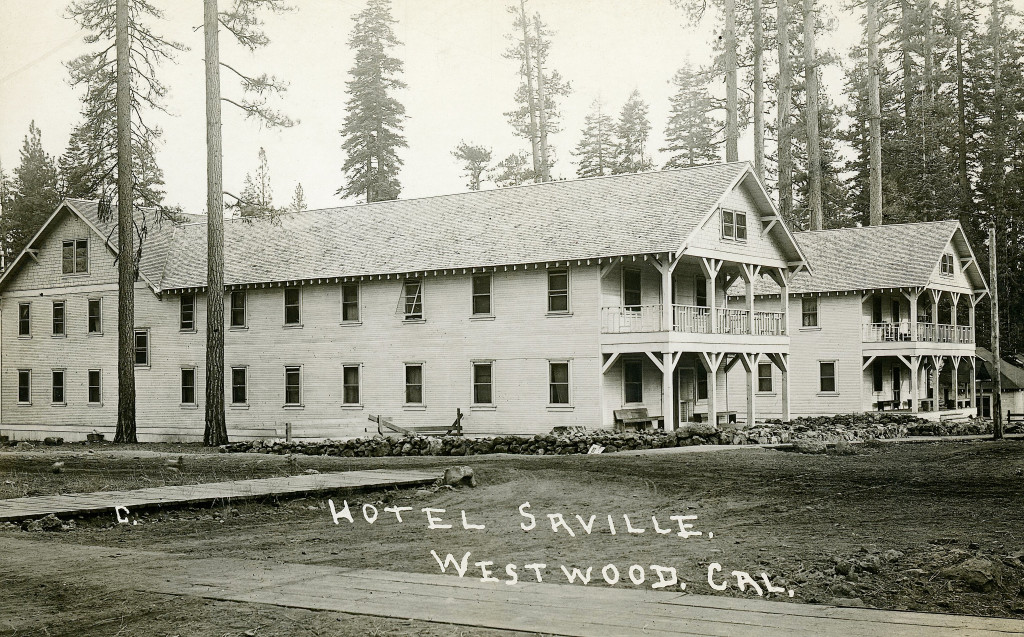
This was a real misnomer, for it was not a hotel, but a boarding house in Westwood. Built in 1913, it was one of the first rooming houses constructed there for Red River’s employees. It was a substantial structure with 250 rooms. Initially it housed Spaniards, though in time many of them relocated across the millpond to Old Town. It was destroyed by fire on March 30, 1918.
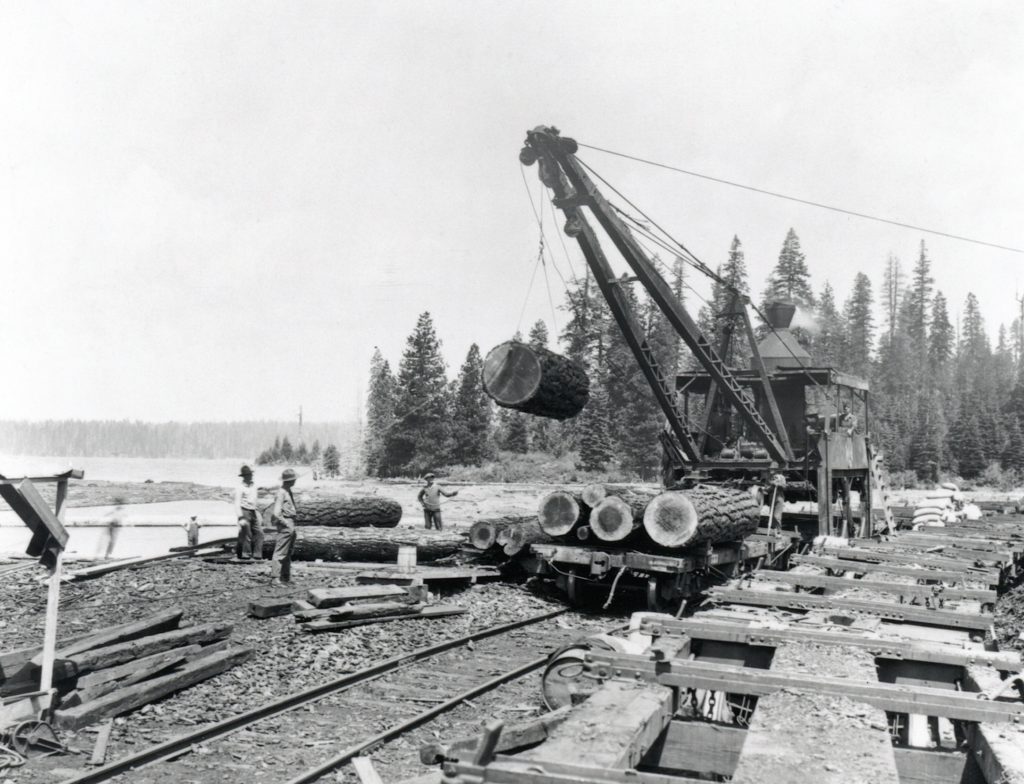
Reloading logs at Camp 14, Lake Almanor—Minnesota Historical Society
One of the challenges that Great Western Power Company encountered building the dam that created Lake Almanor was the removal of pine timber. They estimated between Almanor and other other reservoir site of Butt Valley that there was 200 million board feet of timber. In 1911, Great Western contacted the Red River Lumber Company who at that time still had not decided where they would construct its first mill. In July 1913, after much wrangling the two reached an agreement. Great Western would pay RedRiver one dollar per thousand board feet of pine timber removed—approximately $200,000. Red River estimated the cost at $500,000.
With the agreement, and time being of the essence as the dam would be complete and the flooding to create Lake Almanor would begin by the spring of 1914. That fall Red River put its loggers at a frantic pace to fall some 80 million board feet of timber, which would be subjected to initial flooding.
In the spring of 1914, Red River using a gasoline launch boat, would float the timber to the east side of the newly created lake by Big Springs. From there the logs were reloaded onto railroad cars and shipped to Westwood for milling. They would repeat a similar procedure in 1924 at Butt Valley and again in 1926 when Lake Almanor was enlarged.