Tag Archives: Red River Lumber Company

Westwood’s LDS Church

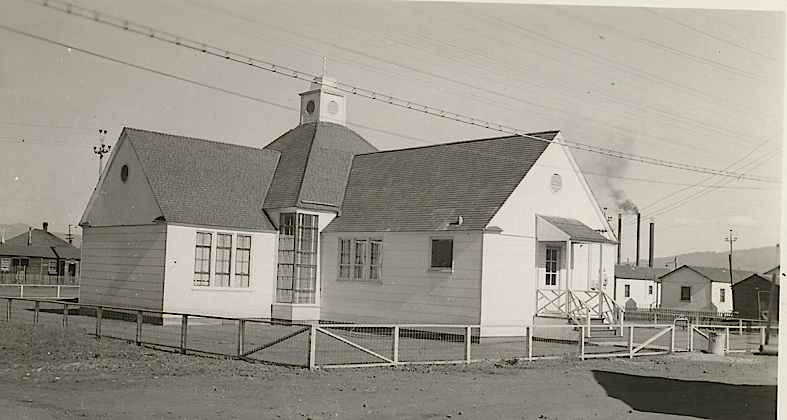
Church of the Latter Day Saints, Westwood, June 14, 1943

On March 9, 1940 the Church of the Latter Day Saints held groundbreaking ceremonies on corner of Ash and Fifth Streets, in Westwood. This was the last house of worship to be constructed under Red River Lumber Company’s tenure at Westwood.

The church  was designed Caldwell and Richards, Los Angeles architects. After World War I, the LDS Church began to implement standardized plans. This particular church was the first to use this particular layout. The $9,000 church was built by volunteer labor and completed in four months.

In 1986, its congregation had grown, wherein they bought property in nearby Clear Creek and built a new church. In 1991, their old our church was acquired by Our Lady of Snows Catholic Church which they converted into a parish hall. However, with their new Lake Almanor church, it will be just a matter of time when this is placed on the market, and only time will dictate its fate.

Never miss a story, click here.

The Bonds That Built Westwood

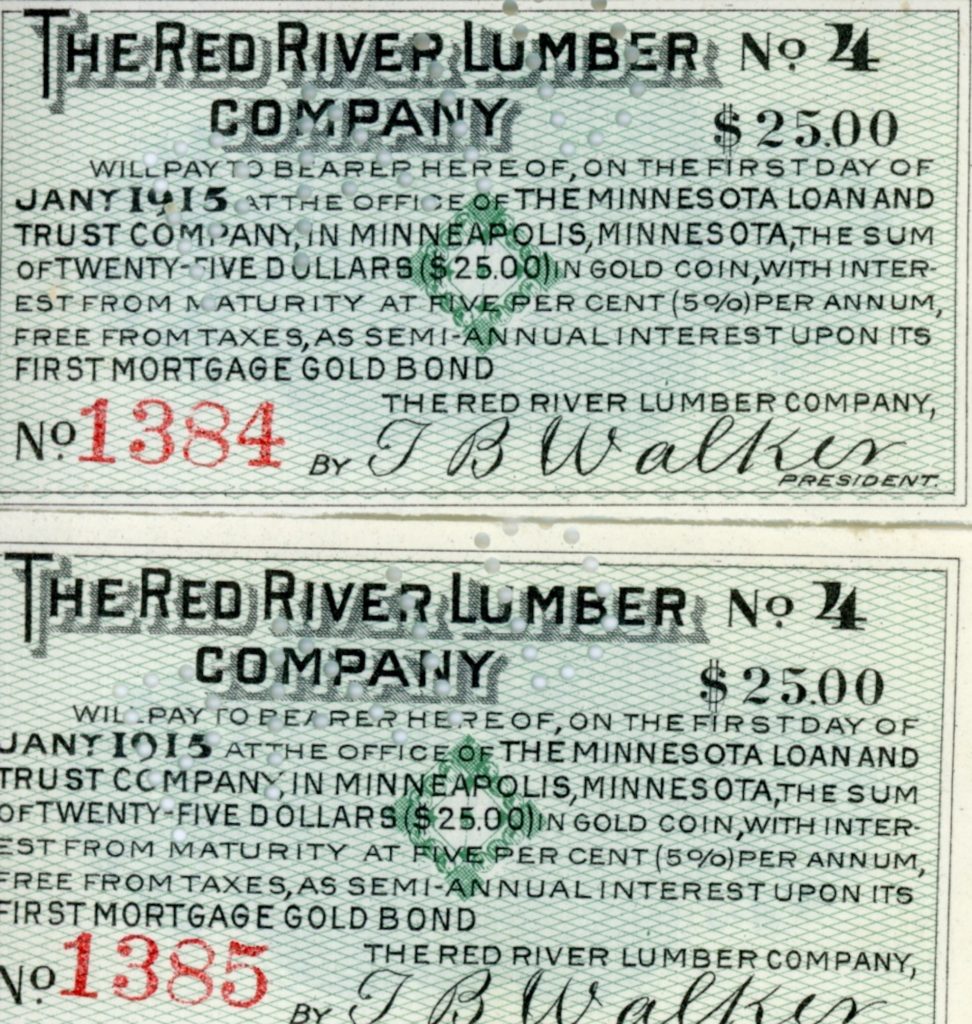
Coupons from Red River’s Akeley, Minnesota Bonds—C. Derek Anderson

Red River Lumber Company’s California expansion was a very costly endeavor. While its founderT.B. Walker had amassed a great fortune, like many successful businessmen, he was constantly investing his profits in new enterprises, some good and others not. To purchase the California timberland  conservative estimates place the cost at $3.7 million. However, not all of this came out of Walker’s pocket. To finance his cause, he enlisted the aid of a New York investor, Doctor John E. Andrus. Together, the two men formed the Waland Lumber Company—its name a derivative combining the names of Walker and Andrus. When Red River made the  final decision to build its first California  mill at Mountain Meadows, the Waland property was used as a collateral for bond issuance.

The initial cost to build Westwood was $3,528,300, nearly equal
as to what was spent on timberland acquisition. This only covered the costs incurred in 1913 and 1914, and the town and mill plant were far from being complete.

In 1913, Red River sold two million dollars in bonds to help pay for Westwood. The bonds were secured with a mortgage on 90,000 acres of Waland timber in Tehama and Shasta counties and experts placed a value on that timber at $6,100,000. The first payment of $50,000 was due on January 1,1916. The bonds had a life span of fifteen-years, but in 1928 a balloon payment of $950,000 was due! That obligation that would not be met, that was one of the dominoes of the downfall of Red River.

Support

Shasta Forest aka Shafco

Red River forest, Lake Almanor, 1926–Roy Rea

In 1944, when the Red River Lumber Company sold Westwood and its Burney Tract, the company still owned a large quantity of timberland in Northern California, besides other properties across the nation. The dissolution process would take years, and like many family affairs some members of the Walker family went their separate ways.

In January 1948, the Walker heirs announced they formed a co-operative company, Shasta Forests to manage their timber holdings. Seasoned residents referred to it as Shafco. In 1969, it went through a reorganization process and a new entity evolved as Red River Forest, which continues to this day. It should be noted that the property is managed by W.M. Beatty & Associates, who have had a long affiliation with the Red River heirs.

Tim

The Demise of the Paul Bunyan Lumber Company

Paul Bunyan Lumber Company, 1953. Courtesy of Fred Lendman

On May 15, 1967, Kenneth R. Walker, president of the Paul Bunyan Lumber Company announced the pending closure of its Susanville mill. Walker cited the lack of available of timber for the closure. The mill closed in August and the liquidation process began.

In 1945, when Red River Lumber Company was in its initial dissolution process, Kenneth wanted to remain in the business. At that time, Red River owned what was referred to as the “Cedar Mill” in Susanville. Kenneth took over that mill and named his new venture the Paul Bunyan Lumber Company.

In conclusion, Walker provided two interesting facts about the mill. He stated that when the last board is shipped, the mill would have processed 650 million board feet of lumber during its operations. In addition, the company’s total payroll during that time amounted to $20 million.

Support

The Mighty McGiffert Loader

McGiffert loader, Camp 28, Red River Lumber Company, 1924—R.S. Pershing

With the advent of railroad logging required the development of supporting equipment. In this particular case, today, a machine to load logs onto flat bed rail cars. Some consider the McGiffert Loader the “Cadallic ” of loaders, which many in the woods just referred to the machine as a “Jammer.”  The McGiffert was invented by John R. McGiffert in the early 1900s , and were manufactured by the Clyde Iron Works of Duluth, Minnesota.

The McGiffert while efficient in getting the job done, did not look like much.  It had an elevated platform for the boiler and spools. What is interesting it was self propelled wherein its chain-driven axles moved it  along the rails. As the McGiffert straddled the tracks, a large, somewhat awkward looking machine. The boiler and spools were mounted on a platform that was elevated over the tracks. The entire machine sat on legs that rested on the ground on either side of the tracks. The McGiffert was self-propelled, as it had a chain-driven drive axles that moved the machine along the rails. The empty log cars were shoved underneath the loader. The log cars would then be rolled through the loader, with logs loaded onto the cars by a boom off of one side of the loader.

McGiffert loader at Camp 28, Red River Lumber Company, 1924–R.S. Pershing

Fruit Growers Supply Company was still using McGifferts into the 1940s on the Susanville Operation, and may have until 1952 when it discontinued railroad logging.

Support

A Progressive Westwood?

Westwood, 1931

One of things the Red River Lumber Company did not like about California was its politics. After the company established Westwood, it initially took a neutral stance to politics. That would change over time.

The Westwood Auto Club served as a de facto chamber of commerce for Red River. Since 1916, Californians voted on several bond measures to build a state highway system. By 1926 those funds had been exhausted and to the dismay of the residents of Northern California the majority of bond revenue was spent building highways in Southern California. In June a movement was on hand to place on the ballot a one cent per gallon gasoline tax to be used for highway construction. The Westwood Auto jumped on the bandwagon and led a vigorous petition drive to obtain signatures to place the matter on the ballot. It was widely supported and by the end of July enough signatures had been obtained to place the measure on the ballot, to be known as Proposition 4.

To date nearly $100 million had been spent in the last ten years for highway construction. It was estimated an addition $123 million was needed to complete the state highway system. Southern California had an initiative also on the ballot—Proposition 8. This was an effort to grab a major portion of road funds for the next twelve years. It turned into a North/South divide issue. Proposition 4 proponents worked hard and were successful. In Lassen County nearly 90% of the voters approved it.

Support

The Creation of Westwood’s Peoples Church

Westwood’s Peoples Church

Red River Lumber Company’s town of Westwood was fairly well planned, but all the facilities built between 1912-14, a house of worship was not included. This was extremely odd when factoring in that T.B. Walker, founder of Red River was a devout member of the  Methodist Church.

The spiritual needs, however, was not completely ignored. In October 1913, the Rev. Robert G. Green, a Methodist minister at Akeley, Minnesota, where Red River operated mill,  was recruited to come to Westwood to oversee the social welfare of the community. Green found it to be challenge as to where to hold non-denominational services. Westwood’s first multi-purpose facility
was the Opera House, and it was there where Green delivered his Sunday sermons.  One of the problems holding services in the Opera House was that Green had to compete with other parties who wanted to use the building, since it was the only facility dedicated to public gatherings. Green had been informed a church would be built after the Opera House was completed, but that did not happen.

By early 1917, the pressure was on for a church to be built. A committee had organized to solicit donations. They had plans for a building, not only for its seating capacity but that it should have a full basement to provide for a library, kitchen/dining rooms, and other rooms for sociable functions such as Y.M.C.A. meetings.  After considerable debate it was determined that ideally the church should seat 600 churchgoers. Once the committee agreed to the building’s size, they were able to calculate the cost. They estimated a price tag of $8,700—with lumber the most expensive item at $4,000.   The committee had secured $3,000 in pledges and pressure was placed on Red River on its “stingy” spending for its employees. Red River was also learning the hard way in a critical labor market, that to retain workers and their families concessions had to be made. Red River finally obliged.

In the summer of 1917 the church project moved forward with Red River donating the lumber and labor.  The site selected was at 500 Cedar Street, which Rev. Green described as a rock pile strewn with empty beer and whiskey bottles. By November 1917 the new church was completed. Initially, it was a church with no name. Since it would serve the needs of variety denominations it was named The People’s Church. On Sunday May 19, 1918 dedication ceremonies were held with Dr. John Wilson, District Superintendent of the California-Nevada  Methodist Conference officiating.

Support

Clear Creek, Lassen County

Clear Creek
Clear Creek as it appeared in 1899.

The idyllic community of Clear Creek has a long history before it took on a new life in the 1920s by the Red River Lumber Company. It was first settled in 1872 by Henry “Hank” Landt who migrated back and forth between Big Meadows (Lake Almanor). Landt wore many “hats” from being a resort operator, fisherman, fur trader and sawmill operator. On August 5, 1875 he filed for the water rights to Clear Creek to protect the development of the trout fishing ponds that he had established. In 1890, Landt sold the property to Orman Folsom and moved to Susanville. Folsom never did anything with the property, it was an investment, like so many others he had. In 1909, Folsom sold to for Thomas B. Walker, of the Red River Lumber Company for $6,500

Support this site and Subscribe today!


An Interesting Fire Editorial

Main Street, Susanville, 1927. Note you can see where the fire burned above the Elks Lodge.

In June 2021 I wrote about a forest fire of 1926 that threatened Susanville, when it jumped the Susan River and spread to Inspiration Point.On July 2, 1926 the Lassen Mail had an editorial “Fire Danger Is Concern of Everyone.” Since it is that time of year when fire danger increases, I thought I would share the newspaper’s observation.

”During the closing days of June Susanville faced conditions that do not usually obtain until August. These conditions will become worse as the season advances and it will require the utmost care on the part of everyone to protect property interests. So far as the town of Susanville is concerned it is now reasonably  well protected from fires that might sweep in from the surrounding hills. But the wealth of Lassen County lies in her forests and these forests are at the mercy of the camper and the tourist.

”The state forestry department should see that a competent fire warden is placed in charge of the Susanville district. He should be a man who realizes the importance of his position and who has the necessary experience. During the past week more damage was done by back fires set by incompetent persons than was done by the original fire. The fire that destroyed Red River timber and finally crossed the Susan River and threatened the town of Susanville was a backfire set by one of those incompetent people that got way beyond control and made the situation worse instead of better.”

Support

The Quirkiness of the Westwood Auto Club

Cover of the Westwood Auto Club’s 1919 Map

The Westwood Auto Club  was the oddest creation of the Red River Lumber Company’s operation at Westwood. Since Westwood was created as a company town one would expect that the community as a whole functioned a bit differently. On the other hand, Red River wanted Westwood to assimilate like the surrounding communities. Enter the Westwood Auto Club. It served as Red River’s de facto chamber of commerce. The Auto Club served as a booster organization of Red River products and civic pride as well.

On February 14, 1916 the auto club held its organizational meeting. Its first goal was to open the road over Fredonyer to Susanville, after all this was prior to the state highway system.  On Sunday, April 9, 1916, the Auto Club organized a work party of one
hundred twenty-five to open Fredonyer, with Red River providing
equipment. A much smaller delegation from Susanville was recruited to work on the snow removal from their side of the mountain. The Susanville team was the first to reach the summit, for they had the added benefit that its side receives more sun exposure.  Being of goodwill, the Susanville crowd began snow removal on the Westwood down slope. Once the two groups connected, everyone regrouped to the summit to celebrate their achievement. This became an annual event for the next several years.

Within a few short years the Westwood Auto Club saw its membership swell to nearly five hundred.  Due to its size, the club felt they needed a place of their own. Upon due diligent search they found an empty building at 303 Ash Street, which had formerly housed kindergarten classes. On New Years Day 1921, after a complete remodel the club opened its doors to the membership.
The Auto Club was on a roll, and in the spring of 1921, it obtained a
lease from Red River to develop a park and campground at nearby Clear Creek. This was a popular picnic site, and the club maintained the park until the organization folded when Red River sold in 1944.

By the mid-1920s the organization had over 1200 members. Its biggest accomplishment came in 1929-30. The Auto Club lobbied hard with the California Division of Highways for the winter snow removal over Fredonyer.

Donate