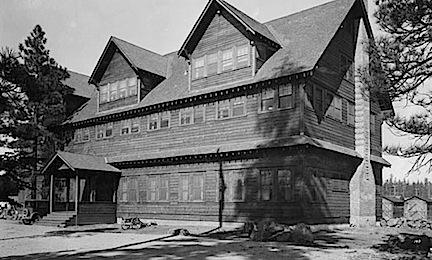
When Westwood was established, its Catholic community was a part of the Sacred Heart Parish—it had only been created in 1912 and covered the territory of Lassen and Modoc counties. The first pastor was Father P.J. O’Reilly. There seems to be some confusion as to when the first Mass was celebrated in Westwood. On December 12, 1913, it was reported in the Lassen Weekly Mail: “Father P.J. O’Reilly made the trip to Westwood to attend to spiritual wants of the Catholic Church in the new lumber town.” However, under the heading of Remarks in the Parish Death Register, Father O’Reilly wrote, “Mass was celebrated in Westwood for the first time by Rev. P.J. O’Reilly on 19 April 1914 in the school house situated near the present fire department. Mass is now said in the school situated on the hill facing Delwood Street.” Father also wrote, “The first Catholic funeral that was held in Westwood was on July 24, 1914. The internment was made in the new cemetery, portion of which viz the North East section is devoted to the use of the Catholics who die in and around Westwood for Catholics only. This cemetery is 3 1/2 miles from Westwood.” That internment was for Jose Alvarez, a 22 year-old millworker who died from typhoid fever. Continue reading Our Lady of the Snows
Tag Archives: Red River Lumber Company
Paul Bunyan Lumber Company

In what might be biggest irony in the history of the Red River Lumber Company was its Susanville mill. Before the site of Westwood had been selected, there was a heated debate inside the company about locating at Susanville. Continue reading Paul Bunyan Lumber Company
Westwood in the movies

The Red River Lumber Company was unusual in that it did not routinely have commercial films made of its operations, as their competitors did. It was deemed a good business practice to show prospective retail buyers, as well as investors, of one’s operation. In the 1930s, Red River officials debated the issue, particularly as it might be beneficial if forced to sell Westwood. On the other hand Red River’s neighbor the Fruit Growers Supply Company routinely had films made. For them it was important for the citrus growers to see what was involved with their investment.
In the summer of 1928 Caterpillar tractors sent a camera man to Westwood to film Red River Lumber Company’s entire operation–from the falling of trees to finished board. Caterpillar was interested in Red River’s operations. Red River’s skilled machinists were constantly making improvements to Caterpillar tractors. Among old time Red River employees there was the folklore that Red River had more patents on Caterpillar tractors than Caterpillar. Whatever the case may be, in November 1928 the film made its debut at the Westwood Theater.
It would be interesting to know if the film exist in Caterpillar archives. After all, Fruit Growers had a 1925 film of their Lassen Operation in their archives.
Spread the word, encourage a friend to subscribe.
Pat O’Dea – The Kangaroo Kicker

In 1919, Charles J. Mitchell arrived in Westwood like so many before and after him seeking employment. The Red River Lumber Company had high turnover in its workforce and always had openings. Little did Red River know their new hire was a famous football player. Then again, Mitchell used an alias. After all this was in an era, where few people carried any type of identification, and Social Security numbers were non-existent. Continue reading Pat O’Dea – The Kangaroo Kicker
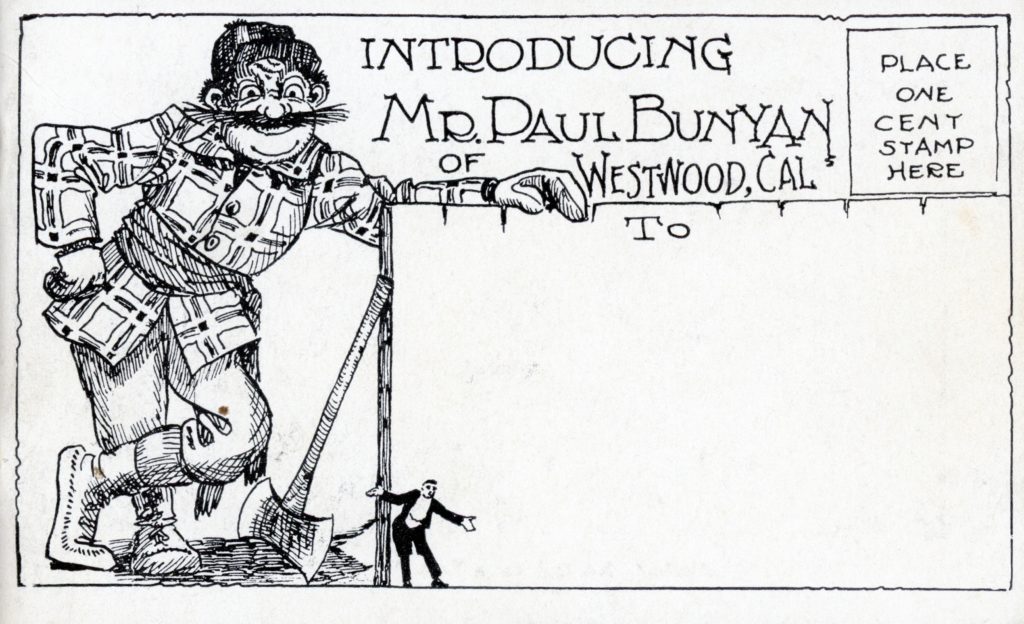
Introducing Paul Bunyan

During Red River Lumber Company’s expansion to California, they had number of hurdles to overcome. Since they would be using a different species of pine, than what they had previously used in Minnesota, they had to monumental task to educate their customers. Part of the duty fell to Archie Walker in Minneapolis, and he contacted his cousin, W.B. “Bill” Laughead, who was doing some free-lance advertising work to assist him. At this time, Paul Bunyan was a little known folklore, associated with loggers. The two came up with the idea of Paul Bunyan, and prior to this no one had rendered a drawing of the mythical logger. Continue reading Introducing Paul Bunyan
Westwood’s American Legion Hall

On July 15, 1918, Westwood resident Clyde A. McKea died in combat in France, making him the first casualty from Lassen County of World War I. In the fall of 1919 a new national veterans organization was formed—The American Legion. Continue reading Westwood’s American Legion Hall
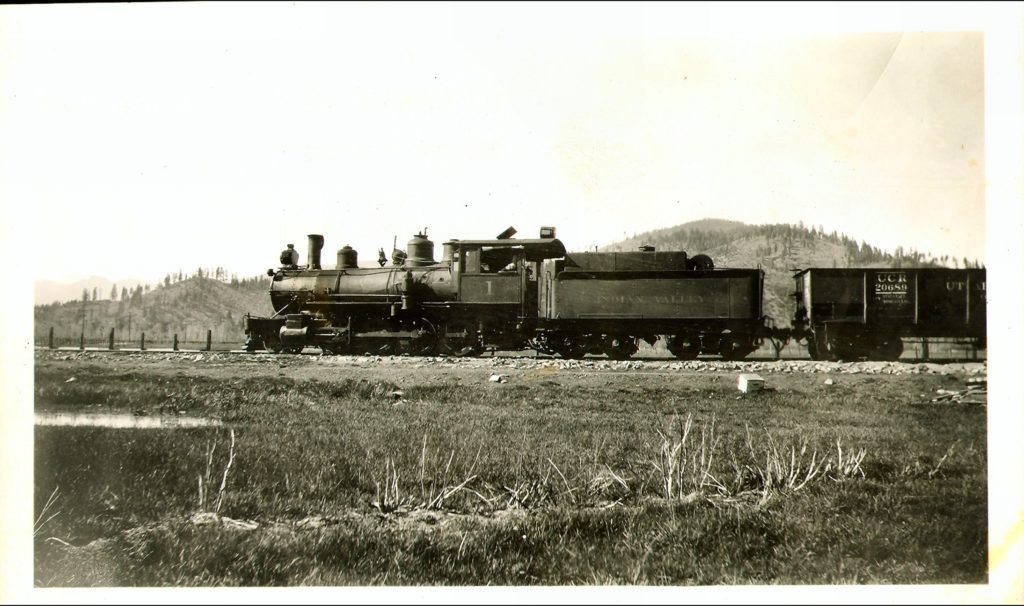
Indian Valley Railroad

One of the biggest issues T.B. Walker had against the Red River Lumber Company’s location at Westwood, was it lacked a railroad link directly to California. For a time there was a glimmer hope with the Indian Valley Railroad.
On June 30, 1916, the Indian Valley Railroad (IVR) was incorporated to build a line from Paxton on the Western Pacific Railroad to the Engel Copper Mine near Taylorsville–a distance of 21 miles. Sixteen months later the rail line was completed. It should be noted, that it was originally proposed as a narrow gauge line, but Willis Walker of the Red River Lumber Company objected. After all, Walker was keen enough to see the possibilities for a link to Westwood, and with that would force the Southern Pacific Railroad to be more competitive in their rates.
Early on the IVR had its sights on Westwood. In 1918 a survey to extend the line to Westwood was conducted, There was speculation that the IVR would extend its line to Westwood, and in 1918 the IVR did survey a line to that place. With Red River’s main branch railroad logging extending along the east shore of Lake Almanor to Canyon Dam, there was not much territory separating the two lines. In 1927 a request was sent to the Interstate Commerce Commission to put in this proposed line to be known as the Northern California Railroad. It was rejected. However, in the works was the Western Pacific and Great Northern Railroads to connect their respective lines with a new railroad from Keddie, Plumas County to Klamath Falls, Oregon. This was approved in 1930, and Red River Lumber Company would finally have a second railroad connection it had always sought.
Never miss a story, click here to subscribe.
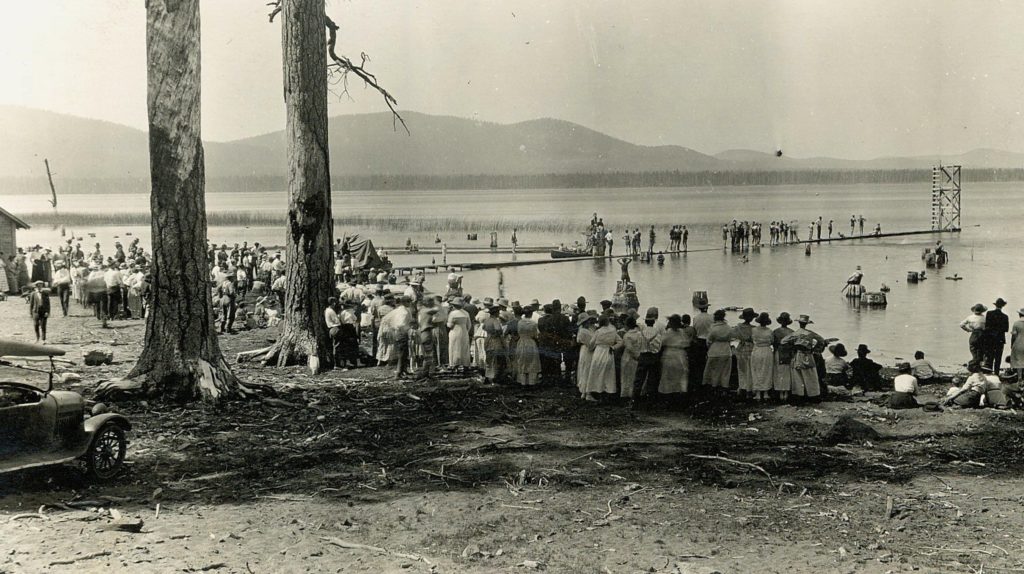
Eagle Lake’s Water Carnival

For two years, 1921 and 1922, the big three lumber companies, Fruit Growers Supply Company, Lassen Lumber & Box Company, and the Red River Lumber Company held a competitive swimming meet between their respective employees. Continue reading Eagle Lake’s Water Carnival
A Belfast Revival?

In the 1870s, Captain C.A. Merrill began work on tapping Eagle Lake for irrigation in the Honey Lake Valley. Where Willow Creek enters the Honey Lake Valley he envisioned a great city there, he named Belfast. In the 1880s, he declared Belfast was destined to become a great commercial center, a city initially serving 25,000 people. One of his many proposals was the establishment of a lumber mill there. The source of timber was the Eagle Lake basin, which the logs would be floated across the lake and down a flume to Belfast. However, not much ever materialized.
In 1912, the Red River Lumber Company was in a hurry to establish a lumber mill in Lassen County. Fletcher Walker liked the Mountain Meadows location. No one else did.The problem was the winter weather was not conducive for much. Clinton Walker suggested Belfast, it had ample water, far removed from other communities and the future employees could even grow gardens. However, family patriarch, T.B. Walker, nixed that idea, as it was too far removed from the timber, thus added costs to transport logs to the mill. T.B. Walker was not keen on the Mountain Meadows site, but when Fletcher stated he would leave the company if Mountain Meadows was not selected. So much for a Belfast revival, and the town of Westwood was created over a temper tantrum.
Never miss a story, click here to subscribe and support.
The Westwood Golf Course

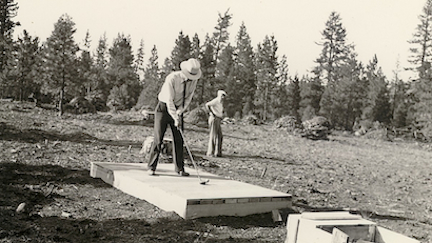
One would not normally associate the sport of golf in a community composed mainly of lumberjacks and sawmill workers like Westwood. However by 1920, the golfing phenomenon swept through Northern California and this lumber town was no exception.
The “divot diggers” as they were affectionaly known then took a little longer to take hold at Westwood. By the early 1920s, Susanville could boast three golf courses, albeit crude by modern day standards. Even Chester, then just a mere hamlet, had a golf course.
As early as 1921, Westwood’s golfing enthusiasts began the debate to establish a golf course. Yet, they just could not generate enough momentum to pull it off. This all changed in 1929 when Westwood’s golfing community organized a club. Those original duffers consisted of Ross Morehouse, Gene Huggins, Bob Pullman, F.W. Koerner, F.M. Jayne, Bill Corbett, Dan Taylor and C.C. Baptie. Continue reading The Westwood Golf Course