Tag Archives: Red River Lumber Company

Red River Control Burns

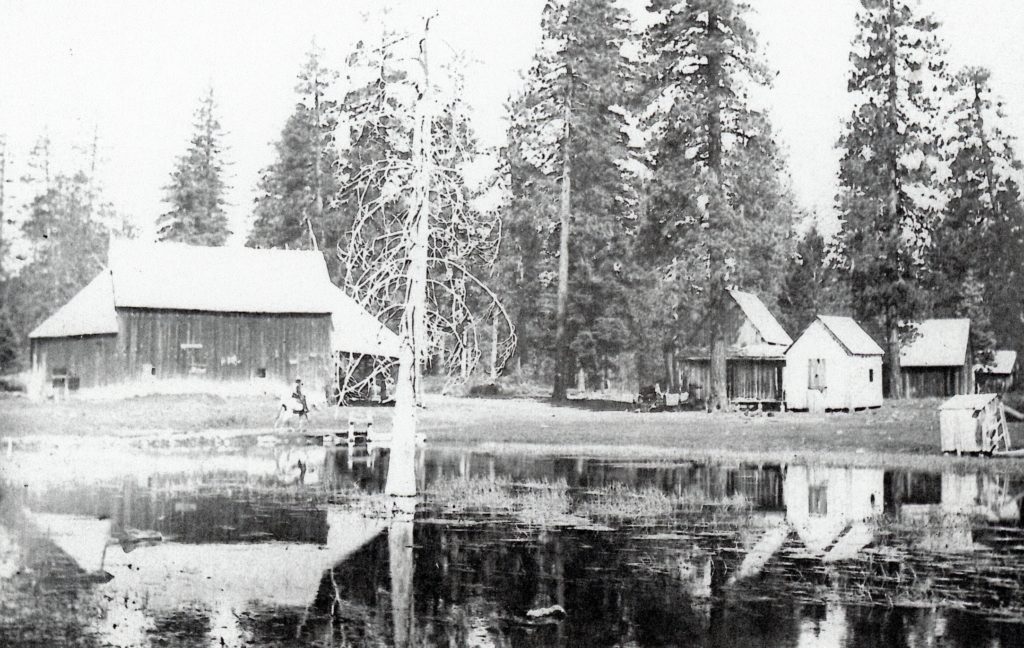
Camp 38
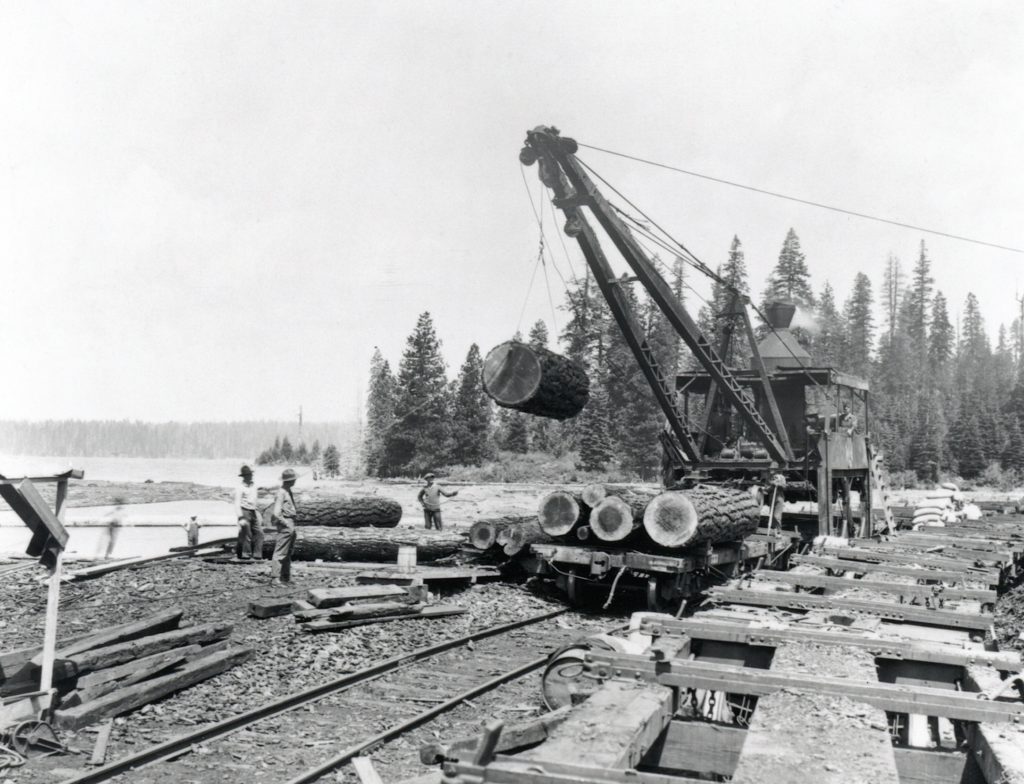
Camp 38, Red River Lumber Company, 1922. It was located on the east shore of Lake Almanor. Courtesy of R.S. Pershing

While I have touched upon this topic before, I came across an interesting letter and how Red River was managing its forest. There are a number of institutions that search this site for all kinds of information, natural history being one. As public service, I bring this bit of information to the surface for future researchers.

On August 10, 1935, Clinton Walker wrote to his brother Archie, who resided in Minneapolis. Archie was stable figure in the Red River Lumber Company’s management, since the company had vast holdings there as well.

Clinton was involved in the initial timber acquisitions in California. In 1913, he resigned over a family dispute on the future operations. He came back into the fold during Red River’s financial crisis of the 1930s. Enough background and onwards to Clinton’s commentary.

”It is regrettable that the house of Walker has no forest man. Kenneth [Walker] covers the nearest, but he seems to be absorbed in the performance of log contracts; our annual fire and insect losses are staggering. A systematic annual light burning at the right season of the year would reduce an ultimately eliminate these sources of loss and the cost would be insignificant as compared to the loss and yearly fire hazard conditions in the forests. Burning by means of power burners on or dragged behind tractors could be done very cheaply and the prospective danger of injuring hollow hulled trees could be eliminated by following the burning with a few shovelers. For the entire period of the Walker family timber operation we have centered our attention exclusively to lumber operation. We are doing nothing but slash down that wonderful forest and letting the fire and beetles burn and eat us down year by year without raising a hand to afford protection from these annual staggering losses.”

Support

Dairy History Tidbit

A view looking at the former Ridenour property with the Sella dairy in the foreground, which was located at the lower end of Gold Run, 1950s. Courtesy of Wendell V. Loughead

Of course, this was one of those scenarios where a week later after I posted about the dairy history, I came across an example of the material that can be found. It just takes a lot of sleuthing.

In a February 1926 Lassen Farm Bureau news report had this: “R.S. Raven of the cow testing association reports that the FGSCo had one cow this month that produced over 60 pounds of butterfat, another produced 50 pounds, five over 40 pounds and eight over 30 pounds for the month. Mr. O”Kelley states that these cows have been fed on silage and grain.”

In March 1926 Lassen Farm Bureau new report had this: “The Red River Lumber Company had 58 cows that produced over 30 pounds of butterfat this month. Fifteen of these produced over 40 pounds of fat, 5 produced over 50 and one cow 78 pounds. E.G. Scammon states the company is milking 175 cows at present.

Donate

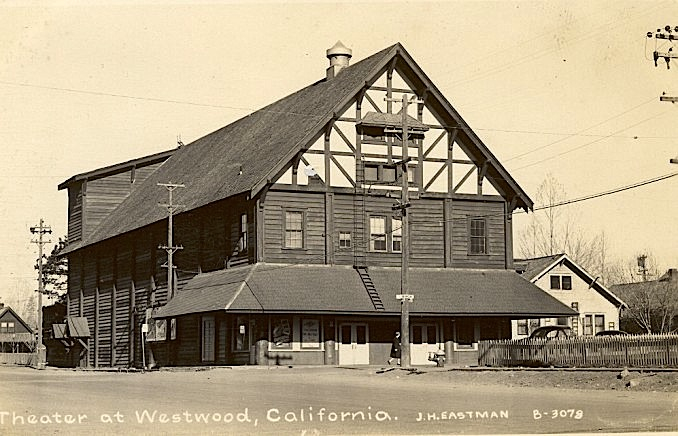
Westwood’s Opera House

Westwood’s Opera House under construction—David Zoller

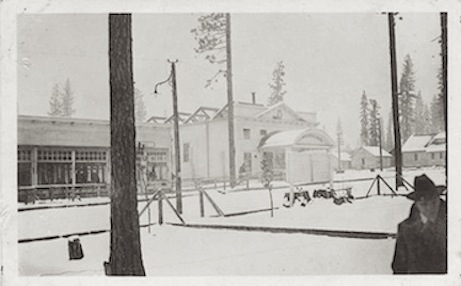
One of the daunting task when Red River Lumber Company built its company town of Westwood, during 1912-14, was they would need to provide recreational outlets for their employees.  One of Red River’s first entertainment venues for its employees was dubbed the Opera House. It was a multi-purpose facility, though it never showcased an opera. The Opera House had a seating capacity of 600 and was the initial hub of social gatherings. It was regularly used as a movie theater and the scene of special events such as boxing matches. It was also the home for church services for several years until the People’s Church was built. In time, the Opera House was just too small as the town’s population continued to increase. In 1925, a new theater was constructed with a seating capacity of 1,100. The Opera House was converted into a store and made part of the adjoining facility known as the Westwood Club.

Donate

Hat Creek Power

Hat Creek No. 1
Hat Creek Powerhouse No. 1, 1921. Courtesy of Lola L. Tanner

The Red River Lumber Company operated many enterprises and it still as an influence concerning electricity to many residents of the region. From time to time when the Susanville area has a power outage, many times there will be a reference to the Hat Creek line. So you may ponder how did Hat Creek come to be? Continue reading Hat Creek Power

End of an Era

Westwood Stage, 1914—Roy Rea

The old fashioned iconic symbol of the American West, the stagecoach would soon suddenly disappear during the time Red River constructed its company town of Westwood, that took an initial two year to build from  1912-14. It was truly a remarkable era with the automobile overtaking the horse and buggy era. Westwood evoked the modern era. A new town with electricity, sewer system and a department store, that would take decades for the neighboring communities to implement such “modern day conveniences.”

A year after the above photograph was taken, the horse drawn stagecoach was replaced with the “auto-stage” a large touring car. In 1916, the voters of California passed a $16 million bond measure to begin the construction of a state highway system.

Brochure of the Mt. Lassen Transit Company, Red Bluff, circa 1920. Courtesy of Margaret A. Purdy

Donate

Red River’s 1917 Logging Season

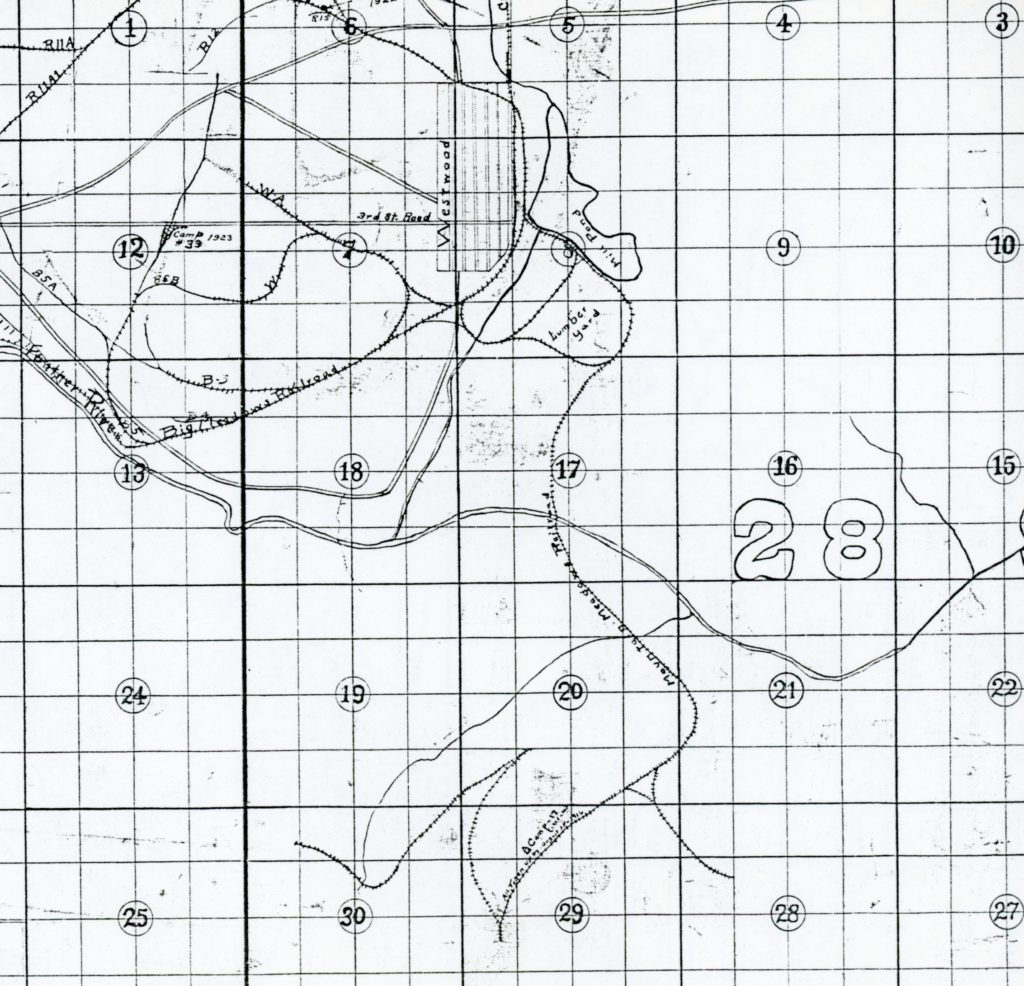
This map was recorded in official records of Lassen County indicating where Red River would log in 1917.

The 1917 logging season for the Red River Lumber Company was somewhat different than previous years. After all, it should be duly noted the majority of its logging was focused on its contract with the Great Western Power Company to log and clear Big Meadows of timber to make way for its new reservoir Lake Almanor.

Now with that obligation out of the way, Red River began logging its timber just adjacent to Westwood. Red River planned to increase its output by logging 150 million board feet in 1917 versus that of 137 million the previous year. This, of course, reflected the demand for lumber with wars ravaging Europe and elsewhere. This undertaking required operating five logging camps and building some twenty-five miles of railroad spur lines.

Donate

No Time to Spare

Snow Shovelers clearing the right-of-way in six feet of snow, January, 1914—B.R. Zimmerman Collection

On January 29, 1912, the Red River Lumber Company and the Southern Pacific Railroad entered into an agreement for the construction of the Fernley & Lassen Railroad. Time was essential, with completion date of two years. Red River already had a contractual obligation with Great Western Power Company to remove the timber from Big Meadows, which would be flooded to create Lake Almanor in 1914..

The line would extend from Fernley, Nevada to a point west of Susanville to be named Westwood Junction. At that point a nine-mile spur would be built south to the soon to be company town of Westwood.

A daunting snow removal task on the Fernley & Lassen Railroad, west of Susanville.—-B.R. Zimmerman Collection

By the fall of 1913, the tracks had reached Susanville. The most formidable task was the Susan River Canyon, wherein the Southern Pacific put 1,000 men to work to meet the January 1914 deadline. However, Mother Nature had a mind of her own, and lashed a series of record breaking storms. Even with eight feet of snow in Susanville during January 1914, was not  a deterrent for the construction. Though due to the unusual circumstances Red River and Southern Pacific agreed upon a two-month extension to the deadline.

Construction of the Fernley & Lassen Railroad, west of Susanville, January 1914. Courtesy of B.R. Zimmerman Collection

On February 21, 1914 the rails reached their destination to Westwood. It would not be until fall when all work was completed such as ballast and sidings.

Support


How Cold?

Dynamiting the Westwood millpond, January 27, 1949. Courtesy of Fruit Growers Supply Company

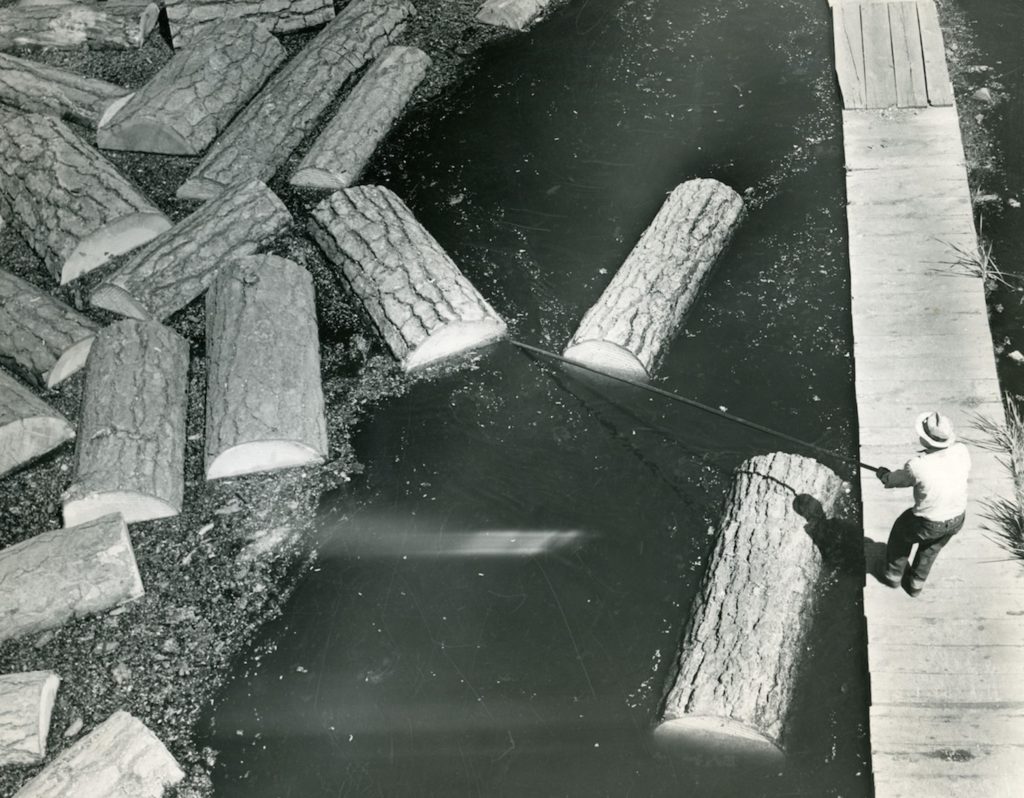
It has been some time since this region has experienced prolonged sub zero temperatures, which is fine with me. When it does get that cold things happen. In January 1949, the temperatures plummeted to nearly thirty degrees below zero at Westwood. The millpond froze. When the Red River Lumber Company designed the facility, they placed piping from the powerhouse that forced steam air directly into the millpond near the sawmill. This system was no match for Mother Nature. To keep the mill operating it was necessary to use dynamite to blast loose the logs in the millpond. Continue reading How Cold?

Railroad to Burney?

Fruit Growers Locomotive No. 105 at Halls Flat, 1946.

In 1940, with the Red River Lumber Company making plans to log north of Westwood in the Poison Lake and Blacks Mountain region further discussions were held as to construct a railroad line to Burney to harvest their extensive Burney Tract that contained two billion board feet of merchantable timber. An initial railroad survey was conducted with a starting point at Poison Lake. The major barrier was that of Hat Creek Rim. It was determined to follow the rim and slowly make a descent at Cassel and then onward to Burney. It was estimated it would cost one million dollars to construct the line. Fletcher Walker, the resident manager of Westwood was eager to build and wrote, “We would increase the Veneer Plant output and get good logs to operate it and this alone would more than pay for the cost to build the railroad.” However, no one else in the Red River family shared Fletcher’s railroad proposal. In 1941, Red River made the decision to sale Westwood and the Burney Tract.

In 1944, after intense negotiations, Fruit Growers Supply Company purchased Westwood and the Burney Tract. They, too, contemplated to build a railroad line similar to the one proposed by Red River. As late as 1951, Fruit Growers still considered the option of a railroad to Burney. Yet, changes were occurring rapidly with the conversion to cardboard boxes, that forced Fruit Growers to reconsider its future plans, as the needed for wooden boxes to ship citrus would eventually be eliminated.

Subscribe

Control Burns Revisited

Bunnell's
Bunnell’s Resort, Big Meadows. Courtesy of Philip S. Hall

While my Red River series covers a tremendous amount of material on the Red River Lumber Company, there were some topics that were not addressed. In 1938, the topic of controlled burns was being discussed, as the company had done it in its earliest years until Clinton Walker’s departure in 1913. Below is an excerpt of a 1938 memo Clinton wrote to the Board and the experience of a control burn at Lake Almanor.

Continue reading Control Burns Revisited