Tag Archives: Politics

Nataqua Territory

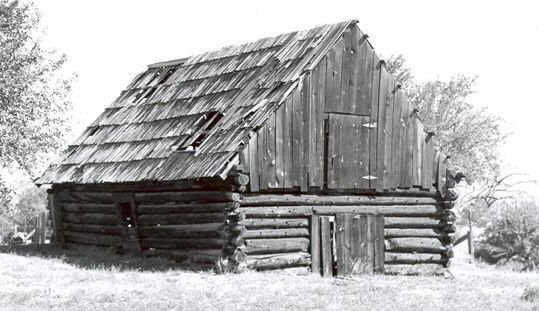
Roop’s Trading Post better known today as Roop’s Fort

On April 26, 1856, twenty settlers in the Honey Lake Valley gathered at Isaac Roop’s Trading Post nee cabin and held a “mass convention” to establish a territory of their own.  After all, the group concurred, they were not residents of California and they did not want to be under Mormon domination of the Utah Territory whose boundaries extended to the eastern boundary of California.  They named their new government Nataqua Territory. Nataqua, or Natauga as it is sometimes spelt, purportedly, was a Paiute word for woman.  Their land grab was grand to say they least. They carved out a territory, 240 miles long and 155 miles wide, almost two-thirds the size of the State of Nevada.  Ironically, the legal description of their new sovereign state, excluded themselves. Roop’s Post for instance, was located 35 miles west, outside the their western boundary.  The Nataqua Territory, in essence, served as a form of local government to provide an avenue to protect their rights and to handle local land affairs.  The territory served as a foundation until a more formal government was established. In 1857, the  Territory was abandoned when an attempt was made to form the Territory of Sierra Nevada.
Support by subscribing.

Remember Emerson Lake Golf Course?

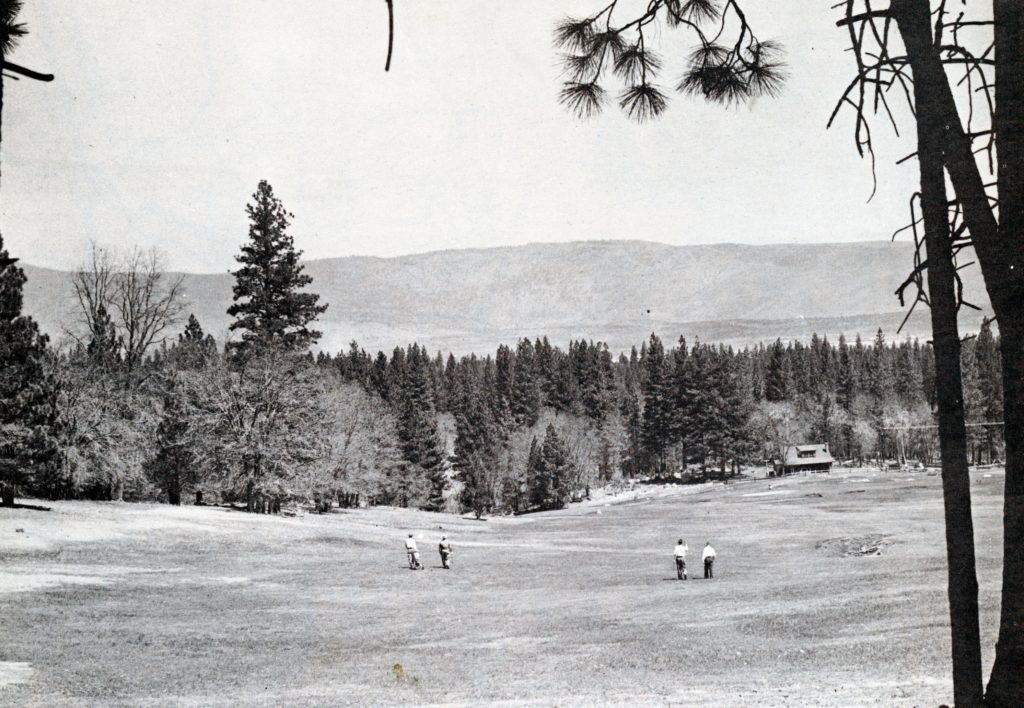
Lost Meadows Golf Course, near Peter Lassen’s Monument, was replaced by the Emerson Lake Golf Course.

In the 1960s there was a movement to have a municipal golf course. In 1967, Rollin “Rollie” Doyle Emerson (1917-1976), sold a portion of the family ranch, near Richmond School, to the City of Susanville that the latter developed into a golf course.  The Emerson family had owned  that property since 1874.

Fast forward, in the spring of 2002, Todd Sickles, manager of the Emerson Lake Golf Course, requested that the City rename the golf course to Diamond Mountain. Sickles, who had a long-term lease of the golf course, cited that with the expansion of the course to 18 holes that he wanted to create a new image for the facility and enhance its marketability.  Sickles also cited that the current name is at times misleading, as Emerson Lake is known to go dry, due to its usage for irrigation.  This issue did spark some debate.  Rollie Emerson’s son, Tro, acknowledged the problem with the dry lake, and requested that the family name remain intact and suggested Emerson Meadows.  Sickles, in the meantime, offered to construct a monument in honor of Rollie Emerson for his early day activities with the golf course and in addition, the first nine holes would be known as the “Emerson Nine.”  The City Council was divided on the issue.  Those in favor of the name change stated that marketing and financial aspects should be a priority over the region’s heritage.  On June 5, 2002, the City Council voted 3 to 2, and approved marketing over heritage and granted the name change to Diamond Mountain Golf Course.

Support by subscribing.

Fredonyer City It Is!

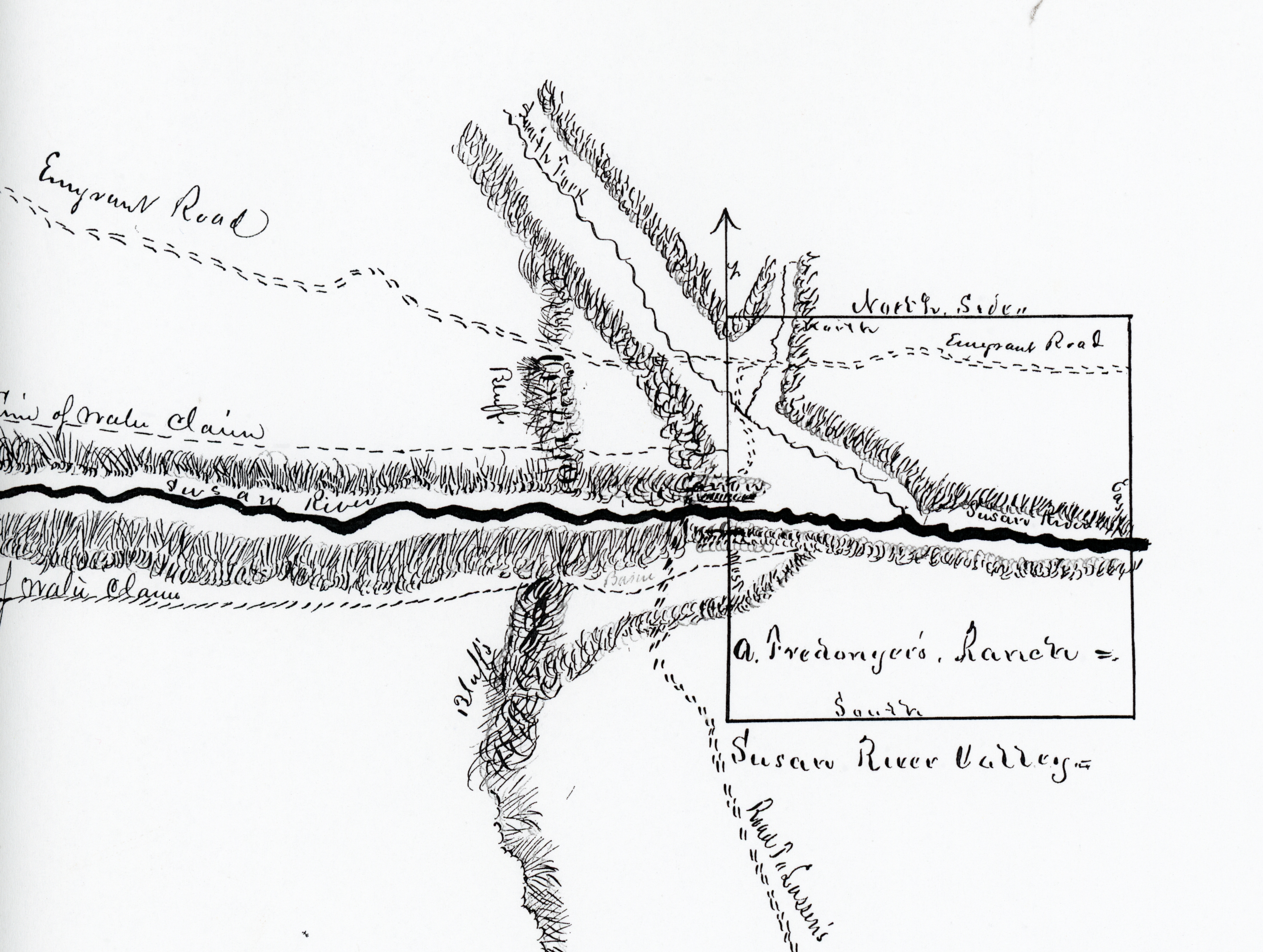
Fredonyer’s Claim to what would become Susanville.

In the spring of 1857, there were only two cabins in what would be latter known as Susanville. By summer a nucleus of a hamlet had developed and some thought it should have name.  In August 1857, two names were proposed for the settlement around Roop’s trading post—Natauga and Fredonyer City. The Red Bluff Beacon reported: “The citizens of Honey Lake Valley are divided in opinion as to which names shall be given to their new town at the west end of the valley. Natauga in the Piutah tongue signifies woman and Fredonyer is the name of the gentleman who claims to be the first white man that ever beheld the beautiful valley. A gentleman who arrived here on Sunday last had in his possession an instrument in writing signed by fifty men declaring their preference for Natauga. An equal number are said to be as enthusiastic for Fredonyer. Simple and unimportant as this question is it said is to be creating quite a jealous feeling between the two rival names. They have no politics at Honey Lake and must have something to cavil about.”

Fredonyer City was the chosen name. However, it was more or less ignored and the place simply referred to as Roops. It should be noted that Fredonyer on April 11, 1857 filed a claim to property occupied by Roop with the Plumas County Recorder.

Support by subscribing.

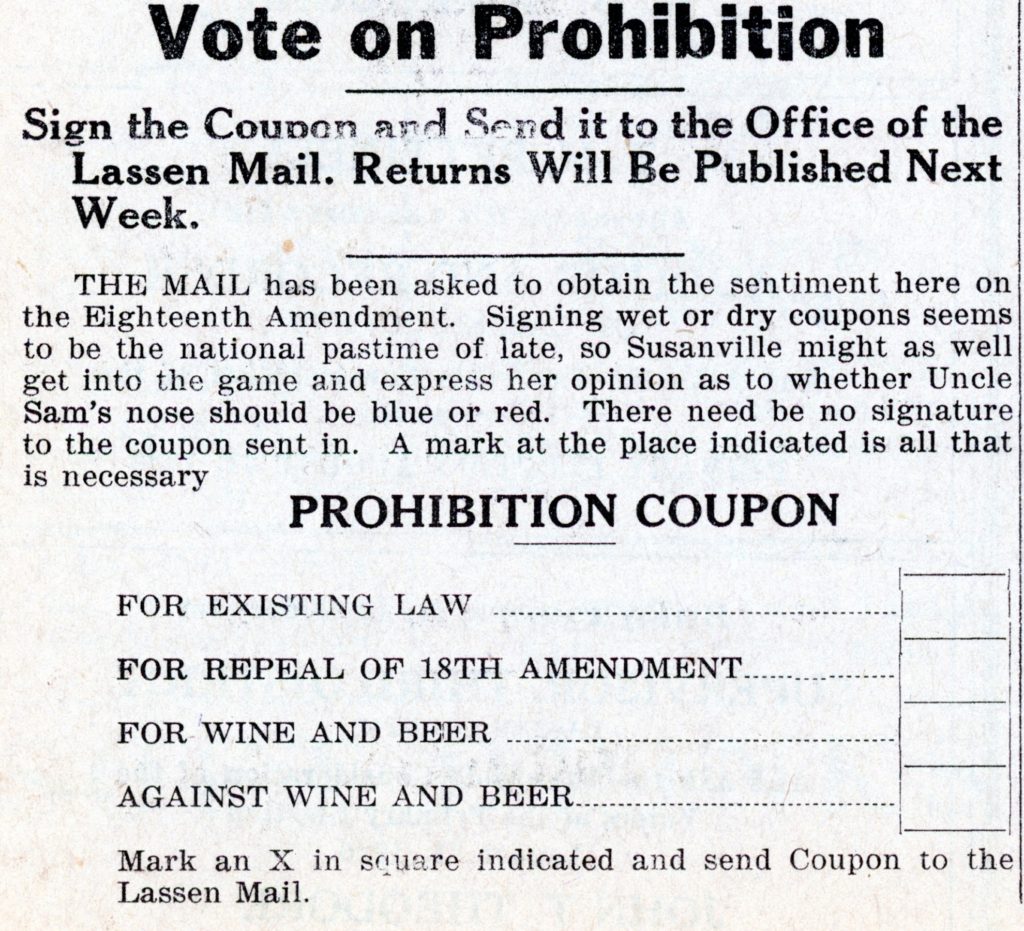
A Straw Vote on Prohibition

Lassen Mail, March 26, 1926

With the passage of the Volstead Act aka Prohibition there would be countless polls taken on whether it should be repealed. Robert M. Cook, editor/publisher of Susanville’s Lassen Mail newspaper decided to take an informal straw poll vote from the readers of the newspaper in the spring of 1926.

The results were not surprising, since bootleg operations were widespread throughout the region. Only 12 votes were cast to keep the existing law, while 401 wanted it repealed. A second question was whether to allow just wine and beer, which 110 said yes and six no.

Some readers sent in comments. One wrote “Voluntary abstinence always, compulsory prohibition, never.” Another “Bear in mind that the organized bootleg ring does not want the present law repealed. If it were the country would have fewer millionaires.”

It should be noted that earlier in the year a national poll was taken  wherein California only 525 voted to keep the law, while 12,637 were against. What was surprising was Utah only 61 yes to keep the law, while 1,323 wanted it repealed.

Subscribe

An Interesting Editorial

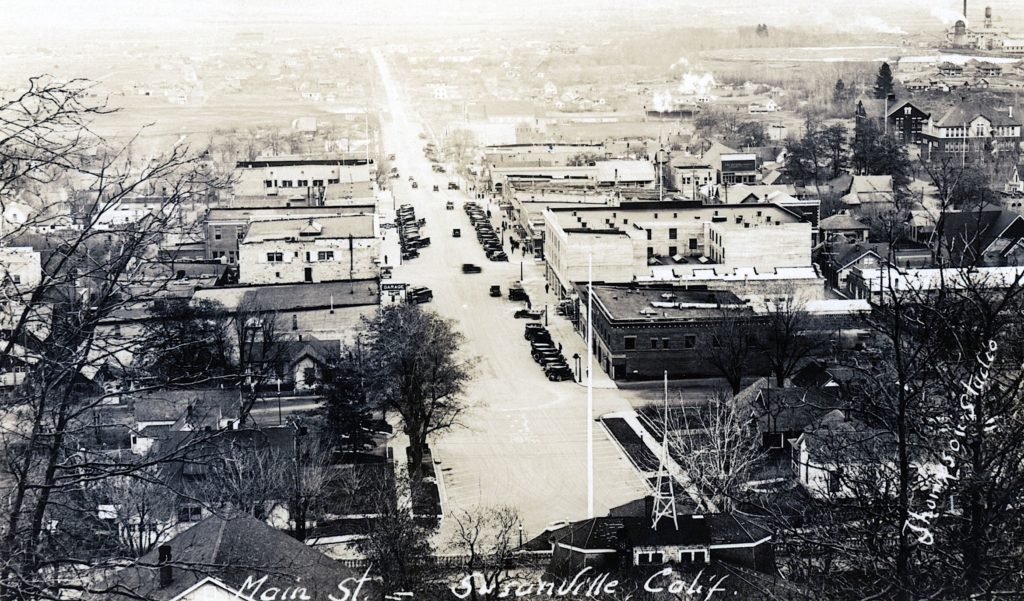
Main Street, Susanville, 1926.

The following editorial appeared in the Lassen Mail on July 9, 1926. It is interesting in a few aspects. There is a story, inside the story about elections/politics, and is only fitting since Tuesday is Election Day.

Buy Where You Earn. There is much talk these days of boosting Susanville and there are many activities that are making it better known, wealthier, bigger. The American Legion Convention will bring it state wide attention and will undoubtedly cause many people to make this their home.

But with all this there are many people who talk Susanville and act elsewhere. What of the man who talks of the great future of Susanville on the street corner and buys his clothes, his automobile, his printing and even his groceries in another city? His words are mere bombast but his buying his needs in other places is one of the worst blows that civic industry in this place can sustain.

A candidate for office approached a business man in Susanville and asked for his support in the coming election. The business man, after explaining that there was nothing personal in his refusal, told the candidate to go to Montgomery Ward for his political support. The candidate did his buying from the mail order house and the mail order house should support him in the election.

A man supports those who support him. You cannot expect business or co-operation if you are not willing to give the same thing in return.

Susanville goods are of the same quality and Susanville prices are just as cheap as those of other cities. The person who is mislead by cheap prices is losing out in the long run. The man who is buying his goods out of town is not gaining either financially or otherwise. If he does this he cannot expect local people to trade with him.

Local trading, of whatever nature, is beneficial to everyone. It increases industry and will increase population. A bigger and better Susanville is the aim of every public minded citizen and the best way to realize that ideal is to encourage home industry and stamp out the man who makes his money in Susanville and spends it in some other city.

Support

A Progressive Westwood?

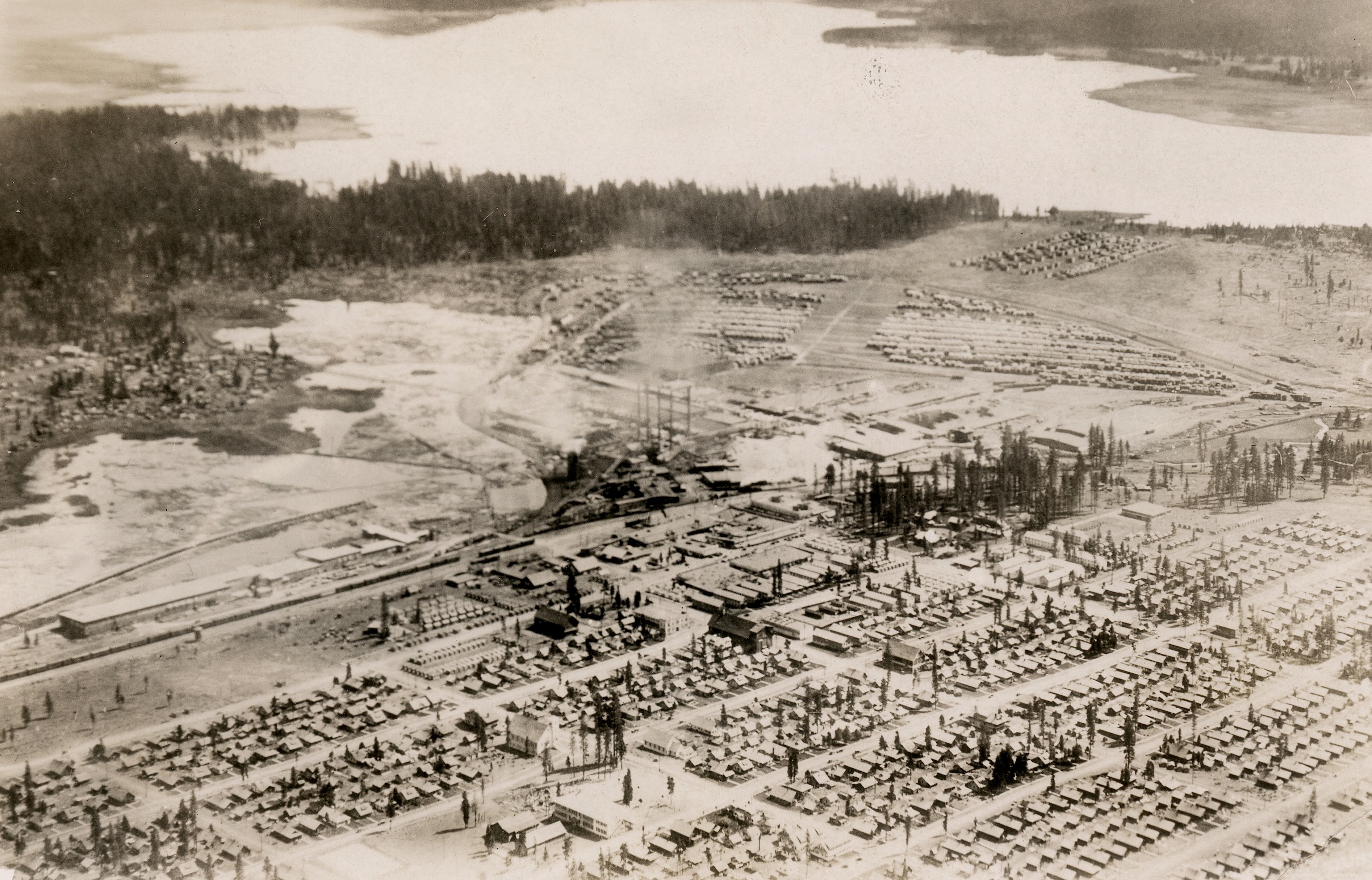
Westwood, 1931

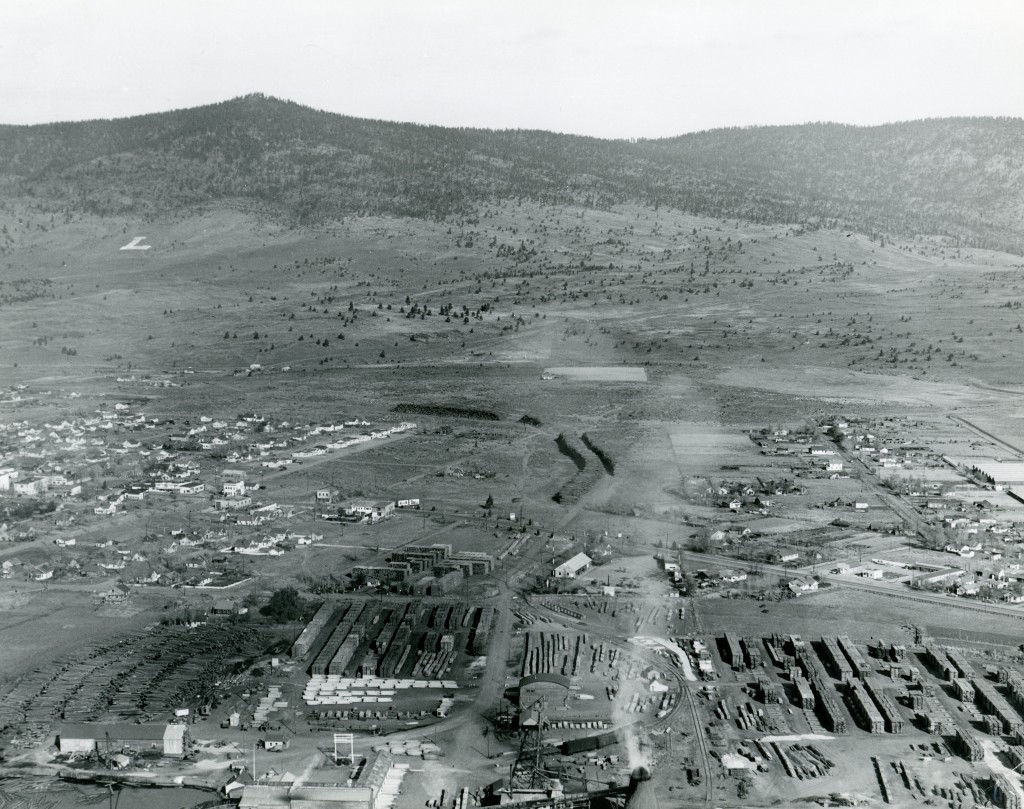
One of things the Red River Lumber Company did not like about California was its politics. After the company established Westwood, it initially took a neutral stance to politics. That would change over time.

The Westwood Auto Club served as a de facto chamber of commerce for Red River. Since 1916, Californians voted on several bond measures to build a state highway system. By 1926 those funds had been exhausted and to the dismay of the residents of Northern California the majority of bond revenue was spent building highways in Southern California. In June a movement was on hand to place on the ballot a one cent per gallon gasoline tax to be used for highway construction. The Westwood Auto jumped on the bandwagon and led a vigorous petition drive to obtain signatures to place the matter on the ballot. It was widely supported and by the end of July enough signatures had been obtained to place the measure on the ballot, to be known as Proposition 4.

To date nearly $100 million had been spent in the last ten years for highway construction. It was estimated an addition $123 million was needed to complete the state highway system. Southern California had an initiative also on the ballot—Proposition 8. This was an effort to grab a major portion of road funds for the next twelve years. It turned into a North/South divide issue. Proposition 4 proponents worked hard and were successful. In Lassen County nearly 90% of the voters approved it.

Support

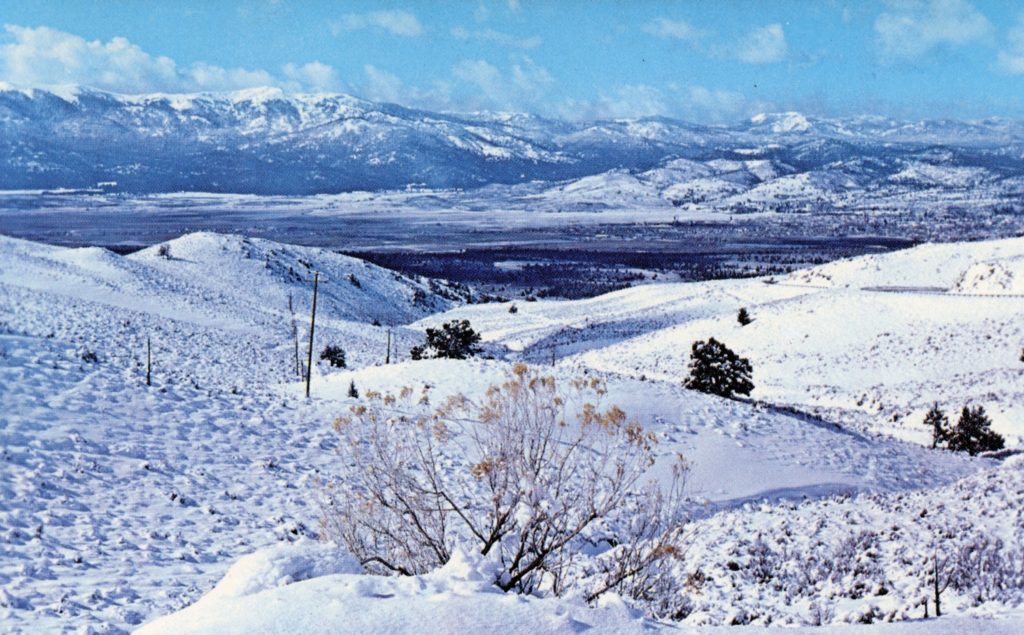
Diamond Mountain

A view of Diamond Mountain from Antelope Grade, January 1975

Exactly who and when mountain was named, is not clear. By the early 1860s it was referred to Diamond Mountain. There are pockets of crystal quartz that can be found along the range, hence “diamond.”

In February 1910, Lassen County historian and retired school teacher, Asa M. Fairfield wanted to name the highest point on Diamond, Mount Roop. It went over like the proverbial “lead balloon.” Fairfield’s quest to have a feature named for Isaac Roop did not end. Fairfield consider Roop the father of Lassen County, while Peter Lassen received all the name recognition.

In 1921, Fairfield petitioned the United States Board of Geographical Names to rename Worley Mountain, to the west of Susanville. In 1922, the Board agreed and changed the name from Worley to Roop Mountain.

Susanville  Peak, 1947. Courtesy of Fred Lendman

Personally, Susanville Peak would have been more fitting to the name designation. In Susanville’s historic core, one cannot see Roop/Worley Mountain. Yet, Susanville Peak is highly visible throughout the community. I still refer to Worley by its given name because when I was growing up that is what everyone referred to it as.

Support

Congressman Raker’s Funeral


John Edward Raker was born in Illinois in 1863, at the age of 10, came to Lassen County with his parents. In 1885, he passed the bar examine, and moved to Alturas to practice law.  He eventually went into partnership with his father-in-law, E.V. Spencer. Raker went on to being elected Modoc County District Attorney and then Modoc County Superior Court Judge. In 1910 he decided to run for the California’s First  Congressional District seat  and won by a slim margin of 141 votes. Raker continued to serve as Congressman until his death in 1926.

Raker was buried in the Spencer family plot in Susanville. The services were held on Sunday, January 31, 1926–an impressive. affair. The body arrived by train at noon at Susanville, which also consisted of a number of Congressmen, along with a contingent of forty-seven people from Alturas.

As the Lassen Mail noted: “The procession was an imposing one, as it slowly and solemnly wended its way along the slush covered streets. When the first automobile reached the Methodist Church, the line was still moving at the depot. The line of march was along Richmond Road to Weatherlow, north on Weatherlow to Main, up Main to Lassen and thence to the church.”

The night before the region was hit with a heavy snowstorm, making the roads a big slushy mess. Twenty-five members of McKea Post, American Legion, attended but it took them two and half hours to make the trip from Westwood. Had the weather been more favorable there would have been an even larger turnout.

Tim

We May Never Know . . .

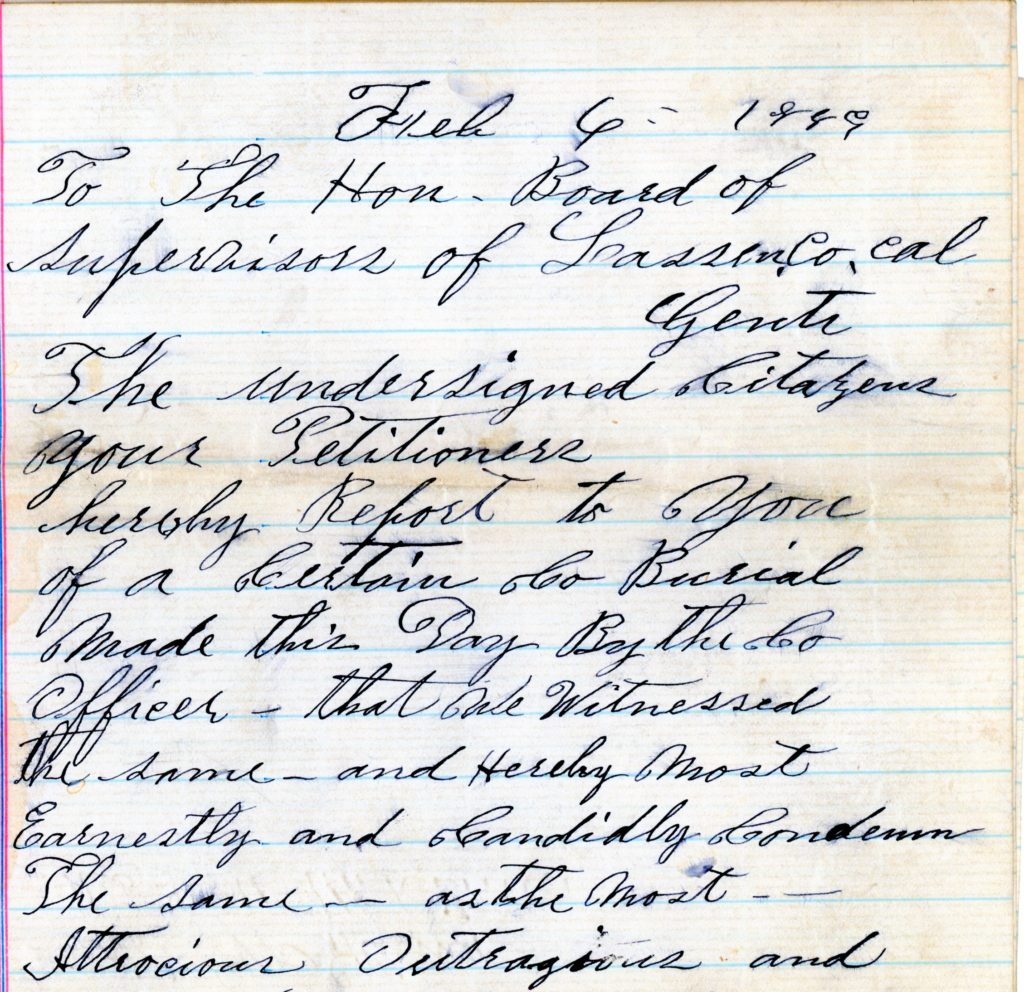
The petition.

This is a tragic tale of a indigent burial in the Susanville Cemetery.  It incensed those in attendance to petition the Lassen County Board of Supervisors to make sure it never happened again. The petition, which is transcribed below, fails to mention the deceased. Who that person was, we might never know. California law did not require that births and deaths be recorded until 1905. There are gaps in the local newspaper, so that avenue could not shed any light on the subject. The minutes of the Board of Supervisors might have information, but those early records are in storage during the courthouse renovation process.

February 6, 1889  — To The Honorable Board of Supervisors of Lassen County

”The undersigned citizens, your petitioners, hereby report to you of a certain burial made this day by the County Officer that we witnessed the same day and hereby most earnestly and candidly condemn the same—as the most atrocious, outrageous and indecent ever by us witnessed. There being no box nor covering for the coffin and the dirt thrown on the coffin lid and the treatment before burial of the corpse. The most inhuman barbarous and disgraceful. We therefore ask that hereafter the person who shall bury the county dead give bonds for at least a decent burial.”

Finally, it should be noted that of twenty-six people who signed the petition, nineteen of them would eventually be buried in the Susanville Cemetery.

Support

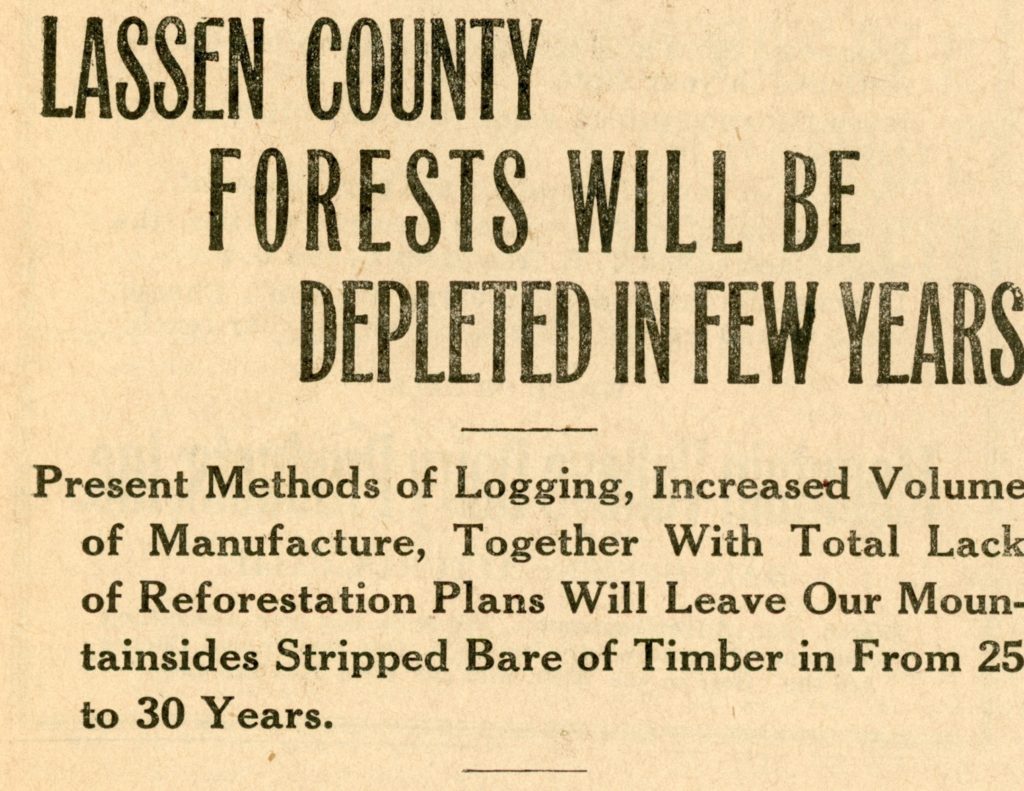
Yikes, the 1926 DeForestation of Lassen National Forest

Lassen Mail, April 16, 1926

In April 1926 a conference of forest service foresters was held in Susanville. It was district forester S.B. Show whose statements caused alarm.  Show had been doing extensive studies for a number of years of the nation’s timber resources.

Show noted that the timber resources of the southern states were rapidly being depleted and that, in turn, would put more pressure on the forests on the west coast. When Show was asked how long the forests of Lassen will last, he replied that at the present rate cutting from 25 to 30 years.  Show continued that practically nothing is being done to reforest the lands that are being denuded by the timber operations and unless some constructive plan is worked out it is only a question of only a few years when the mountainsides of Lassen County will be bare and the only great natural resources within our boundaries will be depleted.

Show was not all doom and gloom. He stressed the importance of reforestation. He also noted the current tax assessments on timber provide the owners of such lands with little or no incentive to preserve timber for the future. It is interesting to note that later in the year the Lassen County Board of Supervisors reduced the timber assessment tax rate by twenty-five percent.

Support