Tag Archives: Politics

Congressman Raker’s Funeral


John Edward Raker was born in Illinois in 1863, at the age of 10, came to Lassen County with his parents. In 1885, he passed the bar examine, and moved to Alturas to practice law.  He eventually went into partnership with his father-in-law, E.V. Spencer. Raker went on to being elected Modoc County District Attorney and then Modoc County Superior Court Judge. In 1910 he decided to run for the California’s First  Congressional District seat  and won by a slim margin of 141 votes. Raker continued to serve as Congressman until his death in 1926.

Raker was buried in the Spencer family plot in Susanville. The services were held on Sunday, January 31, 1926–an impressive. affair. The body arrived by train at noon at Susanville, which also consisted of a number of Congressmen, along with a contingent of forty-seven people from Alturas.

As the Lassen Mail noted: “The procession was an imposing one, as it slowly and solemnly wended its way along the slush covered streets. When the first automobile reached the Methodist Church, the line was still moving at the depot. The line of march was along Richmond Road to Weatherlow, north on Weatherlow to Main, up Main to Lassen and thence to the church.”

The night before the region was hit with a heavy snowstorm, making the roads a big slushy mess. Twenty-five members of McKea Post, American Legion, attended but it took them two and half hours to make the trip from Westwood. Had the weather been more favorable there would have been an even larger turnout.

Tim
We May Never Know . . .

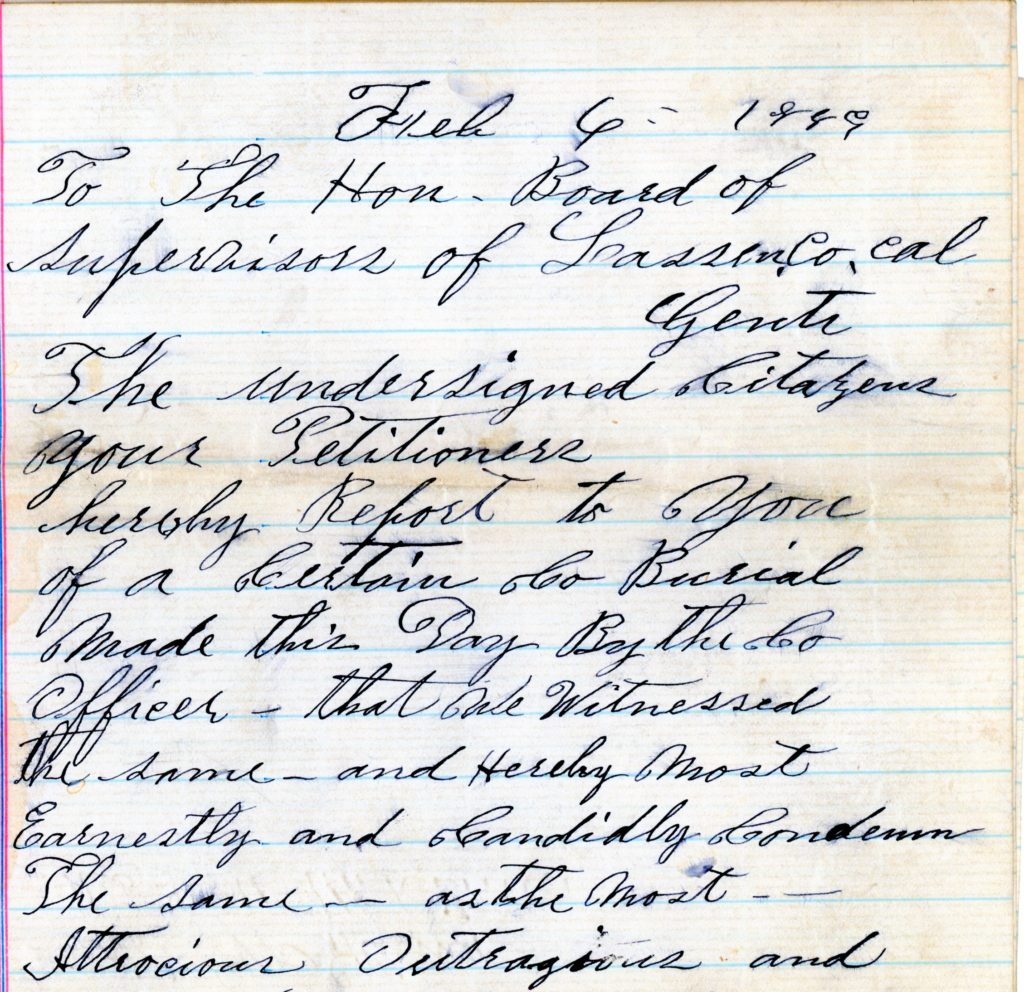
The petition.

This is a tragic tale of a indigent burial in the Susanville Cemetery.  It incensed those in attendance to petition the Lassen County Board of Supervisors to make sure it never happened again. The petition, which is transcribed below, fails to mention the deceased. Who that person was, we might never know. California law did not require that births and deaths be recorded until 1905. There are gaps in the local newspaper, so that avenue could not shed any light on the subject. The minutes of the Board of Supervisors might have information, but those early records are in storage during the courthouse renovation process.

February 6, 1889  — To The Honorable Board of Supervisors of Lassen County

”The undersigned citizens, your petitioners, hereby report to you of a certain burial made this day by the County Officer that we witnessed the same day and hereby most earnestly and candidly condemn the same—as the most atrocious, outrageous and indecent ever by us witnessed. There being no box nor covering for the coffin and the dirt thrown on the coffin lid and the treatment before burial of the corpse. The most inhuman barbarous and disgraceful. We therefore ask that hereafter the person who shall bury the county dead give bonds for at least a decent burial.”

Finally, it should be noted that of twenty-six people who signed the petition, nineteen of them would eventually be buried in the Susanville Cemetery.

Support

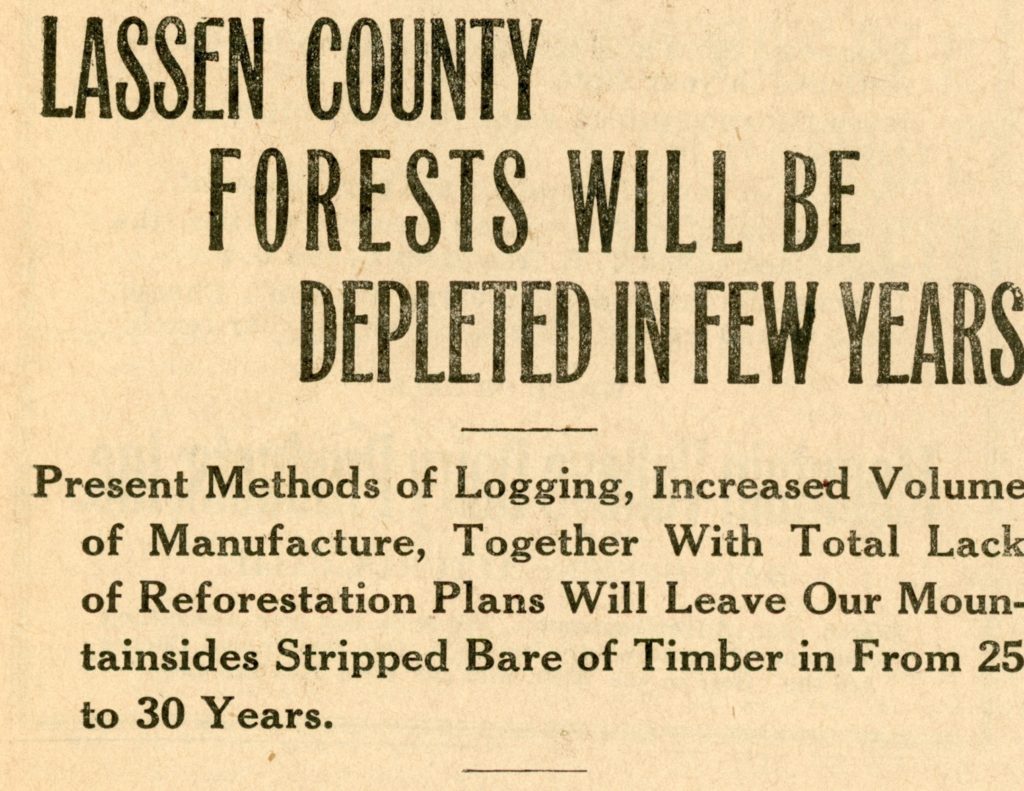
Yikes, the 1926 DeForestation of Lassen National Forest

Lassen Mail, April 16, 1926

In April 1926 a conference of forest service foresters was held in Susanville. It was district forester S.B. Show whose statements caused alarm.  Show had been doing extensive studies for a number of years of the nation’s timber resources.

Show noted that the timber resources of the southern states were rapidly being depleted and that, in turn, would put more pressure on the forests on the west coast. When Show was asked how long the forests of Lassen will last, he replied that at the present rate cutting from 25 to 30 years.  Show continued that practically nothing is being done to reforest the lands that are being denuded by the timber operations and unless some constructive plan is worked out it is only a question of only a few years when the mountainsides of Lassen County will be bare and the only great natural resources within our boundaries will be depleted.

Show was not all doom and gloom. He stressed the importance of reforestation. He also noted the current tax assessments on timber provide the owners of such lands with little or no incentive to preserve timber for the future. It is interesting to note that later in the year the Lassen County Board of Supervisors reduced the timber assessment tax rate by twenty-five percent.

Support

The Prison Debate Continues

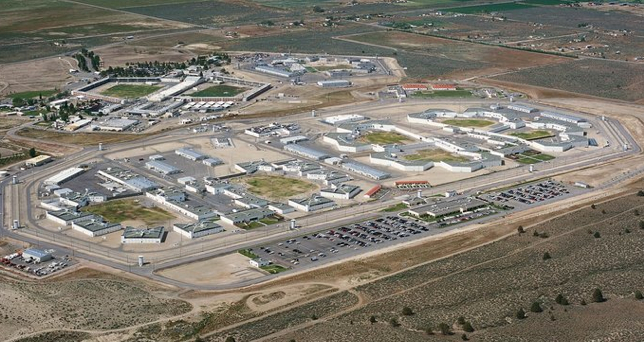
CCC & High Desert State Prisons

Earlier this year, the State of California announced plans to close the California Correctional Center at Susanville by June 30, 2022.

In the early 1950s discussions were being held among the progressives in the community that the lumber industry, that had such a profound economic impact, was now fading. The big question was what to replace with it. A state prison sounded like a worthy option that would also be stable. On October 13, 1953, the first public hearing was held in Susanville to discuss the merits. Earlier in the year, California Lt. Governor Goodwin Knight, toured the region and thought that Susanville was a favorable site for a future state prison. Not everyone was in agreement. There were some in the community who gave it tremendous support, while an equal number who were dead set against. As is customary, there was also a large segment in the community that had no opinion. Ten years later, a dedication ceremony was held for the nine million dollar California Correctional Center.

Subscribe

California County High School Act

W.H. Weeks architectural rendering for the Lassen County High School. .

In 1892, California passed a progressive piece of education legislation enabling counties to establish public high schools.  Many California counties, while embraced the concept, were slow to implement due to the financial crisis of 1893, which certain regions took decades to recover.

In the spring of 1902, Lassen County Superintendent of Schools, O.M. Doyle embarked on an ambitious campaign to form a Lassen County High School. He succeeded. On November 4, 1902 the voters approved the measure—637 Yes and 295 Opposed. The opposition came mainly from Big Valley, Madeline Plains and Long Valley, since there was no doubt the high school would be located in   Susanville, and they resided such a great distance from there, it would not be beneficial in their opinion.

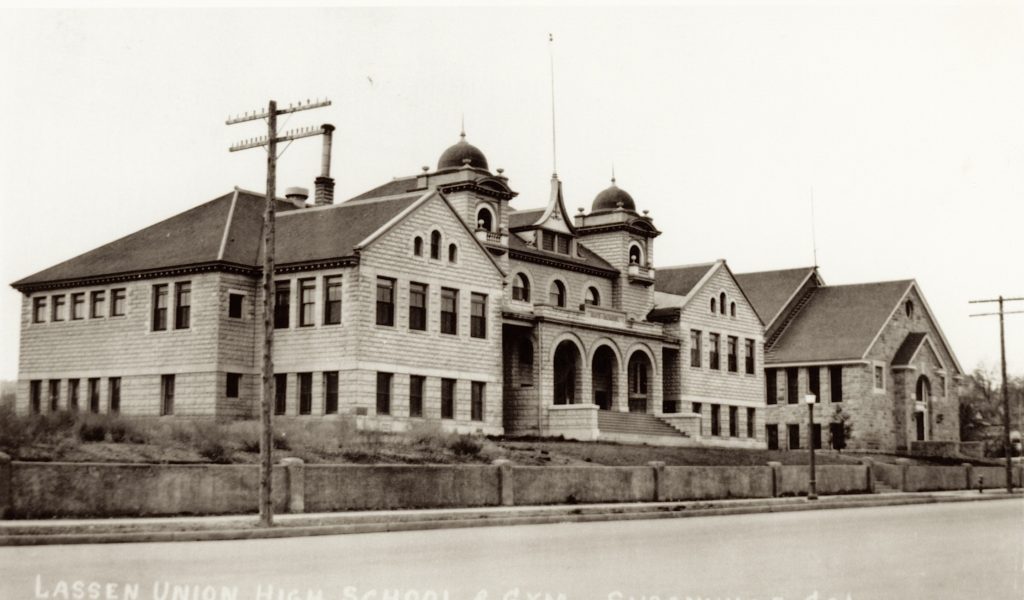
On September 14, 1903, the first session of the Lassen County High School was held. In attendance were approximately forty students, with two instructors, George Barton and F.C. Schofield, the latter also served as principal. In the summer of 1905, construction began on a high school, at a cost of sum $30,000. That iconic building on Main Street was torn down in 1968 and replaced with the current structures.

Subscribe

Lassen County Budget Crisis—Trim the Fat!

Lassen Union High School—Lola Tanner

In November 1931 a Lassen County Farm Bureau committee was formed to see how to make cuts to the expenses of Lassen County government. One of their first recommendations was to make the Lassen County Assessor personally inspect every tax payers property to make sure nothing escaped assessment.

It was education they really set their sights on. J.H. Hunter of Westwood stated that 32 cents out of every state dollar went to education. It was Hunter’s opinion that colleges were turning out so many yearly graduates who could not find employment.

J.A. Pardee chimed in with his two-cents worth. He thought community colleges were a waste of time and money. Its was Pardee’s thought that a grammar and high school education was more than sufficient and that higher education was not necessary. Their consensus, “We are spending hundreds on ten-cent kids.”

Subscribe


A County Seat Proposal

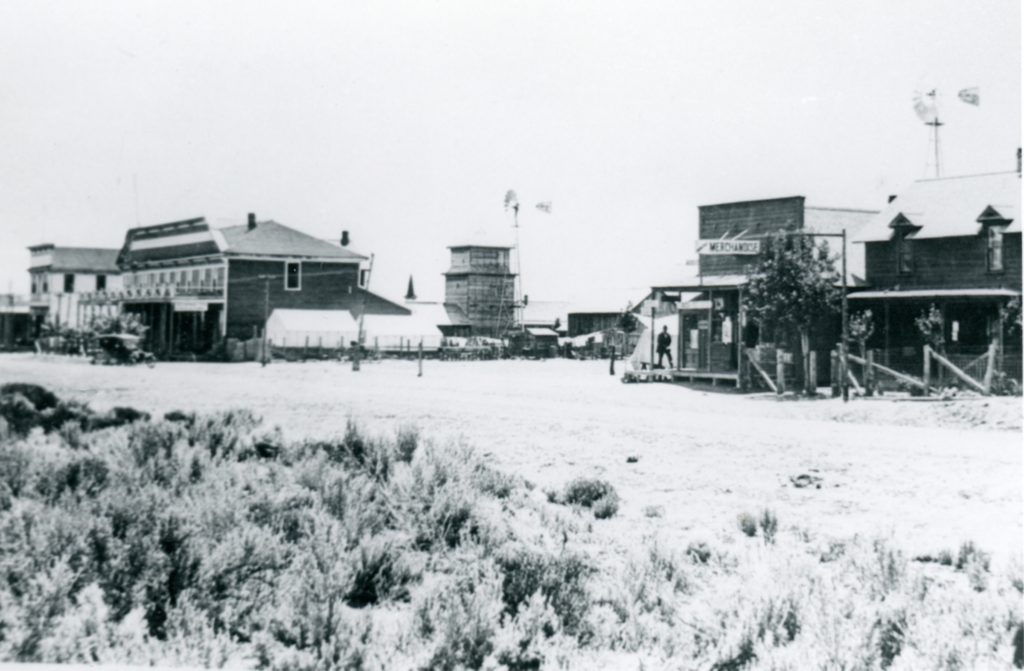
Standish, 1910–Prentice Holmes

The May 1907 meeting of the Lassen County Board of Supervisors was a lively one. The hot topic was a new county jail and courthouse. The board received numerous petitions from throughout the county. One common thread that residents was for better roads. Many thought the county should be investing in a rock crusher and replacing wooden bridges with steel. There was, of course, resentment from the public who resided far Susanville over the cost of the newly established Lassen County High School.

The petitions from Bieber and Standish had another odd twist. Both petitions urged the board that the county seat be relocated. It was their opinion that Standish be made the county seat on the grounds it was more centrally located. The board took no action on these topics. In addition, it would be some time before the board would even bring up the topic of a new jail and courthouse.

Support

Koken For Assessor

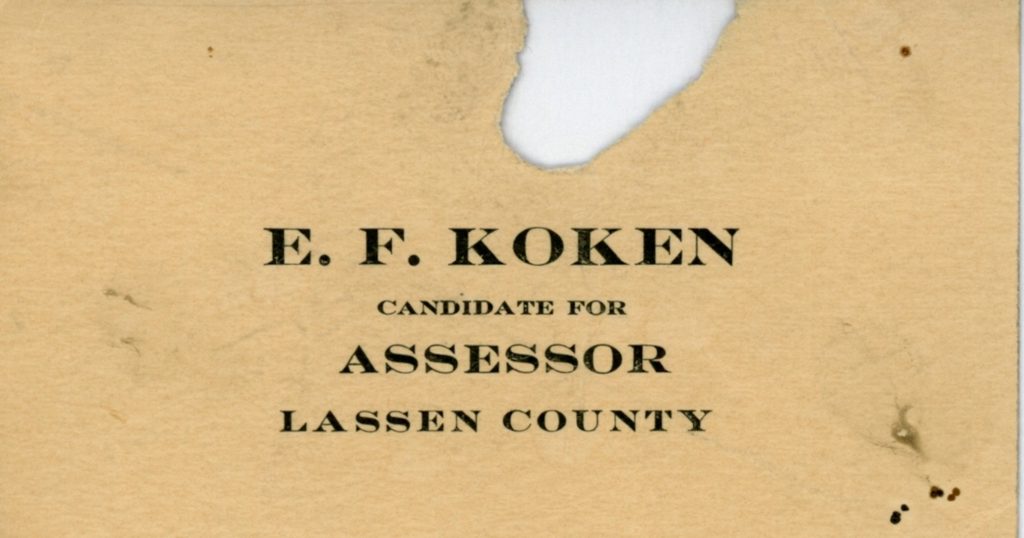
Koken’s politcal hand out card

This is an accidental post, if there ever was one. Last December while in the garage to work on the Triumph, this came out of the owner’s manual. How it found its way there I do not know. Several months later  while researching a 1926 topic, is when I stumbled across where Elmer Koken was a candidate for Lassen County Assessor.

In 1891, Koken came to the Honey Lake Valley from over the mountain from Taylorsville. He was involved in many activities  and at one time managed the Standish Creamery. He entered politics in 1922 and was elected District Three, Lassen County Board of Supervisors. Four years later, he set his sights higher, instead of running for re-election as Supervisor, in March 1926 he took out papers to run for Lassen County Assessor. He was soon followed by Milford resident, Lyman Stiles. Next to enter the race was Frank Wemple. During the primary, the race was whittled down to two—Koken and Wemple. In the general election, Frank Wemple was victor, who would be re-elected to four additional terms. While Koken lost the election, he eventually found employment with Lassen County as its first Purchasing Agent.

Tim


The Roop Land Register

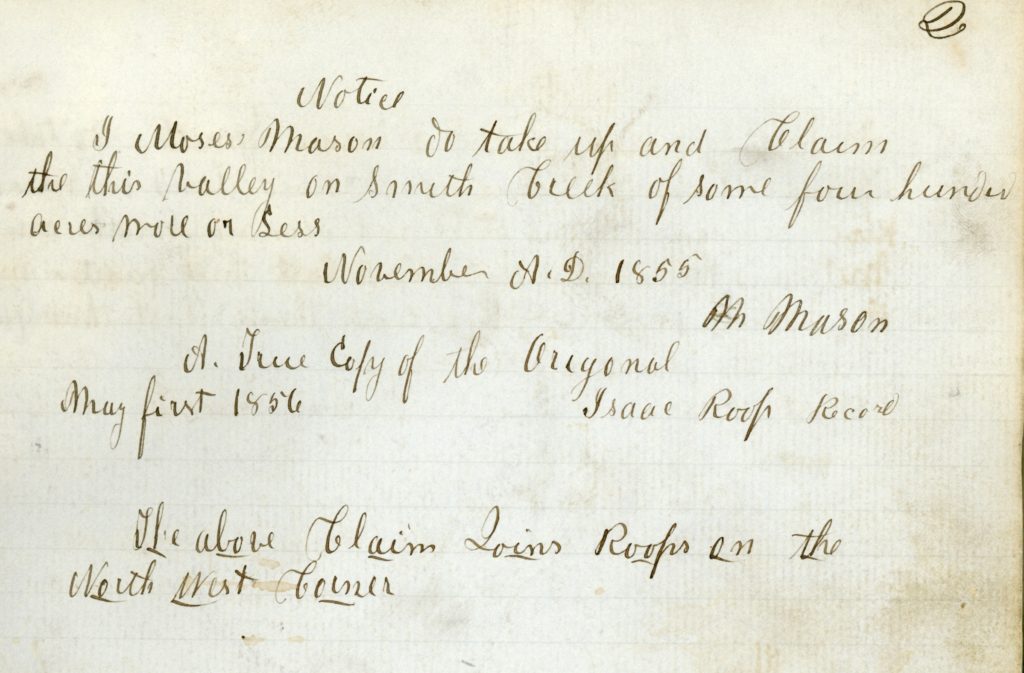
Moses Mason was the second claim recorded in Roop’s Land Register. He settled on present day Susanville Ranch Park and referred to Piute Creek as Smith’s Creek.

In the spring of 1856, with settlers arriving in the Honey Lake Valley they realized they needed to form some type of self-government. They did not believe they were part of California and did not want to be a part of the Utah Territory, there was no Nevada then. On April 26, 1856 a group of twenty-men assembled to form the Territory of Nataqua.

As to land matters, any male twenty-one years or older could claim 640 acres of land to be recorded with the Recorder, which Isaac Roop assumed that role. A number of claims had vague descriptions. Whatever, the case may be, it worked for them. In 1857, some individuals began documenting their claims or the sale of such in the form of a deed with the Plumas County Recorder. By 1859, a few hardy souls ventured all the way to Marysville to file a claim with the United States Government Land Office, the nearest one available. By 1861, the Roop Land Register was rarely used.

When Lassen County was formed in 1864, the original County Board of Supervisors did something unique. They paid Plumas County to transcribe all land transactions of Honey Lake and Long Valleys prior to the formation of the county.  This is why Book A. Deeds, Lassen County starts in 1857.

Subscribe

Lassen County Courthouse Square

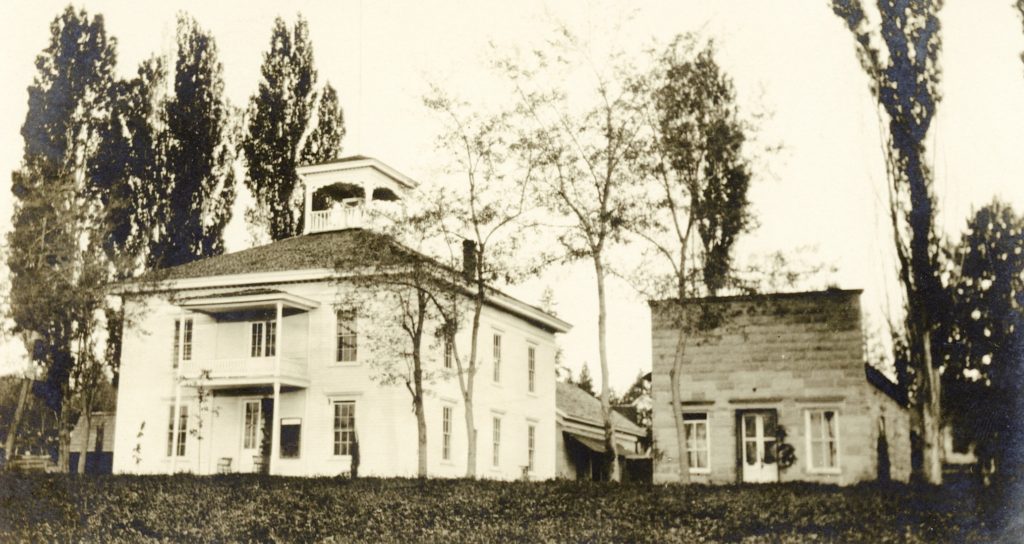
Lassen County Courthouse and Hall of Records, 1908–David Zoller

On June 18, 1864, the County of Lassen purchased Block 22, in Susanville for $100 from Isaac Roop. It was the only block on the south side of Main Street that was not subdivided into lots. It should be noted that many lots on Main Street sold for more than $100. In many ways it was a fair price. It did contain a stipulation that should the county no longer use it for a courthouse that the property would revert to Roop or his heirs. This was not unusual, as a number of school properties such as Lake and Willow Creek contained such stipulations, but when those properties were no longer used for their original purpose the stipulation was ignored. However, in the late 1970s Lassen County acquired property on North Mesa Street, in Susanville, as a possible new County complex site. When the courthouse stipulation was revealed it brought about some palace intrigue, especially since heirs of Roop still resided in the community. However, the Mesa Street proposal would be abandoned, thus ending that debate. The county could have challenged that stipulation and would have won, because Roop never owned the property in the first place. More about that later.

Support