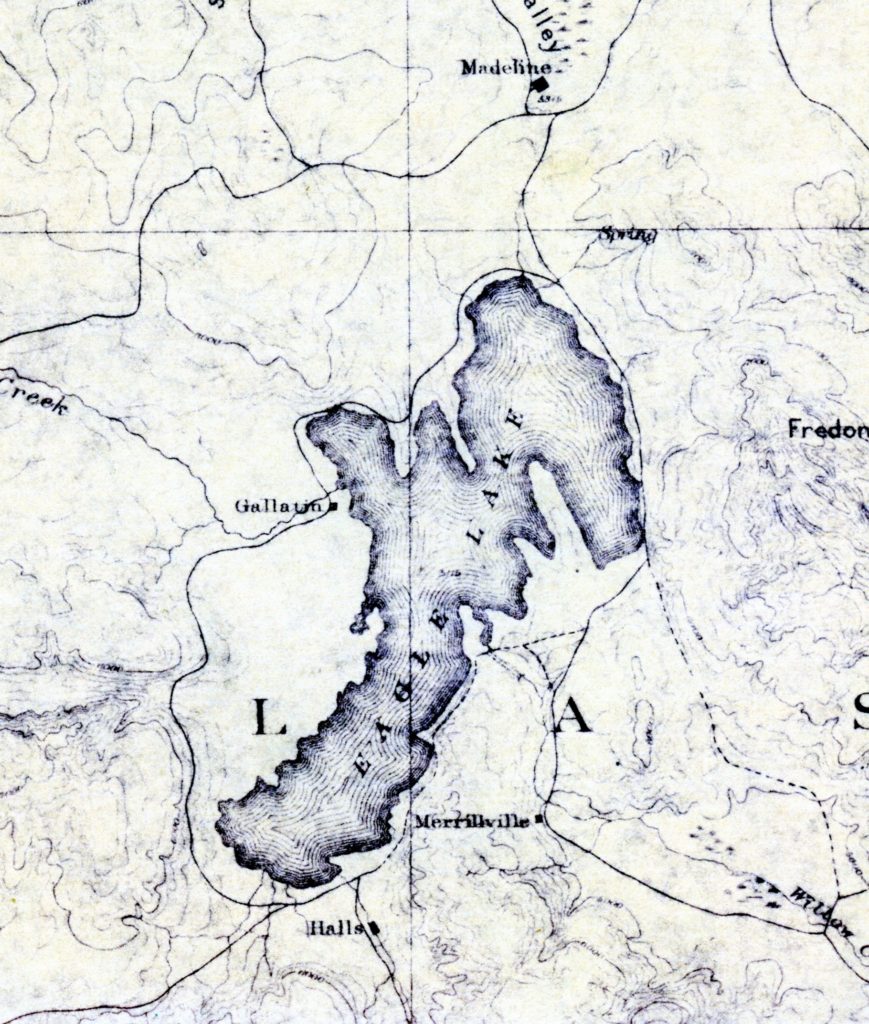
Some might be interested in this map of Eagle Lake. No doubt, there might be a few folks, who think that the cartographer had gone mad. I can rest assure you that was not the case. In the modern era, the Gallatin name has always been synonymous with the south shore of the lake. As one can see from the map, the south shore was referred to as Halls in the late 1800s. It was so designated as Wright P. Hall, a Susanville resident and well known Lassen County public figure, owned Papoose Meadows since 1876. Albert Gallatin’s, ranch manager Byron Bell had a sheep camp near what is known today’s as Spaldings. Prior to this, there had no designation for that locale. In 1914, things suddenly changed. Malvena Gallatin had a built summer home at the south end of the Lake. It was in 1914, the first Spalding subdivision was plotted on the west side of the lake.
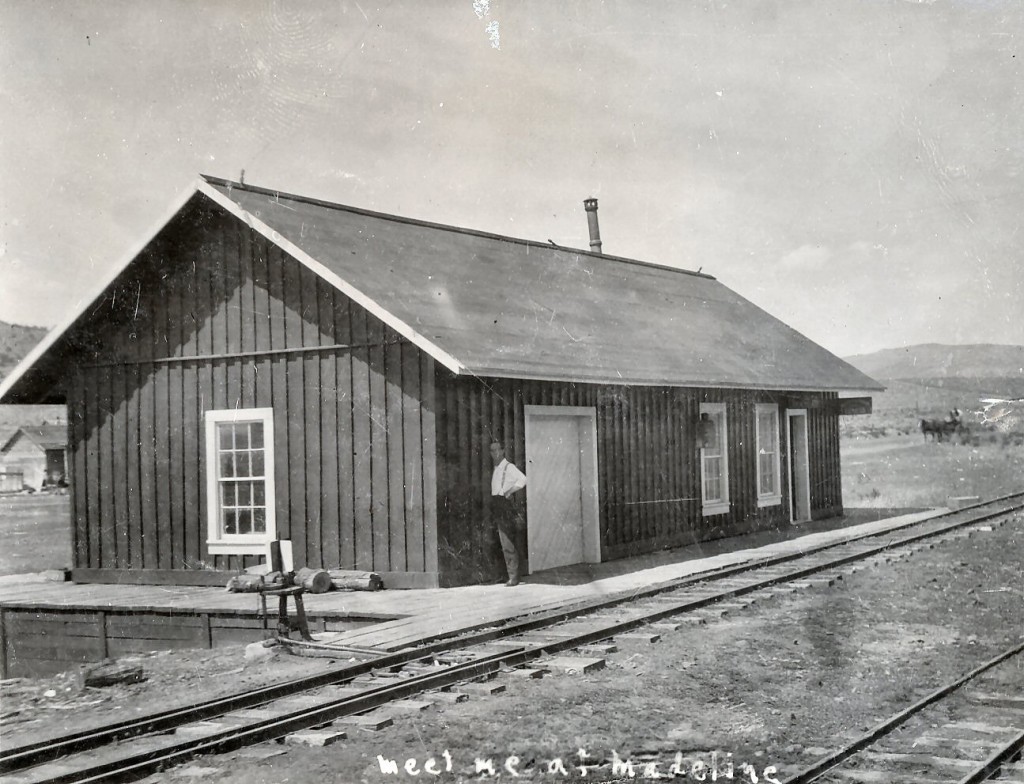
Another interesting note, is Madeline located in Grasshopper Valley. The first Madeline was established in 1870s as a stage stop to accommodate travelers to Hayden Hill and other points north. The Madeline we know today on the Madeline Plains came into existence 1902 with the arrival of the NCO Railroad, which was formally known as Van Loans.
Spread the word, and encourage a friend to subscribe
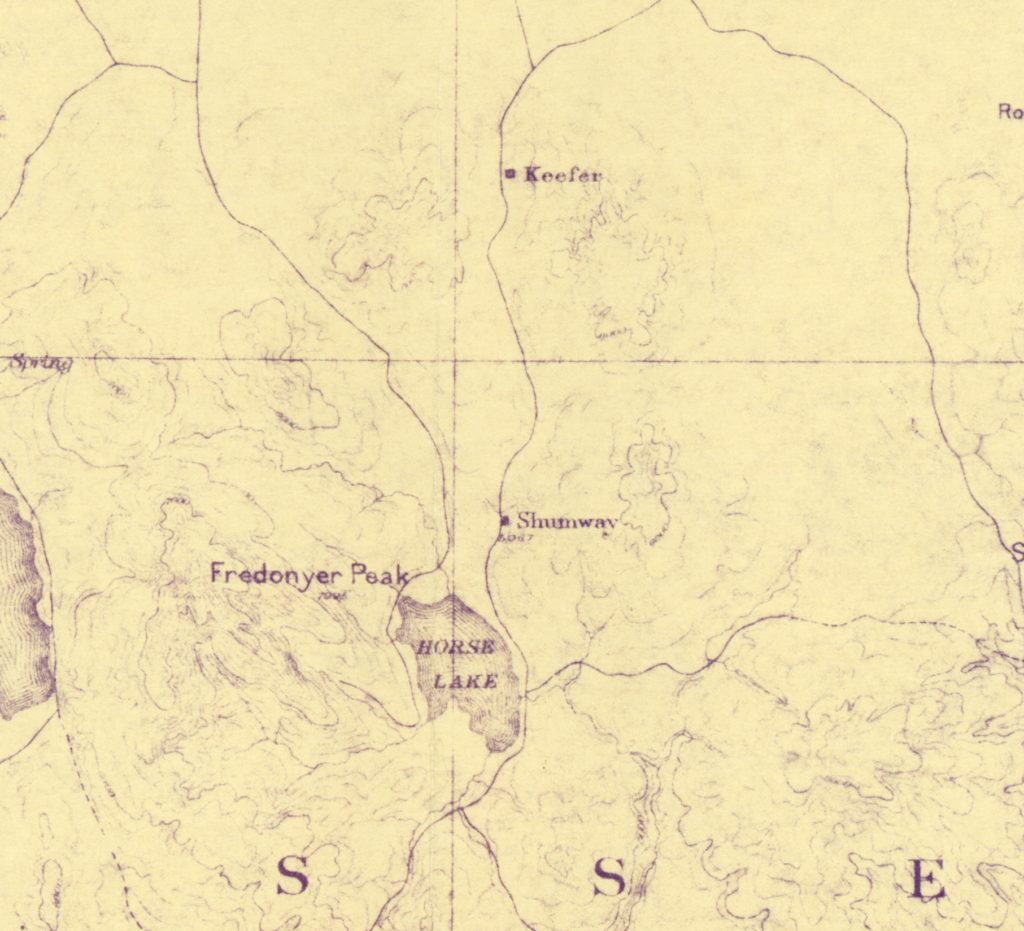
Keefer, on the edge of the Madeline Plains, was one of those lonely stage stations. In 1869, the most direct route to Alturas and Surprise Valley from Susanville followed a most interesting route. The road travelled north to Willow Creek Valley and onward to Horse Lake. It then veered straight north to the Madeline Plains. Let me inform the intrepid explorer, I traveled the route from Horse Lake to the Madeline Plains——its one of those roads you only do once.
On June 3, 1890, James Edward Keefer (1861-1916) purchased this stage station from Herman Knipping for $600. In 1898, the station had already been shuttered, and Knipping was residing at Vina, Tehama County when he sold the property for an undisclosed amount to Mahala Shumway. The station was also known as Knippers, Mud Springs and Long Hollow Camp..
Spread the word, and encourage a friend to subscribe
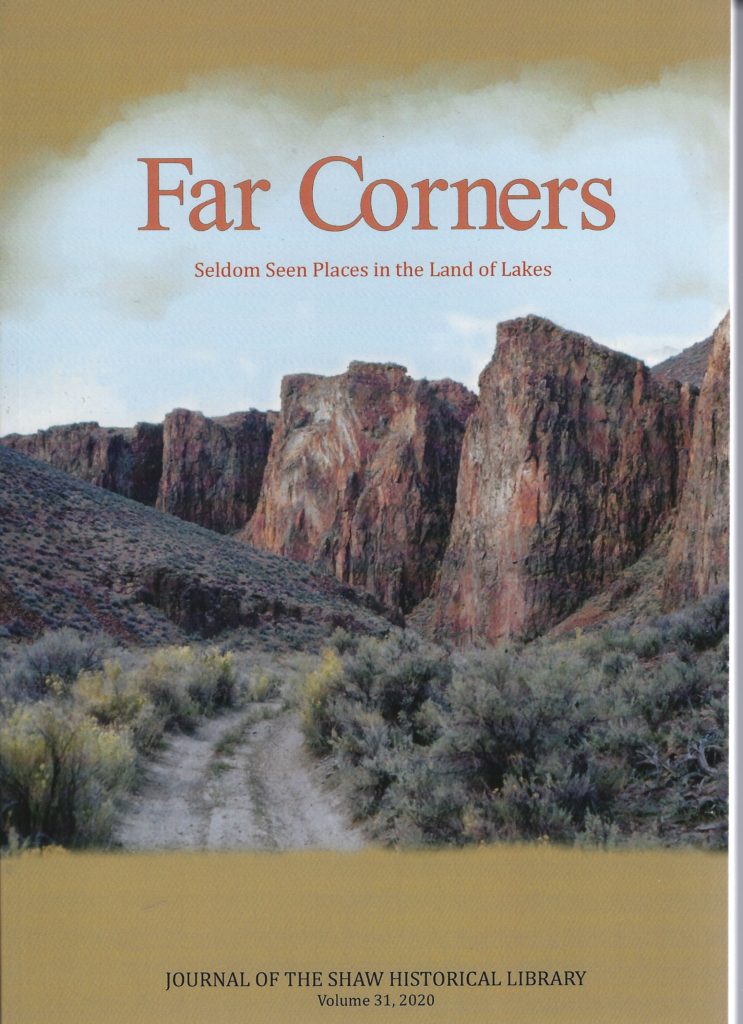
Seldom seen places, from forgotten settlements in northern Klamath and Lake counties to “Ghosts” of Crater Lake National Park and the Tri-Corners area where the states of Oregon, California and Nevada come together are featured in the newly released 2020 Journal of the Shaw Historical Library.
“Far Corners: Seldom Seen Places in the Land of the Lakes,” features stories by a variety of authors about settlements and communities that were or, in some cases, exist with small populations.
“We tried to include important historical sites, such as railroad stops, stagecoach stops, boat landings, military camps and ranches that played a noteworthy role in the development of the area,” Lawrence Powers writes in the introduction, which also includes a listing of 195 communities in the 11 counties in four states that are part of the Shaw’s “Land of the Lakes.”
Far Northern California is represented in stories about Picard, Clear Lake, Tionesta and Long Bell Camp and the Madeline Plains communities of Madeline, Termo and Ravendale by a variety of authors, including Powers, Ryan Bartholomew, Sylvia Copeland and Ron Hathaway.
The far Northern Klamath County communities of Mowich, Crescent Lake and Shevlin are featured in a trio of articles by John Driscoll while Stephen Mark, the historian for Crater Lake National Park, tells about “ghosts” at the park and writes about historic places in Malheur County.
Marie Lee, a Lakeview author of several historical non-fiction books who also is the Lake County Museum director, provides information about such little-known North Lake County settlements as Cliff, Arrow, Buffalo, Connley, Fleetwood, Viewpoint, Loma Vista and more. A separate story features Valley Falls.
A comprehensive history of commercial uranium mines that were located near Lakeview is provided by Michelle Durant, an archeologist for the Fremont-Winema National Forest.
Adding a unique perspective about Wagontire is Larry Wagner. His mother, Vera Addington Wagner, was born and lived at the community located between Lakeview and Burns.
Providing insight about Camp Warner, an Army post that originated at what is now the Hart Mountain National Antelope Refuge, is Dan Goheen while author John Griffin provides little-known details about the gunfight at the Shirk Ranch. Steve Kandra writes about the Civilian Conservation Corp’s Camp Klamath.
Stories by Lee Juillerat tell about Pla-ik-ni, the ancestral home of the late Edison Chiloquin, along with Hardin City and Lowell Jones’ memories of the Long-Bell logging camp and community of Tennant.
A goal of the Journal is to provide information on places people may or may not have heard about or visited. As Powers writes, “many small unincorporated communities thrive. A few have become famous as gateways to tourist attractions and events … some have persisted as stable communities without the benefit of an economic magnet, and other flourished for a brief time and disappeared.”
Copies of “Far Corners” are available at the Klamath County Museum and Basin Book Trader in Klamath Falls, Modoc County Museum in Alturas, Country Hearth in Cedarville, Howard’s Drugs in Lakeview, Margie’s Book Nook in Susanville or by contacting the Shaw Historical Library by email at shawlib@oit.edu or by calling 541-85-1686.
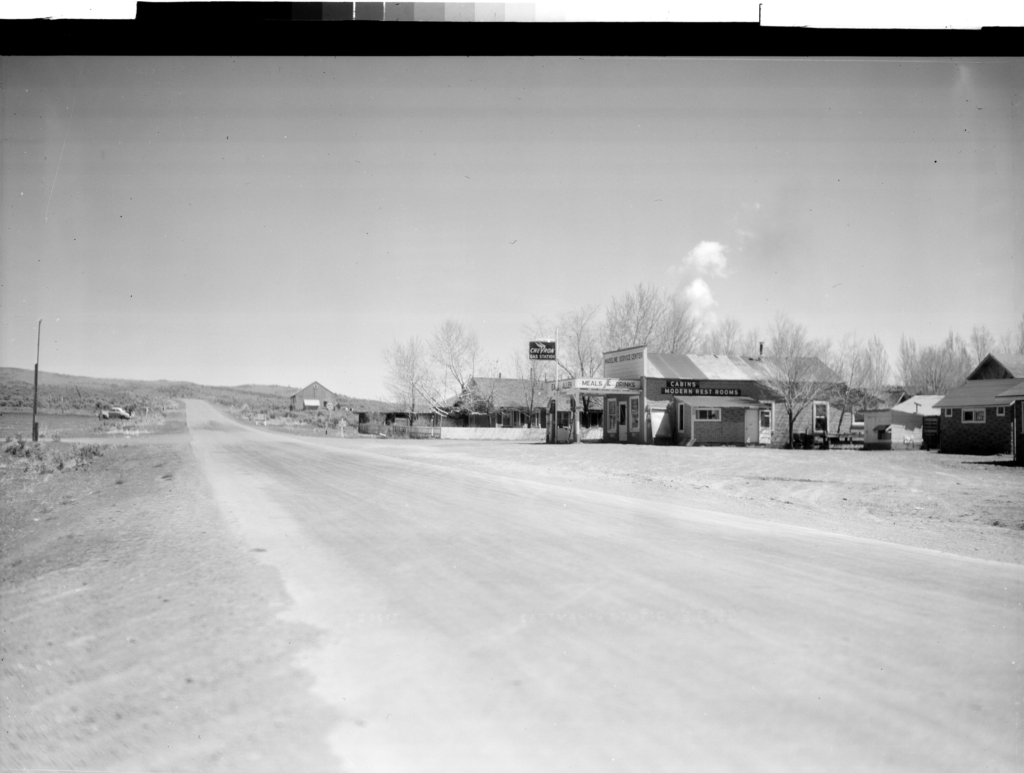
Madeline, Lassen County, 1948–Eastman Collection, U.C. Davis
In the late 1920s, the Southern Pacific Railroad was in a disarray locally, while they fought against the Western Pacific/Great Northern’s Inside Gateway link between Keddie and Klamath Falls. The Southern Pacific had a monopoly on the region and were in a constant flux to combat its proposed competition.
Take for instance in 1929, Southern Pacific greatly reduced its freight rates on timber products. In November 1929, Southern Pacific sent a survey crew out east of the town of Madeline. The surveyors job was to locate a possible line from Madeline eastward through Red Rock Valley and Tuledad Canyon with the ultimate goal towards Gerlach. This officials concluded that this 72 mile route, would save 120 miles to the Klamath Basin. Of course, it was never built, and in 1930 the ICC approved the competitor’s route.
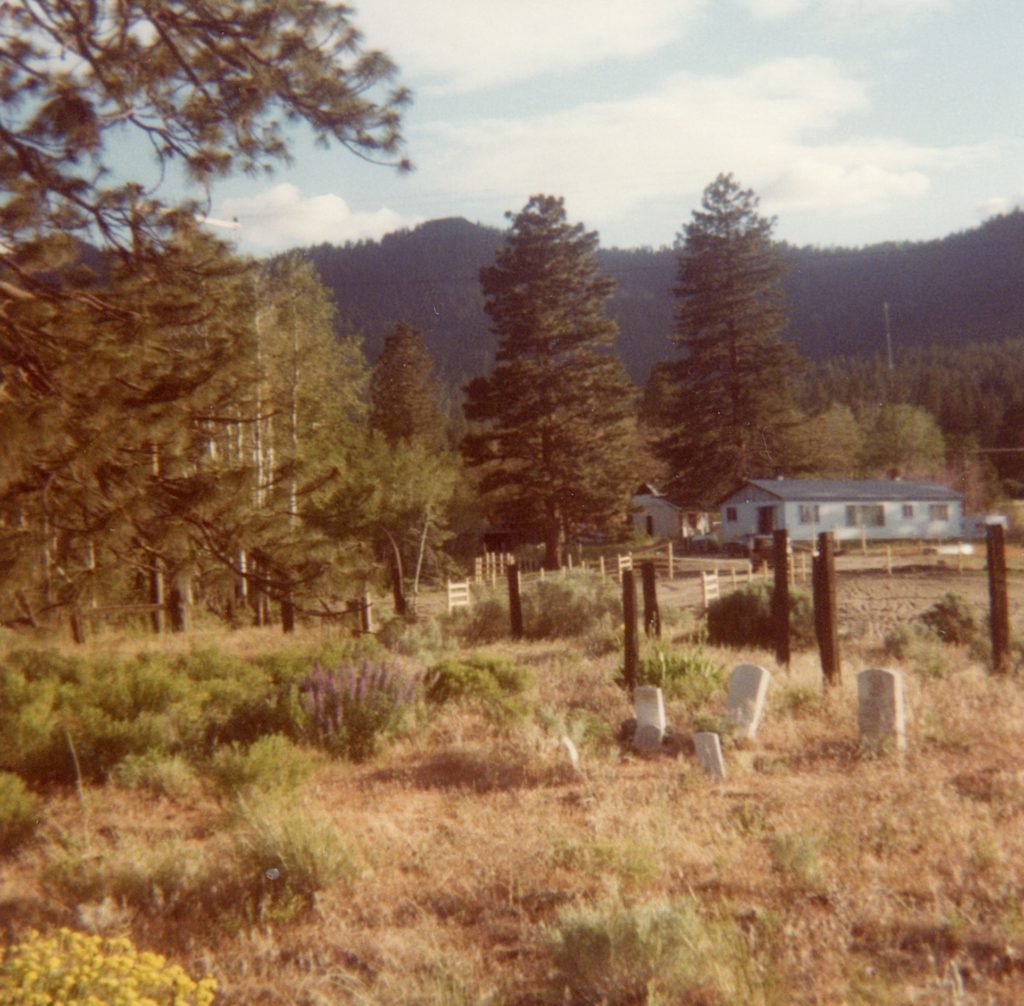
A reader wanted to know about the grave of Charles Crawford which inscribed on his tombstone “killed by Indians, May 21, 1858”. I will put together information about him and his gravesite, the Lake Cemetery, the oldest cemetery in Lassen County. Its my desire to go there a take current photographs, part of my recovery tour.
As to place names, I have done a lot on this topic. Alaska Canyon in the Madeline country has intrigued me as to why it was so named. In addition, its one place that I have never been to. Another Madeline Plains name is that of Skeleton Flat (Section 26, T 36 N R14 E, MDM). According to some, its origin were a result of the Pearson Massacre that occurred near Amedee in 1868. The Pearson Massacre was the last major Indian/White conflict in the region. It was followed by numerous campaigns by the settlers to exterminate any Indians associated with the Massacre. As the story is told, a posse encountered Indians there and killed them. The skeletons, and later scattered bones, could be seen for many years after the event.
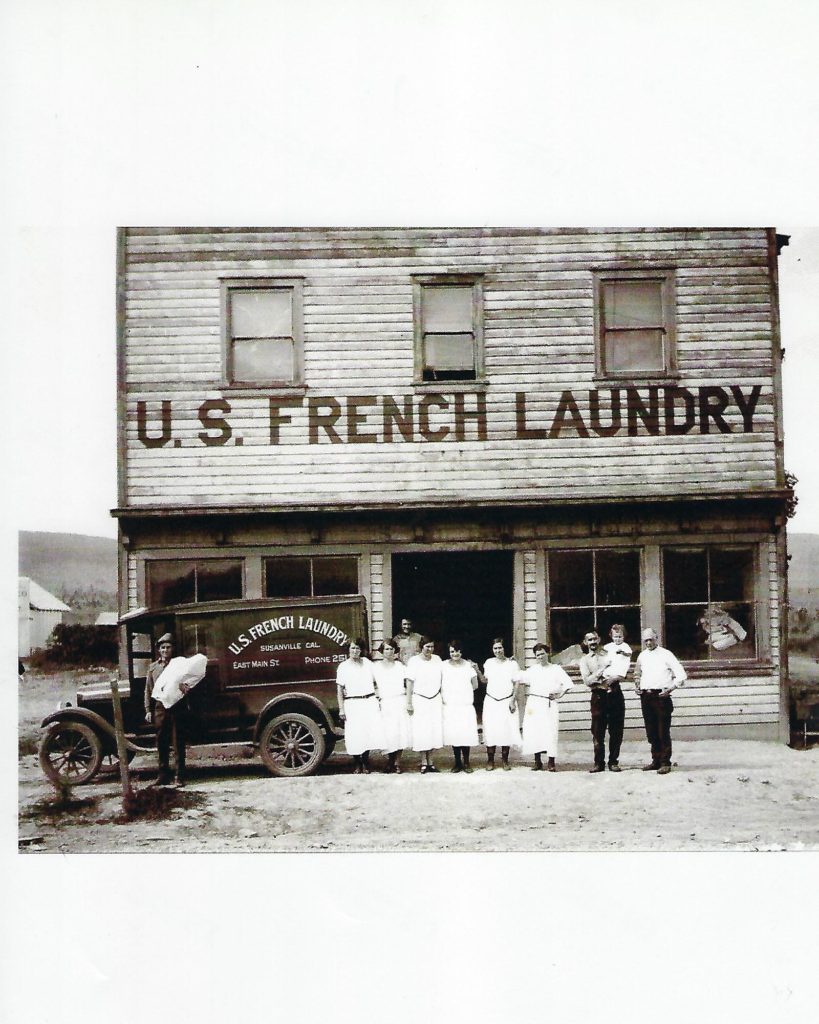
This is a work in progress, since it is something that I am still researching. The U.S. French Laundry was located on the northwest corner of Main and Mesa Streets or 2319 Main Street. It was established some time in the mid-1920s and was still in operation in 1935. It is interesting to note that Susanville was able to support three laundry/dry cleaning establishments. For a brief time it was owned by Jean Boulade, who prior to his move to Susanville was a resident of the Madeline Plains and at one time was the postmaster at Termo.
In the early 1900s the Madeline Plains was home to numerous desert homesteaders. It turned out for many to be a hardscrabble existence, not what they were promised by the developers.
Life on the plains can be challenging. A menace there were jackrabbits. In 1920, the residents wrote their Congressman John E. Raker for assistance and explained the situation. They reported: “As soon as the crops are up and making good progress the rabbits begin work on them. The heaviest damage is done during August. One rancher reported losing 100 acres of wheat last summer. They take this crop in preference to oats and rye. It was reported that 70 tons of rabbit meat [to make tamales] had been shipped last season to the San Francisco market. It appears that the animals cannot be killed fast enough in this region to furnish relief to the ranches.” That is not a typo, 70 tons—the rabbit population had to be epic.
Now to the tamale part. It is not clear who came up with idea of jackrabbit tamales. Don Garate in his history of the Madeline Plains wrote: “Oh they did not make any great deal of money by hunting jackrabbits, but it made a little cash for spending. What they did was to kill the creatures and ship them to the Crown Commission Company in San Francisco, where they were made tamales out of them. The Crown Commission Company paid as high as four dollars a dozen for them. After shipping and handling charges had been taken out by the railroad that left the hunter about two dollars a dozen.
“Two dollars a dozen does not sound like much, but money was real scarce in those days and it did not take long to knock over a dozen of jackrabbits. They would shoot the animals, gut them and put them in gunny sacks. The rabbits would freeze solid in the sacks. Then when they had enough, or after awhile when someone was going to town, they would haul them to the railroad depot.
“The sacks full of rabbits would pile up on the dock at the depot until there was enough to make a shipment on the train. After a couple of weeks, a check would come back in the mail from the Crown Commission Company for each person who sent in a shipment of jackrabbits.”
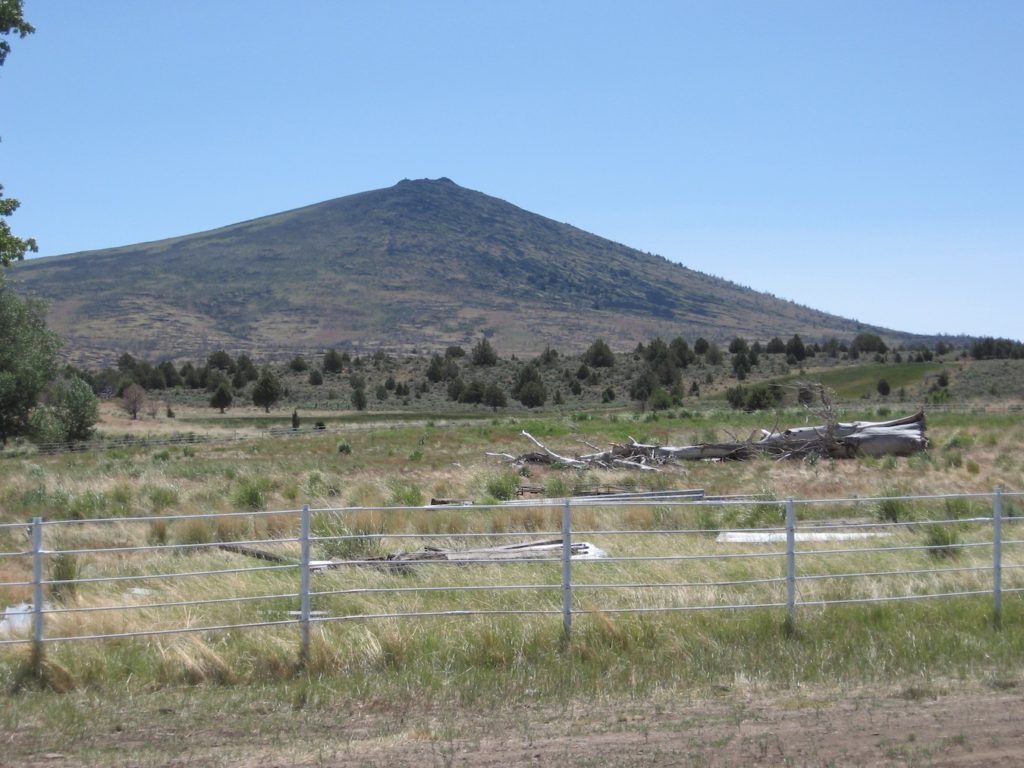
Located on the south side of the Madeline Plains, the Paiute Indians referred to it as Toka kudzi ni roughly translates into Black Peak.
Observation Peak, elevation 7964’, was so named for the views afforded from there. On September 29, 1850 J. Goldsborough Bruff and Isadore Meyerwitz climbed to the top. Atlas Fredonyer had visited there in the summer of 1850 and noted the peak by its name. On June 22, 1854, members of Lt. E.G. Beckwith’s party in search of a transcontinental railroad route climbed the peak. The mountain is sometimes referred to as No. 7. On the southwest flank there is a volcanic rock formation in the shape of the number seven that can be seen clearly as far away as Leavitt Lake.
Rager Reservoir is a small body of water located in the eastern Madeline Plains (Section 24, T. 36 N. R. 15E). It was built in the early 1900s by Thomas Rager, a resident of the Madeline Plains. A native of Illinois, Rager first came to the region in 1879 working as a cowboy for the Smoke Creek Ranch. By the 1890s, he set out of his own on the Madeline Plains where the lived the rest of his life and passed away in 1925.
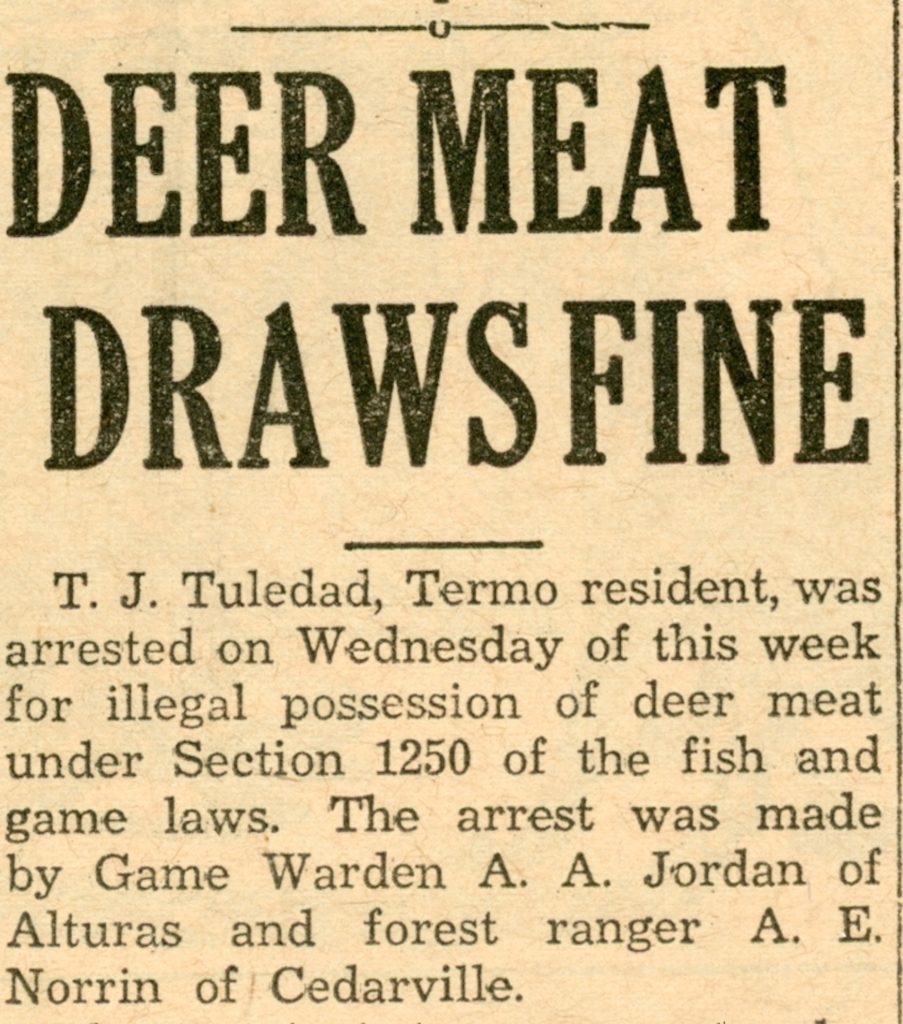
It is one thing to come across the surname of Tuledad, but it is another when one with the last name resided in proximity of Tuledad Canyon, east of the Madeline Plains.
As the newspaper indicates, T.J. Tuledad was a resident of Termo when he was charged with illegal possession of deer meat. When he appeared before Justice of Peace, George Wood, in the Madeline Township, he pled guilty as charged. His sentence was a $50 fine or ten days in jail. Tuledad opted for the bastille in Susanville.