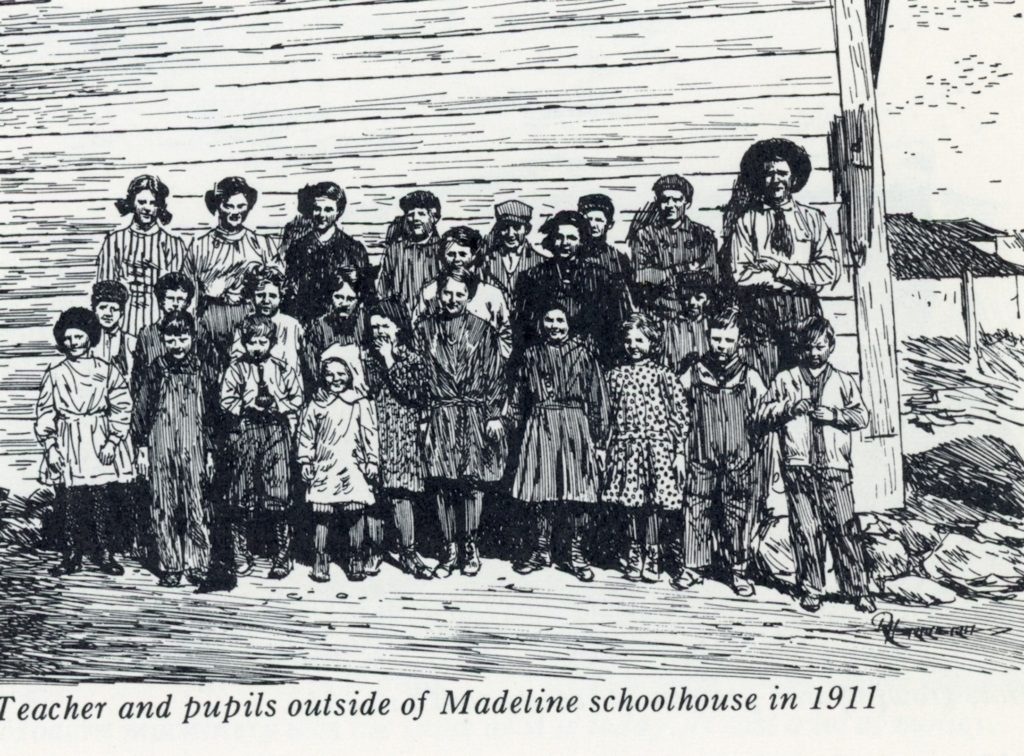
While the vaccination debate rages on, I thought I would share this early day observation from Margaret “Peg” Woodrich of the by gone days on the Madeline Plains. She compiled a small history, “The Early Days of California’s Madeline Plains.” She wrote: “The teaching methods of those times are long since forgotten. Each schoolroom had in its entry a bucket of water and a tin dipper from which all the youngsters drank, exchanging measles and whooping cough with democratic cordiality.”
In 1968, the Occidental Petroleum Company purchased a large portion of the lands owned by the Rees T. Jenkins Land & Livestock Company. On the west side of the Madeline Plains, they subdivided thousands of acres into 20-acre parcels they named Moon Valley Ranch. The first unit was recorded on July 12, 1968. The Company’s advertising of the region made it too good to be true. “Now you get it all at Moon Valley Ranch: prime recreation land, within 4 miles of a 2,500 acre lake, in Northern California, the next recreational capital of the West and profitable investment property almost certain to appreciate as California’s recreation-hungry population continues to explode . . .And what a price now you can buy 20-acre parcels for less than $199 an acre–$150 down, $29 monthly.” Their portfolio expands on all the nearby wonderful recreational areas, such as skiing and golfing at Westwood, though they did not mention that Westwood was some seventy miles away. Also they did not disclose the fact that the golf course at Westwood was only proposed. The Company was correct in their advertisement that is was “The magnificent, away-from-it-all Moon Valley Ranch” to “land-that-time-forgot.” Moon Valley Ranch is a perfect example why there are disclosure laws in the real estate industry today. Numerous folks still invest in that property, purchasing parcels site unseen, only to realize that they bought a lot on a sagebrush plain or a rocky hillside covered with juniper trees.
There was time, that Ravendale on the Madeline Plains was more than a wide spot on Highway 395. Like so many locales, it had experienced some interesting times.
One of these accountss involved the Ravendale Elementary School during the 1938-39 school year. Frances O’Brien had a contract to teach school that year for $1,320. When the school opened in the fall, six students had enrolled. The enrollment then dropped to four, and then to two, and by January 1939, there were no students. The trustees questioned whether they were obligated to pay O’Brien’s contract since there were no students. The matter was referred to California Attorney General Earl Warren. Warren informed the trustees that they had to pay O’Brien’s contract whether she had any students or not. Warren did state that the trustees and O’Brien could negotiate a compromise. Whatever transpired is not known. The school re-opened in the fall of 1939, with thirteen students. However, Emma Metcalf replaced O’Brien as the teacher.
Seasoned California residents know that not only did Attorney General Earl Warren later became the Governor of California, but he went higher up on the ladder and became the Chief Justice of the United States Supreme Court.
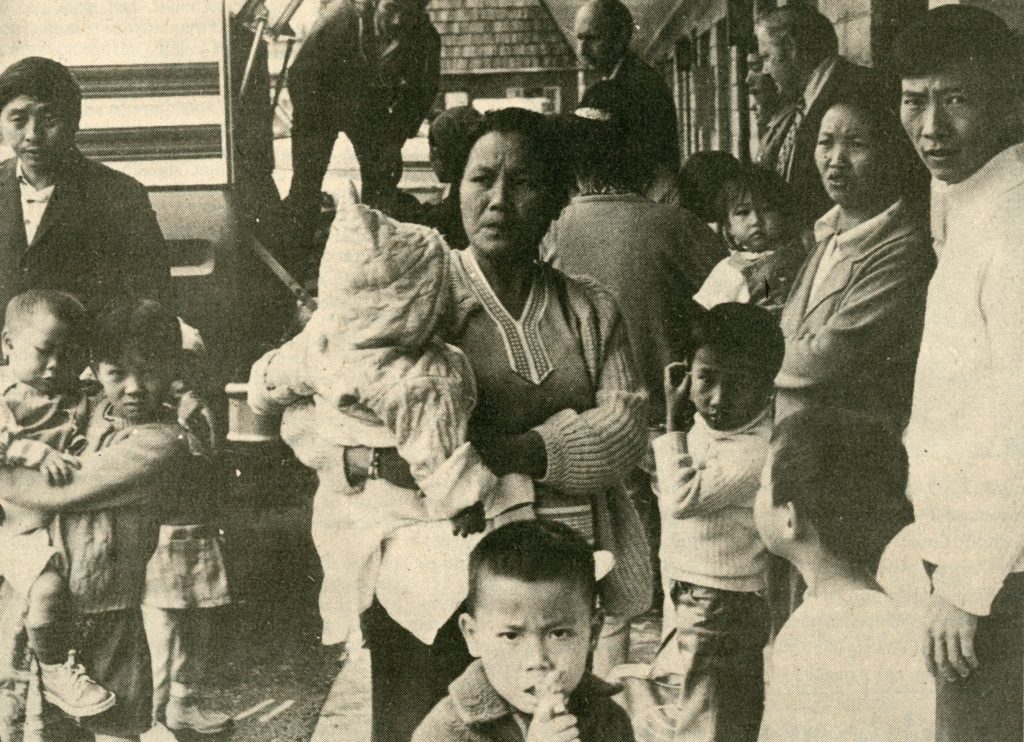
The Laotians waiting for a bus to transport them to San Diego on September 15, 1976.
On the Madeline Plains, one just never knows what to expect, especially if it included well-known rancher, John Casey. Seasoned residents are familiar with his many antics, and this particular episode garnered national attention.
The tale began to unravel when Bill and Florence Anderegg, caretakers of the Dodge Ranch in the eastern section of the Madeline Plains brought 13 Laotians to Lassen Memorial Hospital for medical care. Lassen County Welfare Director Marty Herzog was notified. Herzog in turn contacted the Northern California Emergency Team out of Redding and on September 2, 1976 they visited Dodge Ranch to find 27 Laotian refugees there, who were in dire straits. Fortunately, Vang Song, was the only Laotian that could speak English. The Laotians were bused into Susanville, where they were given additional medical care, clothing, food and shelter. By mid-September the Laotians were transported to a refugee camp near San Diego, so they could find jobs and sponsors. When John Casey was questioned about the Laotians, he pled ignorance, even though according to Vang Song, Casey was their sponsor from Thailand.
With the passing of former Nevada Governor and U.S. Senator, Paul Laxalt on Monday August 6, 2018, many may not realize that family is part of the heritage of the Madeline Plains. Dominique was the youngest of the three Laxalt brothers who had various interactions on the Madeline Plains. Unlike his brothers, Dominique was a true tramp sheepman (though many today use the term itinerant instead of tramp). Dominique would take his band of sheep and move them place to place in search of feed and water. Other Basque sheepman, like his brother, Pete, eventually acquired a home place. During World War I when sheep and wool price went soaring, Dominique and fellow Basque sheepman, Pete Etchecopar formed a partnership. It was during this time when Dominique married Therese Alphetche in Reno, where he moved. In the early 1920s, when wool prices crashed Dominique, Therese and their infant son, Paul, returned to the Madeline Plains. While residing there, the second son, was born, Robert, who became the well known author of Sweet Promised Land. Things did not work out well on the Madeline Plains and Dominique moved his family to Carson City, and started a new chapter in his life.
While Ravendale appears these days as a wide spot one passes through the Madeline Plains, that was not case over one hundred years ago. An interesting note is that it was a decade after the NCO Railroad built its line through there that a town came into existence. In the early 1910s, the town flourished. In 1914, it formed its own Chamber of Commerce. This was used as a vehicle to promote the town next year at the Panama Pacific Exposition in San Francisco. It met with little success, end of story.
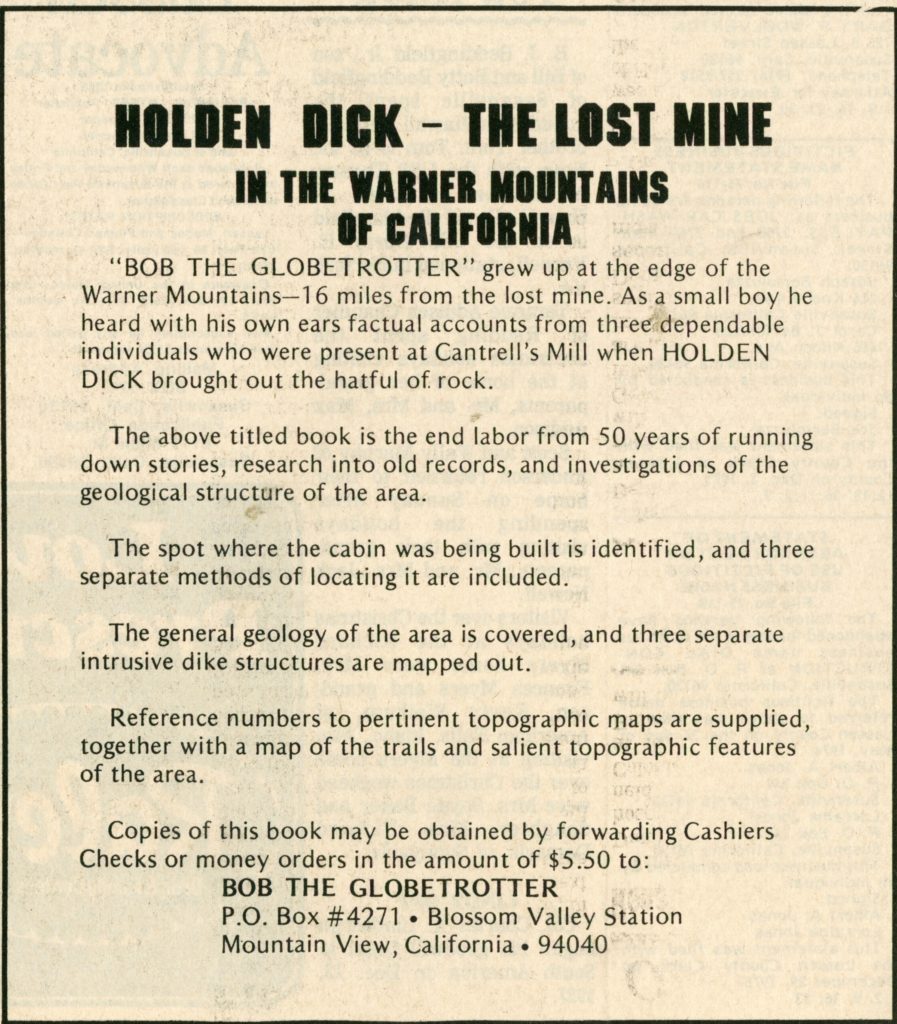
Throughout the American West most every region has some sordid lost gold mine tale, and the region around here is of no exception. Of course, over the years the story takes on a life of its own. Holden Dick was a Pitt River Indian who in 1885 was tried for the gruesome murder of Samuel Shaw on the Madeline Plains. Some attribute that it was not actually a mine, but loot from a freight wagon loaded with gold that was robbed when it traveled through Modoc County. Whether Holden Dick was perpetrator is not clear. Whatever the case may be, the gold was hidden in a cave in the South Warner Mountains. Anyhow, from time to time, Holden Dick would show up in the streets of Alturas and Susanville with gold. Where it came from he never said, and he took his secret to grave when he was lynched in 1886. To add more intrigue there is his lost map. Some sources indicate Holden Dick had a map where his bounty was located and he gave it to defense attorneys, Ephraim Spencer and John Raker. What became of the map is pure speculation. The bottom line, to this day, there are people still looking for the elusive mine.
The site of the original McKissick Ranch on the Madeline Plains.
The desert homesteaders of eastern Lassen County encountered numerous problems in their quest to make their land there productive. One unassuming predator they had to deal with was the rabbit. In 1920, the residents of the Madeline Plains requested aid from their Congressman, John E. Raker, to help them with this particular problem. A study sent to Raker reported: “As soon as the crops are up and making good progress the rabbits begin work on them. The heaviest damage is done during August. One rancher reported losing 100 acres of wheat last summer. They take this crop in preference to oats and rye. It was reported that 70 tons of rabbit meat [to make tamales] had been shipped last season to the San Francisco market. It appears that the animals cannot be killed fast enough in this region to furnish relief to the ranches.”
Early day Ravendale. Courtesy of Dorothy CapezzoliShould you happen to find yourself on the Madeline Plains today stop by the Ravendale Post Office and say hello to Nancy Rendel, Postmaster. On this date in 1910 the post office was established with William B. Edwards as its first postmaster. Times were tough on the Madeline Plains during World War I which depopulated the region. The Ravendale Post Office closed on November 15, 1920, though with good fortune it re-opened on May 19, 1921.
The landmark Termo Store.Termo came into existence with the arrival of the NCO Railroad. The post office was first established on September 18, 1900, with Edmund Welch as postmaster. The post office then was discontinued on August 1, 1908, because the small community suffered from illusion of grandeur that never prevailed. With the arrival of new homesteaders, the post office was once again re-established on September 2, 1915. On January 31, 1989, postal officials from Reno, Nevada inspected the premises. They feared that due to the snow and ice accumulations on the building that it might collapse, creating not only hazard to the postmaster, but to the patrons as well. On February 2, 1989, the post office was officially closed.