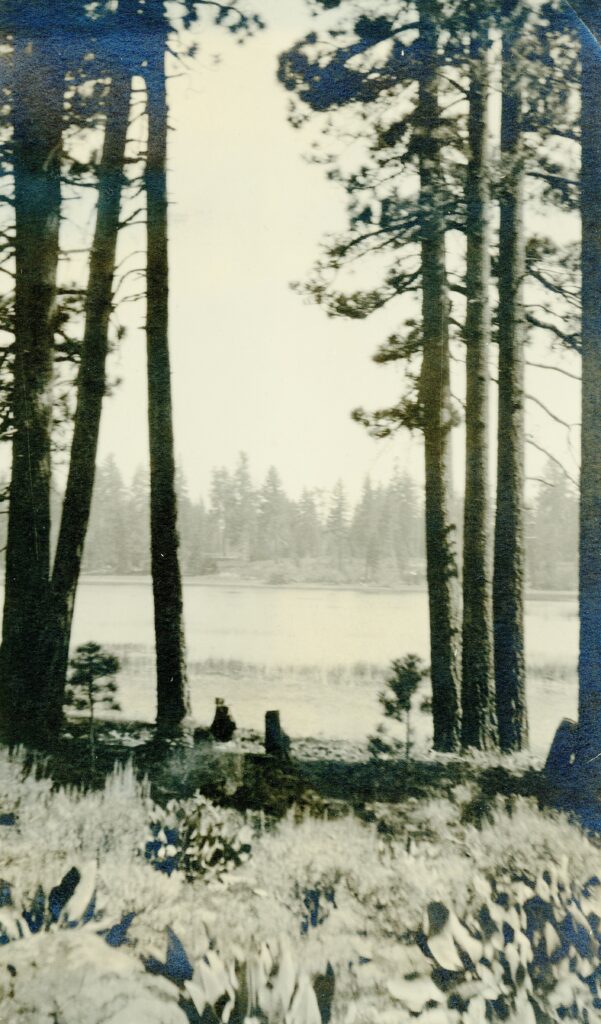
Crater Lake is located seven miles east of the Bogard Rest Area on Highway 44. In 1907, Lassen National Forest Supervisor, Louis A. Barrett, included this lake in his inventory of proposed National Monuments, the other two being Lassen Peak and Cinder Cone. The lake remained inaccessible for years, except for hardy hikers who climbed the mountain. In 1952, the Fruit Growers Supply Company constructed a logging road to the 35-acre lake that is situated in a volcanic crater, on lands owned by the Lassen National Forest. The Forest Service originally proposed to offer summer home sites, but established a campground instead.
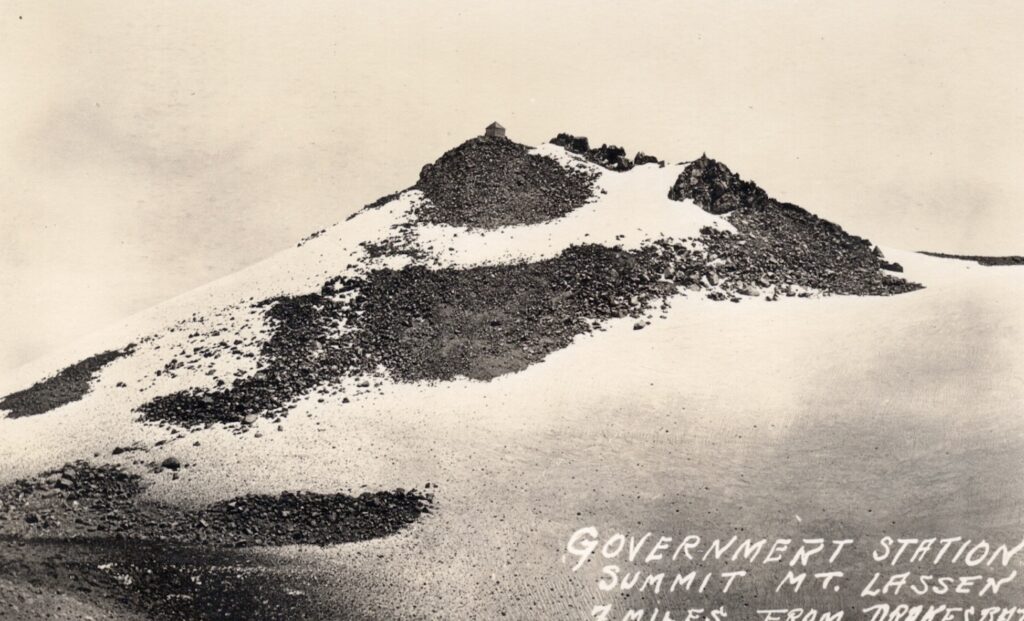
This is a rare view of the summit of Lassen Peak. First is pre-eruption and second is the forest service lookout that only existed in 1913 and 1914.
Prior to the creation of Lassen Volcanic National Park, much of the domain was under the jurisdiction of the Lassen National Forest. Since the peak was the highest point on the Lassen Forest it was only natural that it was the site for its first fire lookout. In the winter of 1912-13 Lassen Forest Supervisors, L.A.H. King designed a collapsible building that could be easily taken apart, transported and reassembled. In most cases these portable lookouts could be hauled by pack animals. The small structure measured ten feet long by six feet wide. Two were built that winter, with one destined for top of Lassen Peak. In June 1913, mules were used to pack the lookout building for Lassen, at least to its base. At that point, man was designated the beast of burden. It took four men two days and sixteen trips to log all the pieces and the sparse furnishings to the top of Lassen. Its first and only occupant was W.H. Packard of Woodland.
Since the eruption of May 31, 1914 and subsequent ones Packard’s services as a lookout attendant on Lassen Peak for 1914 were not needed, for obvious reasons. It was remarkable how well the lookout held up through the summer. On September 13, eruption number 52 greatly damaged the structure. Nine eruptions and seventeen days later it was gone.
The above title was from the headline of the Lassen Mail. It was misleading, since the local Paiute tribe would not be involved in managing the forest It would be a chamber of commerce committee called the Piute Conservationists to undertake the task. It began at the October 1931 meeting of the Lassen County Chamber of Commerce that was largely devoted to fire prevention and suppression. The organization stressed that light burns be conducted in the spring and fall. They drafted a resolution to be sent to Congress about this issue. The following was the opening statement.
“Whereas the United States Forest Service in adopting policy of fire prevention and suppression at all seasons of the year has not assisted nature, but prevented it from fire proofing the forests and because of the fact that the natural elimination of debris by decay is too slow to keep pace with the rapid accumulation of highly inflammable rubbish., time will prove, and is proving, that the accumulated mass is go great that no human means can cope with the terrible force of a present day fire under unfavorable conditions.”
While group commended the forest service for its fire prevention and suppression during the summer months, it deemed that it should became year round process and not seasonal. Before the group adopted of the resolution, it consulted with W.G. Durbin, supervisor of the Lassen National Forest. Durbin stated it was commendable but there are two areas the resolution failed to include. Of course, Durbin noted who was going to pay for year round fire prevention and suppression. He noted as to light burning private timber company do not attempt it. Durbin did note that in the fall of 1930, on the Lassen, 310 light burns were done though they were concentrated with debris associated with fire lanes.
Fire trail V-drag plow, 1929. Courtesy of Fruit Growers Supply Company
Fruit Growers Supply Company’s Lassen Operation, on the surface seemed ideal–abundant timber supply supply, two billion board feet worth. In 1922, Fruit Growers purchased one-half of that billion board feet from the Lassen National Forest, a story in itself. It should be that timber was intermingled on Fruit Growers and Lassen National Forest property, primarily to the west of Eagle Lake. Early on the two had divergent opinions on fire prevention methods. The forest service preferred the slash.burning method wherein tree limbs etc would be piled and burned. Fruit Growers said that method was costly, i.e. $13 per-acre. Fruit Growers adopted fire lnes, that other progressive timber companies had adopted. Fruit Growers created fire lanes that were 100 feet wide and completely void of vegetation, each encircling 100-acre sections of timber. They were formed by a specialV-drag hooked to a 60-Caterpillar tractor which could clear up to six miles of fire lines a day. The lanes not only served as firebreaks, but provided quick access in an emergency.
During the fire season, two crews of eight to ten men worked as fire prevention team. It was their job to build fire lines, oversee brush and slash piling, remove dead snags and maintain the company’s private telephone lines. Telephone “boxes” were attached throughout the forest, allowing for daily monitoring between the logging camps and the mill. The telephone system was also used to report fire or an accident when medical aid was needed.
By the end of 1932, the 178 miles of fire lanes constructed over 26,000 acres had proved very effective. Even though three of the. seven years it took to build them were critical fire years, only 53 acres burned. From 1925 to1940, prevention cost $40,373.54, fire fighting only $7,546.65. During World War II the construction of fire lanes was abandoned.
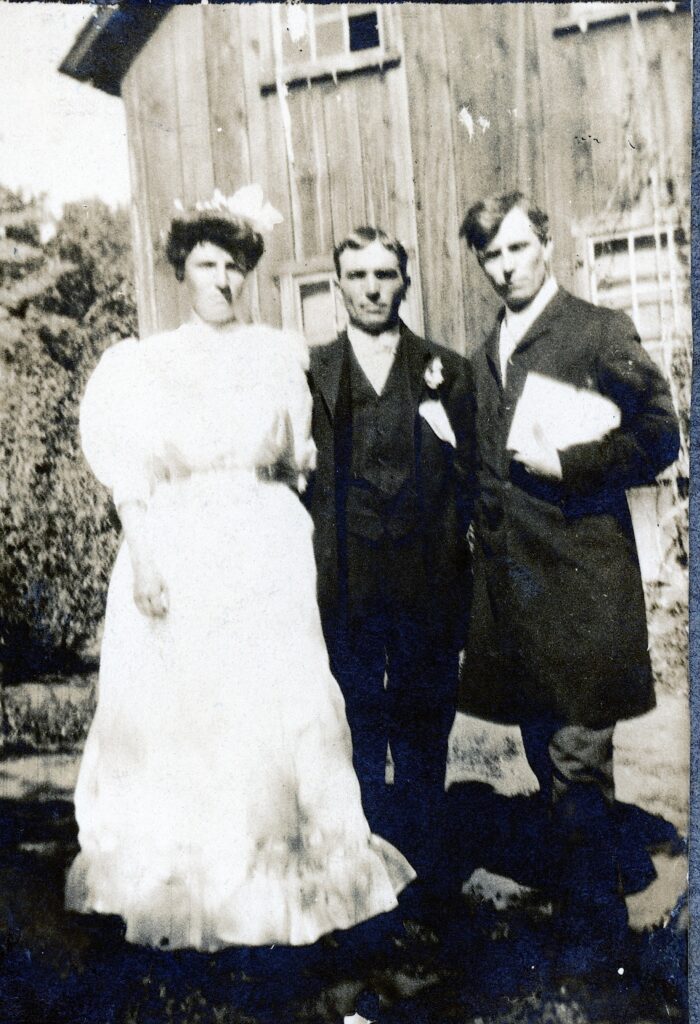
David and Theda (Williams) Fritter wedding portrait 1906.
Some years back, I received an unexpected call from the Eagle Lake Ranger District, Lassen National Forest. There are petroglyphs on the west side of Eagle Lake that are on the forest service land. Over century ago, two Eagle Lake residents, Dave Fritter and Charles Spalding etched their names along side of the petroglyphs. The forest service wanted who those two individuals were. I obliged.
There are petroglyphs on the east side of Eagle Lake. Personally, I have not observed them, but I have never done due diligence to locate them.
Closer to home, i.e. Susanville there are a handful of petroglyphs. Most on private property, but one site is owned by the City of Susanville.
On April 16, 1921, a grand celebration was held in Susanville for the Fruit Growers Supply Company new mill that was placed into the operation. In evening, a banquet was held for an assorted of company officials and local dignitaries. Fruit Growers General Manager Frank Hutchens stated how the Lassen would be operated. Fruit Growers would conduct selected tree harvesting, whereby 30 percent of the merchantable trees would remain as seed trees. Fruit Growers and the Lassen National Forest Service were working on a selective harvest plan that would allow to operation to continue in perpetuity. They estimated it would take between fifty to sixty years to log their holdings. By that time, the original logged areas would be ready for the second harvest of mature trees which again would take between fifty and sixty years to harvest, and the cycle could continue.
C.E. Emerson, a local merchant and rancher, told the crowd of his reforestation experience locally. Emerson recalled as a child, forty years ago, he helpd plant a tract of pine trees on the family ranch just south of Susanville on Diamond Mountain. Those seedlings, he said, had become a fine stand of pine timber, many of which were 22 to 24 inches in diameter.
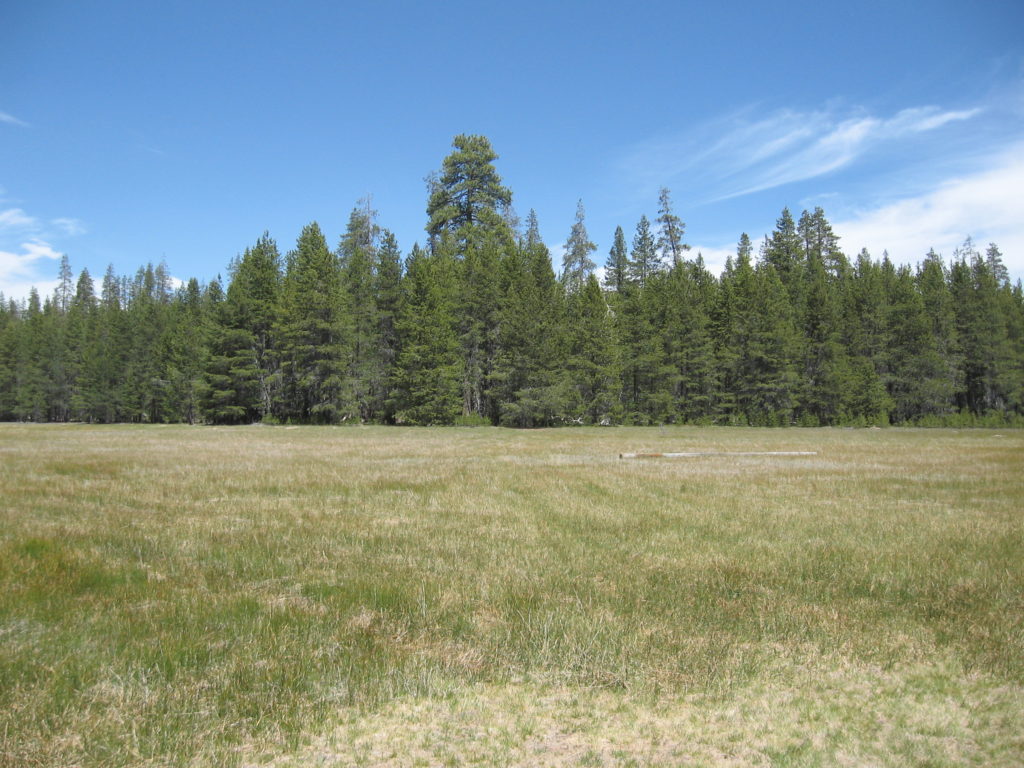
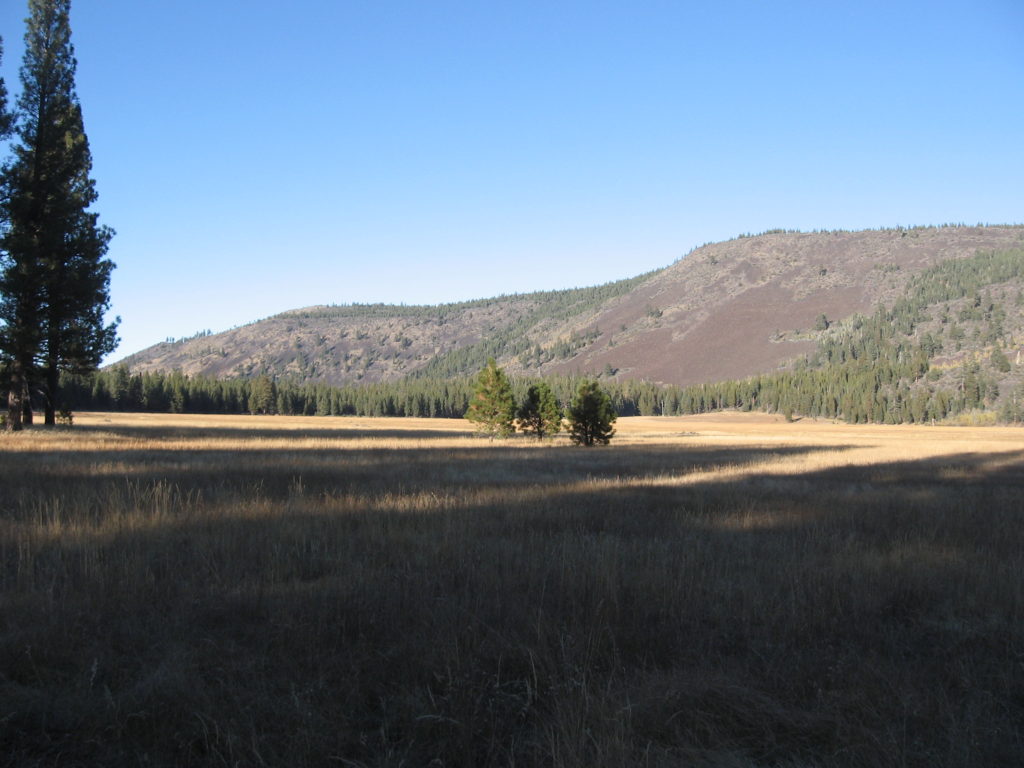
Mahogany Lake is a small twenty-acre shallow body of water, more or less, that is situated on Mahogany Ridge east of Eagle Lake. Since it has no inlet or outlet it is susceptible of going dry. When that it occurs it appears to be a grassy meadow.
Papoose Meadows, with Mahogany Ridge in the background October 13, 2017
The lake was originally named Walters. after George William Walters (1865-1923). Walters was a one-time employee of Albert Gallatin who used Eagle Lake for summer livestock grazing. In 1887, Walters sold the 40 acre parcel that encompassed the lake to Gallatin for $300. The property remained in the Gallatin family’possession for decades. In 1947, the Lassen National Forest Service acquired the Gallatin property. It is quite possible that forest service changed the lake’s name.
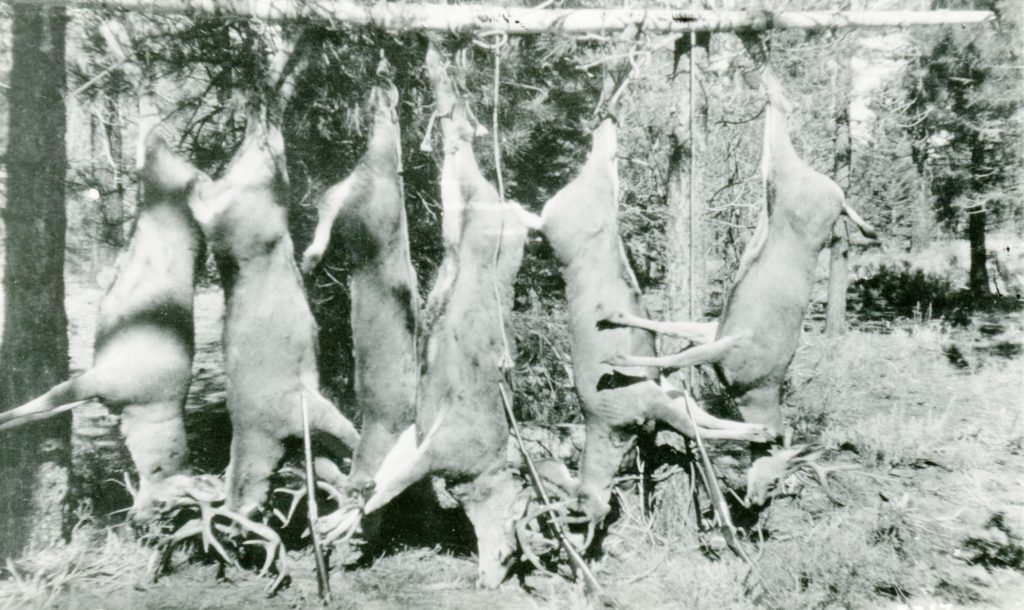
Since this end of deer season in these parts, it is fitting to examine past historic statistics. During the 1930s and 1940s, Lassen National Forest monitored the deer hunters. It was not easy task to register some 19,000 deer hunters on the Lassen. Data compiled relative to age, antlers, weight and condition of the deer, as where as the location where they killed. While there were check stations, they are also sent checkers with scales to weigh animals in the deer hunting camps.
Over 2,000 deer were killed in 1935 season on the Lassen National Forest. They consisted of 35% were forked horns; 32% had three points; 29% carried four points and the remainder 4% had five, six, seven or more points.
It was in September 1924 when the Lassen National Forest announced that they had subdivided summer home sites at Silver Lake in far western Lassen County and the headwaters of Susan River. The Lassen Mail newspaper reported on September 5, 1924: “Forest Service Offers Homes on Silver Lake. The United States Forest Service has laid out a number of lots on Silver Lake which will be offered for lease to people who wish to establish a summer camp or home. The forest service is building a good road to the lake which will make it easily accessible.” Susanville’s other newspaper, the Lassen Advocate never published any account on the topic.
Information on the early day cabins is sketchy due to the fact since the lease records were filed with the forest service. The Lassen Mail of June 28, 1929 reports, “New Cottages at Silver Lake. Marble Burch, owner of the resort at Silver Lake was in Susanville the first of the week purchasing supplies and making preparaions for the opening season. He is superintending the erection of two new cottages at the lake for Chico residents.”
This is first part of a three part series examining logging camp remnants. Today, we will focus on Fruit Growers Camp B and C. These camps operated during the early to mid-1920s in the Martin Springs vicinity, north and east of McCoy Flat Reservoir. Both were substantial camps comprising some 250 men. Camp C boasted a boxing arena that seated 500 people!
Camp C, no date. Courtesyof Lenala Martin Collection
Today, there is plenty of remnants at Camp B. Among those are the concrete foundations of the commissary and cookhouse. Though it’s been some time since I last visited. the railroad service pits were somewhat in tact. There is scattered debris in the area, and I even found an old pocket watch. Camp C is just the opposite. Without any remnants or any other tell tale signs it is difficult to locate. Why the difference? Camp B is located on land owned by Fruit Growers. Camp C was on land owned by the forest service, the latter required the site to be cleaned up after no longer in use.
Next up the examination of the Harvey line that had four camps–Bunyan, Puls Harvey and Stanford.