Traveling across Highway 44, the Pine Creek Valley appears to be a desolate wind swept sagebrush flat, surrounded by pine trees. After all, the majority of human activity is concentrated at the Bogard Rest Station. By the way the area is named for John Jasper Bogard, a Tehama County stockman, who in the mid-1870s started using the area for summer grazing of sheep. Actually, the region was home to many sheep outfits, such as Champs, Cone, McCoy and Stanford, the latter as in Stanford University. These sheep outfits had a huge impact on western Lassen County, and so many of the natural features were named for them. Continue reading Pine Creek Valley, Lassen County→
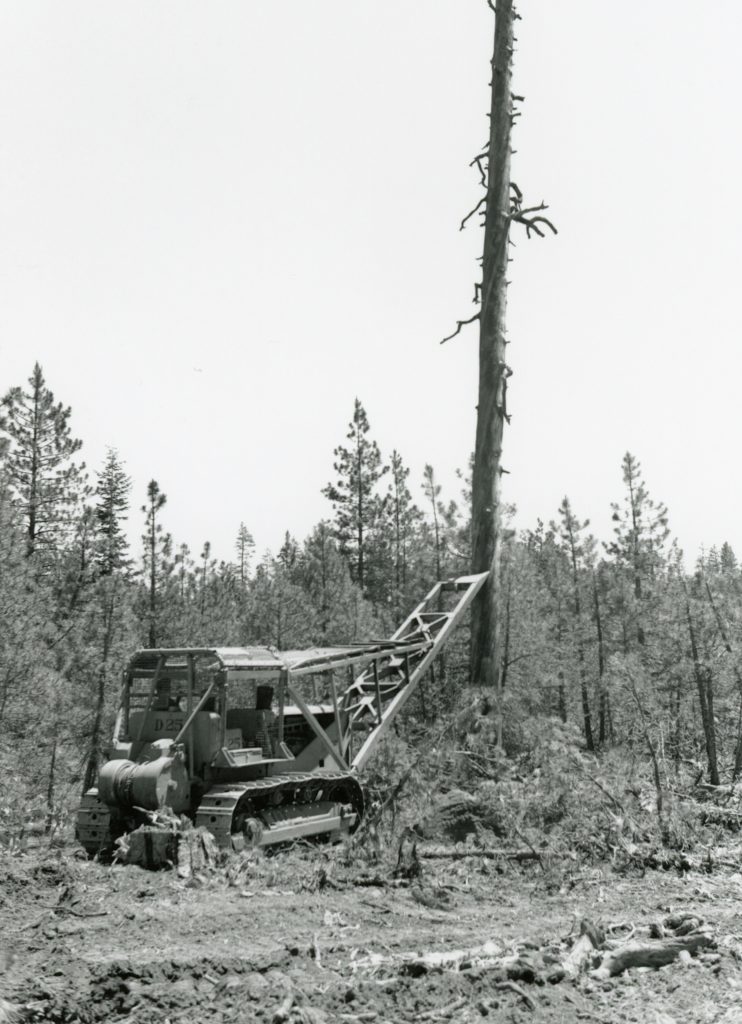
Fire trail V-drag plow, 1929. Courtesy of Fruit Growers Supply Company
No doubt this winter there are many fire officials having discussions about last year’s horrendous fires. During the winter of 1924-25 Fruit Growers Supply Company officials plotted out a new course of fire prevention after a brutal forest fire season.
In 1925 Fruit Growers adopted a new method, building a series of fire lanes. The fire lanes were 100 feet wide and completely void of vegetation, each encircling 100-acre sections of timber. They were formed by a specialV-drag hooked to a 60-Caterpillar tractor which could clear up to six miles of fire lines a day. The lanes not only served as firebreaks, but provided quick access in an emergency.
During the fire season, two crews of eight to ten men worked as fire prevention team. It was their job to build fire lines, oversee brush and slash piling, remove dead snags and maintain the company’s private telephone lines. Telephone “boxes” were attached throughout the forest, allowing for daily monitoring between the logging camps and the mill. The telephone system was also used to report fire or an accident when medical aid was needed.
By the end of 1932, the 178 miles of fire lanes constructed over 26,000 acres had proved very effective. Even though three of the. seven years it took to build them were critical fire years, only 53 acres burned. From 1925 to1940, prevention cost $40,373.54, fire fighting only $7,546.65. During World War II the construction of fire lanes was abandoned.
Fruit Growers Supply Company lumberyard, 1935. This contained 54 million board feet of lumber. An interesting tidbit. If all this lumber was used for boxes, it would only meet one-third of the boxes needed for Sunkist for that year..
This is a topic while I have addressed it in the past, its appropriate to bring it back to life for new readers and refresher for those seasoned ones. As we explore Lassen’s lumber industry’s past, there are references to the volume of a million board feet (mbf). During the 1920s, the lumber mills of Lassen County had an average annual output of 250 million board feet of lumber. That is a lot of lumber.
Sunkist Street,Susanville, 1921. Courtesy of Ed Standard
George Cone, who worked in the Lumber Division of Fruit Growers provided this definition using that mill’s output for the 1922 season at 62 million board feet. If it was placed on a single freight train, that train would extend eighteen miles. And since it took 6,000 board feet of lumber to build an ordinary house in those days, Cone figured that the 1922 output could build 60,000 houses. According to Cone, with an average household consisting of five persons, this production could provide the housing needs of 300,000 people!
Fruit Growers Susanville Box Factory as it appeared the day it opened on April 9, 1921—Ed Standard
Yesterday, I briefly mentioned that during the Great Depression that some of the grower members wanted to sell the Susanville mill. Some thought the cost was excessive, after all the growers passed a four million dollar bond to finance the construction of the mill and to purchase a billion board feet of timberland in 1919. At that time the growers agreed to assess themselves two cents per box. In addition to the assessment, for every 1,000 board feet of lumber , four dollars was budgeted to pay off the bonds, generating $300,000 annually. In 1934 Fruit Growers paid off the bonds, two years ahead of schedule and its Lassen Operation was debt free!
During the Great Depression of the 1930s Fruit Growers like so many sawmill operators on the West Coast had the debate whether to close their mills at Hilt and Susanville. This after all, with the realization that Fruit Growers could buy wooden boxes cheaper than they could manufacture. One other alternative was not just close the Susanville, but sell it.
The final decision was to keep the mills open. It would be costly, but Fruit Growers understood the long-term implications. If they closed the mills, they would lose many valuable employees and would be forced to start over once the economy rebounded. Logging operations at both Hilt and Susanville were suspended that year. At Hilt 1932 witnessed the end of railroad logging there. In addition in 1932, the Susanville mill operations were scaled back to a five-day week, rather than six to avoid layoffs. The decision paid off in the long run and were still able to meet the needs of the grower members.
One of the things that impressed me about Fruit Growers Supply Company was they valued their employees and went the extra mile in taking care of them. What the company had learned early one, was how costly labor turn over could be. By providing the employees a bit higher wage, extra amenities, paid off in the long run, with a loyal and stable workforce.
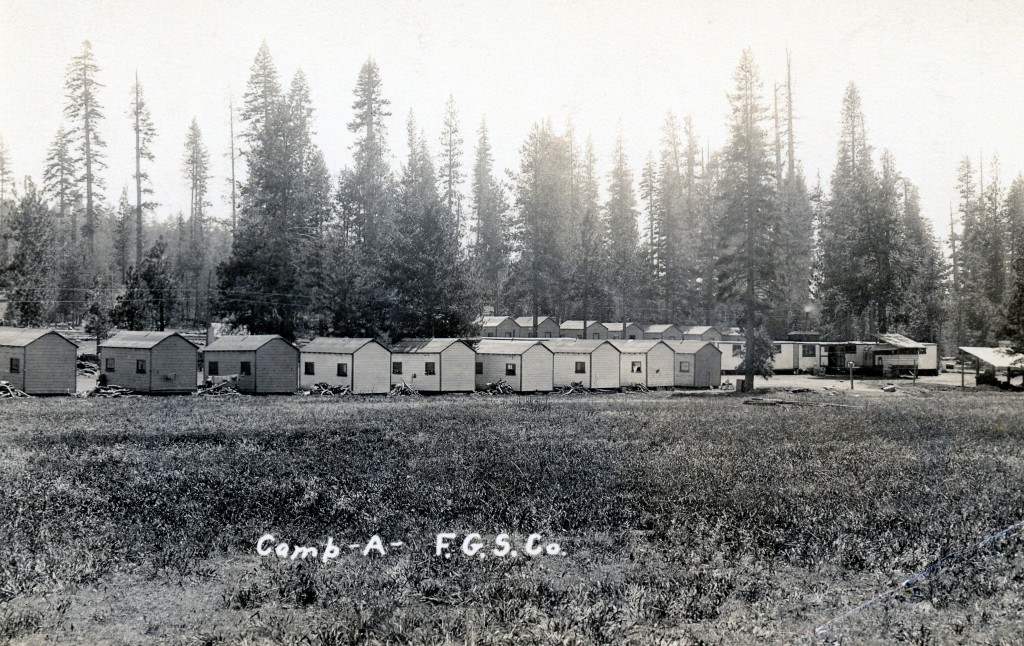
The company’s logging camps were exceptional, besides the living conditions, even provided recreational activities. In 1922, motion pictures were offered at Camps B and C. In 1923, at Camp C a 500-seat outdoor arena was the site of professional boxing and wrestling matches. On June 23, 1923 at the inaugural wrestling match pitted Susanville wrestler Bill Mohler against Paul Kinney of Omaha, Nebraska.
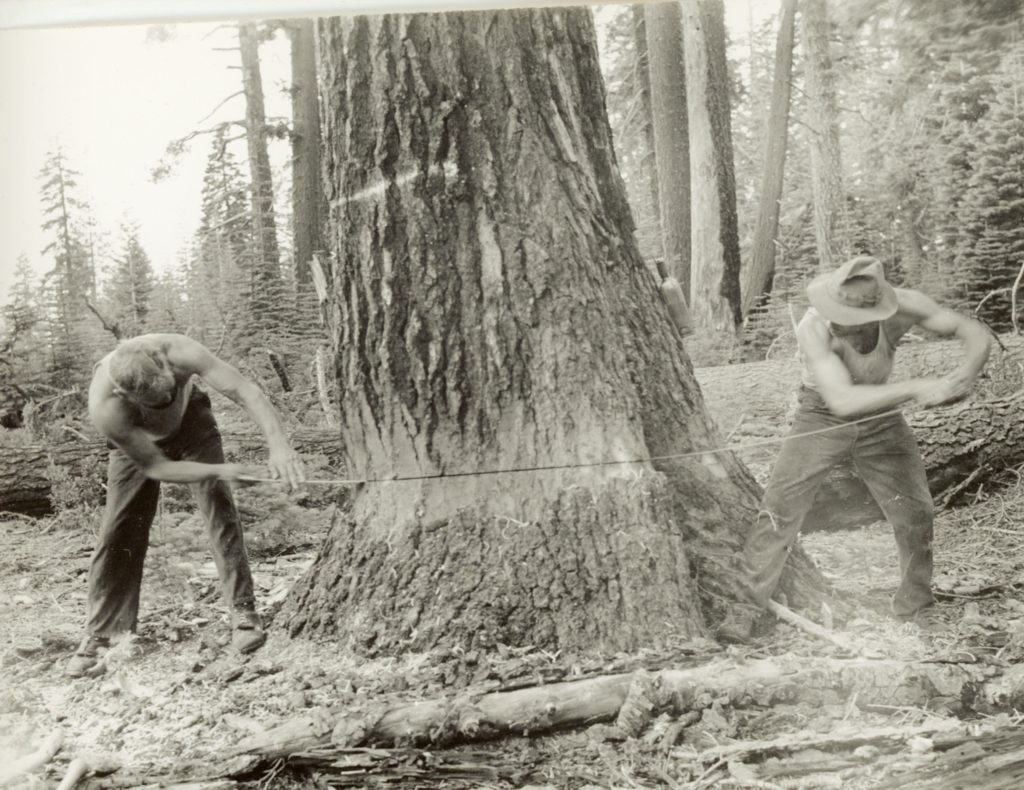
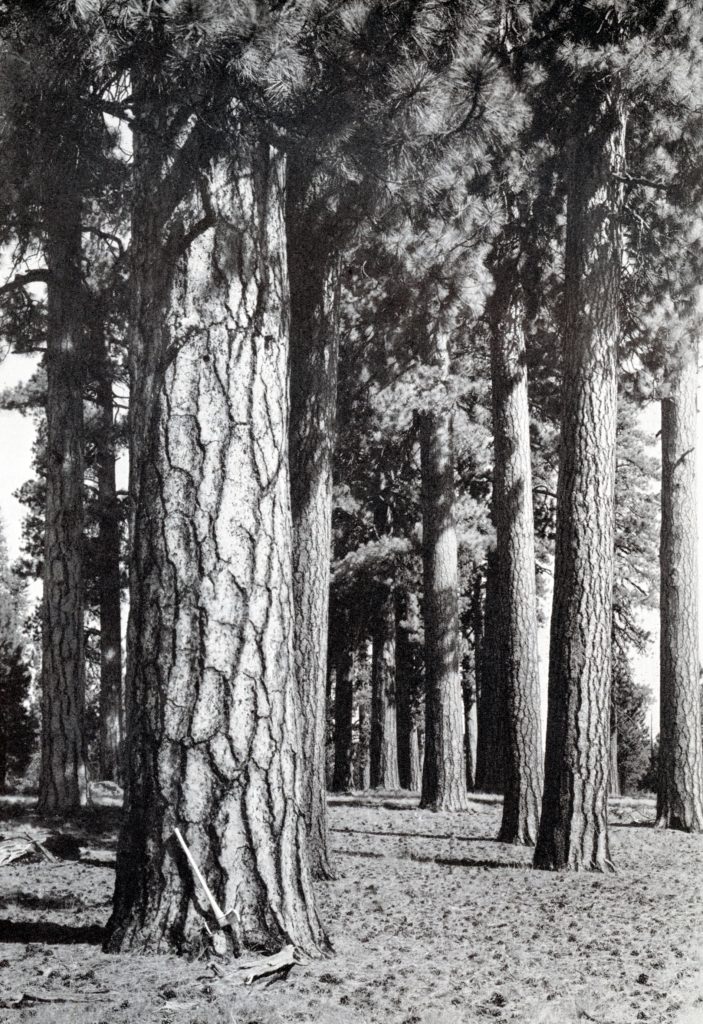
This six foot diameter ponderosa pine log entering the Fruit Growers’ Susanville mill, 1943—FGS Co.
Whenever an exceptional logging and/or mill scene Fruit Growers made sure the event was captured on film. In turn, in many instances it would appear in the company’s annual report. In a sense it was part promotional and educational tool at the same time. Fruit Growers’ audience was the citrus growers who owned the co-operative and invested in the mills and timberland to provide them an adequate supply of wooden boxes at a reasonable to price to ship their fruit. The majority of the owners had little knowledge of the sawmill industry that they were heavily invested in.
Lunch time at Dow Butte, August 21, 1953. Courtesy of Hank Martinez
What Fruit Growers did was not unique. Many lumber companies did the same to provide illustration to their investors where their money was being spent.
Craveneer moving through the lamination process—-Hank Martinez
When it was announced that Fruit Grower’s Westwood facility would become its Craveneer plant it came as a great relief to the employees there that the operations would continue. It was after all a $200,000 investment.
Machinery installation was expected to take four to six months and production to start by July 1954. Unexpected problems caused delays, however, and it was not until November that the first shipments of Craveneer were sent. It is interesting Fruit Growers box factories at Hilt and Westwood continued to operate . In addition, Fruit Growers even contracted for a supply of cardboard cartons. The growers now had their choice—wood, cardboard or Craveneer.
Cutting machine clipping the finished Craveneer into sheets—-Hank Martinez
In the meantime, Fruit Growers had not ruled out a Burney plant. In early 1955 they began to budget a new plant there that would cost $9,450,000. To make the Burney plant flexible besides a Craveneer plant, it would also have a plywood plant.
Changes on the horizon were swift. In the summer of 1955, it was announced by Sunkist that the cardboard box, was the container of choice. Thus, no longer a need for wooden boxes or Craveneer. On June 18, 1955 the Westwood box factory closed. On August 25, 1955 the Craveneer plant was closed and liquidated, which the California Barrel Company of Arcata purchased the Craveneer machinery. It should be noted that the box factory at Hilt remained in operation to manufacture picking boxes.
Steaming logs in preparation for peeling into Craveneer—-Hank Martinez
The Chicago Mill & Lumber Company developed the Craveneer process during World War II in their Tallulah, Louisiana laboratory. Experimenting with Mississippi delta oaks, which had no commercial value, Chicago Mill & Lumber Company discovered an adhesive that would glue 42 pound Kraft paper to the green veneer wood with a continuous roller process. One advantage of the process was the small amount of shrinkage when it dried. Conventional rotary cut veneer shrank up to 10 percent; Craveneer shrank only 1 1/2 percent. The Kraft paper also hid defects such as knots. And the exterior could be treated with a wax emulsion that acted as a mold inhibitor, a real plus in a citrus packinghouse.
The Globe DeBarker preparing logs for peeling into Craveneer—-Hank Martinez
In 1953, Fruit Growers Supply Company purchased the necessary machinery from Chicago Mill & Lumber Company and became the sole licensed manufacturer of Craveneer for the West Coast.
The big question facing Fruit Growers was where to install the plant—convert the box factory at Hilt or build a new sawmill and Craveneer plant at Burney? On November 9, 1953 it was decided to convert the veneer plant at Westwood into a Craveneer plant, yet Burney was still a future option.
A craveneer box, which resembles the standard wooden box—-FGSCo.
For whatever reasons the California citrus growers did embrace the cardboard of the late 1940s, like vegetable produce growers did. Fruit Growers were in quandary with diminishing pine reserves to manufacture the citrus grower’s demand for wooden boxes.
Fruit Growers came across a patented material known as Craveneer. It was a variation of veneer—wherein a log is peeled to make a thin slice of wood, instead of being sawn into a board. On the surface Craveneer appeared to make the ideal container. It utilized white fir, of which Fruit Growers had an abundant supply. It cost less to manufacture than the wooden box, yet it was more durable than the cardboard carton.
In 1952, Fruit Growers decided to experiment with the Craveneer and more about in the future.