Tag Archives: Fruit Growers Supply Company

Industrial Workers of the World

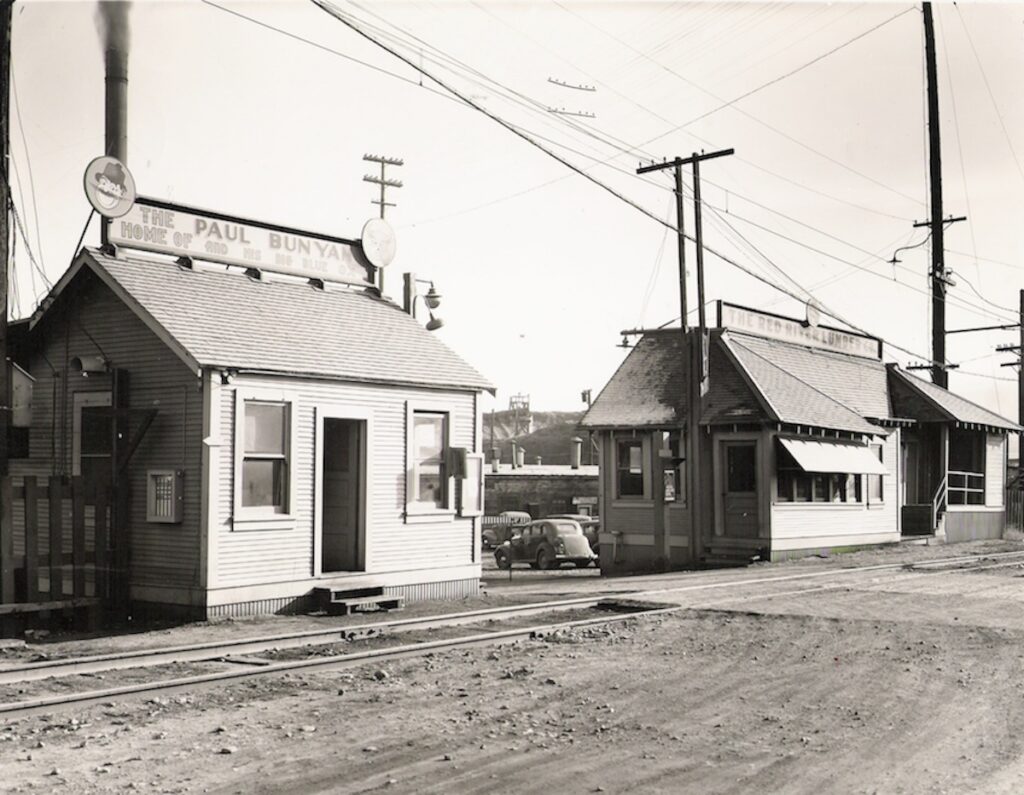
Employee entrance at Red River Lumber Company’s mill, Westwood

Since it is Labor Day, it is only fitting to have a topic about the labor movement. With the events leading up to World War I, demand for lumber soared. It was in the Pacific Northwest that two labor organizations—the Industrial Workers of the World (IWW) and the American Federation of Labor (AFL)—gained momentum in union organizing in the lumber industry.

The IWW had an image problem. It was considered radical in its
thinking for the time. Some considered it a communist organization. It gained notoriety for its strikes that were marred with violence. It
was from these and other factors, and with the emergence of the Loyal Legion of Loggers and Lumberman that hindered its movement.

After World War I the lumber market plummeted. This weakened labor’s leverage to organize unions. Yet, by the early 1920s, Fruit Growers Supply Company and the Lassen Lumber & Box Company established sawmills at Susanville. So these operations combined with Red River Lumber Company at Westwood, the IWW saw a lot of potential in Lassen County.  IWW members worked very hard to recruit there, but with little success. It could be perilous duty and arrests and convictions of suspected organizers occurred. Case in point is the story of Charles Griswold, alias Thomas B. Miller. A Red River employee, Griswold worked the green chain at the mill. He was arrested and charged with the violation of the Busick Injunction for recruiting members for the IWW—the Busick Injunction deemed the IWW was a part of a communist syndicate. On March 25, 1925 Griswold was taken to Susanville and a short jury trial was held. The jury deliberated for ten minutes before they came back with a guilty verdict. Griswold was sentenced to six months in the Lassen County Jail. He could consider himself fortunate for many who were charged with the same offense never had a trial and were automatically sent to prison.

The biggest problem IWW faced in Lassen County was that all three
lumber companies paid the prevailing wage, if not above, and provided better housing than found in other regions on the west coast. The employees had few grievances, so there was no incentive to be a part of the labor movement. It was because of these conditions that Lassen County sawmills remained union free during the 1920s.
Support by subscribing.

A Logger’s Lunch

Lunch time
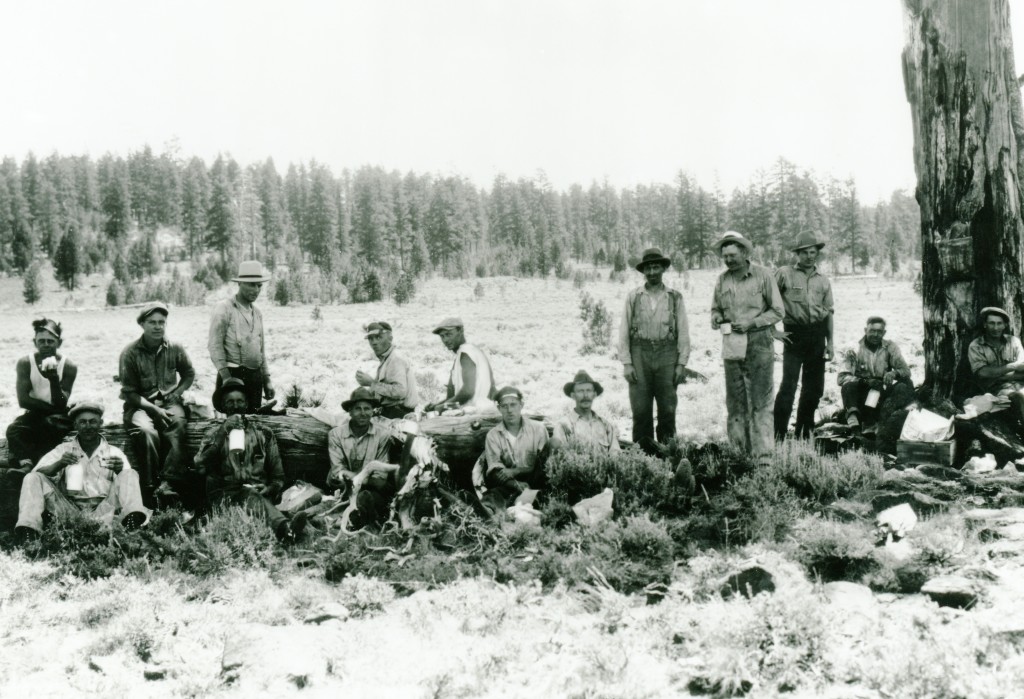
Loggers having lunch, 1932. Courtesy of the Fruit Growers Supply Company

The most important component to logging camps of yore was food. It could make or break a camp. After all, loggers worked long hours in a very labor intensive environment. Food was one item they looked forward. If it was not up to par, they quickly moved on to another logging camp. Breakfast and dinner were legendary. These meals were served in the logging camp dining hall.

What about lunch? It was not practical to bring the loggers back to camp to feed them lunch. Leonard Uhl, who worked at Fruit Growers Camp 10 in the 1940s,  provided insight as how lunch worked. Just off the end of the main dining hall there were tables loaded with packaged food. After breakfast each man would get up and grab a brown bag (or two or three) and build his lunch to suit himself Uhl said.

”One table had three different kinds of sandwiches which were always excellent (with the exception of the ones with thin sliced bologna but you didn’t need to take them if didn’t want to). Another table had all kinds of pastry. made fresh by the camp baker, who was an artist at his trade. There were two or three different kinds of pie, fresh baked glazed or sugar doughnuts and cookies, cake etc. On the third table were different kind of appetizers and knickknacks such as pickles, olives, pickled peppers, bananas, oranges, apples and whatever fruit might be in season. There sure was no way a logger could go to the woods with a lunch he didn’t like without blaming himself” according to Uhl.

Tim

A Fruit Growers Overview

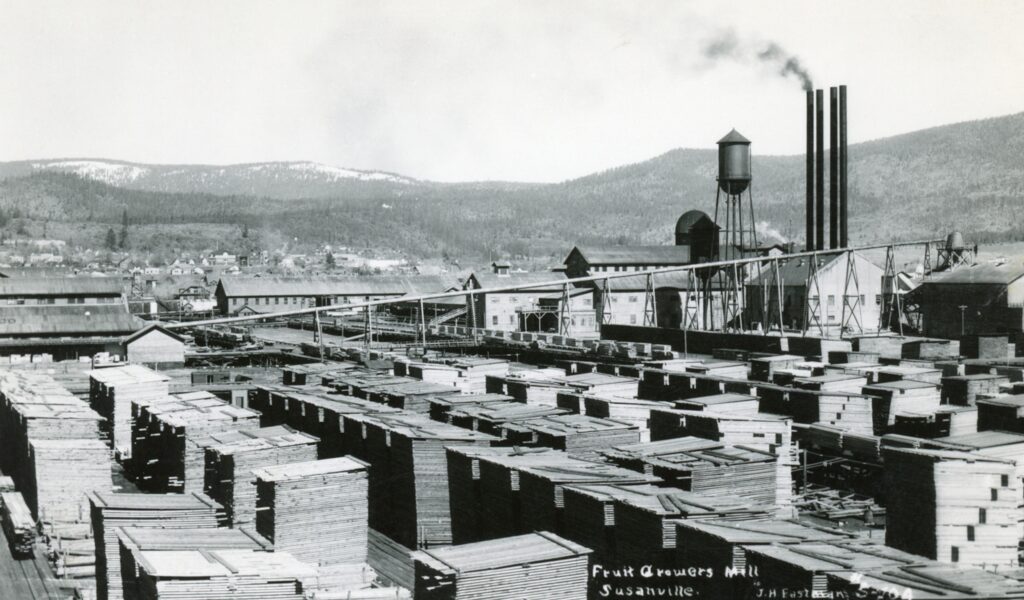
Fruit Growers, 1921–Ed Standard

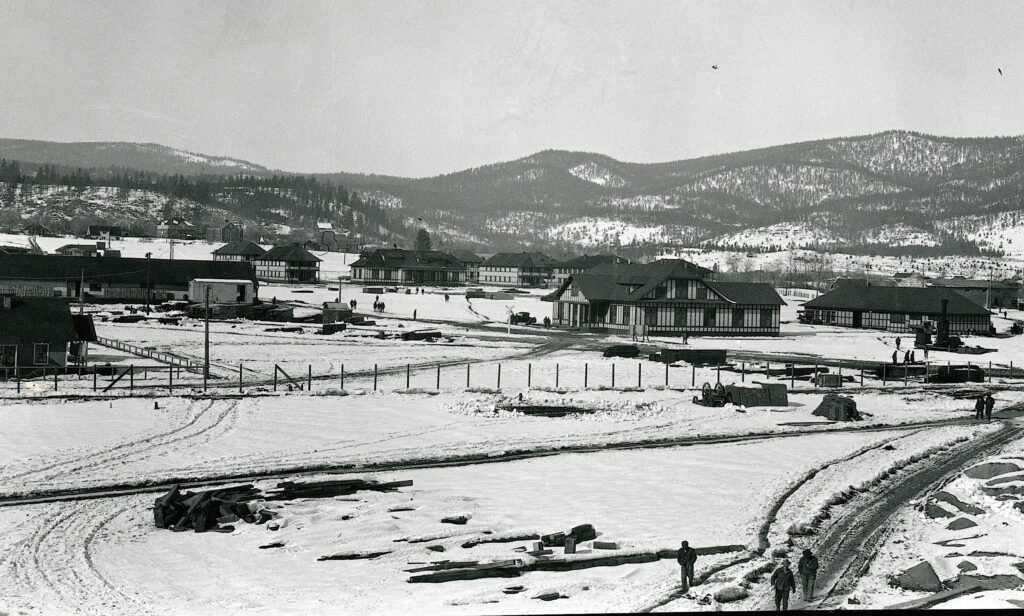
This is something a little bit on the lighter side. Personally, I happen to like this view of Fruit Growers Supply Company of its office/residential section, prior to the construction of its famed three-story Story Club. From the angle it was taken, and probably from the mill’s smokestacks, there is no indication in the background  that Susanville exists. Today, the site is best known as Riverside Park.

Tim

Michigan Big Wheels

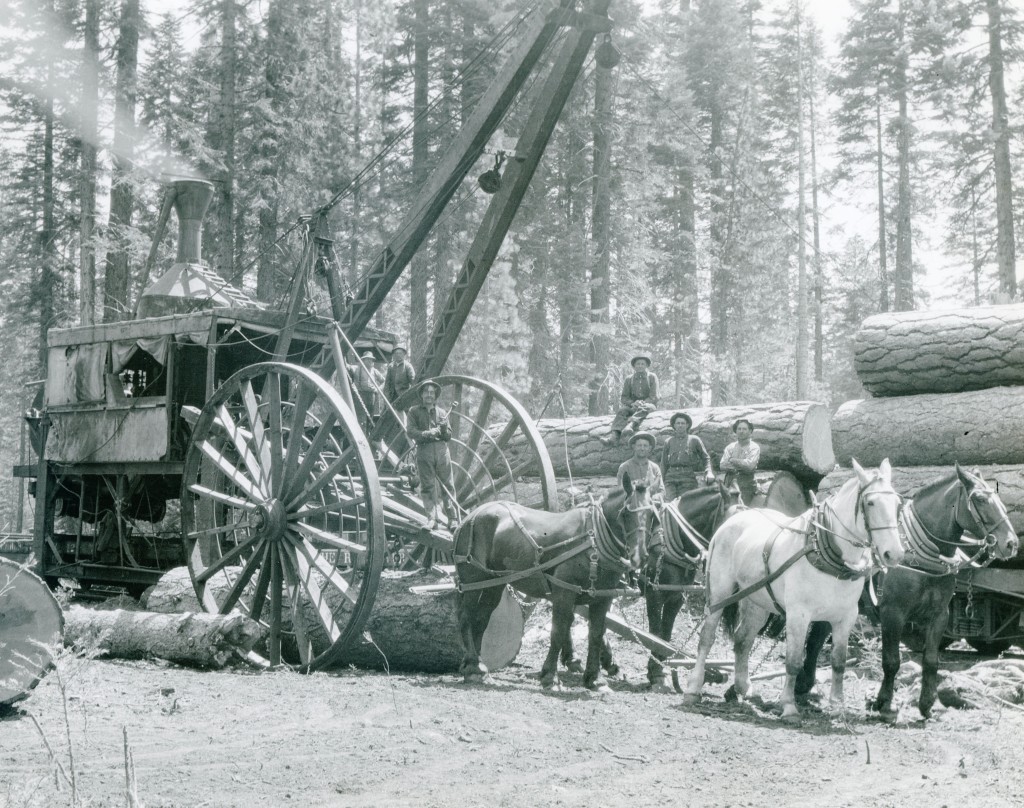
Red River Lumber Company, with Big Wheels and a McGiffert loader in the background. Courtesy of Hank Martinez

Logging operations of the early 1900s was extremely labor intensive. Motorized equipment was still in the experimental stages. One of the best advancements was the development of the Michigan Big Wheels, which everyone just called them big wheels. The wheels were a simple but efficient way to transport fallen logs to a landing, wherein they were then loaded onto railroad cars. The big wheels in time would become a key component in revolutionizing logging methods.

Horses provided the power to operate the big wheels. The name big wheels stems from their size ten to twelve feet in diameter. It was necessary for that size, in order to straddle a log and navigate moderate terrain. The logs were attached to a twelve foot tongue and with a lever, the driver could not only elevate a portion of a log in the front thereby making it easier to drag, but could loosen or tighten the cable, for braking purposes. One big drawback of big wheels was that it required a great deal of labor. Most big wheel logging camps employed as many as of 150 men. Two thirds of them worked as “swampers.” It was their job to remove brush, tree saplings, rocks and other debris that could injure a horse’s leg.

By the late 1920s, both Fruit Growers Supply Company and the Red River Lumber Company had replaced the big wheels with motorized “cats”.

Never miss a story, click here.


Susanville’s Fruit Growers’ Subdivision

Sunkist Street, 1921. Courtesy of Ed Standard

In 1919, when the Fruit Growers Supply Company decided to locate its second lumber mill at Susanville, they thought that community would come forth to provide housing for its workforce.  It kind of happen. Yet, Fruit Growers with over 1,000 employees for its Susanville operation, was too much for the community to handle. To be able to attract a stable workforce, Fruit Growers only option was to develop its own residential district next to the mill. Those streets all have names associated with the citrus industry, such as Sunkist.

For those not familiar with Fruit Growers, it is a purchasing agent for co-operative then known as the California Fruit Growers Exchange comprised of citrus growers. In 1907, the Exchange coined the brand Sunkist and in 1952, they renamed the Exchange to Sunkist.

Never miss a story, click here to support and subscribe.

Northern Counties Utility Company

Birch Street, Westwood. Courtesy of Hank Martinez

In 1945, when Fruit Growers Supply Company took over the town of Westwood from the Red River Lumber Company it presented all kinds of problems. It should be noted for the record, Fruit Growers did not want Westwood or its mill, but it was packaged deal to obtain Burney Tract which contained a billion board feet of timber.

Westwood provided all kinds of challenges for Fruit Growers. What worked for Red River, did not for Fruit Growers. To provide water, telephone and electrical service to the community Fruit Growers formed the Northern Counties Utility Company. It was necessary for the company to avoid the involvement with its lumber and timber operations.  The residents were not happy with any change, and in the past their utility cost were included in the rent. Fruit Growers did not initially charge a separate utility bill. This, of course, was an accounting nightmare for Fruit Growers. In 1945, the utility company lost $35,549.65. Fruit Growers covered the loss from revenues from rental properties, but it was still a out-of-pocket loss for Fruit Growers. In 1956, when Fruit Growers sold Westwoof it was no longer their problem.

Subscribe

Fruit Growers’ Bond Measure

Fruit Growers Supply Company, Susanville, circa 1935

After a few years after Fruit Growers Supply Company took over a lumber mill at Hilt, it had turned into a wise investment for the citrus  growers to meet the demands for wooden boxes to ship citrus.  In 1919, after extensive research Fruit Growers decided to embark on a second mill at Susanville.

To finance the purchase of timberland as well as the cost associated to build a sawmill was not a cheap proposition. To purchase the Collins Tract of timber would cost $1,102,493 and to build a mill and related facilities was priced at $2,331.249. To raise the capitol its was deemed to sell $4 million in bonds.

One half the bonds were sold privately and the other half publicly. The private issue was immediately oversubscribed. Sold in denominations of $500 or $1,000, the bonds yielded 6 1/12 per cent interest payable semi-annually.

To pay for the bonds the growers agreed to assess themselves two cents per box. In addition to the assessment, for every 1,000 board feet of lumber sold, four dollars was budgeted to pay off the bonds generating $300,000 annually. In 1934, Fruit Growers paid off the bonds in record time and the Susanville operation was debt free.

Support by subscribing.

Fruit Growers No. 5

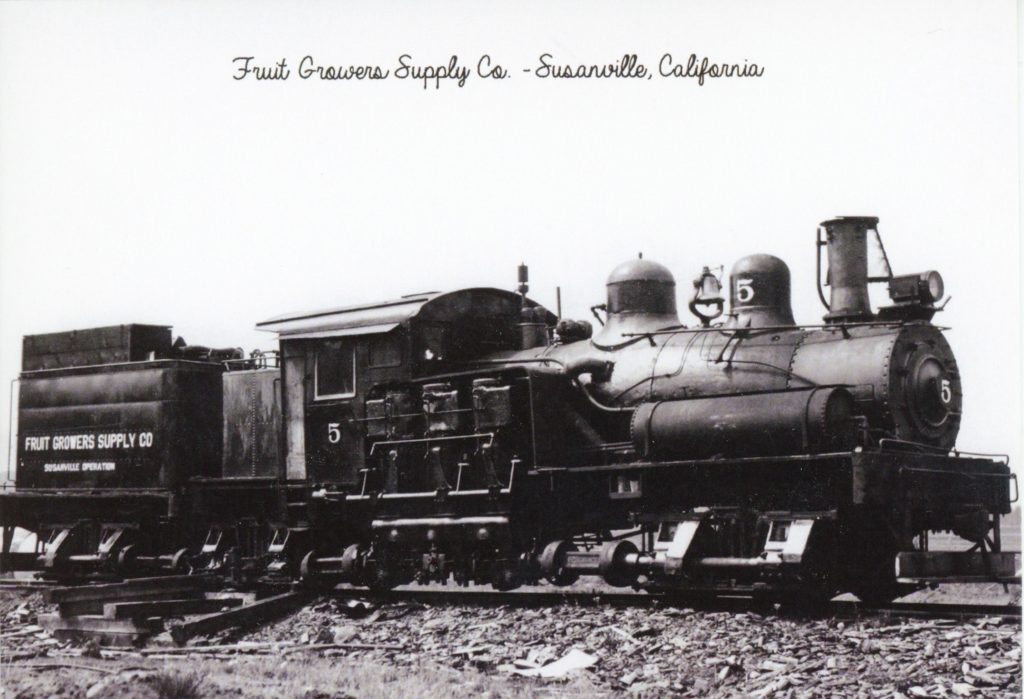
Fruit Growers No. 5 locomotive

First, a little story about the photograph. I had never seen these kinds of postcards of Fruit Growers. I had spent a lot of time at Fruit Growers headquarters in Sherman Oaks going through their archives. They did not have this in their collection, nor was there any documentation about the postcards being manufactured. As it turns out, an individual in Australia has taken old photographs of locomotives and produces postcards, which I purchased this on Ebay.

Fruit Growers had two Shay locomotives on the Lassen Operation. The No. 5 was purchased in 1924 from the McCloud River Lumber Company. According to. railroad historian David F. Myrick, he indicates that the No.5 was no longer in service by 1949. Three years later, Fruit Growers would discontinue railroad logging.

Tim

A Millpond Tragedy

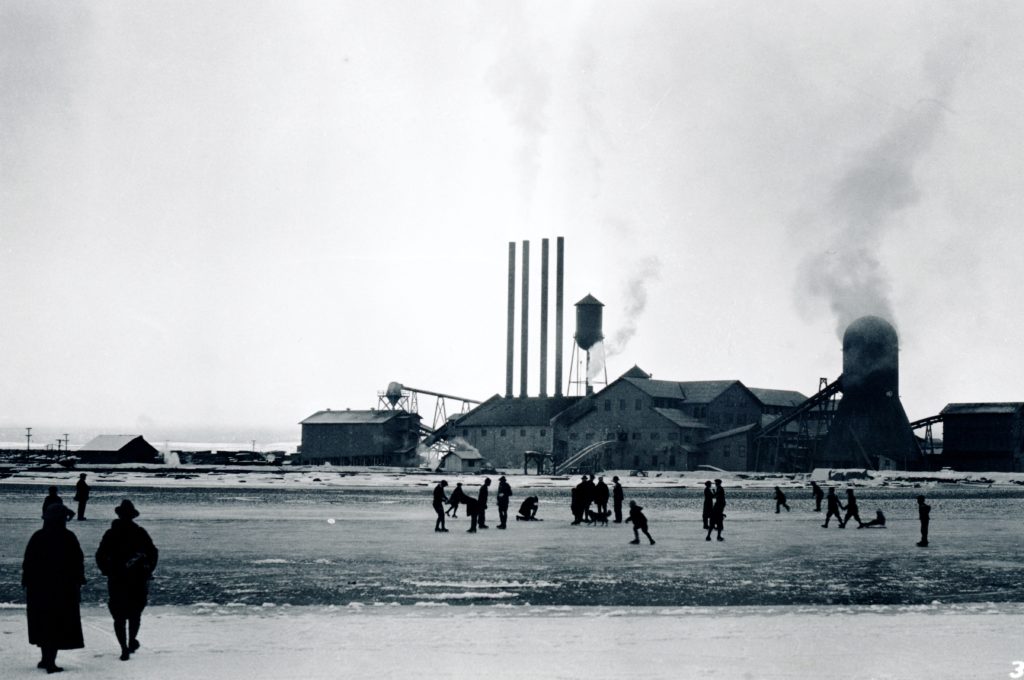
Ice skating on the Fruit Growers millpond, 1921. Courtesy of Ed Standard

Way back in the day, and I am talking over a century ago, the two most popular spots to go ice-skating was Leavitt Lake and Honey Lake.  There were on times, in Susanville, where the current Memorial Park is located, it would flood naturally, and with winter conditions freeze and the locals took that opportunity to ice skate there.

When the Fruit Growers Supply Company constructed their mill in Susanville it came with the pre-requisite millpond. In the winter, when the millpond froze, some took advantage to ice skate on the pond. It all seemed relatively harmless.  On Monday evening, January 23, 1922, about twenty-five people were skating on the pond. Percy N. Wemple, age 11, ventured too far out, where there was still open water and fell in. O.O. Winn without hesitation jumped into save Wemple. However, Winn struggled to get out. F.L. Shank came to the rescue and both Winn and Wemple were pulled out. They were both rushed to Riverside Hospital.  The shock of the cold water, was too great for young Wemple and he could not be revived.  After this incident, Fruit Growers prohibited skating or any other activity on the millpond.

Support by subscribing.

.

Some Early History of Hilt, California

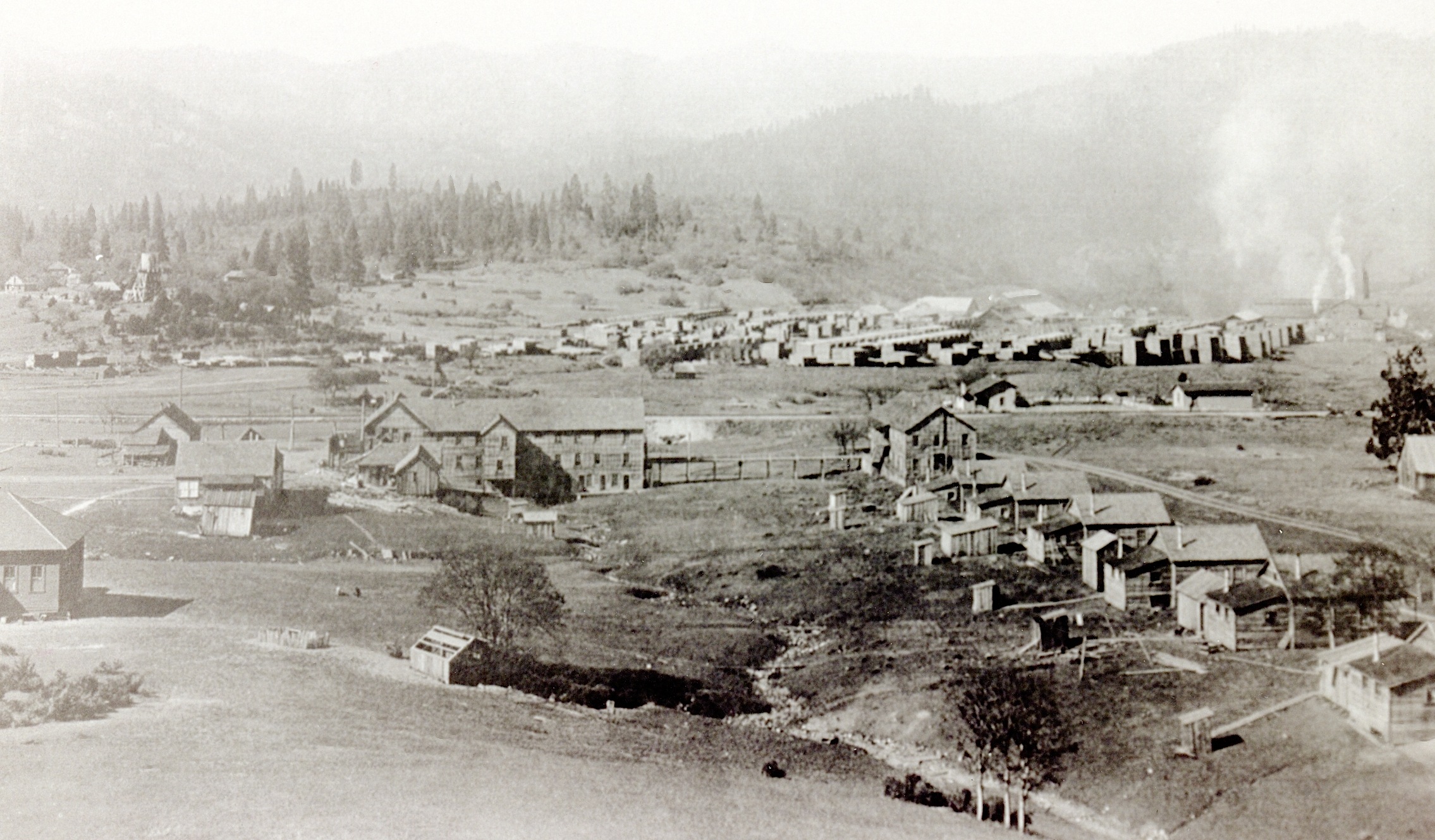
Hilt, California, 1910–Domenic Favero

The most commented post on this site is about the former town of Hilt located in Siskiyou County near the Oregon border. While Hilt is far removed from the Lassen region, it has a unique relationship to the area. This was Fruit Growers Supply Company’s first sawmill, which proved successful. With the expansion of the citrus industry, created the need for an additional lumber to manufacture box shook, the wooden components to make a wooden box, which was the standard container. In 1919, Fruit Growers established a second mill in Susanville and in 1944 the company purchased Red River Lumber Company’s mill at Westwood.

The origins of Hilt started in 1855, when John Hilt began mining along Cottonwood Creek, just south of the Oregon border. In 1878, he purchased his son-in-law’s sawmill. In 1887 when the railroad was built through there, Hilt did not take advantage of it and  continued with a small time operation. That changed in 1901 when he sold out to some Grants Pass, Oregon businessmen who formed the Hilt Sugar Pine Company. That was short lived. It was acquired in 1907 by Shasta County investors who formed the Northern California Lumber Company. From day one they had financial problems.

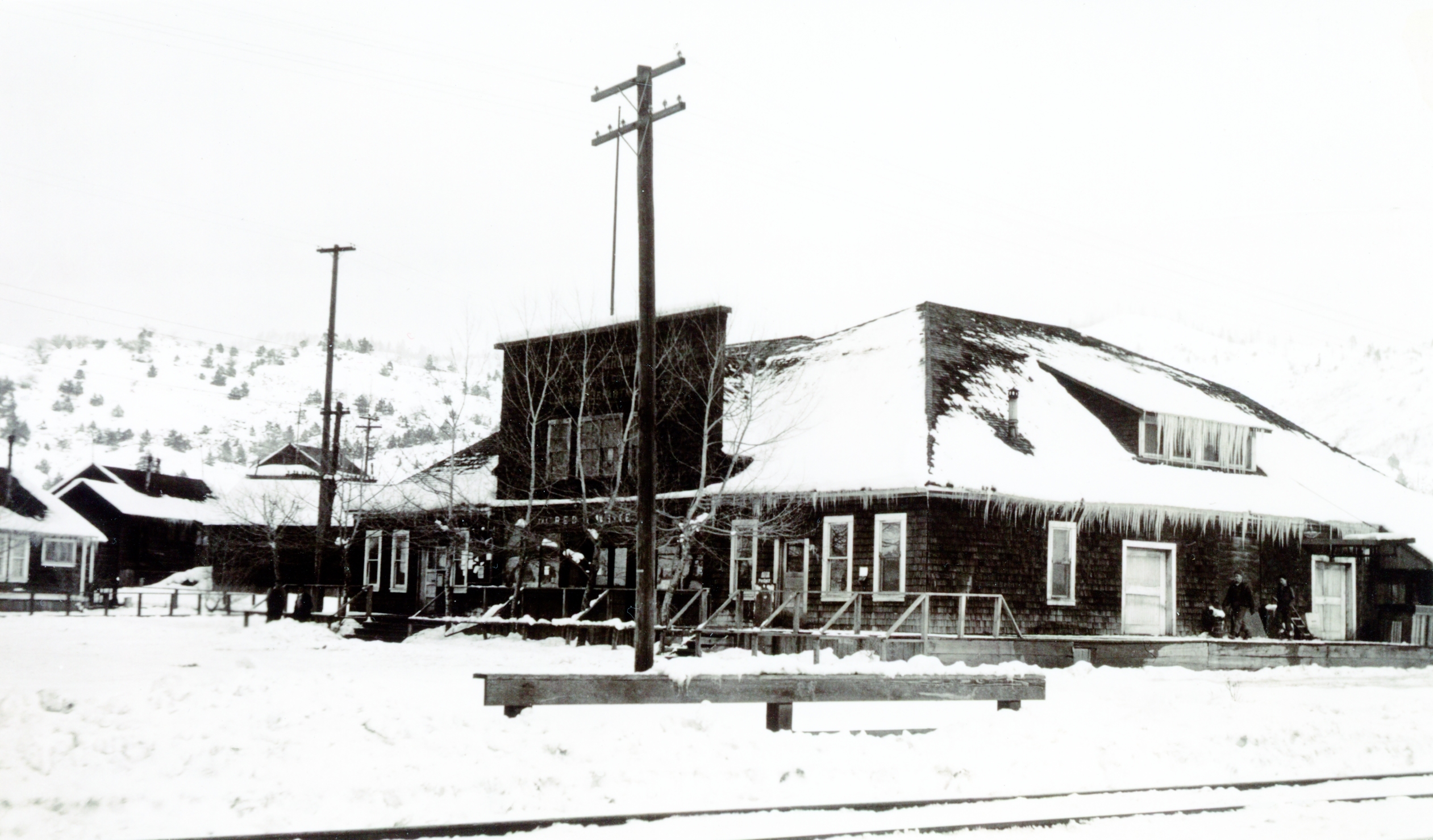
Hilt Company Store and Post Office, 1937.

Enter Fruit Growers. Fruit Growers reluctantly lent the lumber company $100,000, however, they were not impressed with its operation. Their logging operations deemed primitive, as they still used oxen with no intent to convert to modern railroad logging. It was stipulated that a portion of the cash advance was to be used to construct four miles of logging railroad. Progress, was slow but sure, with the construction of a box factory, but again needed additional money. By 1910, the  day of reckoning was at hand, whether Fruit Growers should cut their losses or take over the troubled lumber company. After careful consideration, Fruit Growers went ahead and acquired Hilt and entered into the lumber industry. They would operate the Hilt mill for sixty-one years.

Support