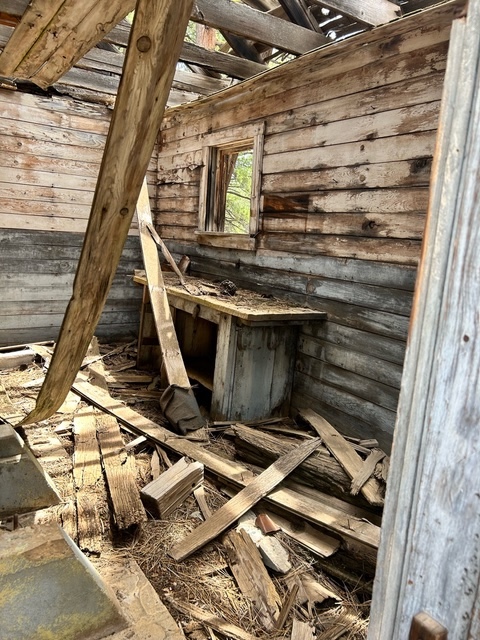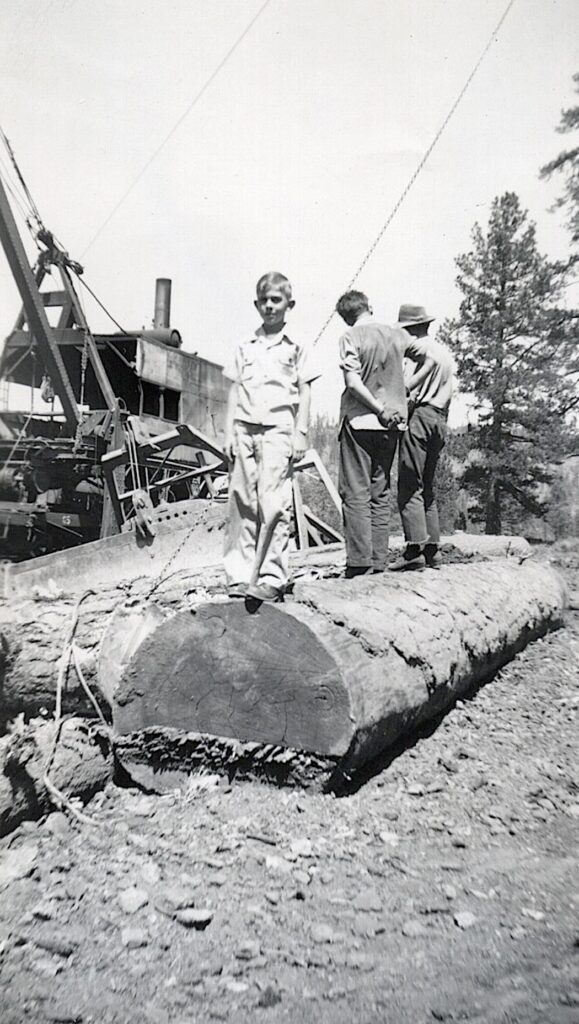
Camp 10, Pine Creek Valley was longest operating logging camp of the Fruit Growers Supply Company’s Lassen Operation. It operated from 1929 to 1952.
Tim

On April 16, 1921, a grand celebration was held in Susanville for the Fruit Growers Supply Company new mill that was placed into the operation. In evening, a banquet was held for an assorted of company officials and local dignitaries. Fruit Growers General Manager Frank Hutchens stated how the Lassen would be operated. Fruit Growers would conduct selected tree harvesting, whereby 30 percent of the merchantable trees would remain as seed trees. Fruit Growers and the Lassen National Forest Service were working on a selective harvest plan that would allow to operation to continue in perpetuity. They estimated it would take between fifty to sixty years to log their holdings. By that time, the original logged areas would be ready for the second harvest of mature trees which again would take between fifty and sixty years to harvest, and the cycle could continue.
C.E. Emerson, a local merchant and rancher, told the crowd of his reforestation experience locally. Emerson recalled as a child, forty years ago, he helpd plant a tract of pine trees on the family ranch just south of Susanville on Diamond Mountain. Those seedlings, he said, had become a fine stand of pine timber, many of which were 22 to 24 inches in diameter.
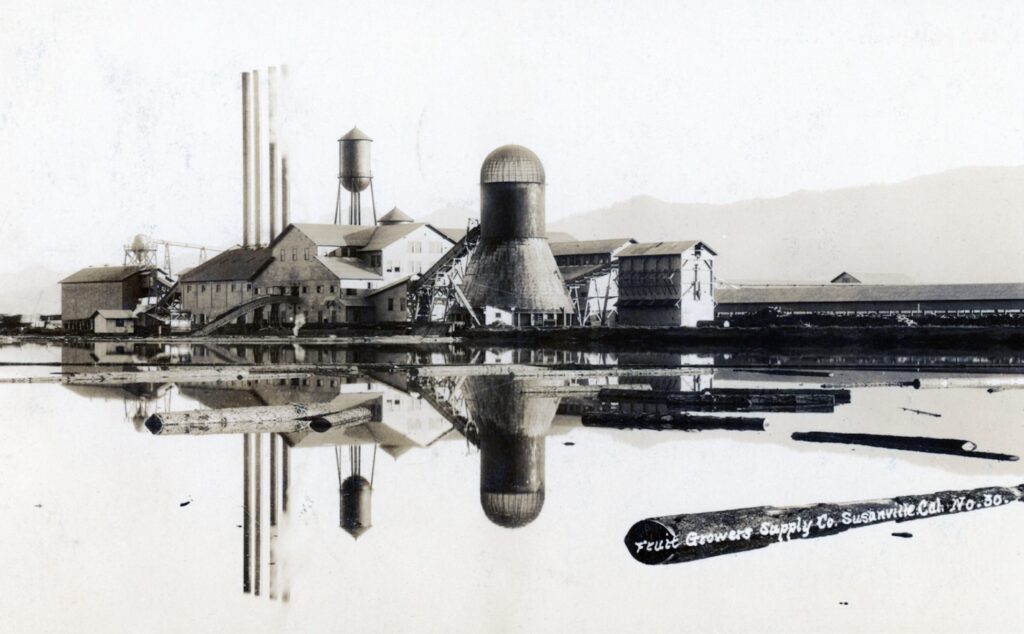
Awhile back we explored the closure of the Lassen Lumber Box & Company mill. It was acquired by its neighbor, Fruit Growers. That company purchased Lassen Lumber for its water rights, in case Fruit Growers wanted to convert its mill to a cardboard plant. While that event had never happened, Fruit Growers did operate a cardboard plant in Southern California.
The question posed was whatever became of those water rights. I would assume, and that can be dangerous, that when Fruit Growers sold their mill in 1963, the water rights would have been included. This is where it gets tricky. One can with hold the water rights, and its done more often than one could think. Title companies do not include water rights in their property search. If water rights are in an adjudicated system, like the Susan River watershed, there is. a water master to oversee it. The water master fee is included in the county tax bill. I use of have list of the water users, but I am not sure how I filed it away.
Back of the question at hand. It would be interesting to know who possesses those water rights, since there is no mill, let alone a millpond.
Tim
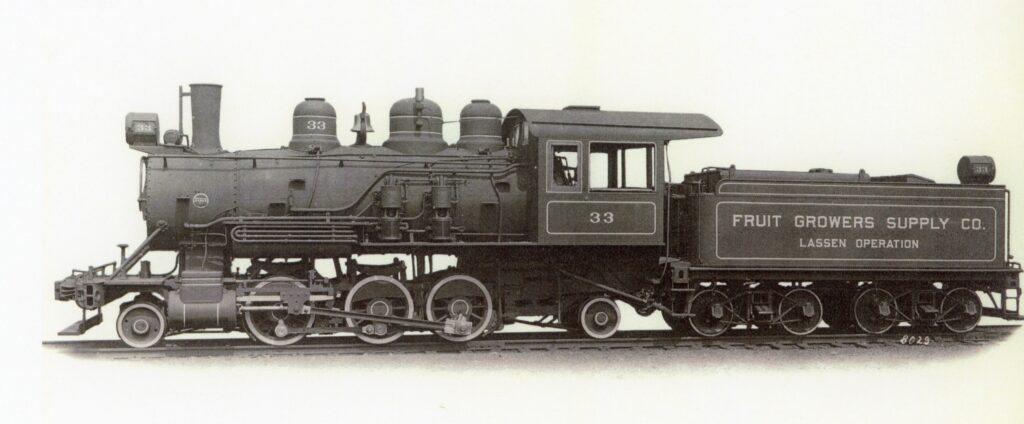
In 1921, Fruit Growers bought a new Baldwin locomotive, that was designated the No. 33. Some where the down line they changed it the No. 2. In 1952 Fruit Growers discontinued railroad logging on the Lassen (Susanville) Operation. In 1955, Fruit Growers announced the closure of Westwood Operation. In 1956, Fruit Growers sold the entire Westwood Operation to a liquidation company Wershow & Weisz. Some Fruit Growers locomotives were included and auctioned off in the fall of 1956. If No. 33 was included, that information would be in my Fruit Growers Westwood file that is in storage.
Tim
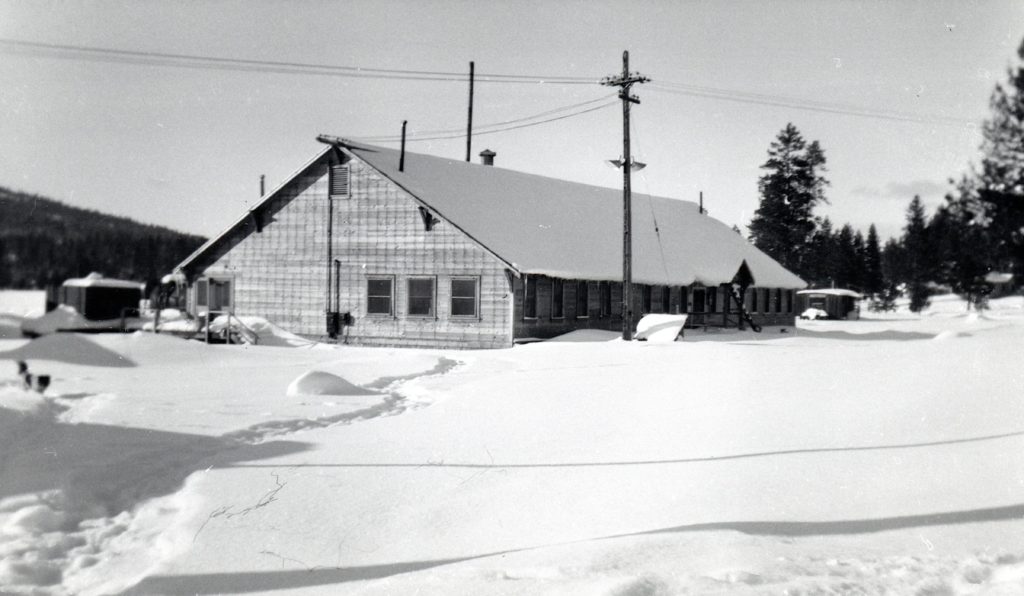
In 1929, Fruit Growers Supply Company consolidated all of its logging camps into one larger camp, known as Camp 10. It was located thirty-eight miles northwest of Susanville near the bank of Pine Creek. Ten years later, Fruit Growers considered leaving Camp 10 to establish Camp 11 on the east end of Champs Flat, about ten miles northeast. In the spring of 1940 that plan was put on hold.
In the early 1940s, Fruit Growers was awaiting a very important government decision on the Wage and Hour Law–whether or not an employee would be paid for travel time to the actual work site. Travel time between Camp 10 and the logging site was 1 to 1 1/2 hours each day. If the government mandated paid travel time, Camp 11 would be established, but not necessarily at Champs Flat. It would not be until 1948 when the government ruled that employees were not entitled to paid travel time, and the need for a new logging camp disappeared.

In early 1940s, the Red River Lumber Company proposed to build branch railroad logging line off the Western Pacific near Poison Lake with a final destination to Burney. That planned was on hold due the conditions of War World II and subsequent sale of Red River in 1944 to the Fruit Growers Supply Company. It should be noted that the Burney Tract contained estimated two billion board feet of merchantable timber.
Fruit Growers surveyed the railroad line descending off the Hat Creek Rim near Cassel then onward to Burney. In 1949, the Harvey Railroad logging line shut down. The rails were stored Halls Flat near Poison Lake, and that increased the speculation of the pending railroad. Then things got complicated and a new player enter the field the McCloud River Lumber Company. McCloud’s mill was sixty-one miles northwest of Burney. The Company was expanding to the south and had eye on the Burney Tract.
In 1951, Fruit Growers and McCloud drafted a mutually beneficial agreement. Fruit Growers would build the line they had surveyed from Poison Lake to Burney and lease it to McCloud, who would be responsible for operating and maintenance. McCloud would eventually scrap the Poison branch. Instead, McCloud extended its line to Burney and on July 3, 1955 the formal dedication of that line was held.
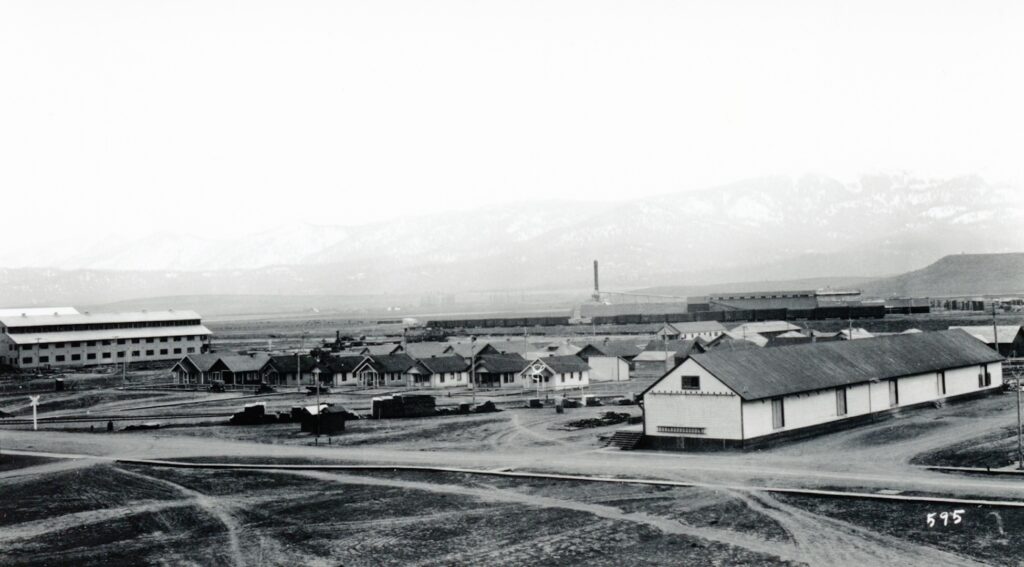
Fruit Growers Supply Company had another issue besides the housing shortage when they opened their Susanville plant in 1921. Inflation had a been issue not just locally, but nationally. However, Susanville’s prices were higher than elsewhere. There were accusations that the local merchants were gouging consumers to take advantage of the tremendous population growth.
Fruit Growers employees complained. Did they ever. Fruit Growers even hired an undercover detective to investigate. It turned that yes, Susanville prices were high, but the local merchants were not gouging any one.
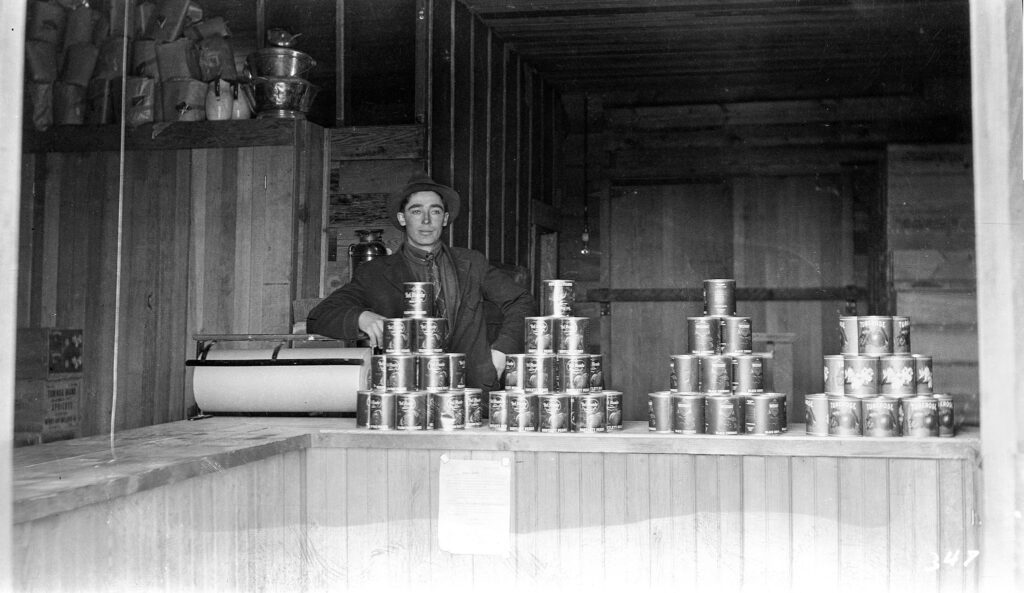
Fruit Growers solution, they opened a commissary. It ws nothing fancy and carried the necessary staple items. The commissary opened on December 12, 1920 and the discount store was only available to Fruit Growers employees. Local Fruit Growers manager, S.M. Bump wrote in a memo “Merchants can exploit all they want.”
Over the ensuing years the commissary evolved and would eventually be open to the public. Its name became Sunkist Grocery. While the store no longer longer exists, the building does. It is now the Lassen Senior Center at 1700 Sunkist, Susanville.
Tim
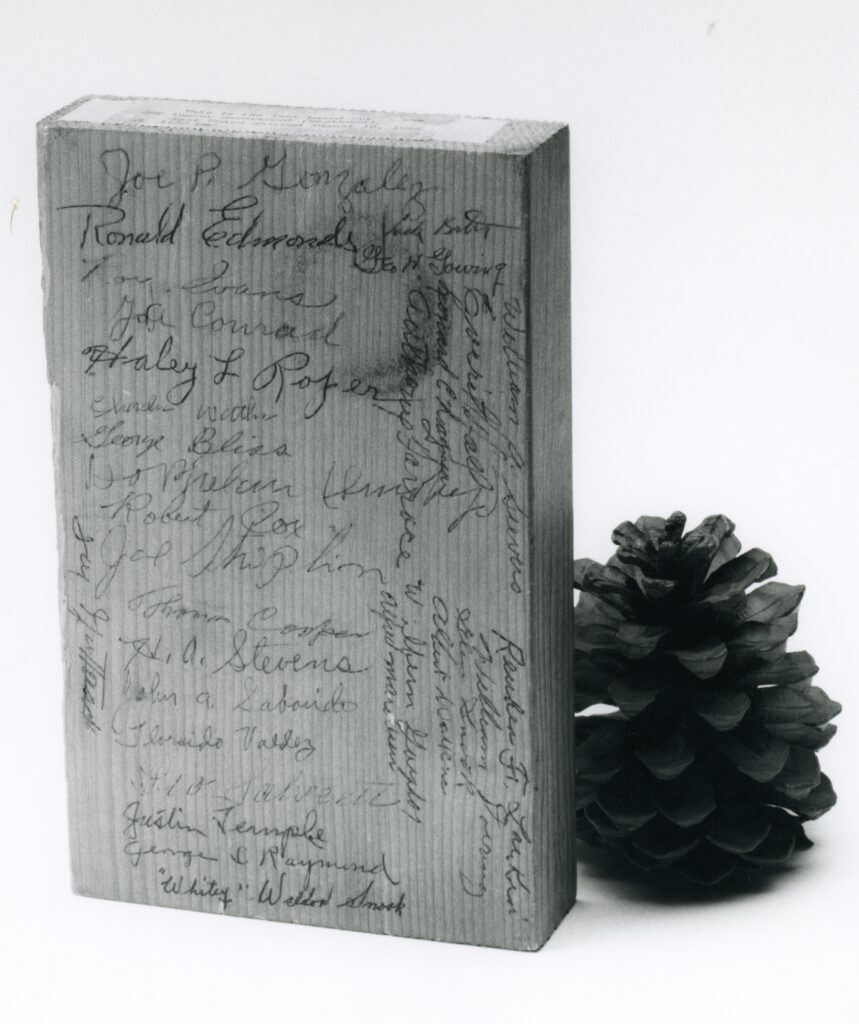
In January 1999, a relic of Westwood’s past was found in the old Community Center at Hilt. It was a piece of vertical grain Douglas Fir 5 1/2 inches wide, 9 inches high and 1 1/2 inches thick. It was the last board cut in the dry lumber department at Westwood in 1956, signed by the last workers. The board was put on display at Fruit Growers headquarters, then located at Sherman Oaks. Since Fruit Growers has moved from location there is not telling as what became of it.
The board was signed by Joe P. Gonzalez, Ronald Edmonds, Roy Evans, J.A. Conrad, Haley L. Roper, Charlie Watkins, George Bliss, D.O. “Smokey” Phelan, Robert Cox, Joe Stripling, Thomas Cooper, H.A. Stevens, John A. Saborido, Florida Valdez, Tio Salveltti, Justin Temple, George C. Raymond, “Whitey” Weldon Snook, Jack Bates, Geo. H. Gowing, Reuben F. Larkin, William Doeering, Glen Snook, Albert Watkins, Wilbern Taylor, Alfred Mardesen, Jay Guttered, William A. Sievers, Everett Hall, Leonard F. Lagnear and Anthony Farrace.
Tim
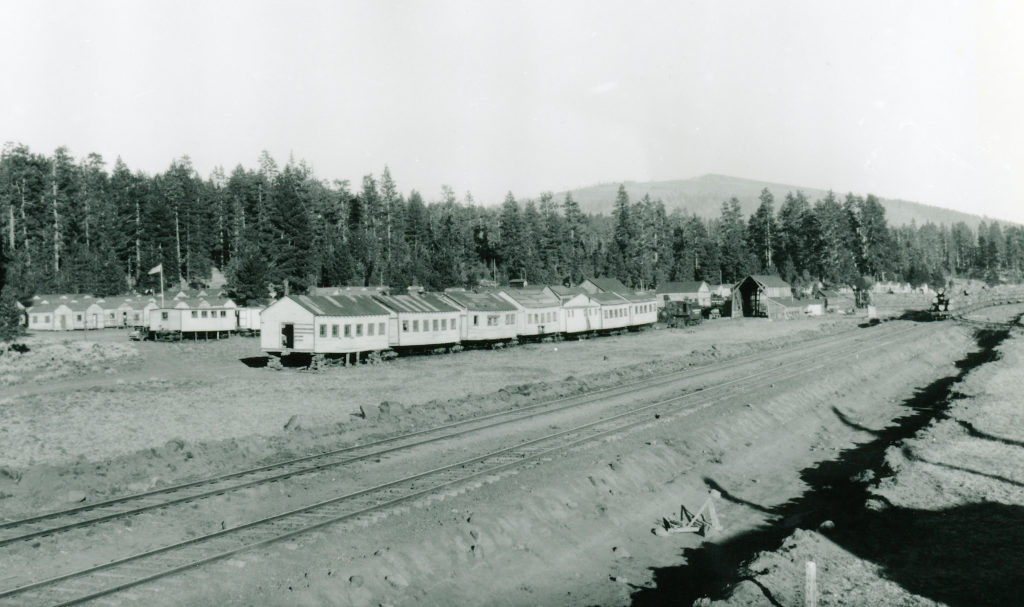
Fruit Growers logging Camp 10 is unique that it lasted over twenty years and did not shut down until the end of the 1952 logging season. The camp was located at the northern end of Pine Creek Valley, near the creek. An interesting note, its water supply came from Bridge Creek Springs.
Camp 10’s remnants differed from that of Camp Harvey. One distinction is the camp was situated on both private and public lands. Also, due to the fact of its longevity there was bound to be lasting impacts. While there are structures at Camp Harvey, there are none to be found at Camp 10. Foundation remains of other residue are present.
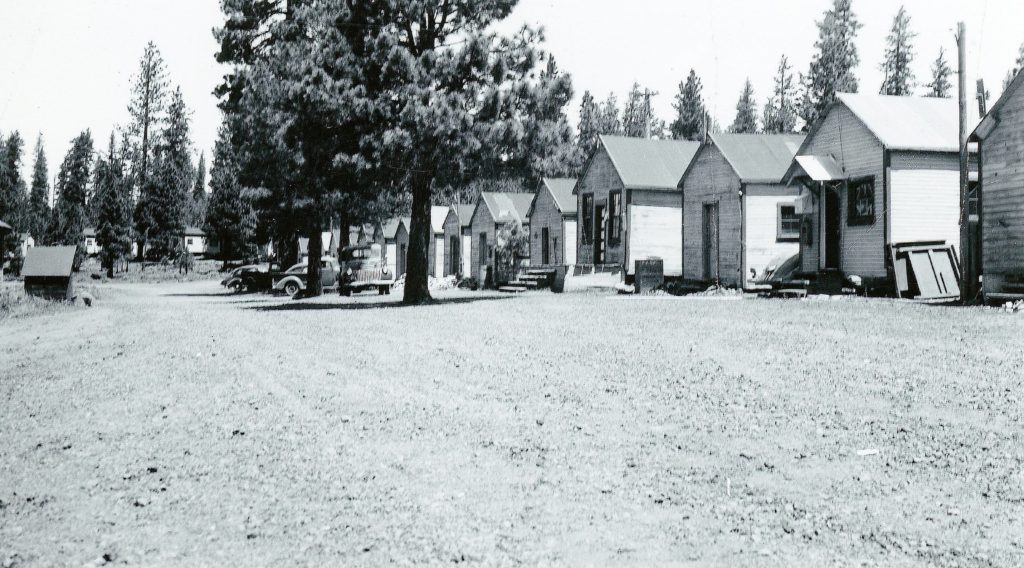
The cabins were brought into Susanville and sold. There are a few that can still be spotted around town. Seasoned residents may recall a row on such cabins near Piute Creek and Roop Street that Dan Marmo rented. Dubbed by some as ‘wino shacks’ they had no plumping or heat. Some may know the location as the residence of Al and Joy Robbins, 713 Cherry Terrace, Susanville.
Tim

In 1942 this railroad logging line had its origins at Halls Flat, near Poison Lake, headed into an easterly direction towards Harvey Mountain. By 1949, its entire length was just a bit over forty miles ending near Slate Mountain. A culinary workers strike abruptly shut down this line. Camp Bunyan was the initial camp at Halls Flat, established by the Red River Lumber Company. It was a mixture of portable permanent structures and housed some 350 men.
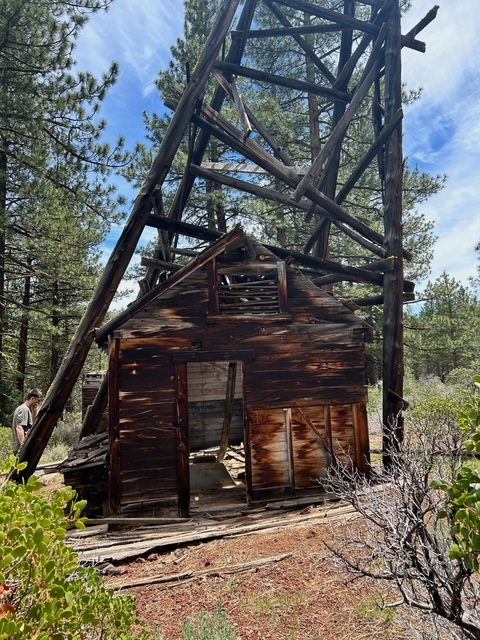
In 1944, Red River sold to Fruit Growers Supply Company and they continued with operations until the 1949 closure. As previously mentioned in an earlier post on this topic, it depends on who owned the site where the camps were located and what type of conditions included as to removal.
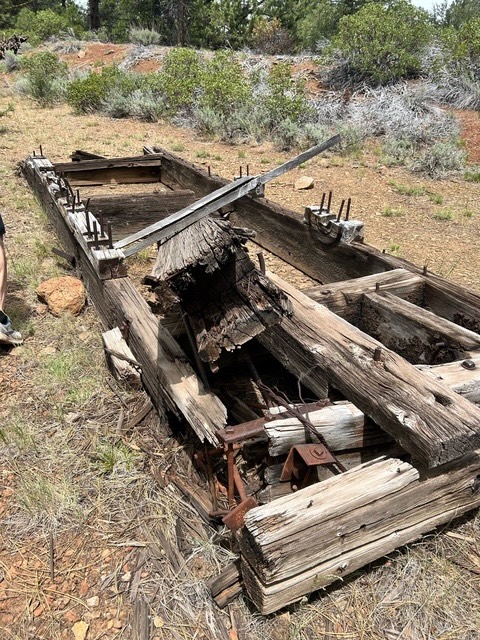
In 2024, there is hardly any remnants of Camp Bunyan, Puls Camp or Camp Stanford. Camp Harvey is an entirely different story. Fruit Growers had an agreement with Shasta Forest, who managed the property for the heirs of the Red River Lumber Company, that they could take their time in removing the structures–the agreement stated they had up to 1967. Most all of the logging cabins and related structures were removed in 1952. It was mutually agreed to keep the water tank tower with its 10,000 gallon redwood water tank, along with the pumping house and pipes in place for fire protection.