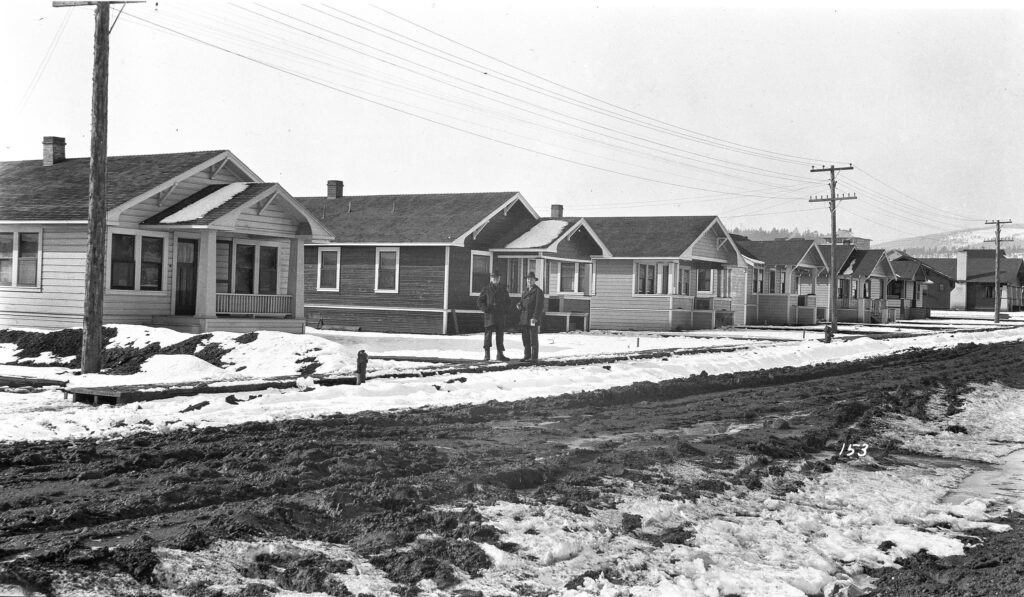
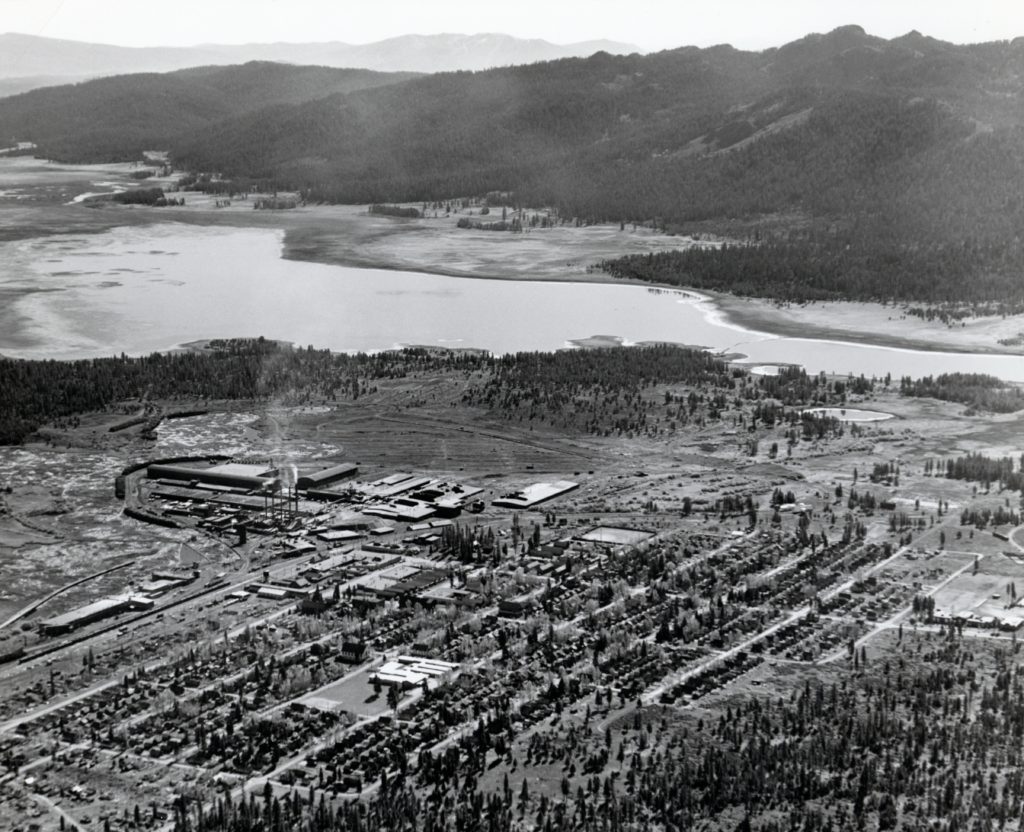
A family residential section of Fruit Growers, 1921—Ed Standard
In 1919, when Fruit Growers Supply Company planned to build a mill at Susanville, they saw many benefits. Instead of the situation they had at Hilt, a company town they inherited. They felt confident that Susanville entrepreneurs would fill void, especially when it came it to housing. Nothing went according to plan. First of all, Fruit Growers hired 1500 men, the majority with families, which that figure was larger than the population of Susanville.
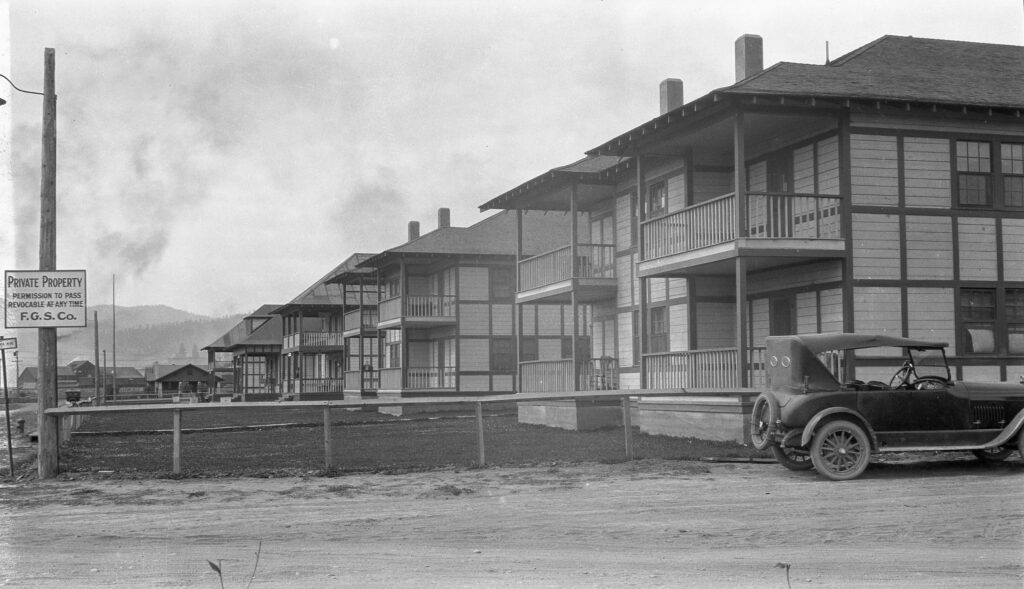
Fruit Growers dormitories, 1921–Ed Standard
Fruit Growers had to go plan B and build affordable housing for its employees. A residential district, Fruit Growers Townsite was laid out to the west of the plant. Half the townsite contained 80 cottages, the other half dormitories and apartments. It cost Fruit Growers $245,000 to build the housing project. While Fruit Growers is gone today, many of these buildings remain. Another item are the street names, a legacy of the state’s citrus landscape—Sunkist, Monrovia, Upland, Orange, Limoneira to name a few.
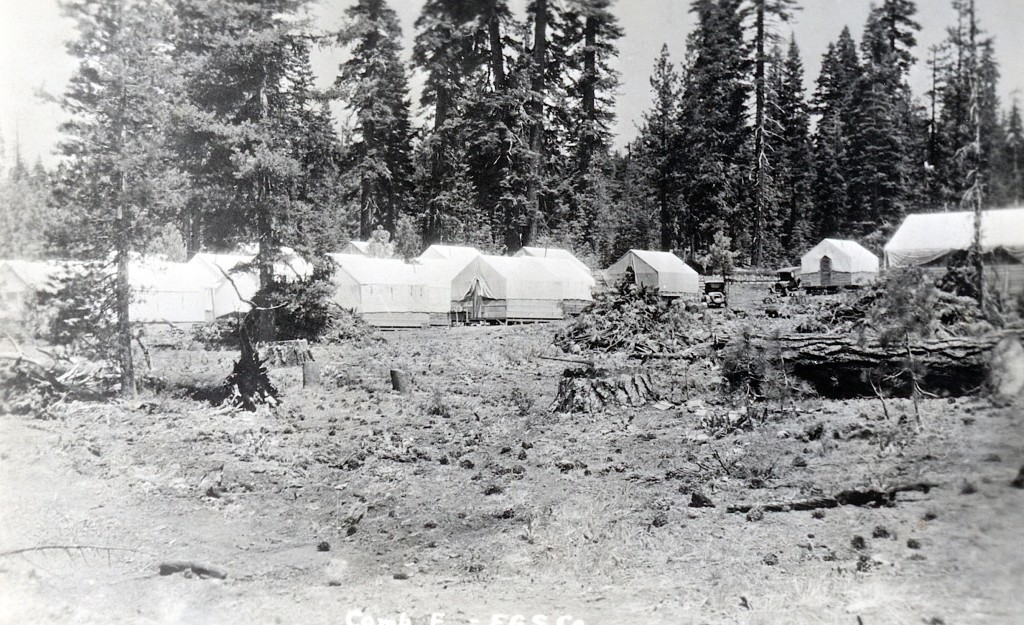
This is first part of a three part series examining logging camp remnants. Today, we will focus on Fruit Growers Camp B and C. These camps operated during the early to mid-1920s in the Martin Springs vicinity, north and east of McCoy Flat Reservoir. Both were substantial camps comprising some 250 men. Camp C boasted a boxing arena that seated 500 people!
Camp C, no date. Courtesyof Lenala Martin Collection
Today, there is plenty of remnants at Camp B. Among those are the concrete foundations of the commissary and cookhouse. Though it’s been some time since I last visited. the railroad service pits were somewhat in tact. There is scattered debris in the area, and I even found an old pocket watch. Camp C is just the opposite. Without any remnants or any other tell tale signs it is difficult to locate. Why the difference? Camp B is located on land owned by Fruit Growers. Camp C was on land owned by the forest service, the latter required the site to be cleaned up after no longer in use.
Next up the examination of the Harvey line that had four camps–Bunyan, Puls Harvey and Stanford.
After the logging season of 1952 ended, Fruit Growers discontinued railroad logging. In the Hazard Reduction of the Pine Creek Unit timber sale with the forest service in 1936, stated that all existing railroad grades be converted into roads, once the steel and ties were removed. In 1952 Fruit Growers had 48 miles of railroad line. A total conversion would be excessive. To rectify the difference Fruit Growers and the Forest Service conducted a joint field survey–the parties agreed upon the conversion of fifteen miles instead of the original 48. Fruit Growers agreed to maintain the roads for ten years after the timber sale.
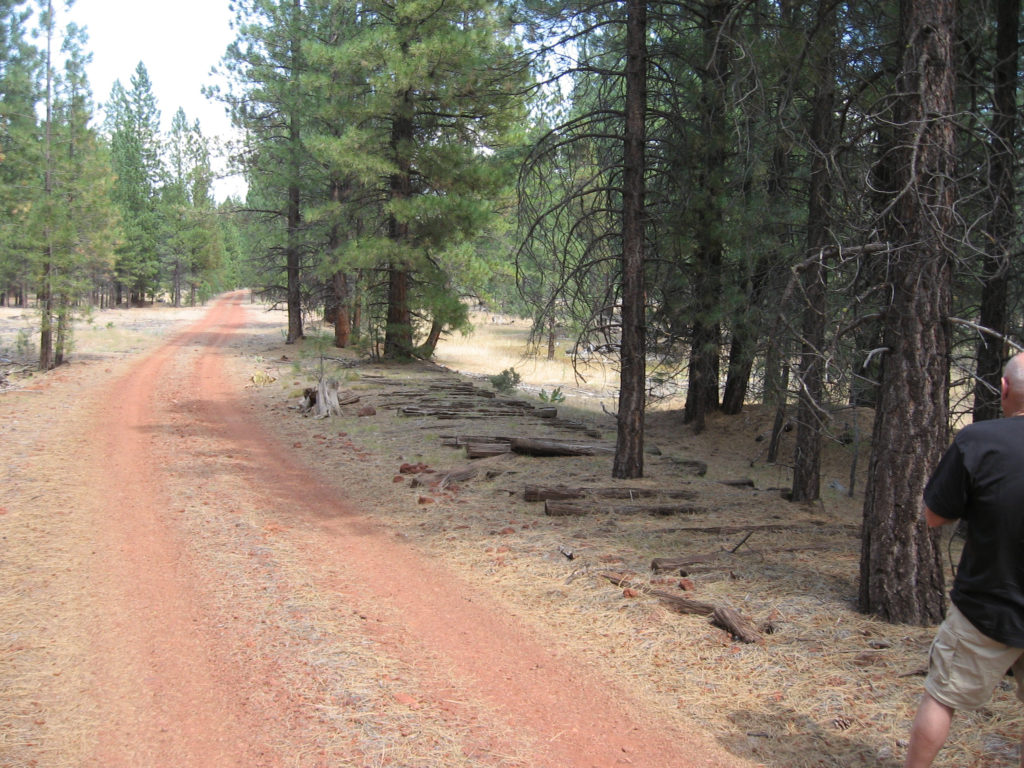
It was one of those days, that I had a lapse of better judgment should have, but did not take a picture of Shay’s Hole. However, about a mile down the road, we stopped to take pictures of these old railroad ties still in place.
A view of Westwood with Keddie Ridge in the background, 1955.
Truth be known when Red River put its mill plant and town on the market in the early 1940s, no one wanted it. Some of the factors were an aging mill facility and majority of the tributary timber depleted. There was also the major headache of operating a town. It was not until Red River sweetened the proposition with the Burney Tract that contained an estimated one billion board feet of timber that made it more attractive. Reluctantly, Fruit Growers Supply Company succumbed and made the purchase.
Major changes were on the horizon and the universal adoption of the cardboard box changed the way Fruit Growers business operations in the future. On August 25, 1955 Fruit Growers announced it would shut down the Westwood plant. Since it appeared there was not market for the mill, Fruit Growers sold everything the following year to a liquidator Wershow and Weiz of Los Angeles. For Fruit Growers one of its greatest relief it no longer had the complicated burden of maintaining a town.
When Fruit Growers Supply Company accidentally became owner of a sawmill and town at Hilt, Sisikiyou, County, it was a major learning curve. One lesson they learned early on, you treat your employees well and they in turn do the same for company. Recreation amenities for Fruit Growers employees was deemed essential. By offering such, the company recouped its investment by reduced employee turnover.
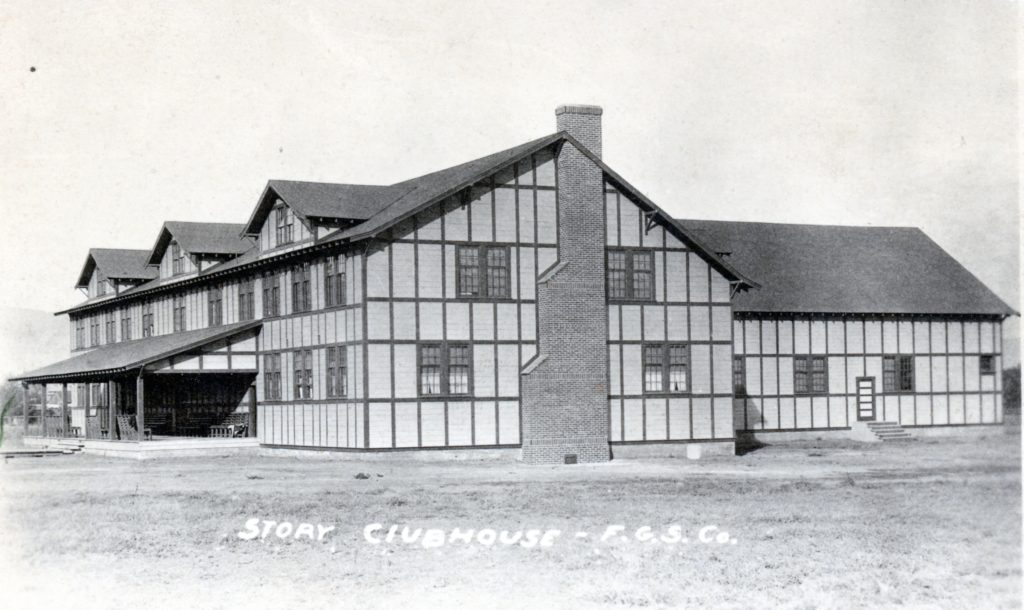
In 1922, Fruit Growers constructed a three-story recreational facility known as the Story Club. In July 1924, on the on the north side of the Story Club and adjacent to Riverside Drive they built a public park complete with a children’s playground, the first in Susanville. When the Story Club was destroyed by fire in 1944, the company decided not to rebuild since there were a variety of recreational outlets in Susanville. However, not to let the vacant space go to waste, they expanded the park.
In 1963, Fruit Growers sold its mill properties, which included the park, to Eagle Lake Lumber Company. Prior to the sale, the City of Susanville, agreed to take care of the park’s maintenance, since the public had use when it was created. In 1976, A.A. “Red” Emmerson, president of Sierra Pacific Industries, of which the Eagle Lumber Company was a division, offered the park to the City for $23,000. It had recently been appraised at $45,000. The City accepted the offer and by end of the year the deal consummated.
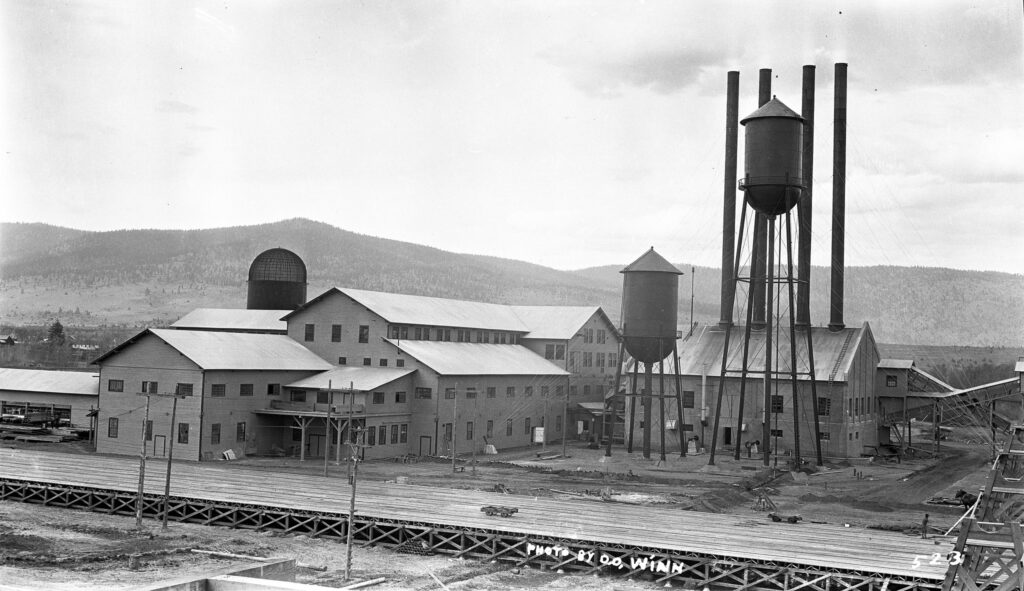
Fruit Growers Susanville mill under construction, 1921–Ed Standard
In 1920, Fruit Growers Supply Company hired photographer O.O. Winn for a two year period to capture on film the construction of its Susanville plant. Interesting, when I examined Fruit Growers’ archives in Studio City back in 1997, they only had a handful of these photographs. It should be noted, Frances Johnson, was meticulous with company’s paper files, but alas the photograph collection was in shambles.
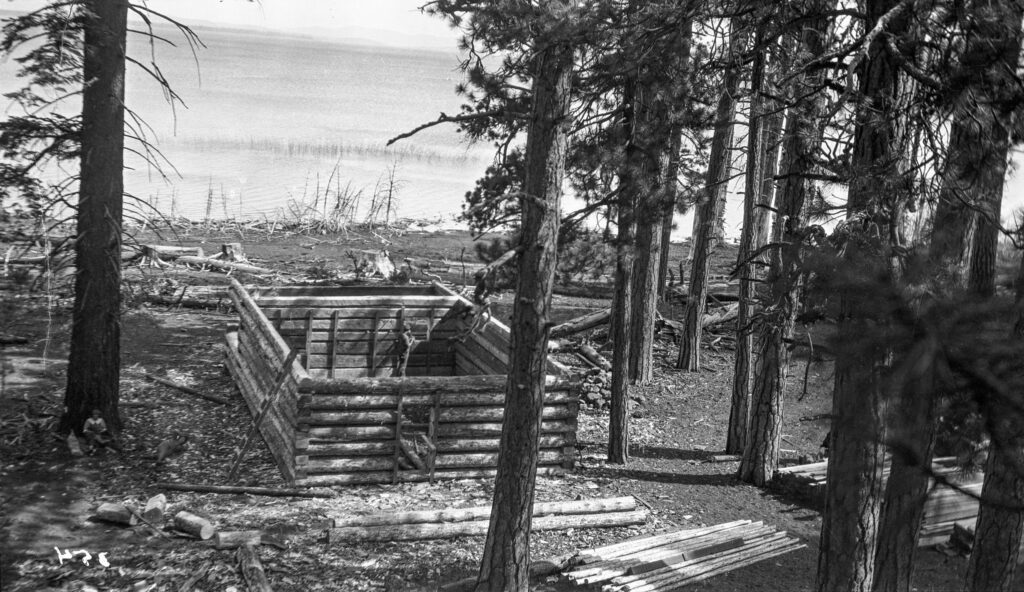
A Fruit Growers log cabin under construction at Eagle Lake, 1920—Ed Standard
A strange development occurred in 1998 when I was away to visit my grandfather John Tanner’s only living first cousin in Cornwall, England. When I returned home there was a small package containing some 700 negatives of Winn’s negatives. It turns out, that Ed Standard, who worked for Fruit Growers, was delegated of task of cleaning the Susanville office in 1963 prior to the sale. He was instructed to take the negatives to the burner to be destroyed, but took them home instead. My dear friend, the late Hank Martinez, made prints of selective negatives that I chose, the collection was to overwhelming. Fast forward to 2024, a volunteer is scanning many of the negatives into positives. So over the next few months you know why an abundance of Fruit Growers photographs.
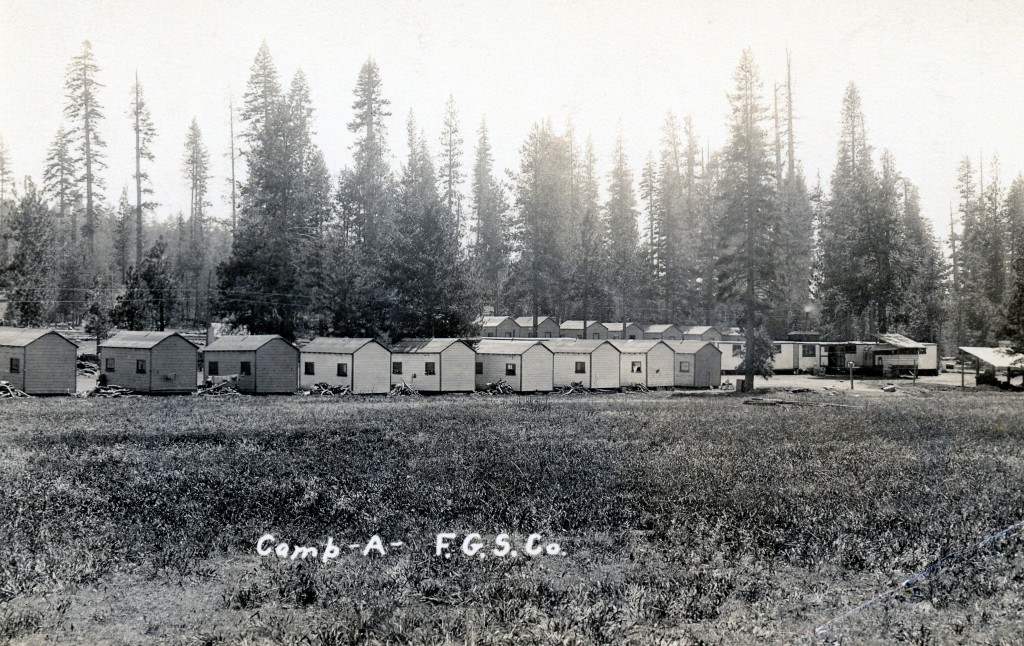
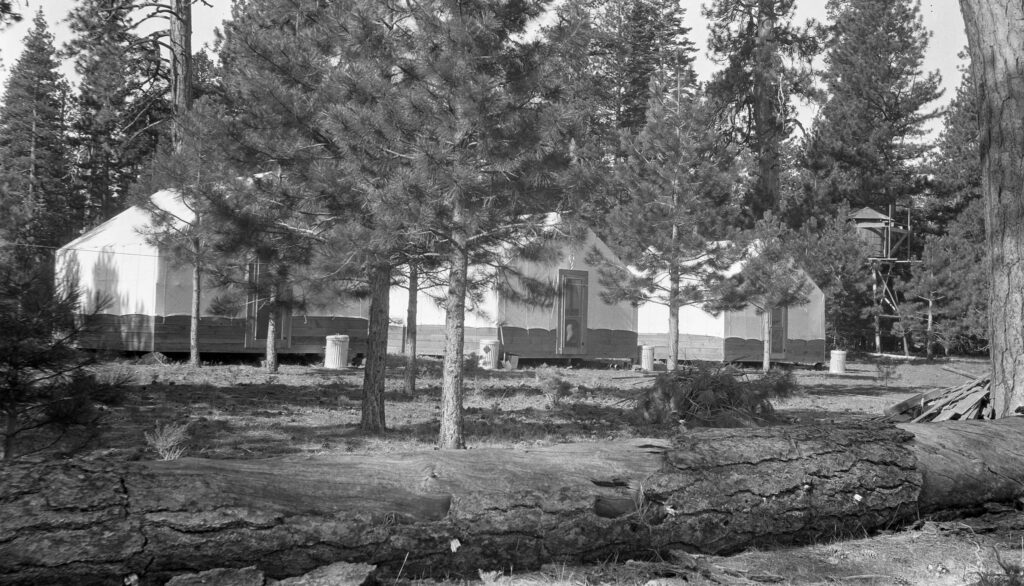
In a ten-year period between 1920-29 Fruit Growers Supply Company established 10 logging camps west of Eagle Lake. Many of these camps were substantial in size, housing over 200 men. There were several smaller camps that only existed for a single season. These small camps differed from their counterparts as they had wooden canvas tests, whereas the others were actual cabins, that could be placed on rail cars to move from one place to the next.
Camp A, Fruit Growers Supply Company, located just north of McCoy Flat Reservoir, 1921
Camp 9, located a few miles west of Camp 8, also known as Summit Camp operated during the 1928 logging season. It was not a full fledged logging camp, and it only housed timber fallers.
A Fruit Growers railroad logging crew with iies and a Clyde tracklayer, 1932 in Pine Creek Valley
A subscriber inquired from the Ask Tim post of April about railroad logging/grades west of Eagle Lake. I have been slow to post, as I have been experiencing technical issues with scanning, however on a bright note that will soon be resolved.. Of course, to properly address this topic will take several posts. However, I wanted to begin the series with these two illustrations.
A Fruit Growers Clyde tracklayer in operation near Camp Harvey, 1947
The top one is an excellent photograph depicting everything needed, workers, railroad ties and a Clyde tracklayer machine. Fruit Growers initial railroad logging began just north of present day Highway 44, and a little southeast of McCoy Flat Reservoir in 1920. The Susanville mill was still under construction, so only a small volume of logs were needed. The following year, witnessed large scale railroad logging activity and the establishment of two large logging camps Camp B & C.
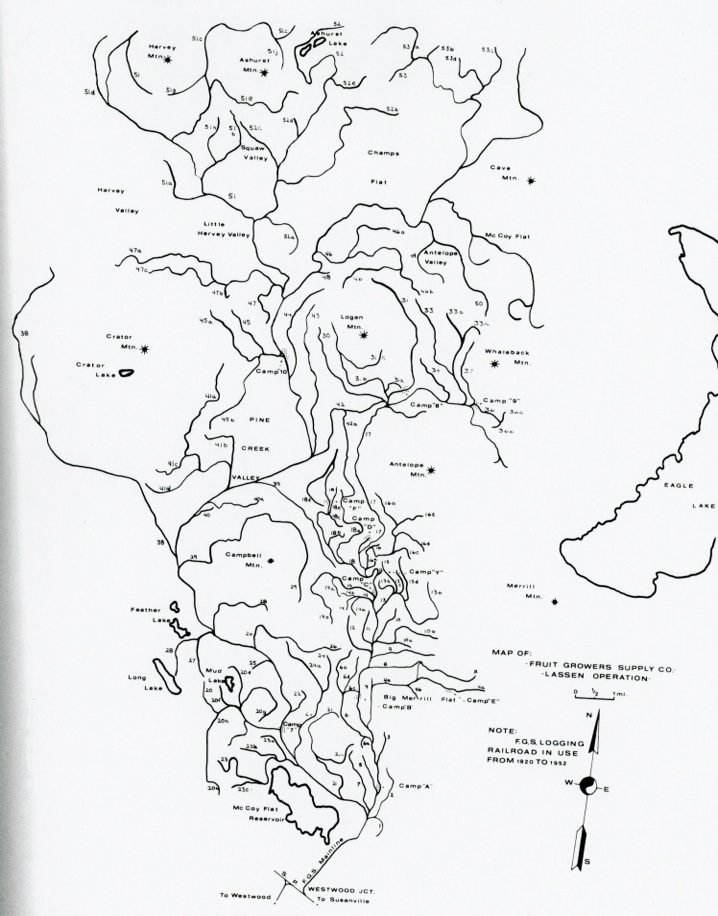
Stay tuned more to follow.,including a map showing all the lines and spurs.
A historic view near present site of Susanville Ranch Park parking lot/trail head.. Courtesy of Hank Martinez
Susanville is fortunate to have the Bizz Johnson Trail on the south side of town and Susanville Ranch Park with multiple trails on the north side of town. Each has their own unique story how they evolved. Today, we focus on Susanville Ranch Park.
The first person to examine the property for non-agricultural purposes was T.B.Walker, founder of the Red River Lumber Company. In 1912, the Walker family had a heated debate. as to their permanent mill, though a site had been selected at Mountain Meadows. T.B. Walker had given considerable thought to this particular site. However, as we known Mountain Meadows would win over, and the town of Westwood became a reality,
The ranch as it appeared in 1922, when Fruit Growers owned it.
In 1919, enter Fruit Growers Supply Company when they were scouting around for a mill site. That company went one step further and purchased the property for while undecided one the site, they wanted the water rights to Bagwell Springs. While Fruit Growers chose a different Susanville location, they retained the property. After all it would be beneficial for pasture for horses, a then an important component in logging. Fruit Growers then established a dairy there. It was brief, and it was a leased to the Okelly family who operated Lassen Dairy there for several decades.
In 1934, Fruit Growers offered to sell the ranch to the City of Susanville. Fruit Growers cited it would make an ideal golf course, that the money received from the golf course could be used to develop the remainder of the property into a park. The City liked the idea, but said no. In 1935, Fruit Growers sold the ranch to the Republic Electric Power Company who wanted to acquire Bagwell Springs as an additional water supply for Susanville. Over the years, that Company went through numerous reorganizations and became CP National. In 1984, CP National donated the ranch to Lassen County, and it is now a county park.
An interesting footnote to the story is that Lassen Community College examined the property for a future campus back in the 1960s, but the asking price was too expensive at $3,500.
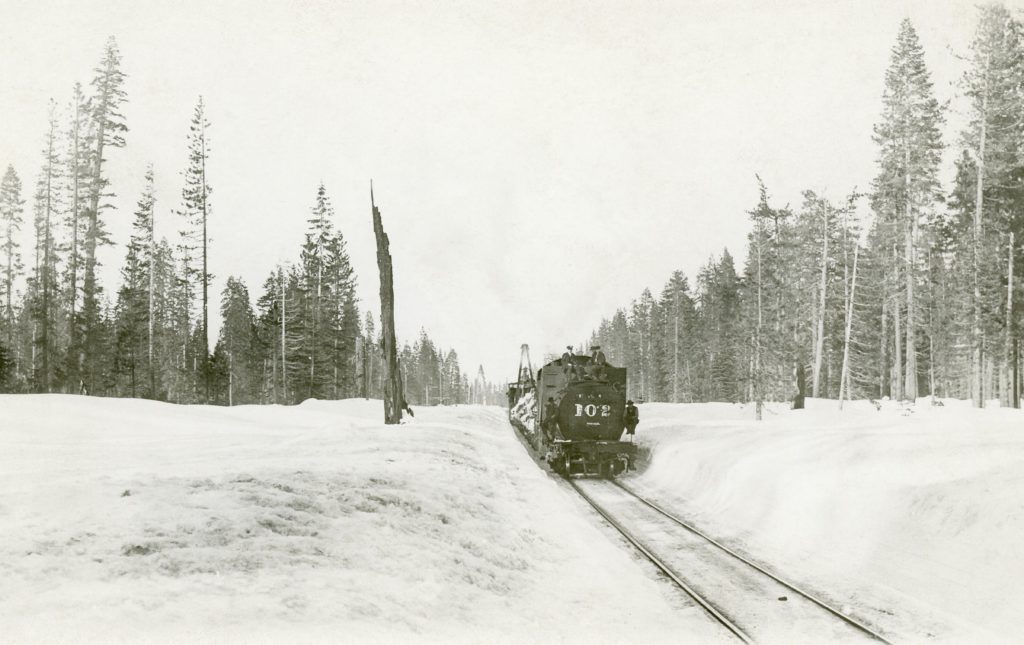
In 1914, Red River Lumber Company purchased three Baldwin locomotives from. the Tonopah Goldfield Railroad for its Westwood operation. Of course, Red River had quite a fleet of locomtives at Westwood.
The 102 remained in operation during Red River’s tenure there and the locomotive became the property of Fruit Growers Supply Company in 1944. When Fruit Growers closed the Westwood mill in 1956, the 102 was sold for scrap.