Tag Archives: Fruit Growers Supply Company

Tree Growing Clubs

Fruit Growers tree nursery at Susanville, 1928.

In the early 1900s there was a nation wide movement of forming tree growing clubs to sustain a future supply. Of course, certain regions were in more dire need of trees than others. For a brief movement, there was an attempt to organize the farmers of the Honey Lake Valley for an co-operative effort to do the same. It never went anywhere. Continue reading Tree Growing Clubs
Greater Westwood, Inc.

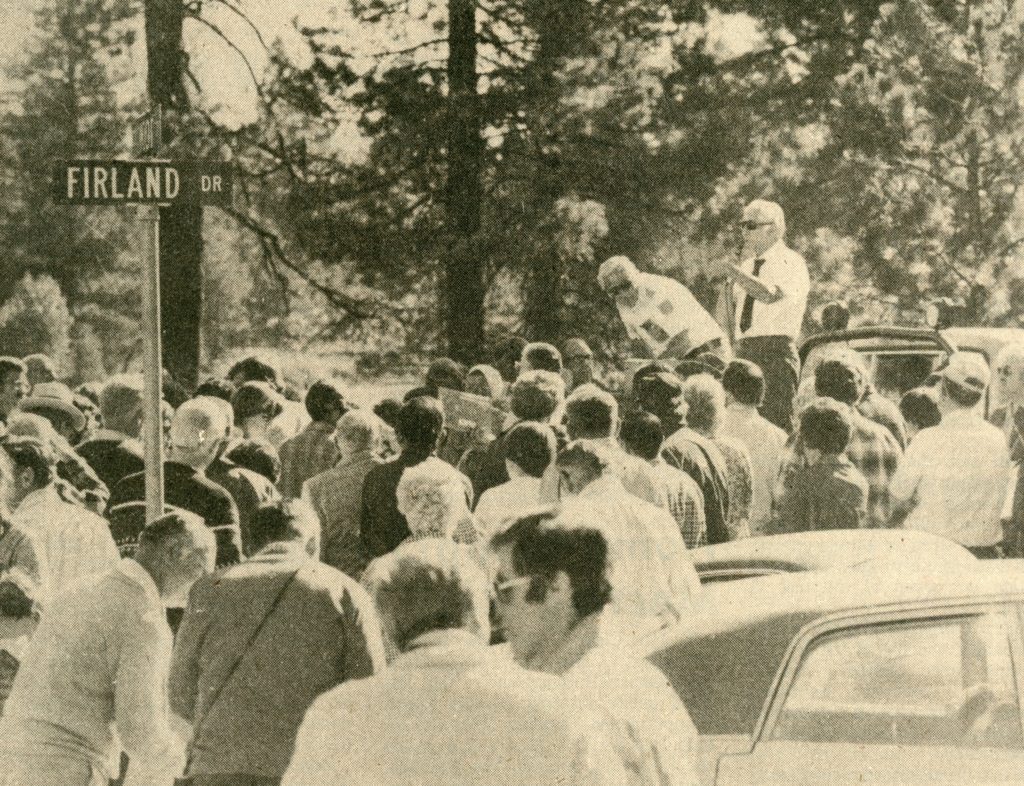
The auction was held at Pinetown.

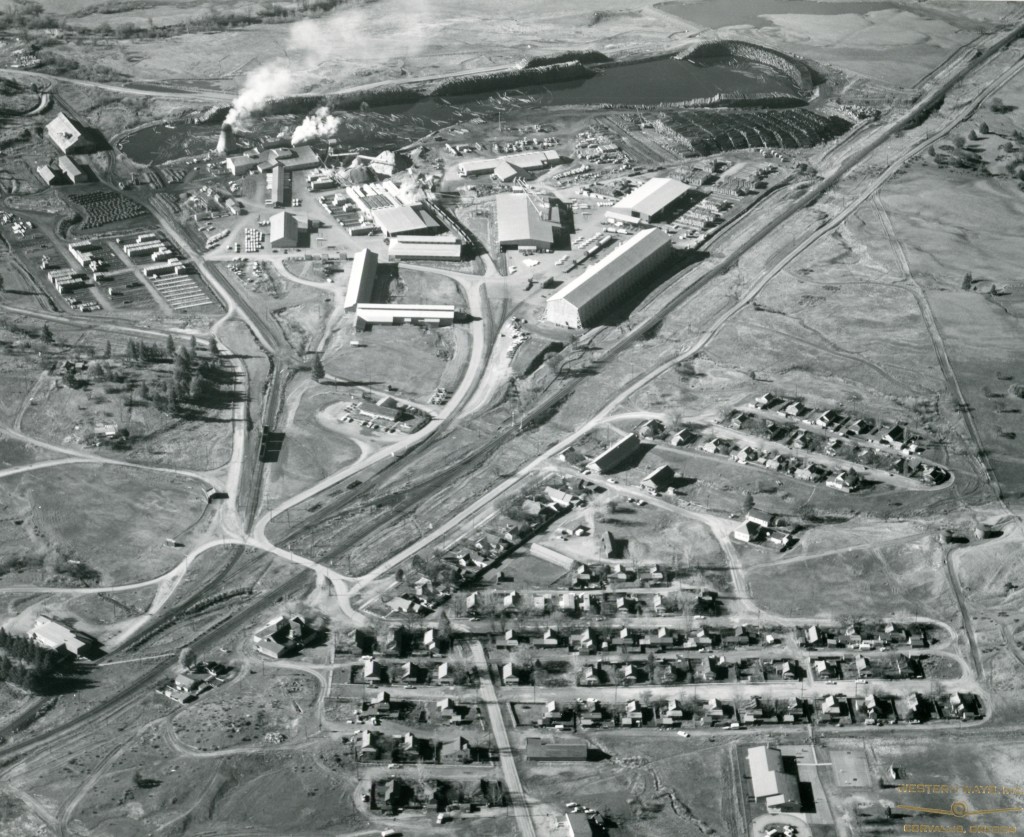
On September 12, 1956, the Fruit Growers Supply Company sold its Westwood operations, i.e., the mill and town to Milton Wershow and David Weiz of Los Angeles for $625,000. The two men operated a liquidation company and it was their original intent to attract other industries to Westwood. When the mill burned down unexpectedly on November 8, 1956 that changed their plans. To handle real estate sales they formed Greater Westwood Inc.  After twenty years, on October 9, 1976 they held an auction to sell of the remainder of their Westwood properties. With several hundred people in attendance they sold 76 residential lots and 28 commerical lots.

Subscribe

The Big Tree – A Follow Up

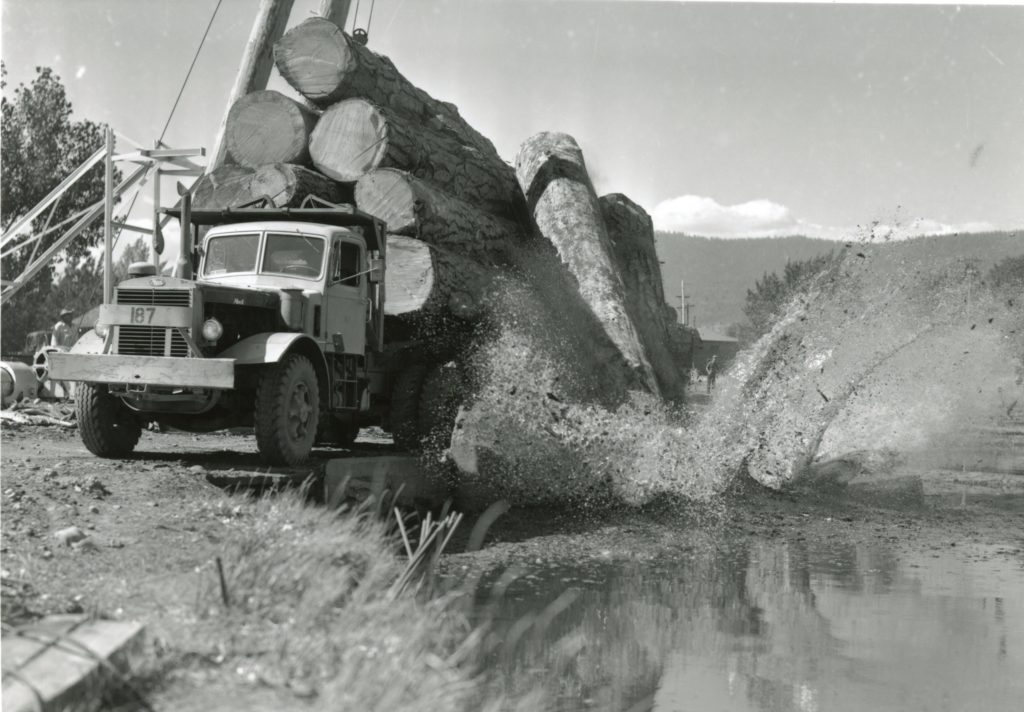
The record load of 26,860 board feet being unloaded at the Fruit Growers millpond, Susanville, August 21, 1953. Courtesy of Hank Martinez

Yesterday, it was noted that the massive sugar pine tree felled by the Red River Lumber Company contained 27,570 board feet. To gain a better understanding, the above photograph is a massive truck load of logs being unloaded at Fruit Grower’s Susanville millpond that contained 26,860 board feet!

A question was raised about timber fallers. A good timber faller can determine precisely where the tree will fall. Well, a not so good faller, is another tale. I recall in one instance working in the woods with my Dad. My father gave the faller instruction as to where a particular tree was to land. Needless to say, it did not happen and some one was not happy with the final result.

Subscribe

Lassen Industrial Bank

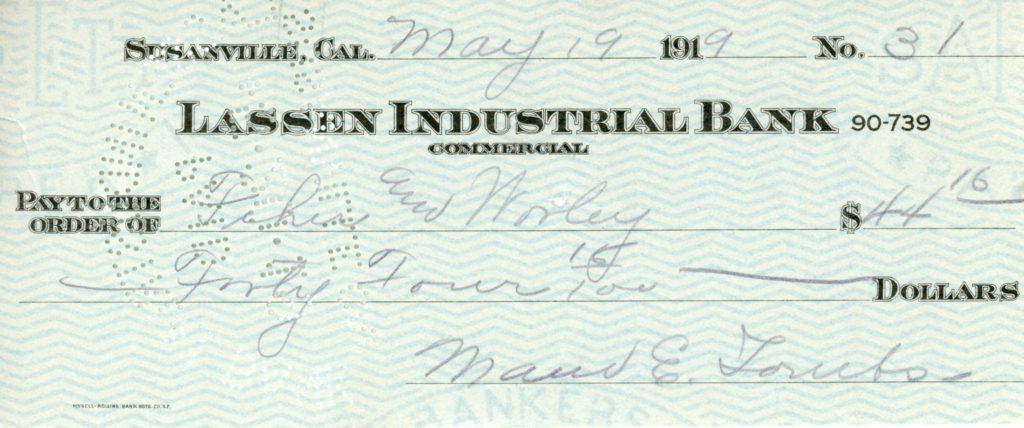
Lassen County Clerk, Maude Tombs cancelled check

The banking industry has certainly changed over the years, and in my opinion not for the better. To accommodate and serve customers banks went out of their way to make life a bit easier. Take for instance, Susanville’s Lassen Industrial Bank, in 1914 offered banking by mail, a novel approach for its time. In the 1920s to handle the needs and convenience of the mill workers of Fruit Growers Supply Company and Lassen Lumber & Box Company, the bank arranged special hours for them. On pay-days of the mill workers, the bank was opened in the evenings from 6:30 to 8:30 for regular business.

Subscribe

Old Time Power Saws

An electric saw powered by a D-2 cat. Courtesy of Fruit Growers Supply Company

In the twentieth century one aspect of logging that was slow to modernize was timber falling. In the mid-1930s, Fruit Growers experimented with a Dow Low Stump Power Saw. It turned out to be too bulky and cumbersome and the fallers returned to falling timber manually. In 1943, Fruit Growers experimented with an electric saw power by a generator attached to a D-2 Caterpillar. To provide for mobility it was equipped with 400 feet of cable.  One of the drawbacks was it took three men to operate it one to operate the tractor and two to run the saw. It was not until the 1950s when a more advance line of lightweight saws were introduced that the traditional hand saws and axes were replaced by the power saw.

Subscribe

Hilt Picnic

Hilt, California, 1972. Courtesy of Fruit Growers Supply Company

If there are any former Fruit Growers Supply Company folks out there, this Sunday, August 5 will be the last Hilt Reunion Picnic to be held in Medford, Oregon. Contact me for details.

For those not familiar with Hilt, it was Fruit Growers Supply Company’s company in Siskiyou County, near the Oregon border. In 1933, Fruit Growers gave serious consideration to close the mills at Hilt and Susanville due to the challenging economic conditions. However, Fruit Growers understood the value of their employees and kept the mills open to retain their workforce. However, there were layoffs. A number of workers from Susanville were transferred to Hilt. There they established a conclave known as “Little Susanville.”

Subscribe

The 1924 Fire Season

The.aftermath of the fire at Camp D

The winter of 1923-24 was one of the driest on record for the State of California. Springs that had always flowed, dried up. With the tinder dry conditions of the summer of 1924, it became a volatile fire year, and the Lassen region was of no exception.

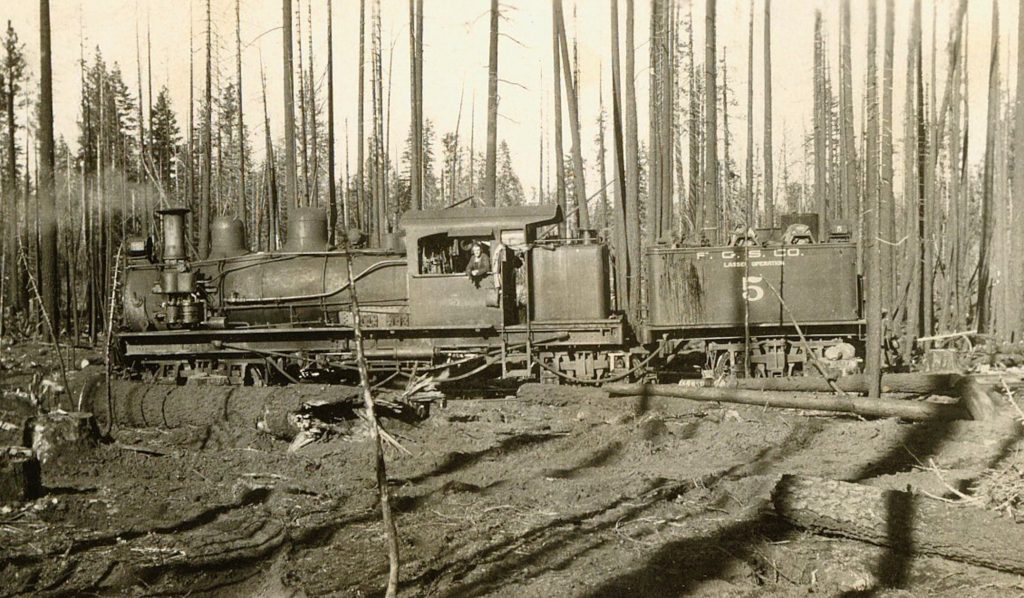
On Monday, July 28, 1924, sparks from a steam donkey engine operating near Fruit Growers Camp D, just west of Eagle Lake. In less than a hour the blaze turned into a firestorm, spreading over four miles and destroying three steam donkey engines, eight railroad flat cars, one water tank car and about three miles of railroad track. Nearly one thousand men fought the fire that destroyed over 7,000 acres. It cost Fruit Growers $34,378.20 in suppression cost.

Donate

That’s a lot of lumber

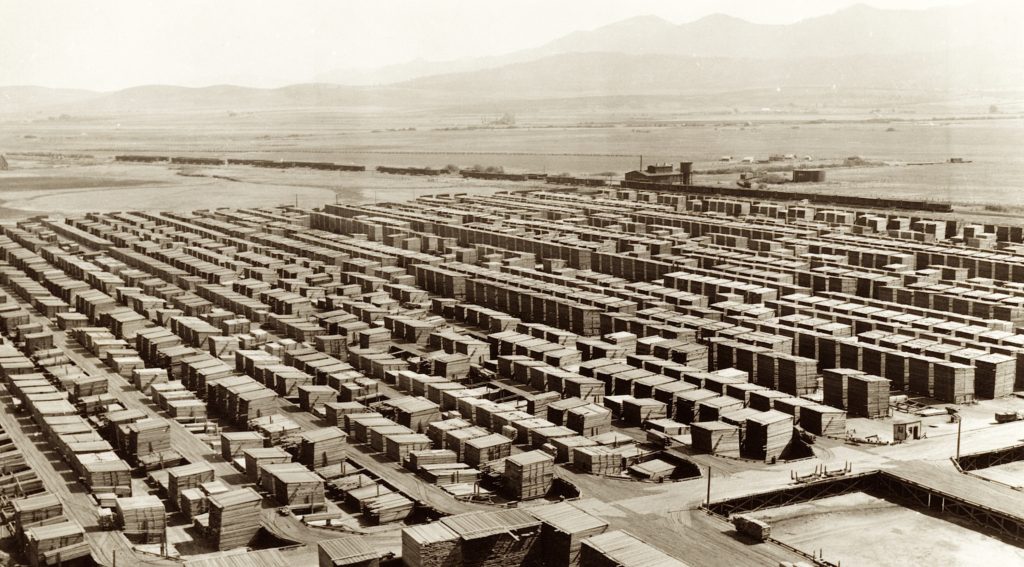
Fruit Growers Supply Company lumberyard, 1935.

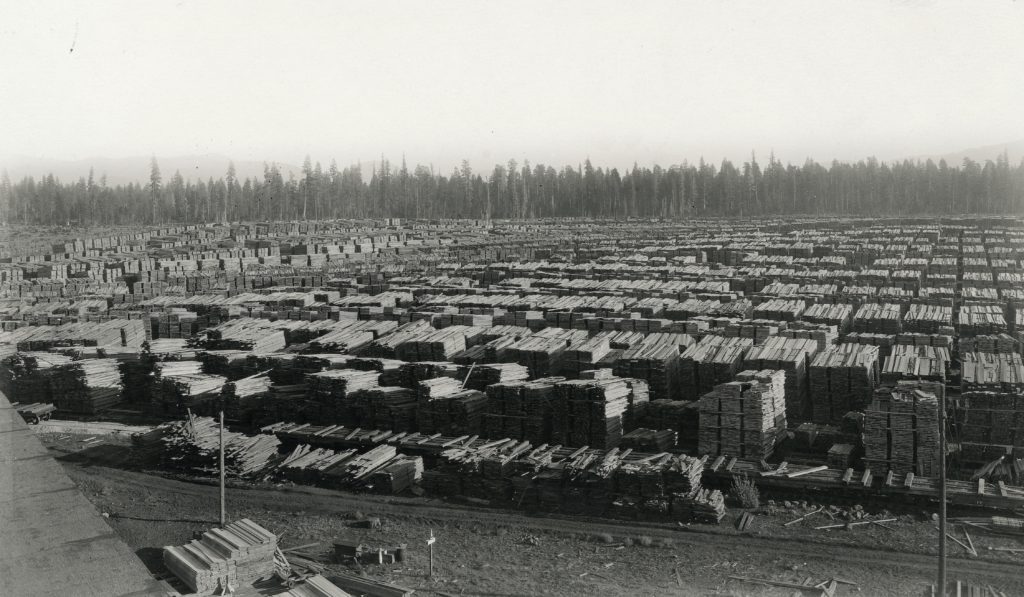
The compilation of the logging history of the Fruit Growers Supply Company was a very enjoyable project.  In their meticulous annual reports there was always some interesting fact. Take for instance of the above photograph that shows 54 million board feet of lumber. The reason why Fruit Growers was in the lumber business was for a supply of box shook, the components used to make a wooden box to ship citrus, since this was before cardboard. Anyhow, if the lumber depicted above was used for box shook, it would only meet one-third of the boxes needed by Sunkist for that year.

Subscribe or Donate

A logger’s lunch

Lunch time!

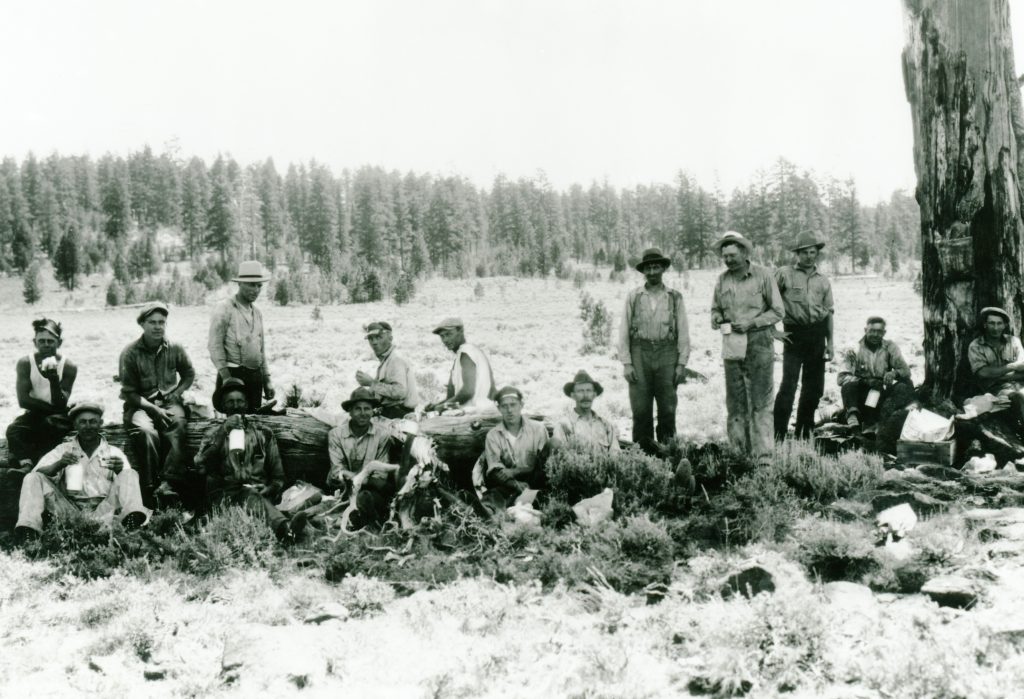
For what ever unknown reason, I have been intrigued by this photograph. It was taken in 1932, by well known photographer Clark Kinsey. The Fruit Growers Supply Company hired Kinsey to photograph their operations at Hilt and Susanville.  Fruit Growers it should be noted is the purchasing agent for the citrus growers marketing co-operative known today as Sunkist.  Photographs such as these, in addition to filming the operations were important tools to show the citrus growers how their money was being invested to provide them wooden boxes at a reasonable price to ship their fruit.

Donate or Subscribe

A million board feet

North Lumber Yard, Red River Lumber Company, 1923. Courtesy of R.S. Pershing

As we explore Lassen’s lumber industry’s past, there are references to the volume of a million board feet (mbf).  During the 1920s, the lumber mills of Lassen County had an average annual output of 250 million board feet of lumber.

George Cone, who worked in the Lumber Division of Fruit Growers provided this definition using that mill’s output for the 1922 season at 62 million board feet. If it was placed on a single freight train, that train would extend eighteen miles. And since it took 6,000 board feet of lumber to build an ordinary house in those days, Cone figured that the 1922 output could build 60,000 houses. According to Cone, with an average household consisting of five persons, this production could provide the housing needs of 300,000 people!

Subscribe