Tag Archives: Eagle Lake

A Eagle Lake Barbecue to Remember

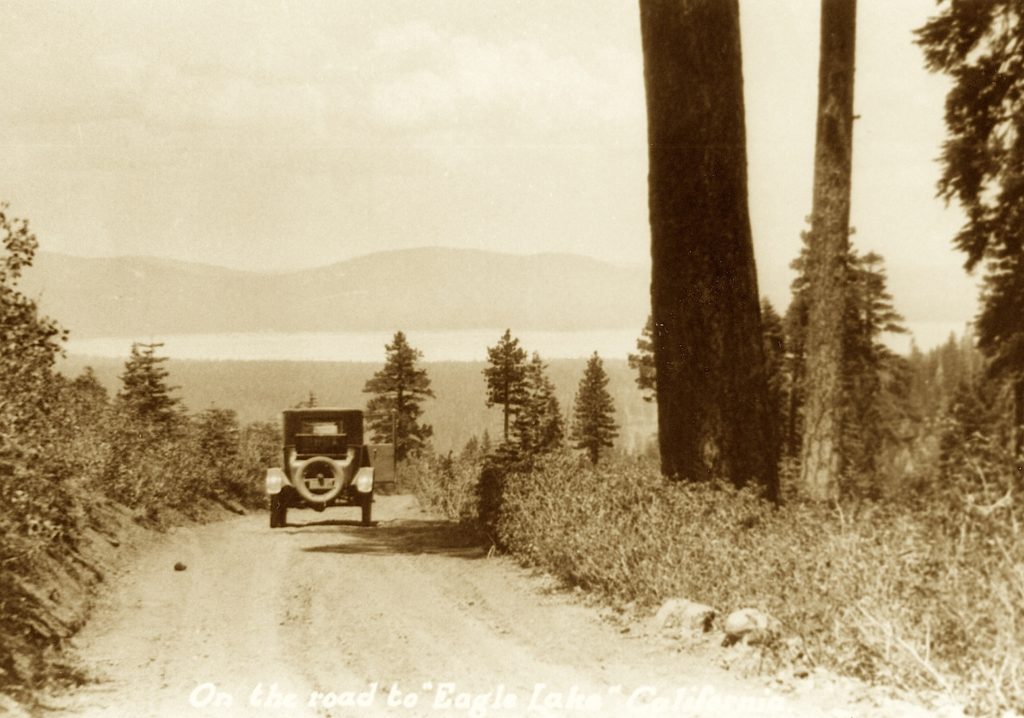
Eagle Lake Summit, 1923. Courtesy of Dick & Helen Harrison

The citizens of Susanville in August 1926, while hosting the California American Legion Convention, did everything they could to make it a memorable event. One of the many events they hosted was a barbecue at Eagle Lake. This was no small feat. It was a logistical nightmare to transport some 2,700 people to the south shore of lake. In addition, to bring all the food and related items to go with it had to been a daunting task. To feed a crowd of that size was more than they were prepared for. Long lines were endured for a serving of steak and beans. Most of the attendees took it in stride. “Happy” Wintz from the El Segundo delegation composed a little ditty he sang the next day at the parade in Susanville, a variation of the local legion’s slogan, “Eagle Lake, Eagle Lake, on the rocks and rills, of California hills. Eagle Lake, Eagle Lake, that’s where we got the belly ache.”

Subscribe

Pine Creek Fish Trap

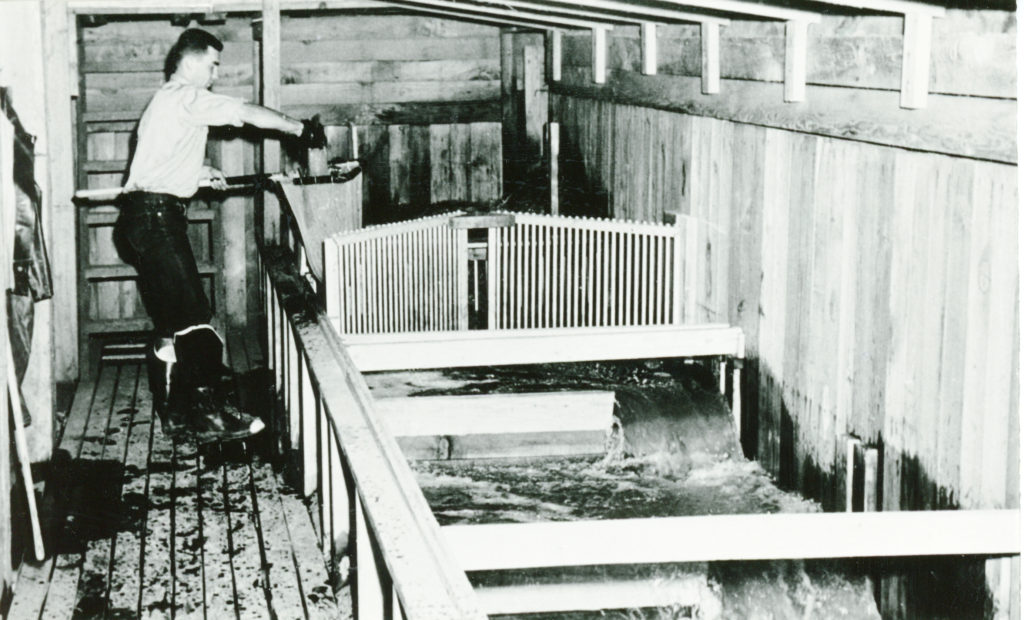
Inside the Pine Creek Fish Trapping Facility, April 6, 1961. Courtesy of Department of Fish & Game

The Eagle Lake trout nearly faced extinction, but fortunately now it is a success story. Between the drought and the Bly tunnel, not only did the lake drop to record low levels, but the Pine Creek estuary became so silted the trout could not go up that stream to spawn. By saving grace, the winter of 1937-38 witnessed tremendous precipitation, that allowed for substantial spring run-off that cleared the Pine Creek channel.

In 1948, the California Fish & Game came forward to save the trout. In 1950, Harry Chandler, a biologist was successful in setting up a trap to catch spawners. One adult spawner happened to yield 2,000 eggs. Those eggs were taken to the Crystal Lake Hatchery were they hatched and reared. While that was a good start more needed to be done. In 1958, the Wildlife Conservation Board allocated $38,810 to construct a fishing trap/egg collection station at the mouth of Pine Creek, and also the Crystal Lake Hatchery with an additional four more rearing pounds. It was money well spent as the following year sixteen adult spawners were caught. Thus, a very successful start and we know the rest.


This is an excellent time to visit the facility, especially for those who have never been there.

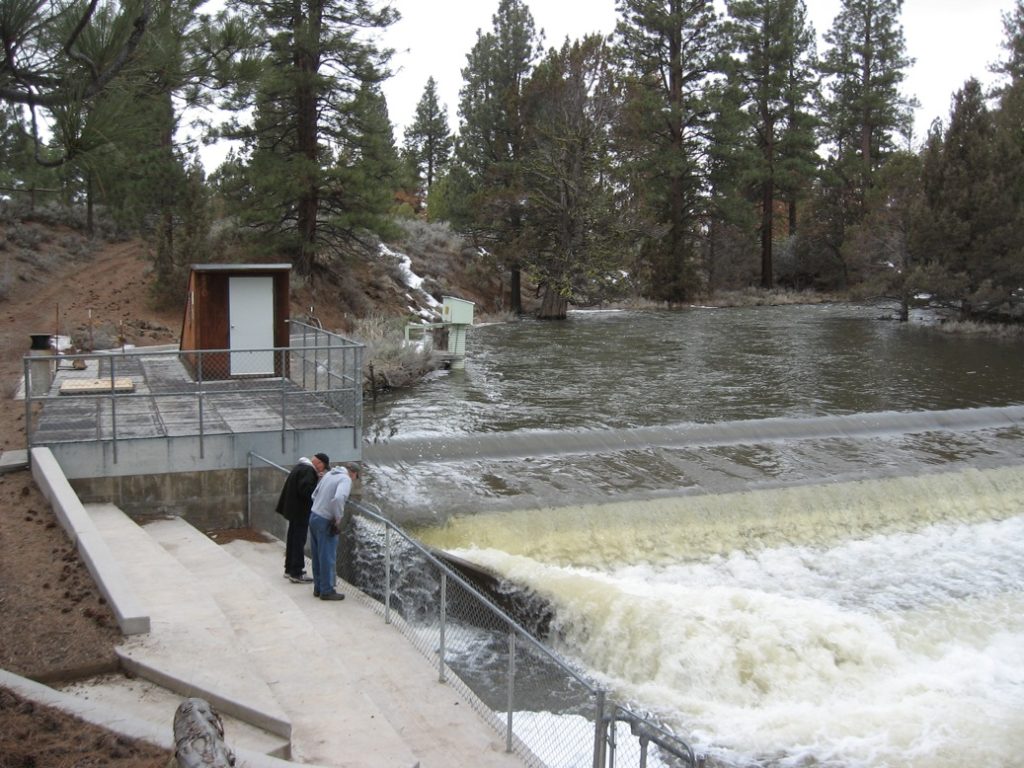
The Pine Creek Fish Trap, April 4, 2019

Support

Honey Lake Paiute Ethnography

Sacramento Bee

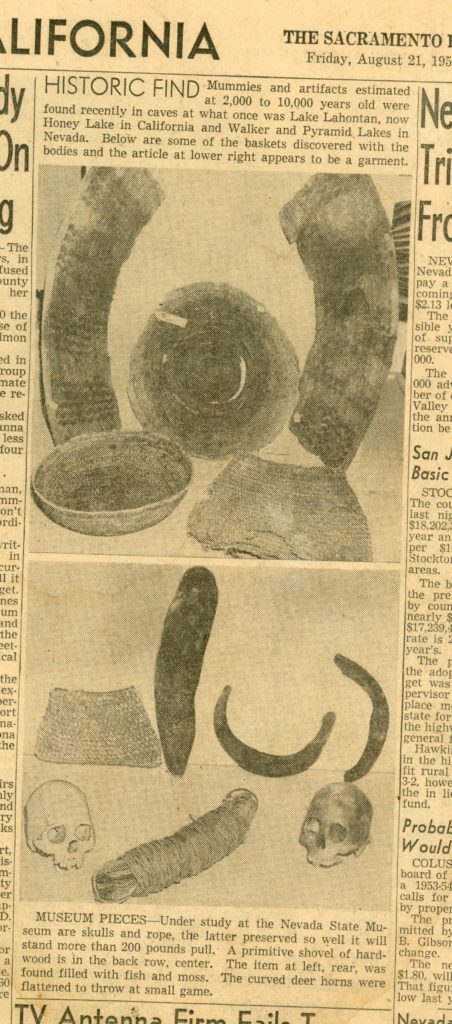
In May 1978, the Honey Lake Paiute Ethnography was published by the Nevada State Museum. It was the work of Francis A. “Fritz” Riddell (1921-2002). Riddell was a well known archeologist and was first professional archeologist to work for the State of California.

Riddell’s father, Harry, came to Lassen County in the late 1920s to assist with the troubled plague Bly Tunnel at Eagle Lake. In the early 1930s, Francis attended the Missouri Bend School near Janesville. There he found arrowheads on the school grounds, that he was so intrigued by that led to his future career. By the late 1930s, the family had relocated to Sacramento. His older brother, Jim remained in Susanville and spent a career as a mail carrier in Susanville. Francis returned to the area on a regular basis to visit his brother, but he a special fondness for the local Native American community. Francis was involved in excavation of Tommy Tucker cave near Wendel, from 1949-1951. He also did extensive field work at Secret Valley.

Support

Pine Creek – Then & Now

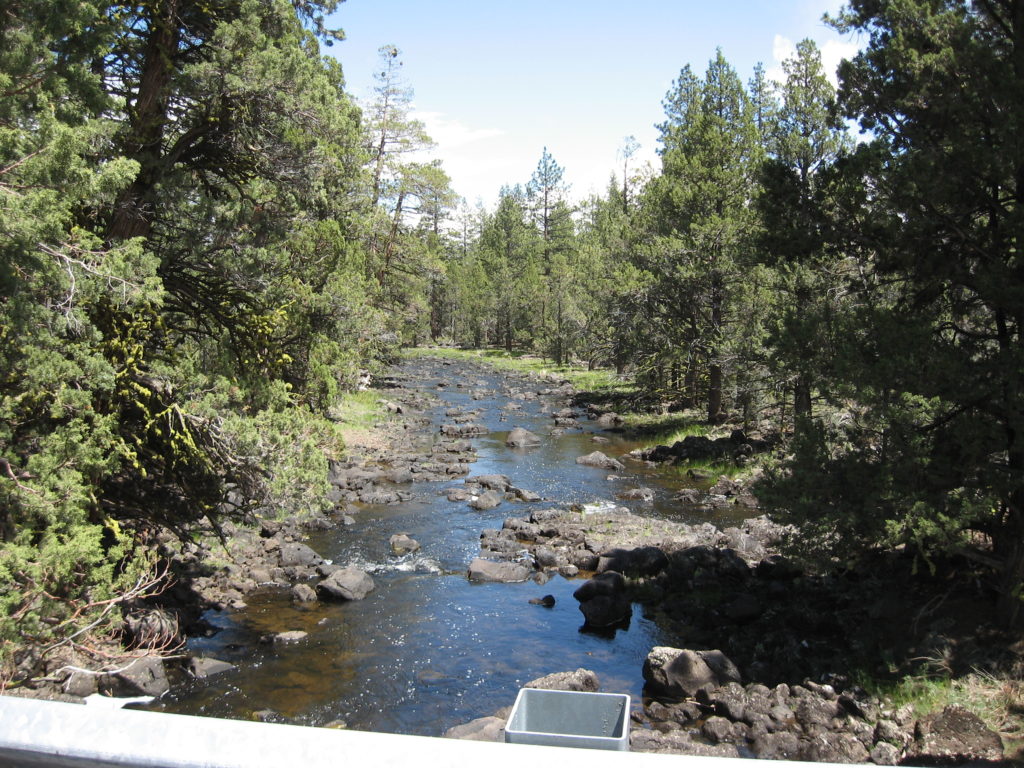
Pine Creek, June 9, 2017

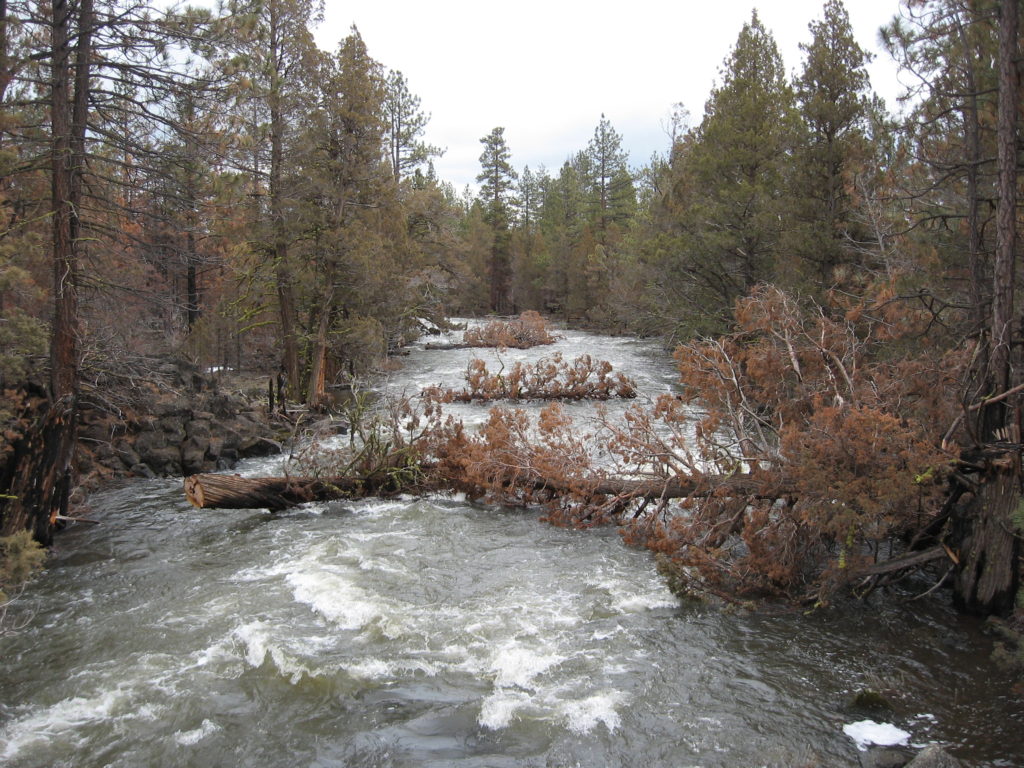
Some times, certain places just always seems to stay the same. Others can go through dramatic transformations. Having a severe case of either cabin fever or the lack of warm spring weather, necessitated an outing, even if it was cold. A journey to Eagle Lake and check out the Pine Creek fish trap/egg collection facility. Turns out the spawners are moving slow, the water temperature even a bit chilly for them. The pelicans on the other hand are abundant. Since we were in the neighborhood, a trip to the south shore to check out the marina, etc. On the return, stop at the Pine Creek bridge, thus the changes taking place.

Pine Creek, April 4, 2019

Support

An Eagle Lake Millpond?

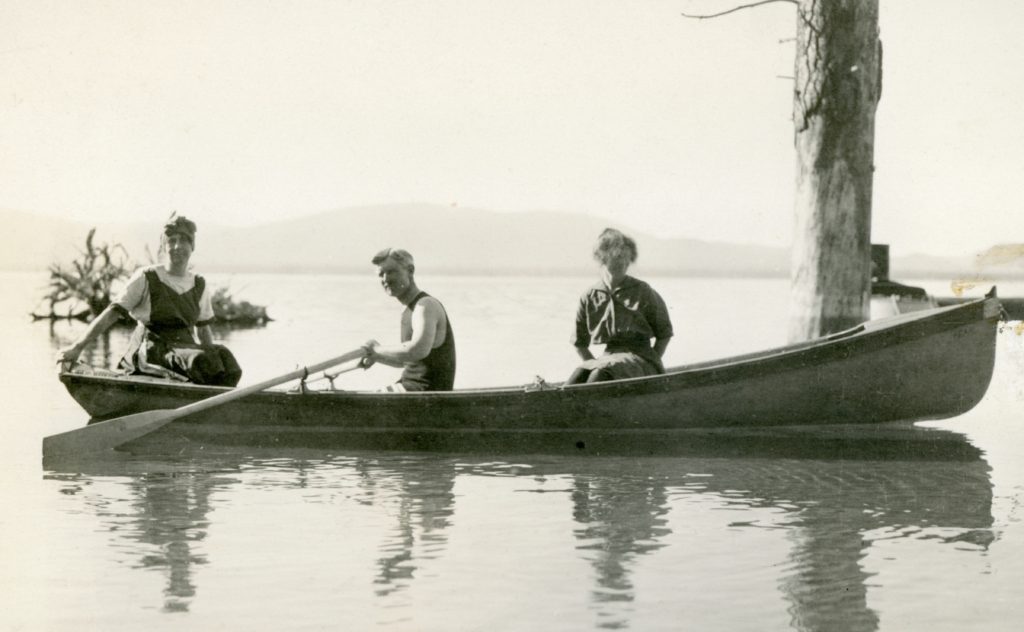
A 1919 Gallatin family boating outing on Eagle Lake. Courtesy of Wyn Wachhorst

In 1876, when Capt. Charles A. Merrill formed his Lassen County Land & Flume Company to tap Eagle Lake for irrigation to reclaim the sagebrush lands of the Honey Lake Valley, in certain ways he suffered from illusions of grandeur. Of his many schemes was to log the south and west sides of Eagle Lake. The logs would be rafted across the lake to the east side of his proposed tunnel, and each log, one by one through the tunnel. From there a flume would transport the logs to his proposed city of 25,000 souls at Belfast in the Honey Lake Valley where they would be milled and shipped out by rail. This pipe dream never happened.

Pine Creek
Pine Creek Estuary, July, 1973

In 1919, when the Fruit Growers Supply Company made the commitment to establish a sawmill operation in Lassen County, they sought advice from the Lassen National Forest Service where to locate. The forest service suggested a mill site along the Pine Creek estuary, that they could use as a millpond. The forest service stated Fruit Growers, if needed could use Eagle Lake as a millpond, but with Leon Bly’s pending project there might be legal problems.

Support

Eagle Lake’s High Water Level

A view of Eagle Lake, looking towards Spaldings, 1921. Courtesy of Lola L. Tanner

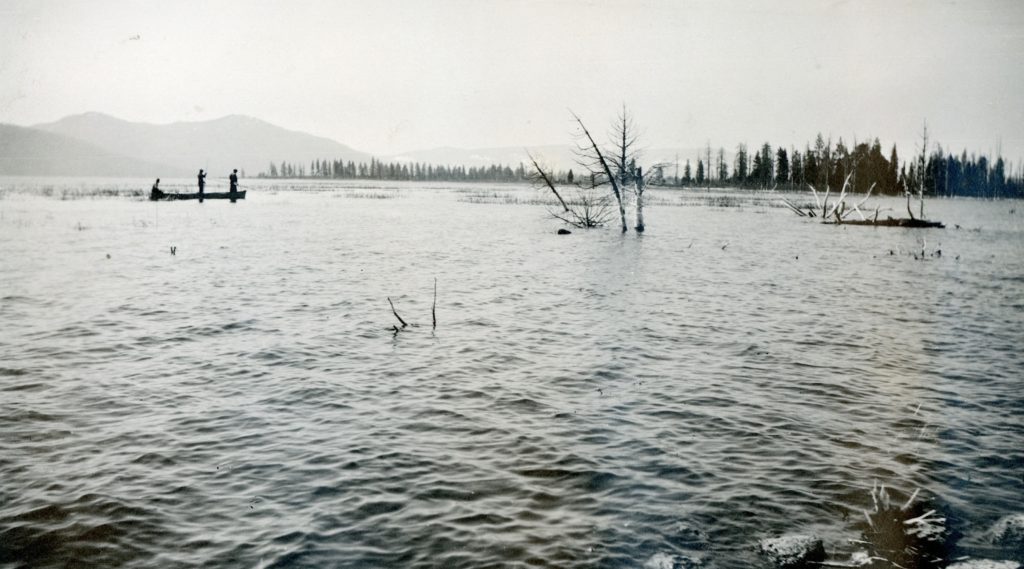
While there are numerous citations that Eagle Lake had reached its highest level at 5,125.2 feet in 1917, though what is peculiar was that this benchmark occurred in late March. One would think that a final observation would have been made in May, after the spring run-off. Then again, no one knew what the future had in store. First of all, 1917 marked the beginning of a twenty-year drought. That would be a rude awakening for many as nothing like that had happened since the Anglo settlement of the region. Then there would be another culprit to greatly affect the dropping of the lake’s level to historic lows. In 1923, water started to flow out of Eagle Lake to the Honey Lake Valley for irrigation through the Bly Tunnel.

To provide a better comprehension just how high the lake was in 1917, is that of March 1, 2019 the level of the lake is pegged at 5095, that is a difference of some thirty feet!

Support

Spalding vs. Spaulding

Pine Creek
Pine Creek, circa 1914. It sholuld be noted that John Spalding’s original homestead was on the north side of Pine Creek. Courtesy of Wyn Wachhorst

From time to time, I am asked about the spelling of Spaulding Tract, as the Spalding name does not contain a “u.” This no doubt is an issue of property title. There were two separate Spalding subdivisions. First one done in 1914, and the second the Spaulding Tract we know today was subdivided in 1924. A portion of the two subdivisions are identical, hence the need for clarification.

Support

Eagle Lake Cabin Site Company

An artist’s rendering of the proposed hotel

After the failed first Spalding subdivision, it was brought back to life as Spaulding Tract, The story of the inserted “u” for another time. In 1924, this time around, the Spalding family with a new subdivision on the west shore of Eagle Lake, hired real estate developers to promote it. This gave birth to the Eagle Lake Cabin Site Company.

Promote they did. These folks were shrewd, and knew first hand the local residents were not their market, because they knew there was nothing there to get excited about or invest in. The Eagle Lake Cabin Site Company produced a brochure to entice folks primarily in Southern California of this hidden gem, more spectacular than Lake Tahoe. To lure people to buy lots, as an enticement was the proposed grand hotel to be built, similar to the famed El Tovar Inn at the Grand Canyon.

The lots initially sold for $50 each. When the company began selling lots in the spring of 1925, they were confident that the entire tract of 5,964 lots would be sold out in six months. While they did not reach that goal, they did sell over 3,000 lots.

In 1926 sales dramatically taped off. This was due in part of the new lot owners when came to inspect Spaulding Tract. First they encountered poor roads and when they finally arrived there were not any visible signs that gave the slightest hint the place was a resort community. So digusted many of the lot owners refused to pay property tax for a non-existant resort community. Thus, the Eagle Lake Cabin Site Company faded into oblivion.

Support

Town of Spalding, 1914-1924

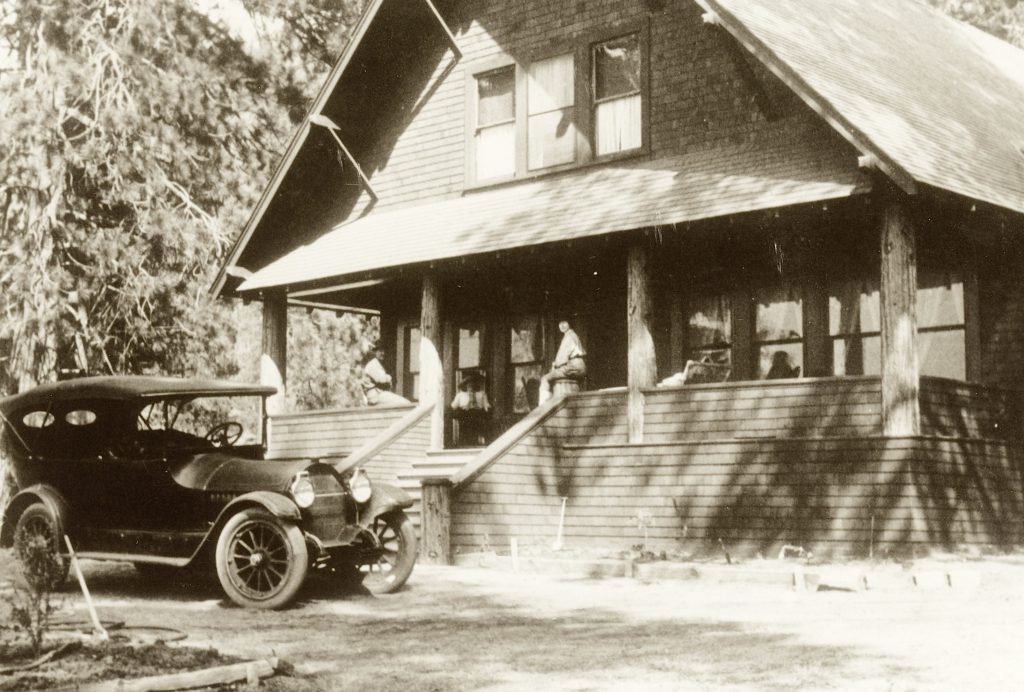
John S. Spalding’s second homestead at Eagle Lake, circa 1919. Courtesy of Wyn Wachhorst

On July 6, 1914, the Lassen County Board of Supervisors approved John S. Spalding’s subdivision for the Town of Spalding, on the west side of Eagle Lake. It was Spalding’s intent to develop a summer resort. The Susanville newspapers had extolled wonderful praise for the project.

Yet, momentum was difficult. First, there was competition of other developments taking place—the volcanic eruptions of Lassen Peak, the construction of Lake Almanor and the newly built company town of Westwood. Yet, one of Spalding’s biggest obstacles was access, or in this case, lack thereof. Even since 1900, considerable pressure was applied to the Lassen County Board of Supervisors to make road improvements to Eagle Lake, though very little materialized. The resort town was a failure. Only one lot was sold, of note it was a purchase by a retired Lassen County school teacher, Asa M. Fairfield.

In September 1924 the Spalding family petitioned the Lassen County Superior Court to dissolve the townsite and was granted.

Where are we – the answer

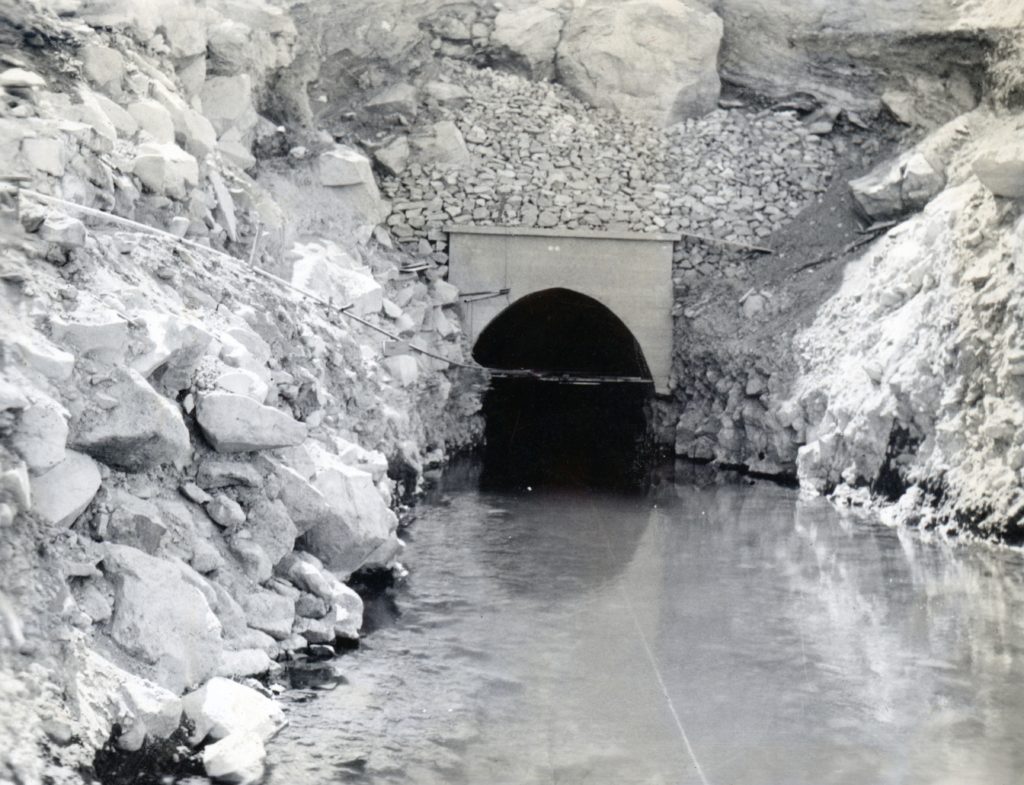
This is a portal midway through Bly Tunnel near Eagle Lake. The fenced off enclosure is easily seen from the road going up to the Eagle Lake Youth Camp. There are still numerous ditches, cement diversions of the canal system, extending all the way to the Sunnyside District near Janesville to past Wendel in another direction from the failed Tule & Baxter Creek Irrigation District’s Bly Tunnel project.

The outlet as it appeared in 2012. Courtesy of Barbara White

Subscribe