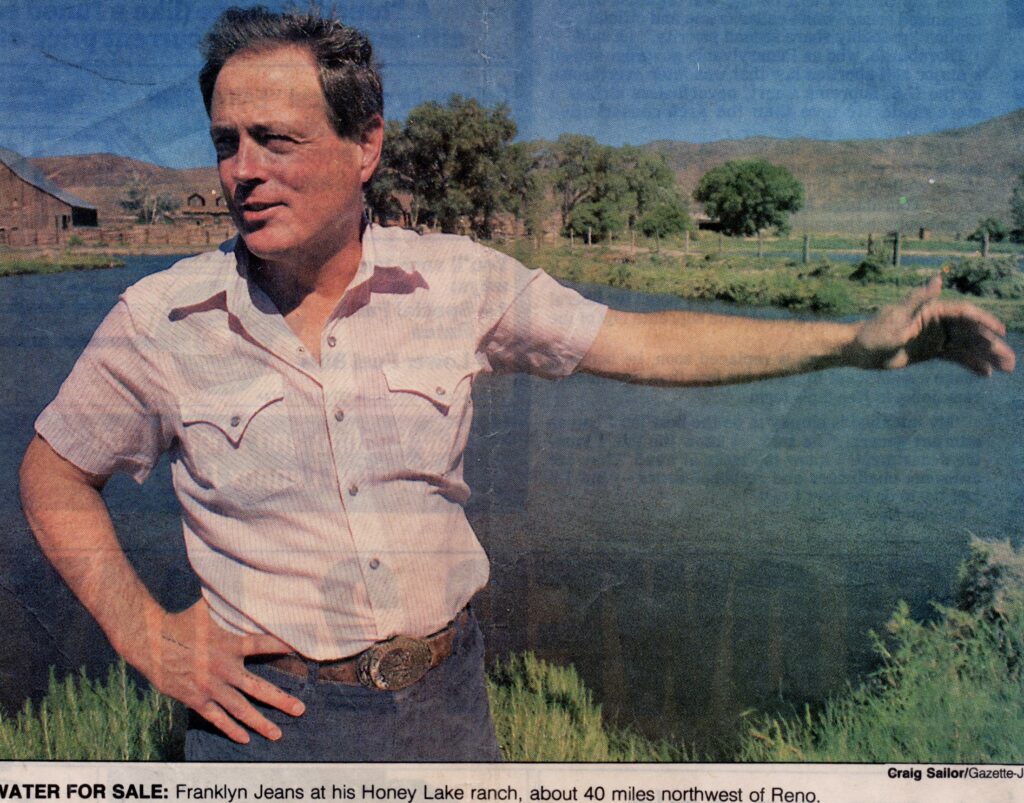
 His original plan estimates put the price tag at $28 million to build the pipeline from the Fish Springs Ranch into the Reno-Sparks area. Since then, the pipeline price estimates have climbed to $40 million because the project includes surface water from the Winnemucca Ranch east of Honey Lake Valley.
In December 1986 Jeans tried to put a three-way deal together with Sierra Pacific and Washoe County. The county could remove some risk from the utility by offering tax free bonds.
That failed, but it did whet county officials interest.
Meanwhile, the Regional Water Planning and Advisory Board received the report it had commissioned about Washoe County water basins stretching to the Oregon border. The study, part of a preliminary look at long-distance water importation, estimated that those basins could yield 62,500 acre-feet of water per year-about the same as Reno-Sparks consumption in 1987.
But the study did not include the Honey Lake Valley.
“I got the feeling I was being hung by the thumbs,” Jeans recalls, “And on top of that, the report said it would take another two years to get this thing on.”
Soon after the report was released, in fall 1987, Jeans says he told county officials he would proceed with his own project. He says they told him to include the county.
“Just from a plain common sense standpoint, there needed to be an alternative to the Truckee River,” says County Manager John McIntyre.
“The Truckee River system is being projected to meet everyone’s needs by 1998. Through a series of steps, none which are guaranteed, that supply can be extended to 2002. We don’t know, nobody knows, if those steps are achievable and therefore, if that supply is available.”
Controlling the Honey Lake water gives the county the upper hand on development, MacIntyre says: “It brings more stability to the planning process and it is important to the community as a far a economic growth.”
And county officials see other advantages to the importation plan: The water wouldn’t be subject to stiff treatment guidelines under the Safe Drinking Water Act which only applies to surface water) and, perhaps more importantly, the water is not part of the complicated and heavily litigated Truckee River system.
Last spring, county commissioner bought the option to buy between 16,000 and 19,000 acre-feet of water from Jeans’ ranch. It would be combined with 3,500 acre-feet of water that the county bought nearly $2 million last year from Winnemucca Ranch.
The deal sets the price per-acre foot between $1,000 and $1.130. That, along transportation and water treatment costs, would result in a $2,000 connection fee for each new family-home. If Jeans’ estimates are correct, Fish Springs Ranch water would supply about 33,333 single family homes with water.
If the project is successful, Jeans stands to earn about $8.6 million from his 10 percent cut on new connections.
The total package of $87 million include importing water from Winnemucca Ranch. Water rights will cost $30 million and the pipeline and related facilities are estimated at $49 million. Interest and contingency costs are tabled at $17 million.
While the county has put up $2.5 million, $450,000 of which is non-refundable, future development would pay for the project by paying for connections to the new water source.
Jeans plans to finance the project the rest of the way with private investors, who would get their money back as new development pays for the water rights. Jeans said he can build the pipeline and distribute the water within six months The county is looking at importing the water within five years and gradually increasing it during 30 years.
The project is no sure thing.
“The issue boils down to in my mind who put the up-front money,” says Bob Jasper, assistant county manager. “There is still a question of how much risk there is and how much a project like this worth in the private sector. We want to have these pay for this water, but until actualy delivery, there’s a pretty large investment to be made.”
And John Collins, Washoe County’s utility director, says there are numerous unanswered hydrological questions: “There has to be a lot of study before we go ahead with any of this. We want to know the aquifers like we know the back of our hand.”
Both California and Nevada are abiding by a voluntary moratorium on any ground water development in Honey Lake Valley until three-year , $550,000 aquifer study is completed by the U.S. Geological Survey.The study is expected to determine how much water is on each side of the border and if the two sides are connected to the same basin.
Although he believes the basins are not connected, Jeans says he’s willing to protect Lassen County’s interest with series of monitoring wells along the states borders.
And while there are unanswered hydrologic and environment questions, the biggest hurdle for a project such as Jeans’ could very well be logical to legal wrangling between the two states.
“The ideal scenario is regulations that both states can agree to that would mutually manage the basin,” says Lassen County Planning Director Bob Sorvaag.
Lassen is California’s second-fastest growing county at 6.4 percent a year, and water for that growth comes from west end of the Honey Lake Valley.
Lassen County Supervisor Helen Williams says the county will do whatever it must protect its interests.
“Our growth rate is forcing us to plan carefully for the future growth and development we must protect the quality and quantity of the water available to us.”
Williams said the key is the U.S. Geological Survey study of the basin: “When we get the unbiased facts, we can deal with the issue.”
“Right now, there is no basis for the water supply Washoe County is talking about. It appears they are going about on pure speculation . . . they are spending taxpayers’ dollars on speculation.”
Tim