Category Archives: History

Red River’s Livestock Brand

Red River’s Brand

In today’s marketing world one of the most used terms is “brand.” However, the agricultural community, brands are more than a marketing gimmick.

One would not think a lumber company would have a brand for livestock. When Red River first set up shop in Mountain Meadows, Fletcher Walker’s goal that the entire operation would be self sufficient, as possible with certain limitations. It was an admirable goal.

Initially, Red River needed horses for logging, which they did not completely phase out until the late 1920s. Red River had its own dairy herd to provide for milk, etc which all was produced in its own dairy. Since Red River owned a sizeable portion of Mountain Meadows, they initially raised their own cattle. Due to the winter weather conditions there, the cattle had to be moved elsewhere. My grandfather, John Tanner, routinely during the 1920s would pasture a portion of Red River’s herd for the winter in the Honey Lake Valley.

It was only fitting that Red River’s used the initials of TB for its brand. For those not familiar with the company, the initials are of its founder, Thomas Barlow Walker, who routinely used his initials, “TB.”
Never miss a story, click here.

The Slow Generation

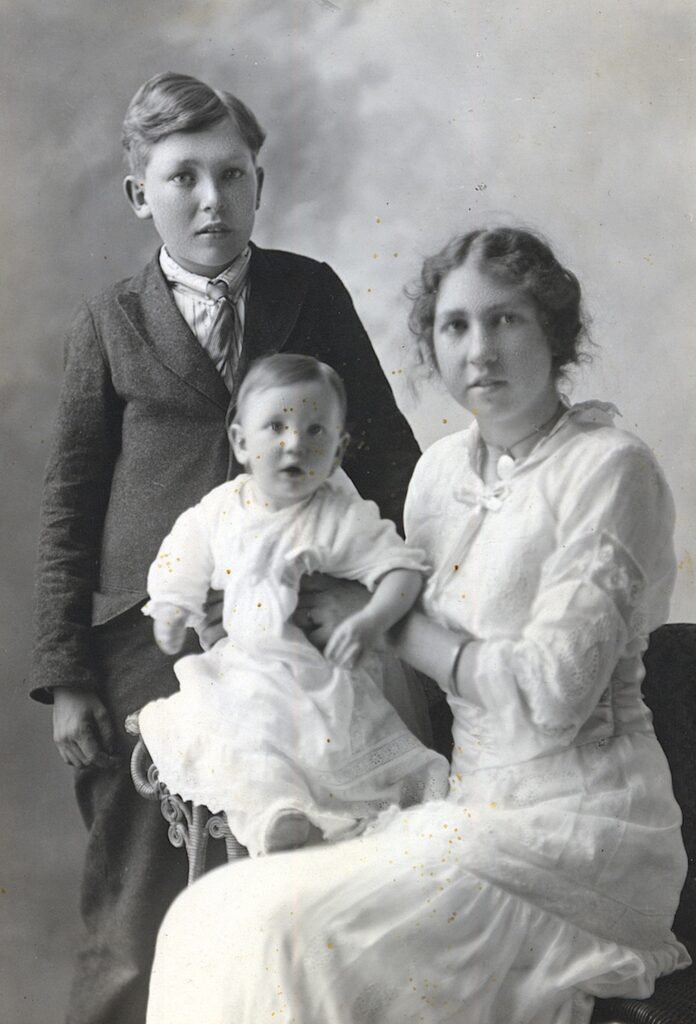
Left to Right: Leo, Alfred and Lola Murrer

My good friend Hannah, made this comment at a Farmer’s Market several years ago. She and I share this generation trait. Even though our ancestors settled in the Honey Lake Valley in the 1860s, one would think that we would be at least sixth generation born, but we are about that half that.

Some families have major age differences. I will use my mother’s family as an example. My grandfather, John Tanner was born in 1882. His wife Lola Murrer was born in 1899. They were married in 1927. My mother, their youngest daughter was born in 1931. My mother’s first cousin Verna Tanner was only three years younger than Lola. Verna married Bill Haley (Clint’s brother for the older valley folks) and her children were the same age as of my mother, but a generation apart. Now my mother’s uncle Alfred Murrer, who was fifteen years younger than  Lola  married Emma Lee Gelmsted in 1951- the same year my mother and father (Leroy Purdy) were married My brother Gary, and Alfred and Emma Lee Murrer’s son, Johnny were born in  the same year. The bottom line, is my mother’s generation of first cousins spans over fifty years! If you are member of this wide generation shift you understand, while others ponder why wrote about it.

Tim

P.S. – Celebrate the  Spring Equinox today

The Bump in Bumpass Hell

Devil’s Kitchen, 1923-Carl Caudle Collection

Bumpass Hell is well known hydro-thermal feature in Lassen Volcanic National Park. In May 1914, when Lassen Peak began its initial eruption, people flocked to the region. Very few people were aware how these features surrounding Lassen Peak received their names. The importance of instititopnal knowledge. A writer for the Sacramento Bee wrote that “its got its name from ‘bumping’ a man named Bumpass around in that super heated mushy caldron for a very insignificant portion of three days he would never have been taken from it , and world at large would never have known whether it was Bumpass ‘hell’ or Bumpass ‘heaven’. It all depends , you know”. There was a rebuttal story that the said writer remembers that  the late Abe Holmes settled at Big Meadows, now Lake Almanor. told this story.  “Mr. Bumpass, a visitor from the East, went to Morgan Springs and Drake’s thirty-five or more years ago. At the former place he was greatly impressed with the heat of the water, and when he saw the bubbling, boiling mud at Drake’s he remarked positively, ‘Well, that is hell.’ Since that time it has been known Bumpass Hell-and no more appropriate name could be given it-no more appropriate title needed. “

Both writers were wrong. Not only  were they wrong about Kendall Bumpass, but Holmes mistook Bumpass Hell for Devils Kitchen!

Subscribe


St. Patrick’s Day, 1914

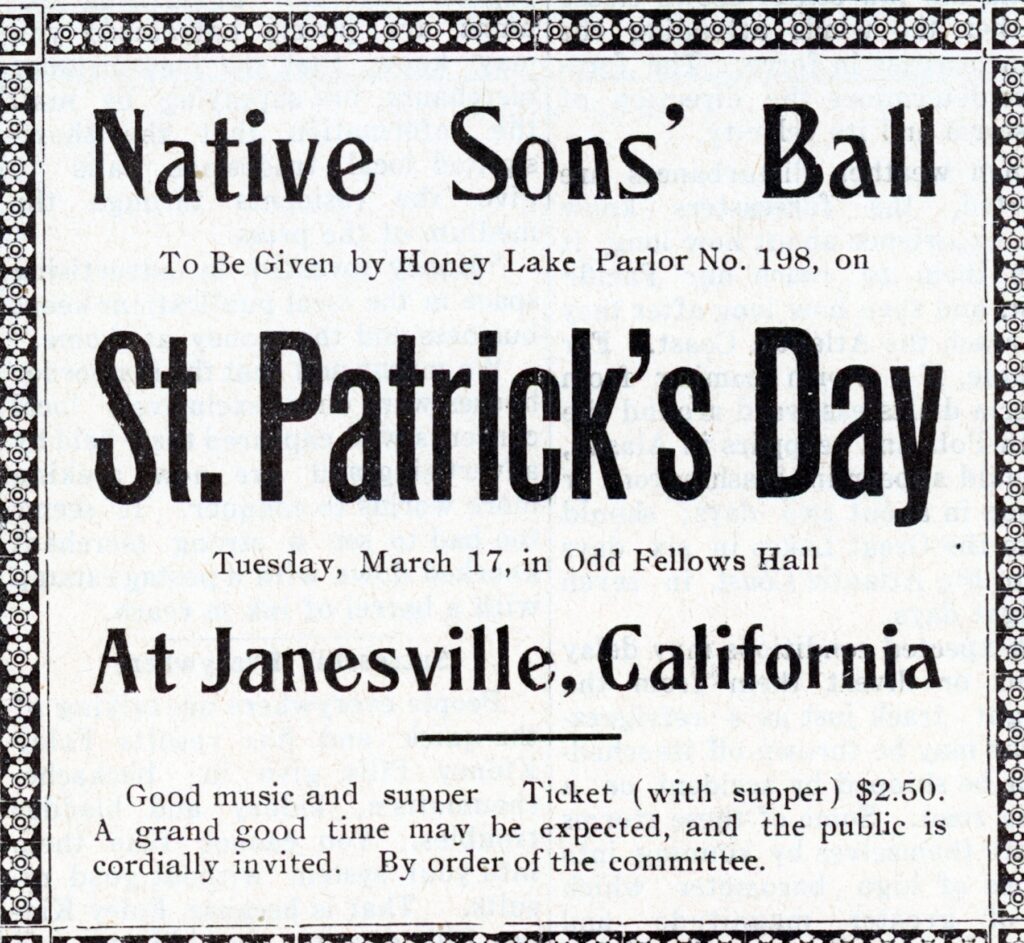
Native Sons’ Advertisement, Lassen Advocate,February 20, 1914

On March 17, 1914, the Native Sons of the Golden West, Parlor. #198 held a St. Patrick’s Ball and midnight supper. Reports were rather vague about the festivities. It was held at the Janesville Odd Fellows Hall, with the Swain Orchestra providing the music. The attendance was better than expected. In fact, forty people from Susanville attended. As one newspaper reporter noted, “That ball was certainly a very pleasant affair.”

Of note, the local Native Sons was organized in Susanville in 1898. They were a very active bunch. Their hall was located on the corner of Lassen and Nevada Streets, the current site of the Masonic Hall. That hall caught fire on November 7, 1921 which was a complete. loss, but destroyed Susanville’s combination city/fire hall that was located next door. According to M.E. “Mul” Mulroney, he was under the impression that the local Native Sons had disbanded by 1930.

Tim

Lassen County’s First Zoo

Elk, with the Wingfield residence in the background.  Courtesy of Alphozene Terrill

In 1910, George Wingfield established a summer residence south of Susanville,. He had a special interest in wildlife and established his own little preserve. That fall, he fenced off eighty acres for an elk and deer park. In 1914, he added four buffalo to his collection. It was purported that the buffalo came from Nevada Governor Sparks. This became a major attraction to local residents to view these creatures.

Where the buffalo and elk roam at Wingfield Ranch. Courtesy of Lola L. Tanner

Wingfield also brought in such “exotic” species as peacocks and mammoth size frogs imported from New Orleans. He had two small lakes constructed on the property to plant with a wide variety of fish.

In 1923 Wingfield sold the property to the Lassen Lumber & Box Company who were primarily interested in the timberland he owned there. The buffalo were shipped to Reno. The fenced enclosure to keep the elk in, was no longer maintained and the animals began to roam the region, with spottings from nearby Bald Mountain to Willow Creek Valley. The elk were poached by hunters over the years, and were wiped out by the early 1940s.

Support

Horne Ranch, Lassen County

Horne Ranch, 2003

It just never ceases amaze me, how some folks settled in an isolated location, when there were prime property to be had. A case example was Frank Eben Horne. When Horne came to California he settled in the Marysville region. By the late 1860s, he relocated to the Smoke Creek Desert, Nevada. In 1870, Horne became one of the first settlers of the Madeline Plains. He kept his Smoke Creek for summer pasture. Horne retired from his ranch in 1905 and turned it over to his sons. Actually, his son Will took over the home place, Arthur took Smoke Creek, and Frank, so the story got an education and moved on.

Will was quite the promoter. In 1914,  he came of with a Russian Colony scheme. About three dozen Russian families arrived on the plains. After all, it was noted, if these Russians could make a living  at farming in Siberia, than they could be really prosperous on the Madeline Plains. It did not work at well. Noted Madeline Plains historian, Don Garate, wrote the Russians were a lazy bunch.

One of the Horne’s family enterprises was the development of the Buckhorn Reservoir. In the annals of Madeline Plains history it was home to many irrigation/reclamation schemes.  On March 28, 1917, Frank L. Horne, William R. Horne, and Arthur T. Horne, along with Raglan Tuttle and Grant M. Lorraine, formed the Horne Development Company–a promotion of a reclamation project. Things did not go as planned and  on April 27, 1927, the Farmers & Merchants National Bank of Reno, Nevada, foreclosed on the Horne Development Company for $38,791.11 and became the owners of the Horne Ranch.

Horne Ranch Cemetery, 1985

In the 1990s, the Horne Ranch had a new lease on life when it was incorporated in R.C. Robert’s Spanish Springs development. This and other properties were made available to guests, whether their interest was equestrian pursuits, hunting, etc.

Support

Reno’s Wingfield Park

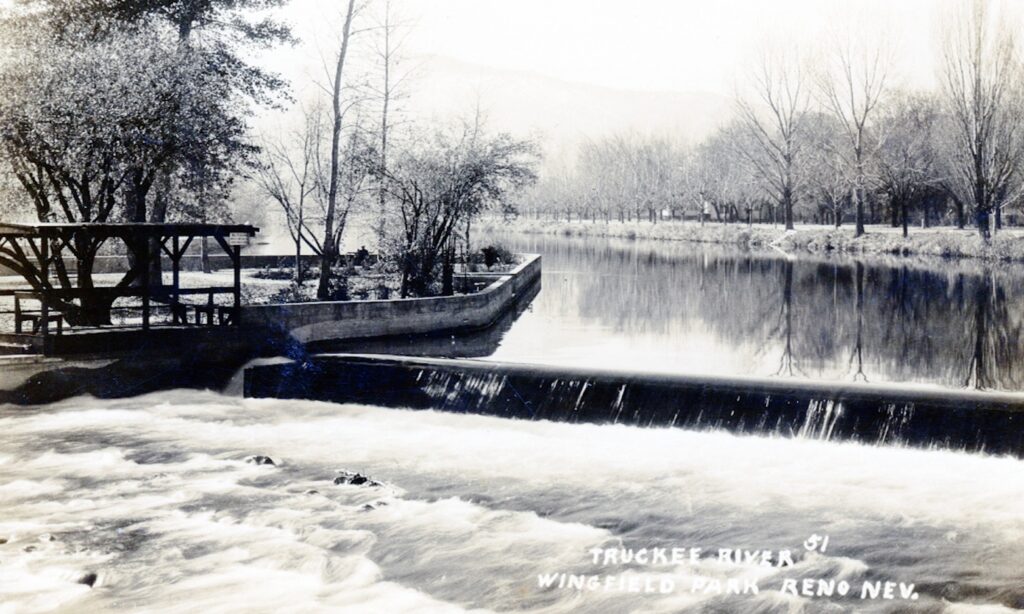
Wingfield Park, 1936–C.H. Bennett Collection

This three-acre natural island on the Truckee River in the heart of downtown. Reno has an interesting history. In 1911, Reno attorney Lewis Hinckley began to develop it for an amusement park. He dubbed the location as Belle Island. In time, the island boasted a dance hall, a 700-seat open air theater among other things. The enterprise went bankrupt in 1916. In 1920, influential miner and Nevada banker George Wingfield purchased the property and donated it to the City of Reno. In turn the City of Reno’s named the property  George Wingfield Park.

Contrary to local folklore, when Wingfield sold his Honey Lake Valley summer home in 1924, he transported four buffalo that he had there to Wingfield Park. Wingfield did relocate the buffalo, but not to the park.

Tim

Use Your Telephone

Susanville Hose Company, 1905–Lola L. Tanner

Susanville was getting a metropolitan airs since the railroad arrived in 1913. Prior to the Suanville Fire Department there was the Susanville Hose Company. In the spring of 1914, C.C. Hampton, the Foreman of the Hose Company issued the following statement and was widely distributed throughout the community:

“Use Your Telephone. Hereafter, in case of fire in town or in the suburbs, telephone calls may be direct to the Hose House in Susanville at any hour night and will be promptly responded to.”

Tim

High Rock Springs, Lassen County – Update

High Rock Spring, April 1975

These springs in eastern Honey Lake Valley and near the Nevada border are quite unique. They are an ancient spring dating back to the time when the area was covered by Lake Lahontan in the Pleistocene epoch.

The second reason is it is a warm water spring with a constant temperature of 86F.  The springs supports two kinds of fish. First is the Lahontan tui chubs.  This, of course, is rather remarkable that the fish have adapted over the years to thrive in constant warm water in a confined space. Water from the spring then goes underground and re-surfaces 100 yards distant, maintaining a constant cooler temperature at 76F. At this point, again, which is also unusual, is found the Lahontan speckle dace, that was to be on the endangered species list. The Lahontan speckle dace in this spring is no more. In the 1990s, the spring  used as a fish farm. Some one planted  exotic fish in the springs channel, thus caused the speckle dace there to be extinct.

I found the newspaper article of interest from the Lassen Advocate May, 15, 1914 – Here From High Rock. Jas. Mapes and Jas. Dudley were there from High Rock last Monday. Mr. Mapes was proving up on his desert land claim before the officers of the land office. Jimmie is very enthusiastic over prospects down there, and is a very busy man. He says he has the dandy water system of the county, and the water problem is one which will not be a great worry him in the future. He has a chain of three dams, and these, by giving out their waters one at a time as needed, will probably prove sufficient for all purposes. In addition, however, he is contemplating building a dam to impound the waters  of the one spring, which will be a valuable addition to his water supply.

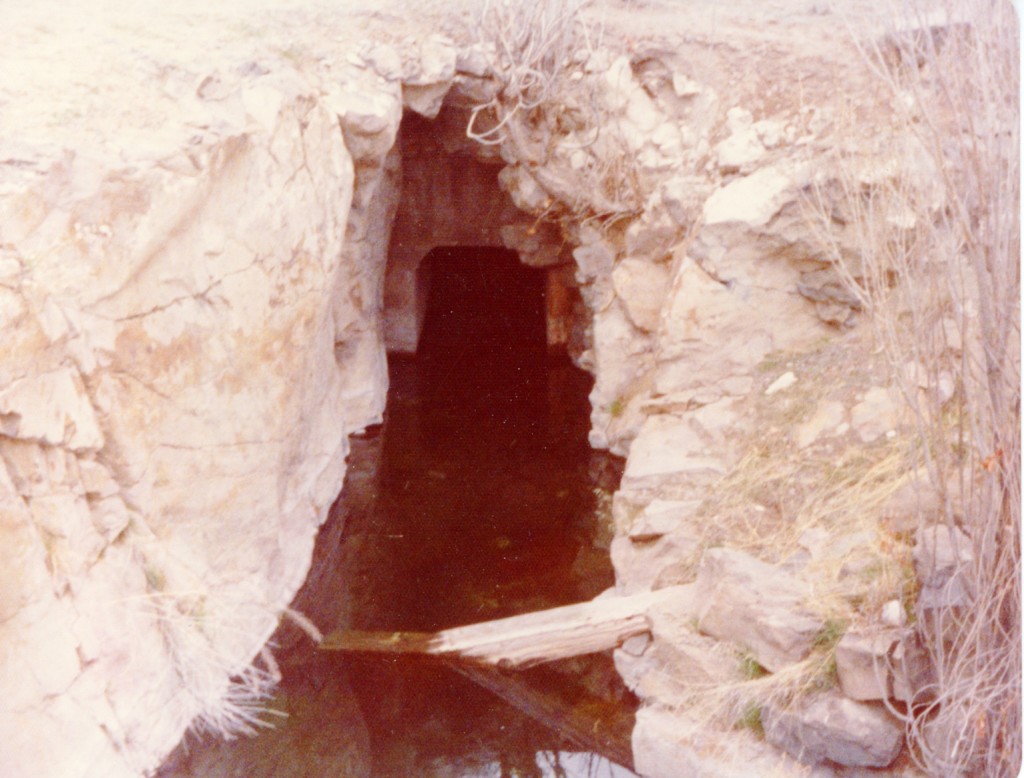
A portion of the tunnel outlet of High Rock Springs. April, 1975

It should be noted that in the 1920s, William Dicting was hired by the Rees Jenkins to develop the springs. He spent eight years to hand drill through the rock to develop the water tunnel to increase water flow.

Support by subscribing.