This year marks the centennial of the dedication of the Lassen County Courthouse. Of course it has under gone numerous changes in the past one hundred years. In September 1978 prison inmate Robert Clawson who was in the courtroom on pending kidnapping charge broke free of the bailiff and fled. He exited the courthouse by jumping out of the window on the second floor landing in the flower bed, From there he ran away, but was later apprehended. From this episode many of the windows were replaced with smaller openings to prevent future escapes.
One of the problems when Lassen Volcanic National Park was established, Congress was real stingy with funds with an annual appropriation of $5,000 a year, though for the first several years they did not even provide that. To make matters worse the initial administration of Lassen was handled by Yosemite National Park officials.
Yet, Lassen Park advocates were a persistent bunch and they explored a variety of avenues. Take for instance in 1919, when former U.S. President Theodore Roosevelt died, consideration was given to rename Lassen after Roosevelt. Not only would it be a memorial in his honor, but it was considered a venue to overcome its financial dilemma with Congress.
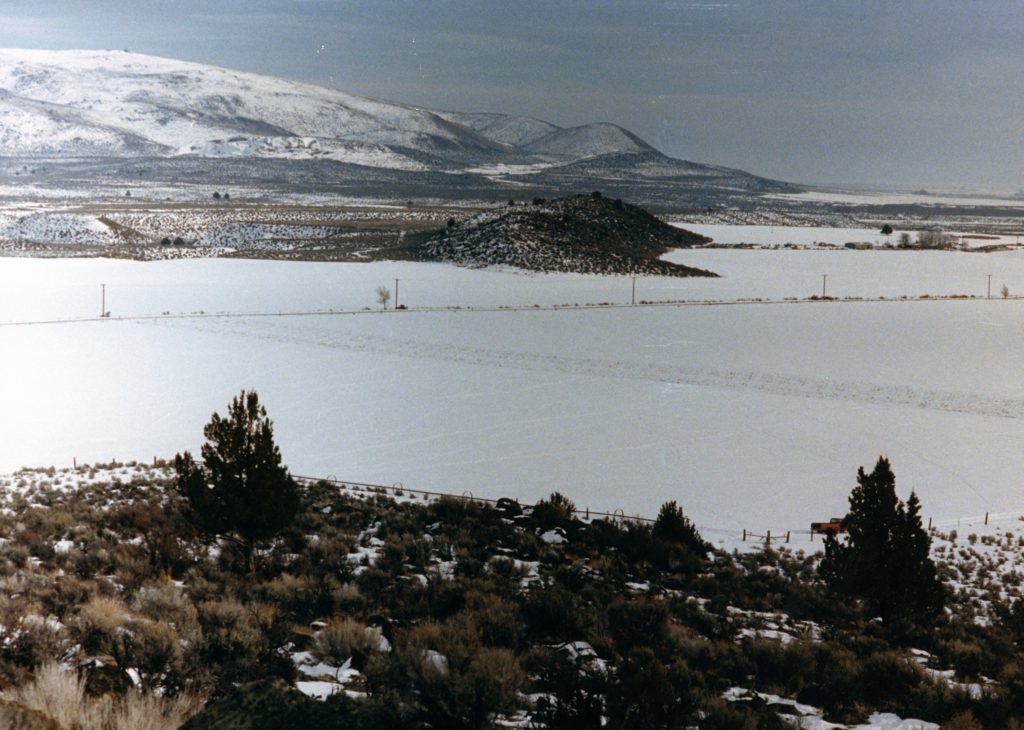
The Belfast District. Courtesy of Bernard McCallister
This rather obscure hill located in Honey Lake Valley’s Belfast District has an interesting tale behind it. Isaac Coulthurst was one of the first Anglo settlers of the region, but in time his sanity came into question.
In 1873 Coulthurst stated that the Lord commanded him to go to the top of this hill. Coulthurst held communion with the Lord in a cave there. He spent a portion of the winter in that cave. Coulthurst stated it was warmed by supernatural heat, but the cave became unbearably hot in the summer. It was then that he discarded his name of Coulthurst and changed his name to the “Second Coming of Christ.” His wife, Mary, had him declared insane. Twice he was placed in mental institutions, each time he spent only a few months. In 1881, a third examination was held on his competency. The courts two examining physicians stated he was fine in all aspects, especially keen in business dealings. They admitted to his religious peculiarity but did not think he would derive any benefit from being institutionalized. After that court hearing, the court proceeded with the divorce proceedings that had been filed by his wife and the court approved it. Coulthurst agreed to the divorce and to pay alimony, but would not divide the property with her. Coulthurst’s refusal to divide the ranch property was based on his belief that it would be the site of a new Jerusalem. Coulthurst contended that a large city would be built there, the streets paved with gold. In 1893, Coulthurst transferred the ranch to his son, Henry, with the provision that his son clothe, feed, maintain, and support him during his natural life. Coulthurst signed the deed “Christ the Lord.”
An interesting footnote when Coulthurst died in 1919, he was the first person interred in the Lassen Cemetery.
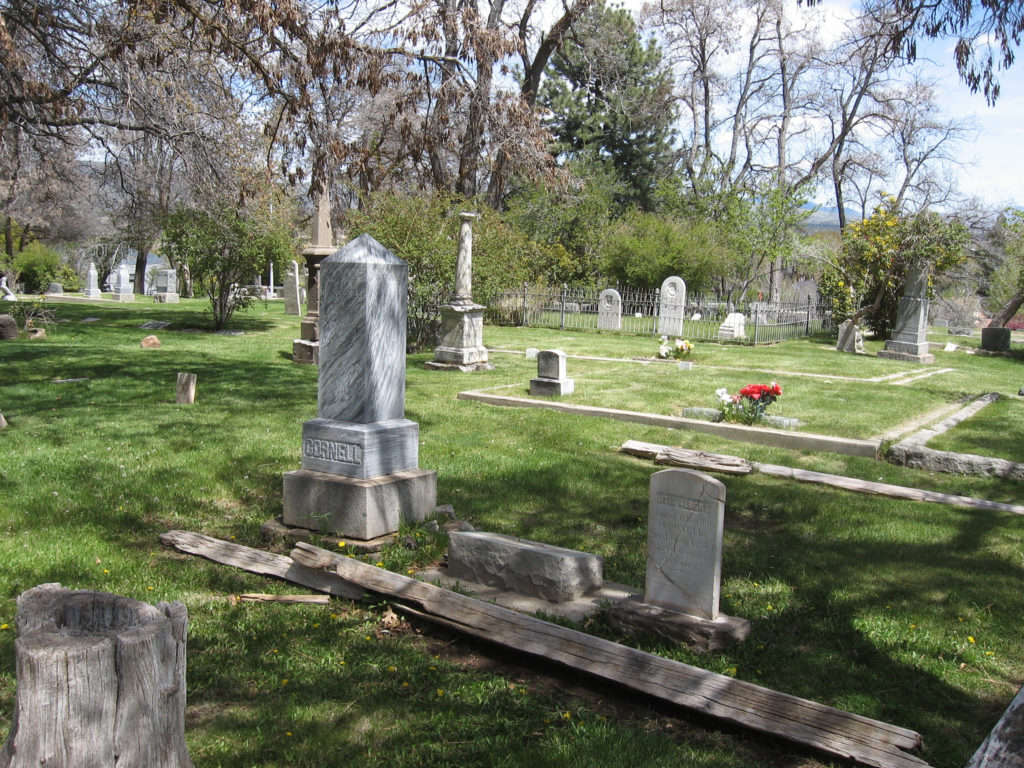
Cornell family plot, Susanville Cemetery, May 2, 2017
In 1864 Heiro K. Cornell and his brother-in-law William S. Hamilton constructed Susanville’s first warehouse. Cornell located on property that now occupies Lassen High School and extended past to McDow Street. In 1873, he sold out and moved to western Modoc County. In 1902, his son, John Cornell returned to Susanville and purchased a piece of his father’s original holdings. During the boom era ten years later Cornell sold to R.F. Pray, General Manager of the Red River Lumber Company. In 1920, Pray subdivided the property and created three streets–Cornell, Foss and Small.
Awhile back I wrote about Leon Bly’s bad karma. During the contested estate hearings, I left out an interesting piece of information. Louise Wick was one of the five beneficiaries to Bly’s Estate. In a letter to the probate judge she stated initially Bly was going to leave a large sum of his estate to Malvena Gallatin. Bly’s housekeeper/nurse Edith Rebhan resented that notion since Gallatin was a “rich woman.” Rebhan also countered she would put in a claim for services as a professional nurse, day and night and at the rate of $18 per day, and this would consume most of the estate. Wick continued, “Nevertheless she [Rebhan] was bitter against the idea of Mrs. Gallatin coming in to anything.” As it turned Rebhan received the bulk of the estate and Gallatin nothing.
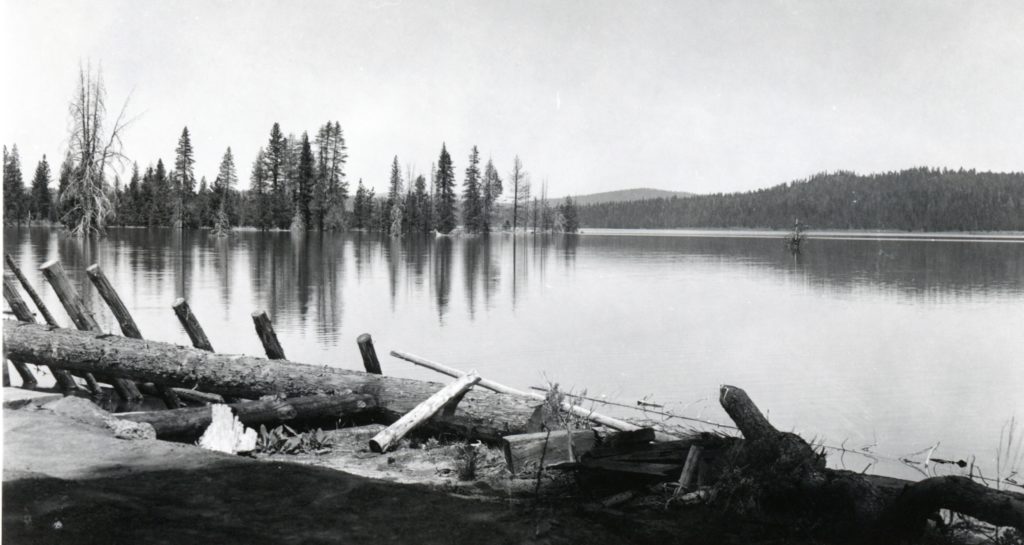
Hog Flat Reservoir, April 1940. Courtesy of Lola L. Tanner
Constructed in 1889 as part of Benjamin Leavitt’s expanding reclamation enterprise and now part of the Lassen Irrigation District. Lassen National Forest Service Supervisor, A. G. Brenneis, wrote an article about the origin of its name that was published in the California Ranger, August 1938: “Many years ago the residents of Honey Lake Valley joined together to start the Susan River Irrigation District and, as a first step, began the construction of the dams at the present sites of Hog Flat and McCoy Flat Reservoirs. The first winter this country received heavy storms and as a result the dam at Hog Flat was destroyed. The entire meadow, which should have been a lake was covered with a rank growth of vegetation and in order to salvage something from the reservoir, the farmers of the district banded together, placed a huge herd of hogs on the meadow, fattened them, and made some money to repay them for the loss of the dam. Ever since then the reservoir has carried its name of Hog Flat.”
The machine shops of the three lumber companies Fruit Growers Supply, Lassen Lumber & Box and Red River Lumber were amazing operations. When these mills were established it was in a time of transition where within fifteen years logging operations would go from horses to traction engines. The sawmills themselves were caught in this phase as well.
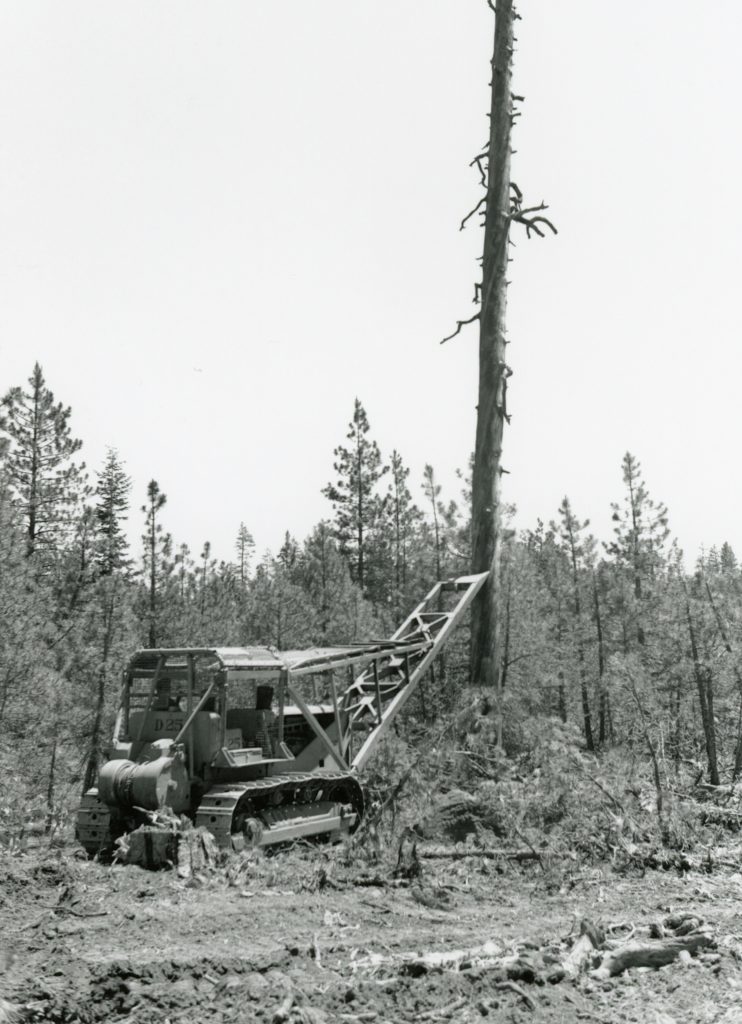
Whether it was a mill foreman or a logger when a person had an idea, they went to the machinist who in their innovate ways came up with a new tool or machinery component. In the 1950s, Fruit Growers Westwood Operation developed a snag pusher to knock down dead trees deemed a hazard for use on the Lassen Operation (Susanville).
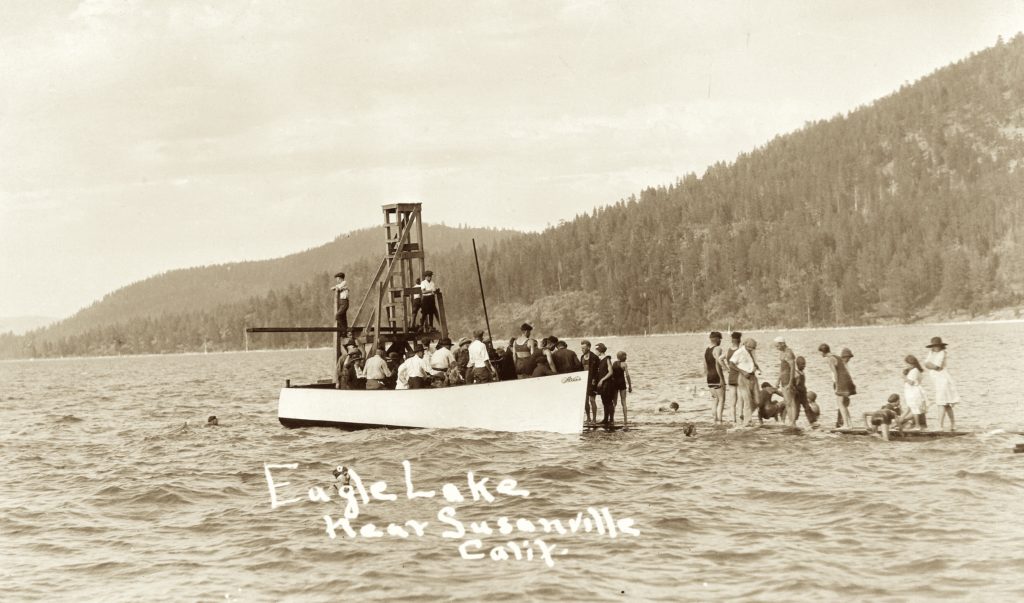
Oscar Rankin arrived at Eagle Lake in 1907, and became the first resort owner, laying foundations for the Eagle Lake Resort on the southwest shore. He constructed several boats for patrons to use on the lake. In 1914, he built The Pelican, a twenty-seven foot galvanized metal hull that was power with a While boiler and Stanley Steamer engine.
Sometime around 1953 Glen Seeber found the old hull near Spalding’s and rescued it before deer hunters or someone else might use it for target pratice. It was his intent to restore it. In the February 1996 issue of the Thru-Bolt the newsletter of the Eagle Lake Sailing Association, stated that The Pelican would be on display at the Bengard residence in Janesville at their next meeting. The Sailing Association launched an effort to help Glen and recruited the historical society and Lassen College to assist. How much restoration work was ever completed or the boat’s whereabouts remain a mystery to me.
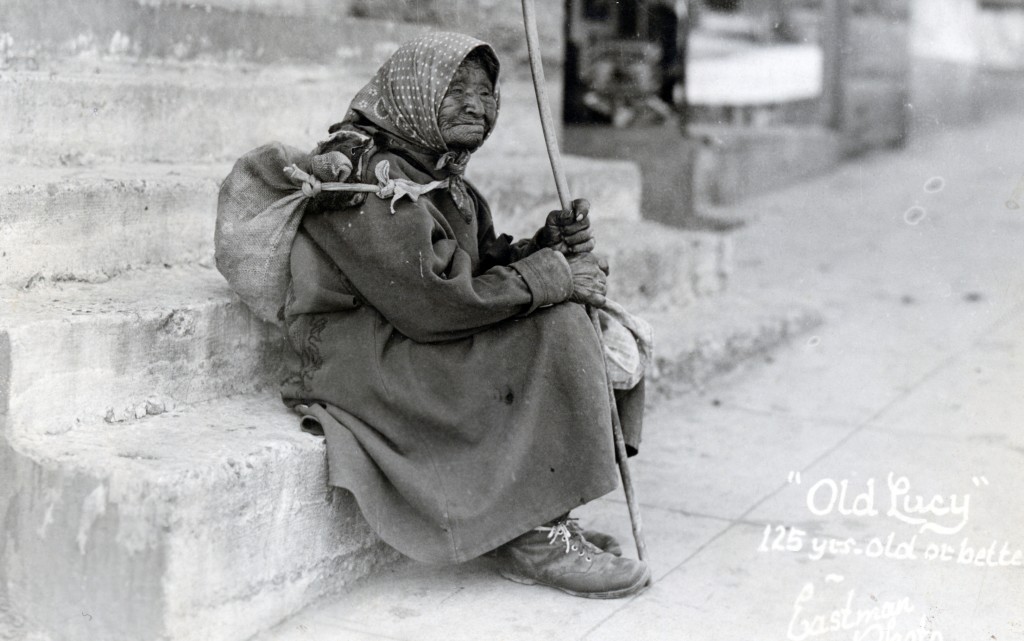
On September 29, 1929 Old Lucy a colorful character on the streets of Susanville passed away, purportedly at the age of 125. While she best known as Old Lucy, she also had another Anglo name, Sally Norman. Dubbed a “picturesque” Native American of the era, she was a familiar sight as she ambled about Susanville, bundled up in numerous clothes, walking with the aid of a stick. People who knew her back in the 1870s considered her old back then. While her age was exaggerated when she died, documents placed her age at around 100. Whether she was born in the Honey Lake Valley is not known, though there accounts that she recalled when Peter Lassen came to valley. In addition, it is stated she was part of the Maidu tribe.
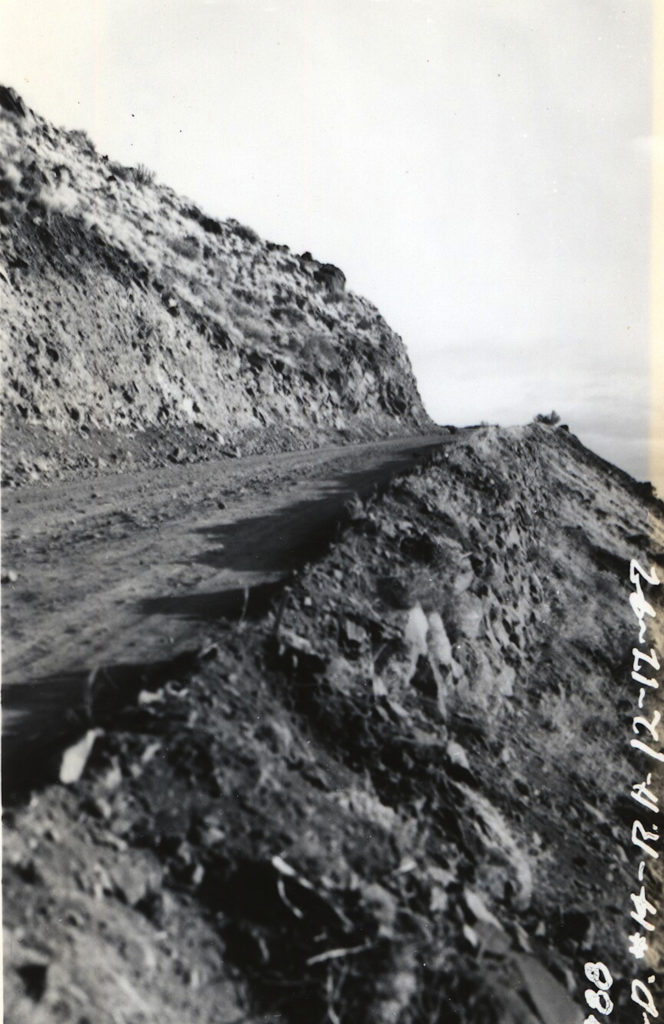
There were a number of Hollywood films that used Lassen County locations in a number of movies. Susanville native, Ephie Asher, had a lot of influence as a Hollywood producer, and members of the Asher family are still in that business. One the last films shot here, was released in 1939 and called “The Good Samaritan.” Featured in the film was Antelope Grade and some scenes near Westwood. I have not an opportunity to research it further to ascertain about its availability.