Category Archives: History

Eagle Lake Youth Camp

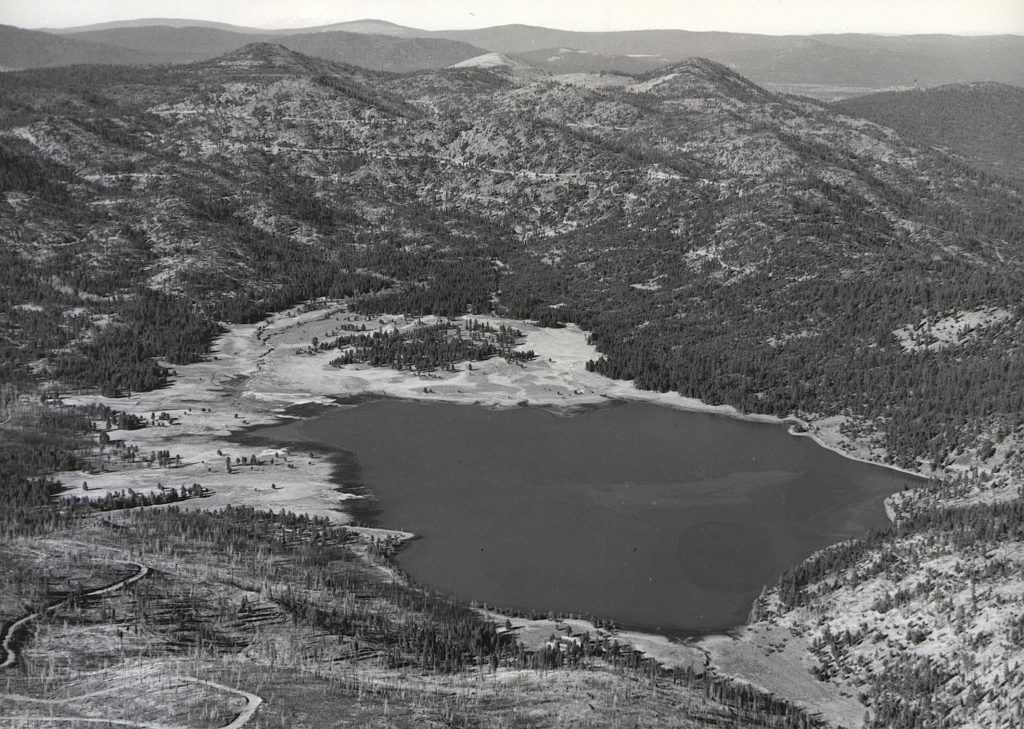
In 1976, the Lassen Advocate had a feature article on the development of the youth camp.

It is officially known as the Lassen County Youth Camp, but its location on the east shore of Eagle Lake and just north of Chico State Biological Field Station, it received the unofficial lake moniker. On November 6, 1962, the County of Lassen received a land patent from the Bureau of Land Management to establish the camp. By 1965, various fund raising drives began and work was done with volunteer labor. In 1974 a restroom and shower facility was completed. It should be noted that a portion of that money came from left over funds from the Save Our Center campaign, which was the result when the state had intentions to close down the California Correctional Center at Susanville. In 1976, the kitchen and dining hall was constructed.

Subscribe!

Lassen Roller Flour Mill

Lassen Flour
The Lassen Flouring Mill, 1901. Courtesy of the A.J. Mathews family.

In spring of 1863, Dr. John Briceland of Cow Creek, Shasta County had a problem. The stream which his flour mill was located had begun to erode the foundation. He made an agreement with P.W. Cunningham and Fred Johnson to relocate the mill, or rather the equipment. For their efforts they received one-half ownership. They found a new location for their enterprise at Johnstonville in the Honey Lake Valley. The mill was located along the Susan River, which was needed for power. They built two small reservoirs and at night they would dam the river and fill the ponds. The two ponds held enough water to power the mill until the next night.

During the late 1860s through the early 1870s, mill changed hands numerous times. In 1875, William H. Hall and Henry Snyder took possession and would operate it for thirty plus years. In 1907, Snyder sold his interest in the mill to Hall, as he desired to retire and move to a warmer climate. Shortly thereafter the mill closed and would remain idle for nearly a decade. In 1919, it was sold to M.A. Taylor of Oakland who dismantled it and took the machinery to the San Francisco Bay area. It should be noted that Standish resident, Sam Alexander purchased some of the lumber that he used to build a barn at his place. Finally, for the record the mill was located at the site of the Gables.

Subscribe!

Earthquakes – Still Shaking

Main Street, Susanville, 1885. Courtesy of Betty Barry Deal
While searching for information on Dry Valley, Nevada, I came across my earthquake file, while looking for my East Lassen file. Anyhow, I came across this article from the Susanville correspondent to the Reno Evening Gazette, dateline February 6, 1885.

“Real estate in Honey Lake Valley for the past week has been decidedly shaky, and when things are to get settled down to a firm and reliable basis it is hard to determine. Since last Friday night there have been no doubt at least 50 shocks of earthquakes felt in the valley. Today something like a dozen have been felt here in town. One at seven o’clock this morning was quite lively. The shocks seem to be more frequent and harder around Janesville. It is a well established fact that below Buntingville, crossing the Epley Ranch, is a place that “sounds hollow” when being crossed and at intervals rumbling sounds are heard traveling along this place. The sounds seem to come from the mountains to the west and travel toward the lake. Horses when plowing over this place have become frightened at the sounds beneath their feet. This has been repeated for years. The occurrence of so many earthquakes in this locality seems remarkable and how ad when they will cease seems to be a hard conundrum to answer just now.

“Not the earthquakes alone but the weather is phenomenal. Yesterday the thermometer reached 68 degrees in the shade, while for a week or more there has been no frosts at night. Last night and today we had quite heavy showers of rain and the snow is fast disappearing from the mountains.”

Subscribe!

More snow berms

The intersection of Cottage and Lassen Streets, January 2005.
Today’s post will be rather brief, since so many folks attention is focused on a singular event. Why, I do not understand all the hype that goes with that. Anyhow, if you recall last Sunday, I wrote about snow berms and Main Street. This is just one of those tidbits to leave behind a record when the City of Susanville changed their snow removal policy. It was the winter of 2004-05 was the last year the city plowed the snow to the center of street creating berms. The current practice is to plow the snow to the gutter. While the streets maybe clear, it is a challenge to reach the sidewalk without injury.

Donate!

Fairview School District

Fairview School District Map, 1910.
In January 1910, east side residents of Honey Lake petitioned for the formation of a school. They cited that there were twenty-seven eligible students in the proposed district. The nearest school was at Amedee, and the majority of the petitioners resided some 12 miles distance. However, the Lassen County Board of Supervisors did not approve the new school until November. The residents built a schoolhouse in the center of the district, since there were no towns in the area. That would suddenly change with Calneva Station established by the Western Pacific Railroad and Stacy on the Southern Pacific. In 1915, Calneva experienced a boom of sorts, and separated from Fairview to form the Fort Sage School. Fairview continued on even as the population dwindled and in 1936 the school closed for a lack of students.

Subscribe!

Ravendale Post Office

Early day Ravendale. Courtesy of Dorothy Capezzoli
Should you happen to find yourself on the Madeline Plains today stop by the Ravendale Post Office and say hello to Nancy Rendel, Postmaster. On this date in 1910 the post office was established with William B. Edwards as its first postmaster. Times were tough on the Madeline Plains during World War I which depopulated the region. The Ravendale Post Office closed on November 15, 1920, though with good fortune it re-opened on May 19, 1921.

Subscribe!

Susanville Congregational Church

The Congregational Church, 1911.
On June 1, 1873, twelve men formed the Susanville Congregational Church, the town’s second church. Initially, services were held in the Lassen County Courthouse until such time when they could construct their own house of worship.

In October 1875 it was announced that the D.H. Tucker was awarded to construct a church on the corner of Pine and Cottage Streets. The edifice would cost $2,200 with a $500 loan from the American Congregational Union of New York. At the same time the Methodist were constructing their own church two blocks away. An informal race ensued as to who would have the first church completed. It was the belief of some that the first church dedicated would receive the most support, since some were doubtful that the town could support two churches. The Methodist won.

On November 17, 1878 the congregational church was dedicated with the Rev. John Phillips presiding. Not only was there a large attendance, but two children—Beatrice Partridge and Grace Olive Lovell—were baptized.

By 1900 the church had disbanded. In the fall of 1903, the Lassen Advocate noted: The old congregational church on Pine and Cottage Streets is going to ruin. It is an eyesore and something should be done about it.” Three years later, something was started to take care of that problem. It turned out the American Congregational Union sued the Susanville Congregational Church Society for the $500 that it had loaned them to build the church. They won by default and Lucy Spencer purchased the church property for $1,150. In 1914, Lucy’s grandson-in-law, Charlie Emerson, moved the church down the street, next to the Methodist Church, where he converted into a warehouse for his nearby mercantile business. On August 5, 1915, a fire broke out in the converted church that would destroy most of the buildings on that block.

Subscribe!

Highway 36 opens for the winter

Highway 36 near Chester.

In the 1920s, the Westwood Auto Club was a force to be reckoned with. After all, it served as Red River Lumber Company’s de-facto chamber of commerce. The club had a lot of influence during the construction of Highway 36. They did have one item of contention with the state when the highway was completed. They did not the like the idea of being snowbound in the winter months and yearned for the day when the state would keep the highway open year round. In November 1928, the club wrote State Highway Engineer Comley to plead their case: “We believe that in asking for this we are justified as in previous years we have been snow-bound for at least four months each year, and as you realize that our work is more or less seasonal nature and that vacations are taken when work is slow or the woods closed down, it does not give us a chance to drive our cars to the section we most desire to spend our vacations and leisure time, and where our cars give us the pleasure that we desire. In addition to that phase of life we would use our cars to a very large extent to also pursue business, which would make this road available for that purpose.

“It is our earnest desire Mr. Comley that you study this problem further, and give it your earnest consideration and although there can be many points raised against the feasibility of is points in its favor should and we hope will predominate. The control of this road during storm periods would eliminate any hazard to lives and we agree that that has been our highest argument against opening the road.”

Comley concurred and understood the plight of not only the residents of Westwood, but all those located along the route who were shut out from winter storms. On the other hand, Comley informed the club there was little in his power he could do to rectify the situation. It was a matter for the State Highway Commission to determine and equally important how to finance the snow removal. The Auto Club’s persistence paid off, a year later the Commission informed the group that beginning in the winter of 1929-30 they would keep the highway open year round. After all, the Commission cited that nearly a million dollars had been spent to construct the highway, therefore it made no sense to have it closed during the winter months.

Subscribe!

Indians of Coo-yu-ee Pah

A good read.
This is the title of Nellie Shaw Harnar’s 1974 book concerning the history of the Pyramid Lake Indians spanning the years 1843-1959. Nellie was born in 1905, a Ne-muh or Northern Nevada Paiute at Wadsworth, Nevada. This is a very well researched work, for those that might be interested in the topic. While it is no longer in print, it is available through such sites as Bookfinder.com or available at many libraries.

Donate!

Snow Berms

Main Street, Susanville, 1952.
The way this winter has been shaping up so far, it is starting to look doubtful that we are going to see the standard snow berm down Main Street. If you are waxing for nostalgia, I provide you with today’s featured photograph taken after the “Big Snow of 1952.” When the City of Susanville was incorporated in 1900 snow removal of the streets was not even given a second thought. It was not until the 1920s, that it became an issue, due to the fact the automobile was replacing the horse as the preferred mode of transportation. In 1933, the City transferred Main Street to the California Highway Department, as a means to alleviate the burden of maintenance because of the financial woes from the depression. In 1935, the city’s finances were so strained that they informed the residents there would be no snow removal that winter as they did not have the funds.

Subscribe!