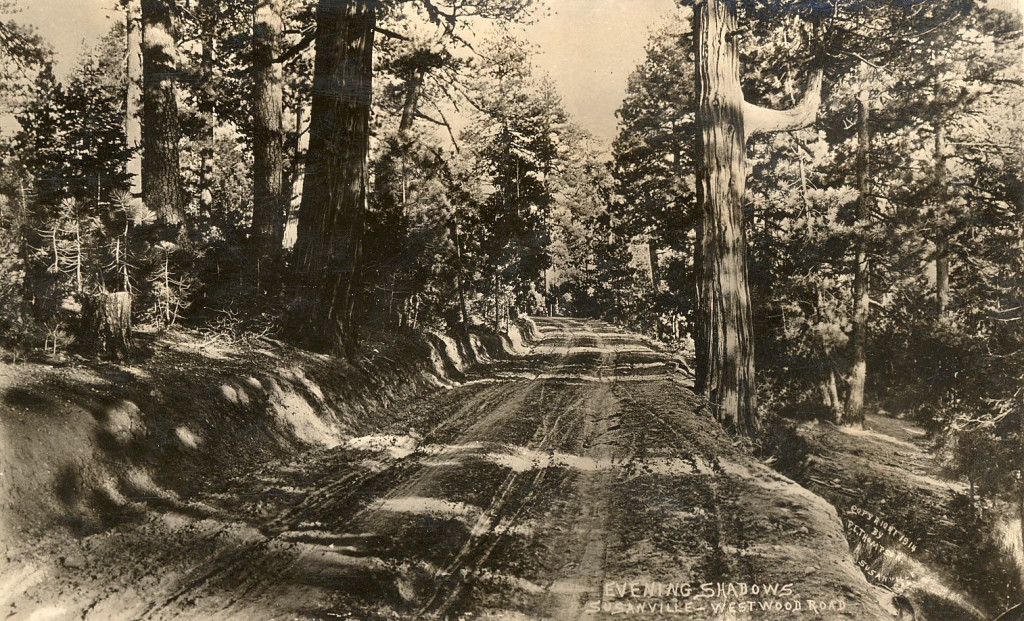
In the 1910s, the State of California had the daunting task of plotting out a highway system, and there were plenty of details to be dealt with. Among them, especially for the traveling public, was the designation of highway routes. In the early 1920s, the California Automobile Association led a campaign to give descriptive names of the mountain routes. Highway boosters of the region proclaimed the route between Red Bluff and Susanville, the Lassen Volcanic Highway, since the highway went by the southern entrance of the national park. In time, the State of California began to use a numbering system, and initially proclaimed this route as Number 29. In 1935, it was changed to State Highway Route 36. The change of the number was necessary to reflect the adoption of a uniform system, where even road numbers went to east-west direction and odd ones were for north-south routes.
The east side of Honey Lake Valley is known for its arid condition. Flanagan is the driest, some historical records have noted the annual average precipitation of three inches of rainfall, which is in the range of Death Valley.
Amedee School Children on the first day of the Big Snow, Tuesday, January 11, 1911. Left to Right: Thelma James, Tom Lally, Minnie Meeske, Fred Meeske, Rita Martin, Sadie Meeske, Norma Jeanne James, Frank Martin and Gregory Martin. Courtesy of Marie Herring Gould
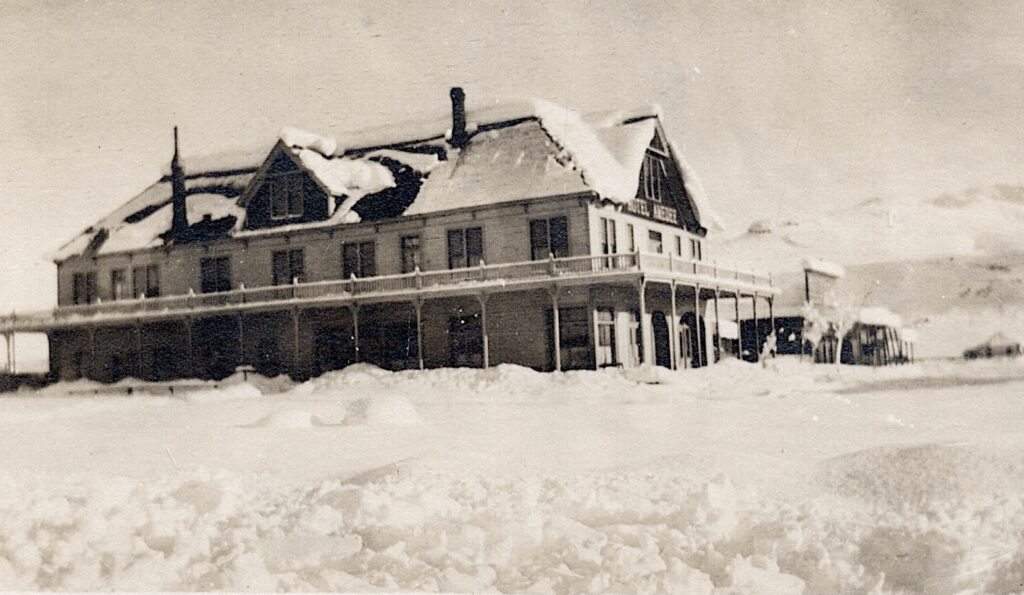
It was the January 1911 snowstorm that caught Amedee residents by surprise. After six day storm Amedee received six feet of snowfall, while Susanville had eight.
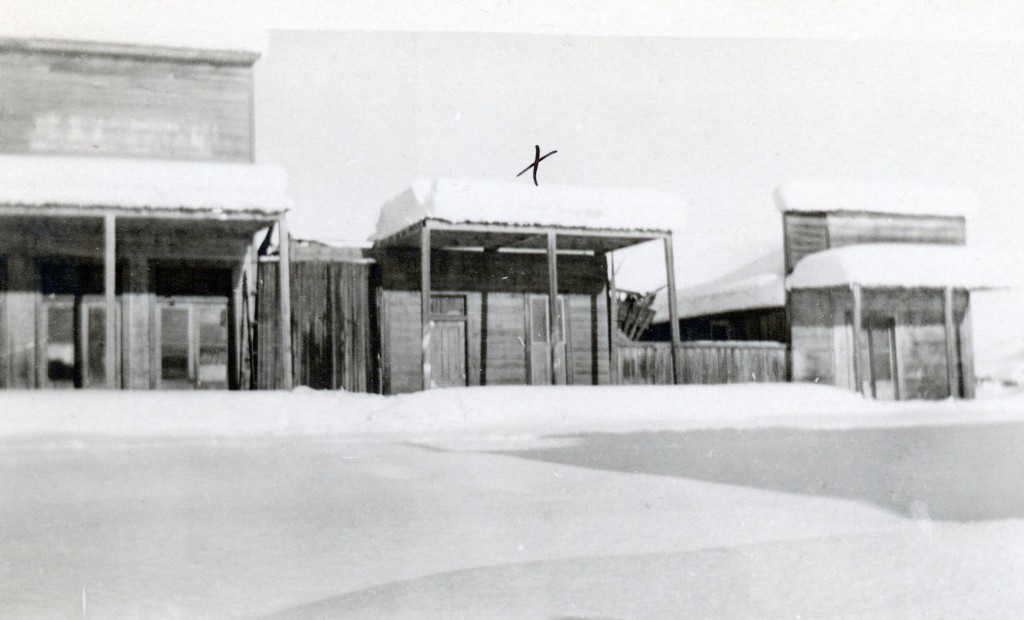
Amedee, January, 1911. The “x” indicates the town’s old dance hall. Courtesy of Madelyn Mapes Dahlstrom
Robert Trussell, a Johnstonville resident, who was thirteen years old at the time, stated there was a not fence post in sight in the Honey Lake Valley.
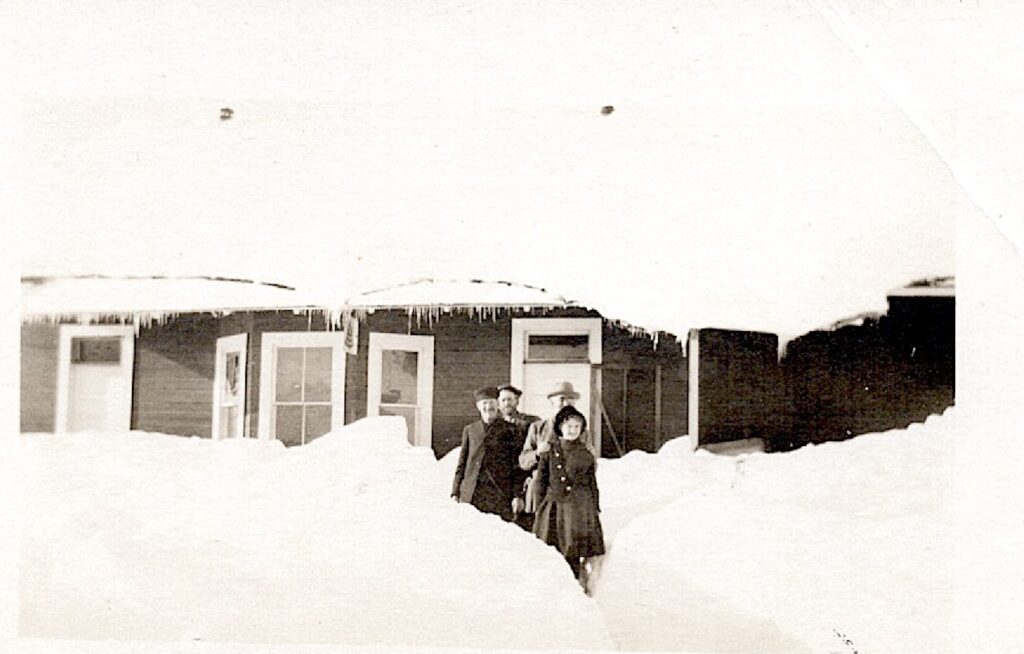
Thelma James, J.H. Pefley, Unknown and William Clayton, Amedee Depot, January 14, 1911
Marie Herring Gould who resided at Amedee during the big snow recalled the NCO Depot looked a like a giant white mound. By the end of the month the snow had melted at Amedee.
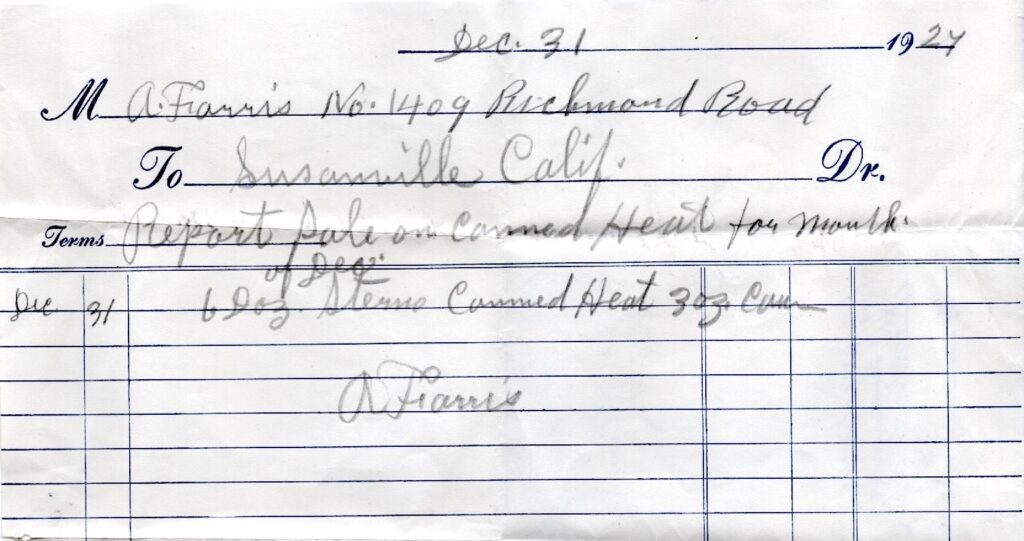
Richmond Road store-keeper. A. Farris and his monthly report of sale of canned heat..
Sterno was developed around 1900 for use in catering to keep chafing dishes warm. The product sold in little cans received the nickname of “canned heat.” It was popular with soldiers during World War I to heat their meals.
Then came along Prohibition. One of the ingredients of canned heat is methyl alcohol, than can be deadly if ingested. This did not stop individuals straining canned heat with a cheesecloth to extract the alcohol. It was not only a nation wide crisis, but a local one as well. In March 1926 the deaths of John Murphy and Pete Nelson were attributed to the consumption of canned heat. It took local officials over a year to curb the usage of this product. In the fall of 1927 both the City of Susanville and the County of Lassen passed ordinances requiring that dealers of canned heat obtain a special license to sell it. The license cost dealers $50 per quarter. It was presumed that by making the special license so high, it would eliminate the product from the shelves. It worked and canned heat was no long a problem locally.
Today, we examine Camp Susan, the nearest appearance of a military encampment the town would experience and to say it was short-lived would be understatement. In late August 1864, the 1st Nevada Territorial Infantry, a mobile military unit from Fort Churchill, under the command of Malachi R. Hassett, established a base camp near Susanville. Their mission was to scout the territory from Susanville, north to Surprise Valley and east to the Humboldt mines. In October 1864, the unit was ordered back to Fort Churchill.
There was a noteworthy at the camp. On September 12, 1864, Private Ebenezer Williams died at Camp Susan. Williams, a native of Wales, had just enlisted in February 1864. My records do not indicate a cause of death or burial.
At the moment, I am searching for the proverbial needle in the haystack. There was the retrieval of three Banker Boxes from storage that consisted of Lassen County archives that I retrieved in 1980 from going to the dumpster. The majority of the records are the original papers of the meetings of the Lassen County Board of Supervisors for the years 1911-1919. Of course, there are exceptions and there documents from the 1920s to 1940.
At the moment, I have two stacks of documents. The first, will be scanned and and I have the information surrounding them to share. They are quite interesting involving a variety of topics that are no longer before the supervisors. The second is same, but those topics I have to research further.
On Sunday, December 28, 2025 at 4:41 p.m. a 4.7 magnitude earthquake centered at Round Valley struck. For those not familiar with Round Valley, it is due north of Susanville, as the crow flies about nine miles and is privately owned. Then on Tuesday night, December 30 at 9:49 p.m. a second 4.9 earthquake occurred there.
It should be noted that east side of Eagle Lake a consist of fault blocks namely Mahogany and Blacks Mountain. You can read about the 1889 Eagle Lake earthquake here. There was a notable quake in 1921, though not as strong.
Personally, I really felt the first one (2025) since, I was preparing dinner (garlic noodles) when it struck. My milk bottle collection rattled and my mantle clock stopped. The second one, I was in bed, but I heard things rattle.
This was a quite surprise, the feature of Indian Valley Hot Springs that was published in 2022 was the most searched of all articles for 2025.
Operating a bath house to a full scale resort utilizing hot springs has in my perspective is a risky endeavor. When times are good, they are real good, but same applies to bad times, and in many instances its the low points where the operation shuts down. Some times revived and some times not.
Indian Valley Hot Springs at Greenville is a perfect example. Greenville was a thriving mining community during the late 1800s. The hot springs became a popular attraction and bathing place. As the mining activity dwindled by 1900, the bath house fell into disrepair and closed.
In the spring of 1926, B.C. Johnson decided to see if he could make a go of it. He spent six weeks in getting the property in shape. Johnson highlighted the fact, that not only could a person have an enjoyable soak, but one could also “soak” in the natural beauty of Indian Valley. How long Johnson operated it I do not know.
A partial view of Indian Valley in the 1960s.
For those interested, awhile back it was on the market with an asking price of $4.95 million. With last year’s devastating Dixie Fire that destroyed a large segment of Greenville, the value might have dropped.
The Colony Dam, Susan River, November 1897. Courtesy of Betty Barry Deal
July – Lassen County Fish & Game Warden C.O. Fisher had some terse words to the farmers along the Susan River watershed. Fish & Game wanted plant some 300,000 trout into the river. Before the planting could be done the farmers needed that there diversion dams and ditches to become into compliance since many were in violation of California Penal Code Sections 629, 636 and 637.
August – On August 26, California Governor William Richardson paid Susanville a visit. It was his twenty county tour to inspect the state highway construction projects.
September – Susanville was chosen to host of the State American Legion Convention in 1926. It was estimated that it would bring 2,500 people for the week long event.
Ravendale, in better times.
October -One consistent theme throughout the year was the prevalence of bootleggers. In October. Lassen County Sheriff Carter paid a visit to Ravendale resident Jim Ingram. The sheriff and his deputies confiscated a still and 80 gallons of whiskey. Ingram pleaded guilty. He was sentenced to pay a fine of $500 or spend 500 days in the county jail. Ingram choose jail time.
November – The Lassen County Board of Supervisors approved the construction of a Veterans Memorial building. It would be a multi-purpose facility, not only provided a much needed auditorium, but it would house the offices of the chamber of commerce, farm bureau and horticultural agent.
December – On December 4 the organization meeting of the Susanville Rotary Club was held. The initial officers were: John B. Spalding, President; J.A. Pardee, Vice President; C.H. Bridges, Treasurer; E.L. Shirley, Secretary and Harry Coleman Sergeant at Arms. It was decided upon weekly luncheon meetings to be held on Wednesday. They selected the Hotel Mt. Lassen as the meeting location, yet it still was under construction. It should noted that the local Rotary Club did not receive its charter until the spring of 1926.
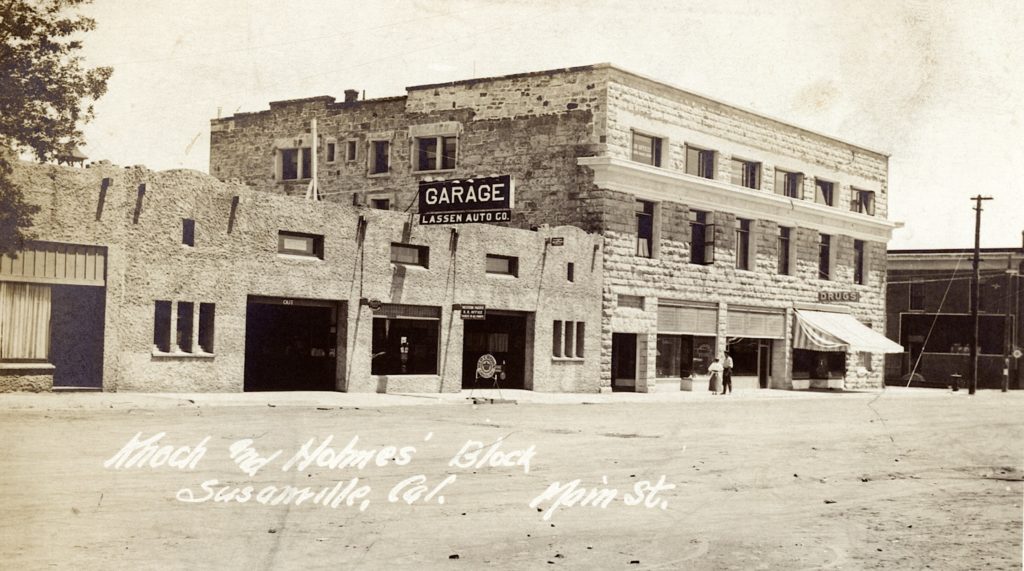
Doyle & Hunsinger and Lassen Auto Building, Susanville, circa 1927
January – Changes in car dealerships. E.W. Smith announced he would relinquish the Ford dealership in favor of Chevrolet. Howard Doyle of Reno, secured the Ford dealership in Susanville that would be operated by his so n Clem and Leland Hunsinger. Later in the year, both would construct combination showrooms/garages and while those car dealerships no longer exist, the buildings still do.
February – A group of Susanville businessmen formed the Susanville Hotel Company. It was their intention to raise $300,000. The purpose to construct a three-story hotel with 64 rooms. it was the beginning of the Hotel Mt. Lassen.
March – The golfing craze continues. As the Susanville Country Club membership was full, the Gold Run Golf Club was organized. They leased the old Ridenour Ranch at the lower end of Gold Run and built a golf course. Stienbrook and Moore owners of Janesville’s Diamond Mountain Inn had plans to construct a golf course there.
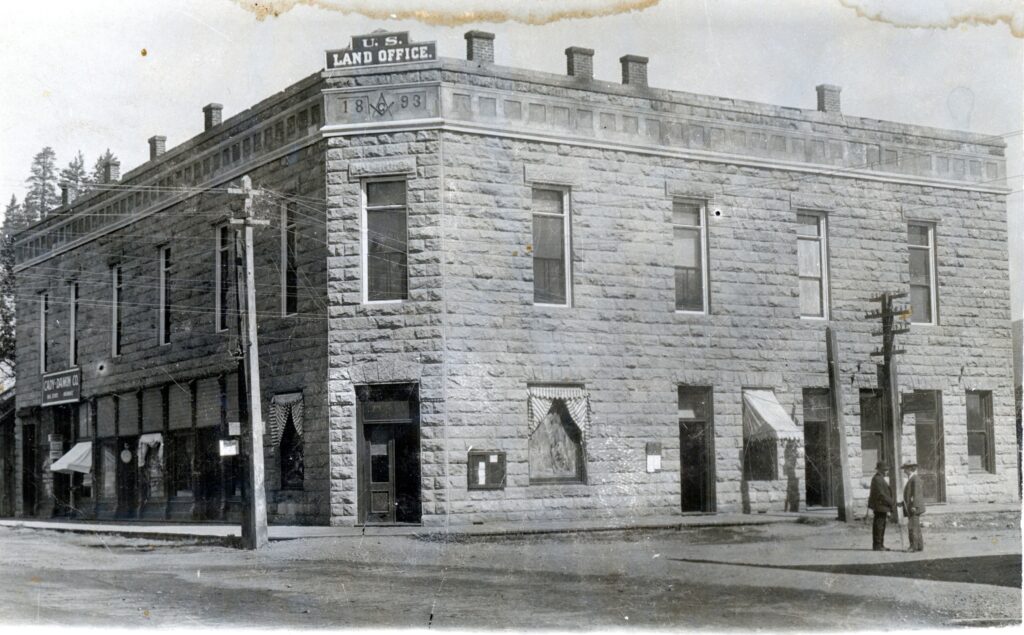
The Government Land Office was located in Knoch Building from 1899 to 1925-Philip Hall
April – Established in 1871 the Susanville Government Land Office played a pivotal role processing homesteads, i.e. federal land patents for Lassen, Modoc, Plumas and eastern Sierra Counties. The Department of Interior used an archaic law to close land offices. Locals fought back. They cited the Susanville office generated $9,000 in revenue and $5,800 in expenses. In addition, there were still 1,280,000 acres of eligible land to be filed on. The office closed on April 30.
May – In May the Susanville School District voters approved a $65,000 bond measure to construct an elementary school on Richmond Road. Once completed in 1926, the school district had four schools. School trustees had found it necessary to name them. It was decided name the schools after U.S. Presidents. The original brick school was named Washington. The school adjacent to it became McKinley. The school, in the Milwood District, was named Lincoln. And finally, the fourth school on Richmond Road was named Roosevelt.
June – On June 12, Dedication ceremonies were for new Masonic Lodge located at Lassen & Nevada Streets. The $35,000 native-stone structure replaced the wooden hall destroyed by fire in 1921. This would be last major native-stone building constructed in Susanville.
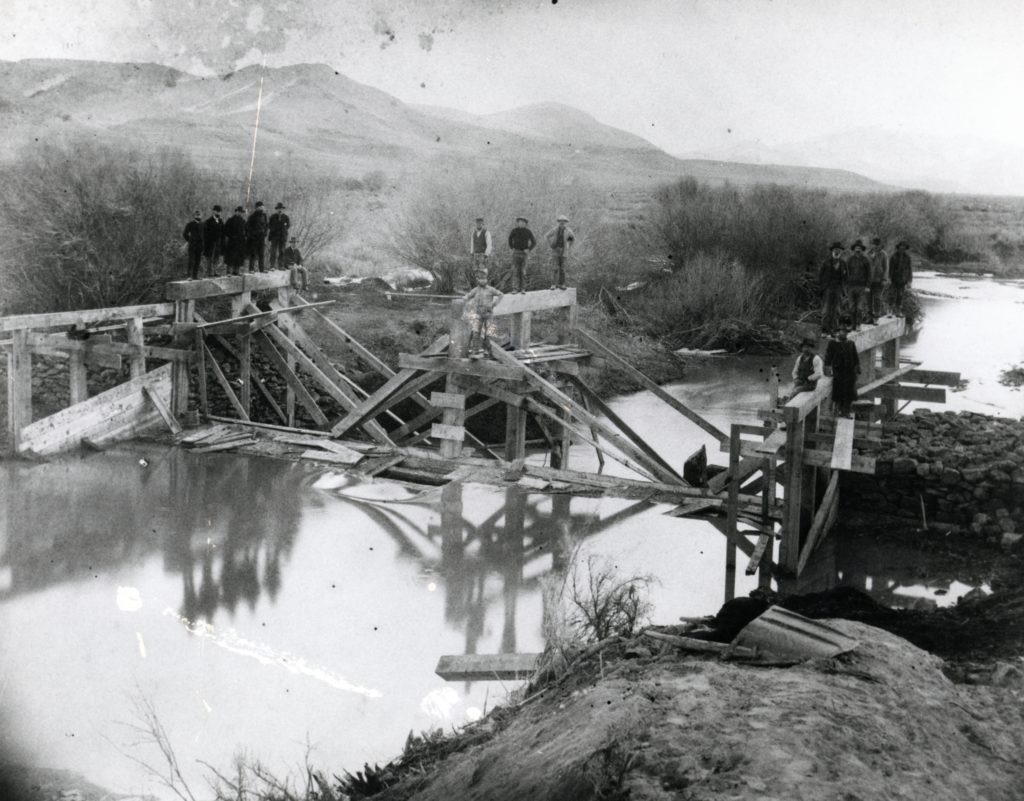
In closing of 2025, there is no longer a Tanner Ranch in the Honey Lake Valley. In 1870, William M. Tanner located on 160-acres along the Susan River once the site of Soldier’s Bridge.In 1883, Tanner sold forty-acres to Andrew Litch for $450 that later became the site of the town of Litchfield.
Tanner Ranch, though, had multiple locations, due to family deaths.. In 1928, John and Lola (Murrer) Tanner acquired the Capezzoli Ranch on Mapes Lane. Later they would acquire adjoining ranches–Hartson, Stampfli and Whitehead.
A view of the old Hartson Ranch, 1975
In 1945, John Tanner passed away. In 1973, Lola died, and the ranch was passed onto to their three daughters, Ardene, Joyce and Mary. It was Mary, who was the last of three daughters to pass away in 2024. It was time for next generation to move forward. On September 29, 2025 Tanner Ranch sold to Matt and Randy Harkness and with it concludes a 155 year-old history of the Tanners in the agricultural community of the Honey Lake Valley.
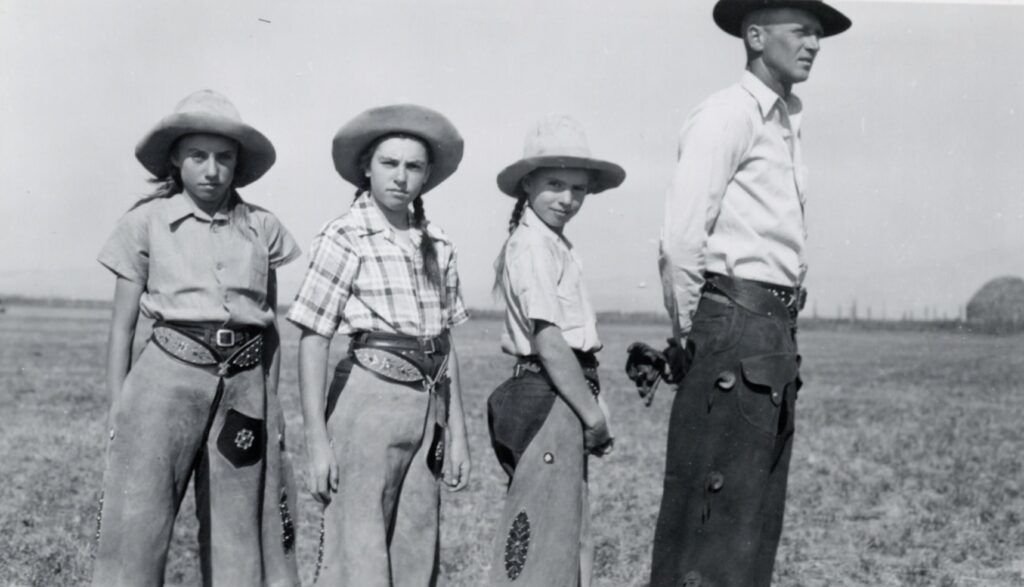
The Tanner girls-Joyce, Mary, Ardene with Bud Driver, September 1942, Tanner Ranch