Category Archives: History

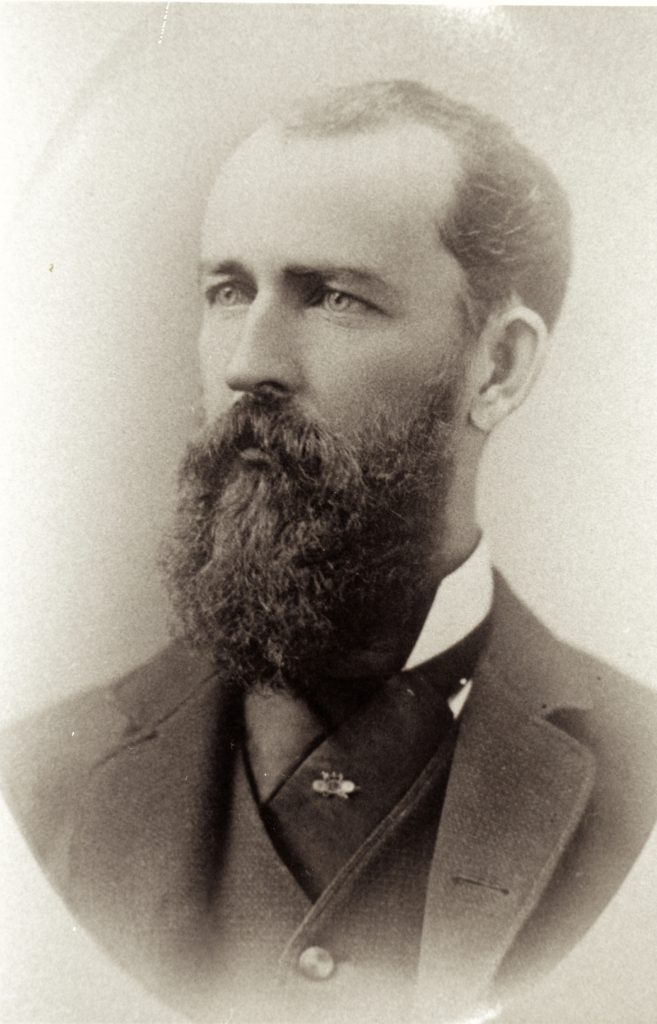
Thomas Bracken Sanders

Thomas B. Sanders. Courtesy of Gilbert Morrill
Thomas Bracken Sanders

He was born on November 29, 1848 in Illinois, one of thirteen children, yet ten of his brothers and sisters died in infancy, some of whom are buried in the Susanville Cemetery. It should be noted that the family came west in 1860 and settled in Plumas County and in 1867, they moved to Susanville.

One of his more interesting jobs began in the late 1870s, when he went to work for the Fish & Game Department as a deputy. They kept him busy planting fish in the various lakes and streams to learn what would best adapt in the area. In January 1879, Sanders along with Dr. H.S. Borette and William Dow introduced the first non-native species of fish at Eagle Lake. It was two wagonloads consisting of 225,000 Great Basin whitefish. That fall they planted brown bullhead catfish at Eagle Lake. Sanders also planted catfish in the Susan River and Piute Creek, where they did quite well. Take for instance, in 1883, Masillon Martsteller caught a twelve pound catfish from the Susan River. Sanders, himself, caught a catfish from Piute Creek that weighed fourteen pounds.

While Fish & Game paid Sanders a stipend for what he did, the work was sporadic and the payment not sufficient to make a living. For a livelihood he learned the carpentry trade. He specialized in making cabinets, furniture and trunks. As most furniture makers of this era, he was called upon to make coffins. He added undertaker to his profession and continued until 1896 when he sold out to Tom Oakes. In 1897, he moved to Sacramento where his brother, Plumas Sanders resided. It was not a good move. Two years later, unable to find steady work, he committed suicide.

Subscribe!
All Those Doyles!

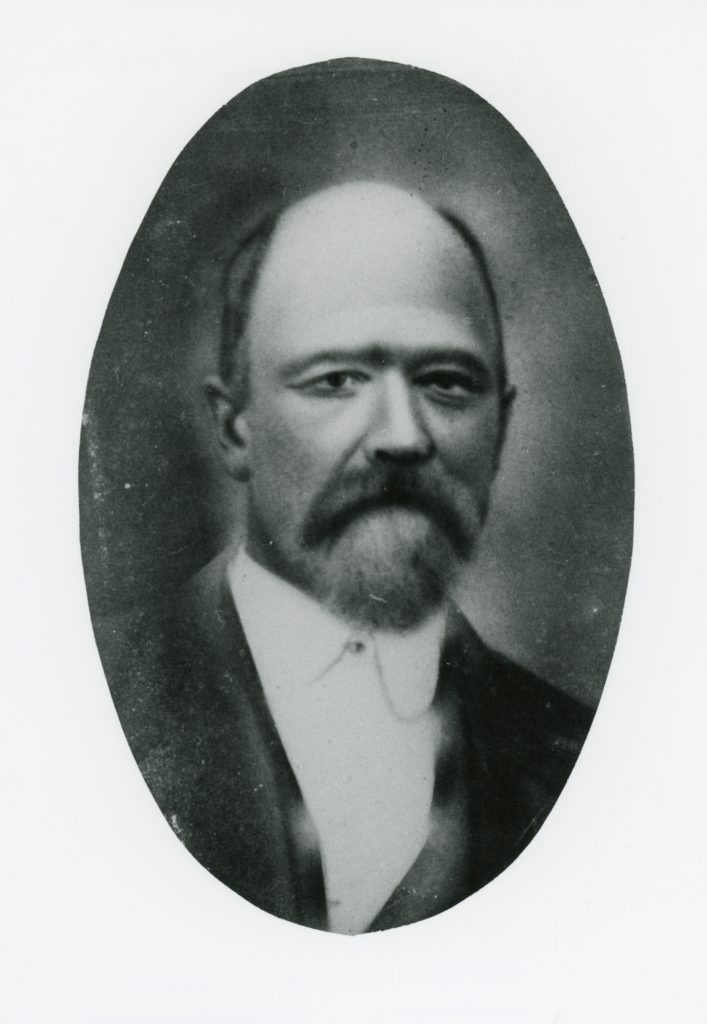
John W. Doyle (1832-1892). Courtesy of the Nevada Historical Society
The community of Doyle was named for John W. Doyle, who settled in Long Valley in 1859 and spent the rest of his life there and passed away in 1892. He had a brother, Stephen who also became a resident of the Honey Lake Valley and for many years operated the Milford Hotel.

In 1860, James Doyle, no relation to the Long Valley Doyle’s settled at Milford. His great grandson, John Doyle, owned Doyle Motors in Susanville for a number of years. Across Main Street from the former Doyle Motors, on the corner of Main and South Roop Street, is the Del Mar building, which was built in 1914 by Otis Doyle, a Long Valley Doyle.

It can get confusing, and descendants from the two different Doyle families still reside in the region.

Subscribe!

1882 Wages

Haying at the Elledge Ranch, near Standish, 1900. Courtesy of Camilla Moody
If you were gainfully employed in Lassen County in the early 1880s, the following was the prevailing wage. Regular farm hands with board were paid $30 to $40 a month. If you happen to just work at harvest time such as haying $2 a day, and possibly board. The sheep industry was a major component in Lassen County’s agricultural community and sheepherders salary ranged from $25 to $40 a month. The task of sheep shearing was paid at 6 cents a head.

In the lumber industry the head sawyer was paid $75 a month, plus board, while the average mill worker received $40 a month plus board. Since firewood was a much needed commodity those laborers were paid on the average 75 cents per cord.

Donate!

Highway 29

Highway 36 Fredonyer
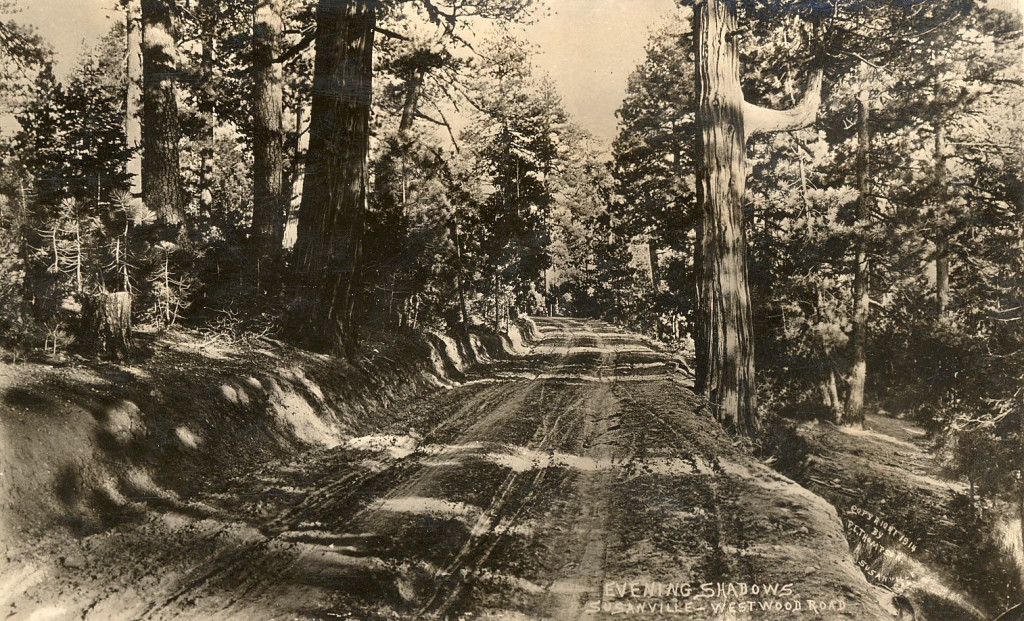
The road over Fredonyer as it appeared in 1914.
In the early 1920s, the State of California had the daunting task of plotting out a highway system, and there were plenty of details to be dealt with. Among them, especially for the traveling public, was the designation of highway routes. In the early 1920s, the California Automobile Association led a campaign to give descriptive names of the mountain routes. Highway boosters of the region proclaimed the route between Red Bluff and Susanville, the Lassen Volcanic Highway, since the highway went by the southern entrance of the national park. In time, the State of California began to use a numbering system, and initially proclaimed this route as Number 29. In 1935, it was changed to State Highway Route 36. The change of the number was necessary to reflect the adoption of a uniform system, where even road numbers went to east-west direction and odd ones were for north-south routes.

Subscribe!

Lewiston, Lassen County

Hayden Hill
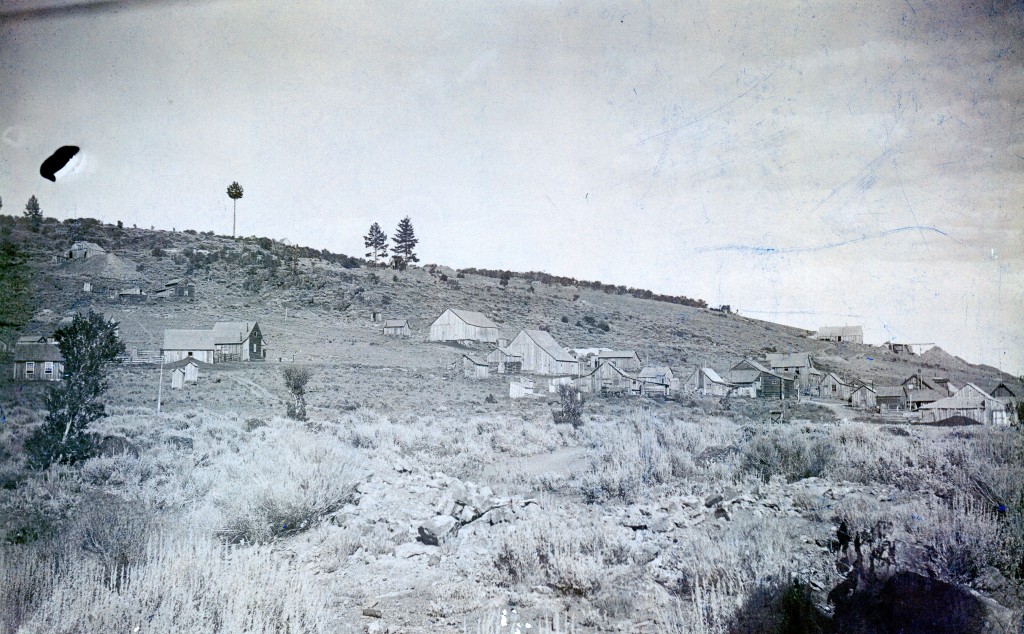
Hayden Hill, 1894
Hayden Hill is Lassen County’s best known mining community. However, and especially in the late 1800s, there were numerous mining camps surrounding the hill. One of these was Lewiston. It was a very short-lived mining camp in 1884, that Joseph W. Hayden named after his partner, Seneca Lewis. Of note, both Hayden and Lewis are buried in the Hayden Hill Cemetery.

Subscribe!

Shirley’s

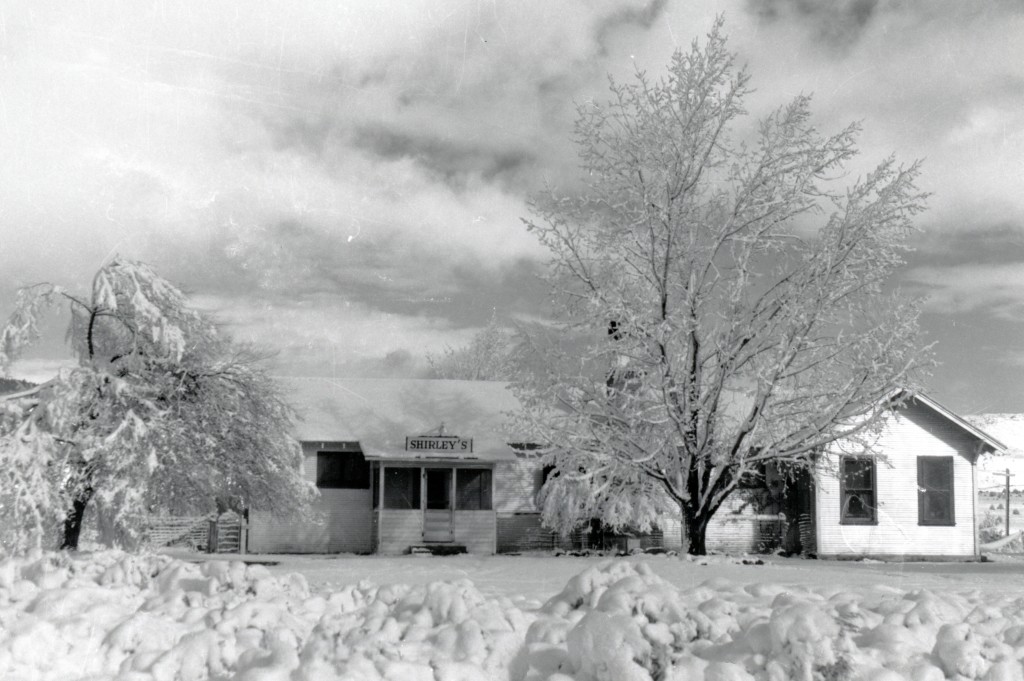
Shirley’s, Hall Street, Susanville. Courtesy of Hank Martinez
Shirley’s was a bar on the north end of Hall Street, the current site of the Juniper Apartments. Established in the 1930s after the repeal of prohibition, by Jean “Shirley” Tilton, and its distance from town on a road heading to points northward was similar to the roadhouses between Susanville and Westwood. *

It was quite the interesting watering hole, “Shirley” a former nurse, was confined to a wheel chair, but remembered for her generosity. She was also a madam, and cabins behind her establishment took care of certain needs of her clientele. Then there was her friend, gay piano man, and member of Sacred Heart Church’s choir, that assisted her, until he committed suicide in 1938. When she died in 1954, Gene Garayoa and Steve Arainty transformed it into the Juniper Inn.

*Ash Street, was not in existence.

Never miss a story, click here.

FacebookTwitterGoogle+Share

Doyle Post Office

Doyle, 1921. Courtesy of Lola L. Tanner
I realized recently that I have not wrote much about the postal history of the area. Just like the one-room schools that were found throughout the county, the same applies to post offices of another era. It was the construction of the Western Pacific Railroad that was the catalyst for the creation of the town of Doyle. The Doyle Post Office was established on January 29, 1908. However, the region was not without mail service. On December 29, 1869 the Long Valley Post Office was established at the Doyle Ranch, just a short distance south of would later become Doyle, and its first postmaster was John W. Doyle.

Subscribe

Eagle Lake – Pelican Point

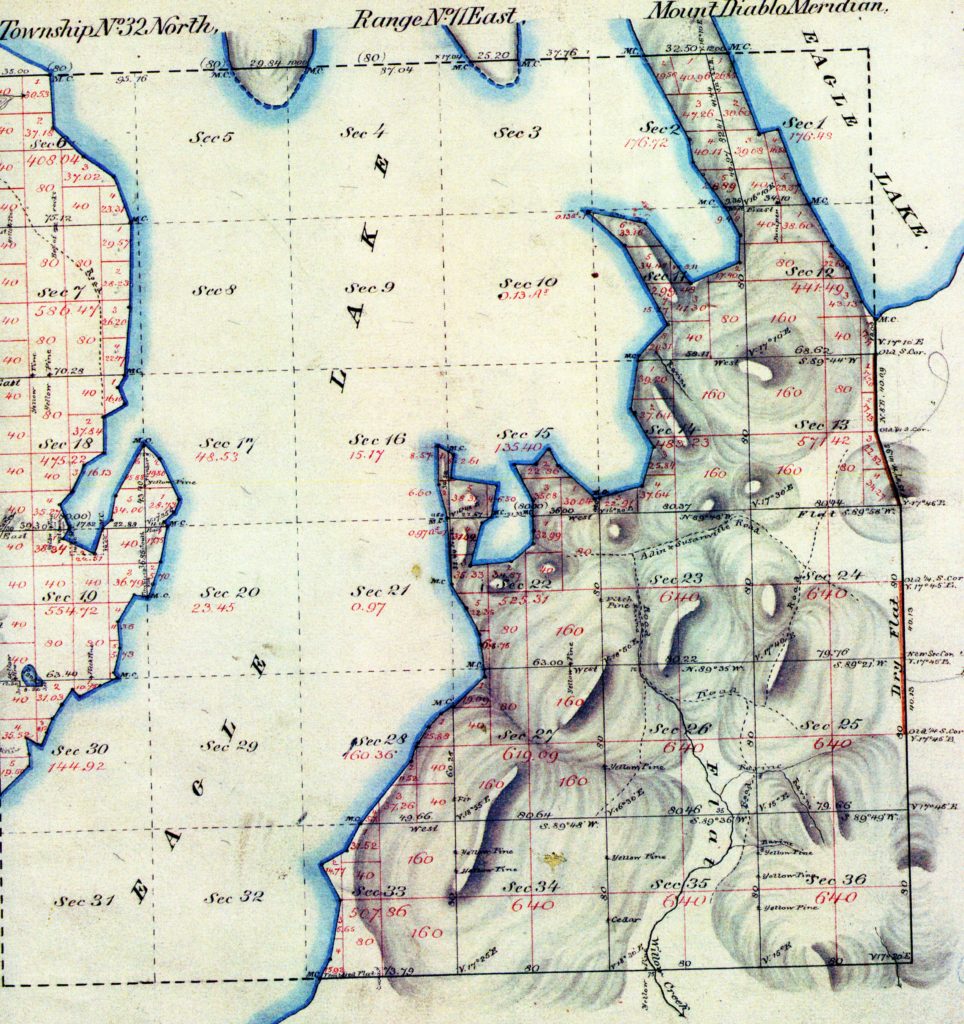
United States Government Land Office survey map.
There are times when I am doing research I get sidetracked. In a particular instance recently resulted in an interesting revelation concerning Pelican Point at Eagle Lake. For a long time the point did not exist, though there was a Pelican Island of sorts. As you can see the above of the Government Land Office survey map of 1875, there is no Pelican Point. At that time the lake level as 5109. In 1917 began the twenty-year drought, combined with the Bly Tunnel, the lake level dropped dramatically, which resulted in the exposure of Pelican Point for the first time since Anglo settlement.

Subscribe!

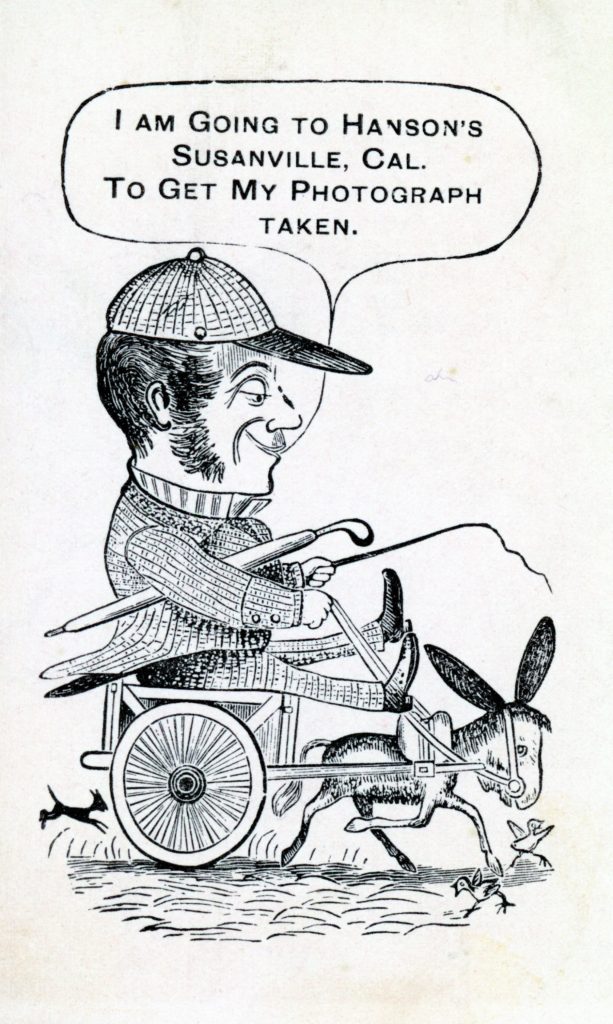
John A. Hanson, Photographer

Hanson’s standard advertisement. Courtesy of Verna L. Haley
The itinerant professional photographer of the late 1800s was an interesting creature in the rural areas such as Lassen. Many were single young men. After all, one would have to ride “circuit.” Susanville at that time, with a population base of less than 500, it could not sustain a full time photography studio. They would travel to neighboring communities in search of business. After a few years, they would move to a new territory.

John Hanson came to Susanville and initially opened his photography studio in a tent. With that type of mobility, it appeared Hanson was just traveling through town. Yet, Hanson found romance in Susanville with a young lady, by the name of Fannie Streshley, who operated a millenery store a block from Hanson’s tent. The relationship turned serious and the two were married on October 31, 1883. The couple made Susanville their home until 1886, when they moved onto unknown greener pastures.

Subscribe!

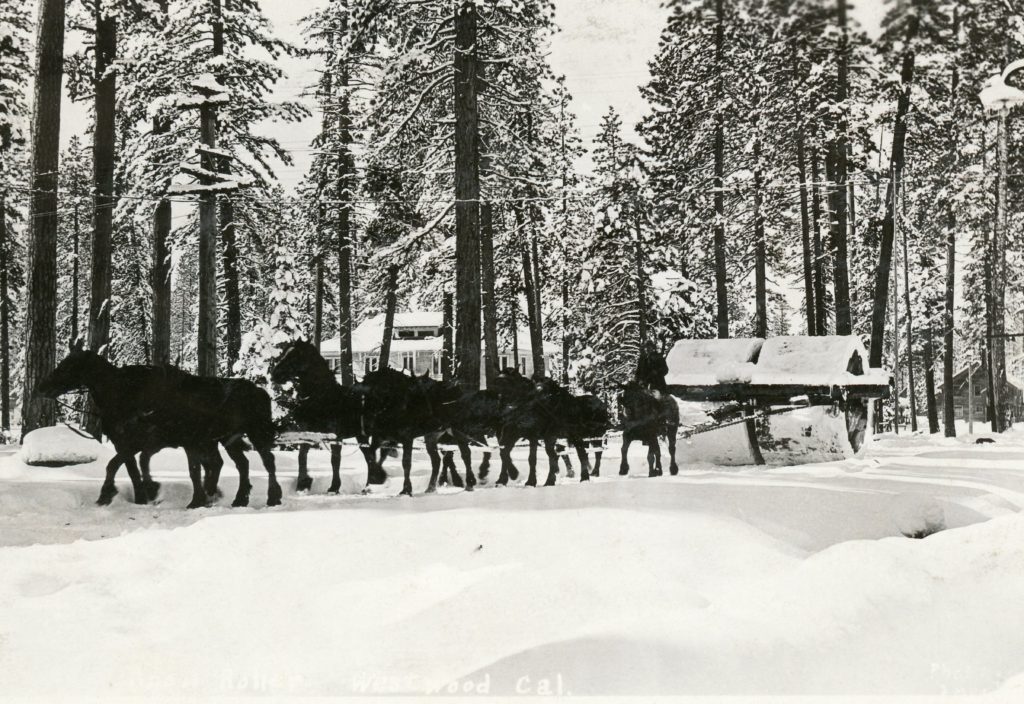
Red River’s Snow Roller

Red River’s snow roller in action. Courtesy of Calvin Sharp
On January 2, 1916, it began to snow, and snow and snow for nearly three weeks. At Westwood it was reported that they fourteen feet of snow. Resident Manager, Fletcher Walker called it a “blue snow.” From this particular snowstorm, standard snow removal techniques of Westwood streets were no match to combat the deep snow. Someone came up with ingenuous idea to build a snow roller to compact the snow. The Westwood correspondent to the “Lassen Weekly Mail,” observed, “The immense snow roller is in successful operation on the streets. It leaves a compressed trail wide enough for teams to pass. Eight to twelve horses have been used to haul it through the streets and the affair makes an interesting ensemble.”

Subscribe!