Upper Biscar Reservoir, as seen from the Modoc Line Trail.
In 1996, the Union Pacific Railroad received permission to abandon an 85 mile segment of railroad from Wendel to Likely. Since then it has been converted into another “rails to trails.” It should be duly it was the NCO Railroad that initialy constructed the line and in the 1920s it was acquired by the Southern Pacific Railroad.
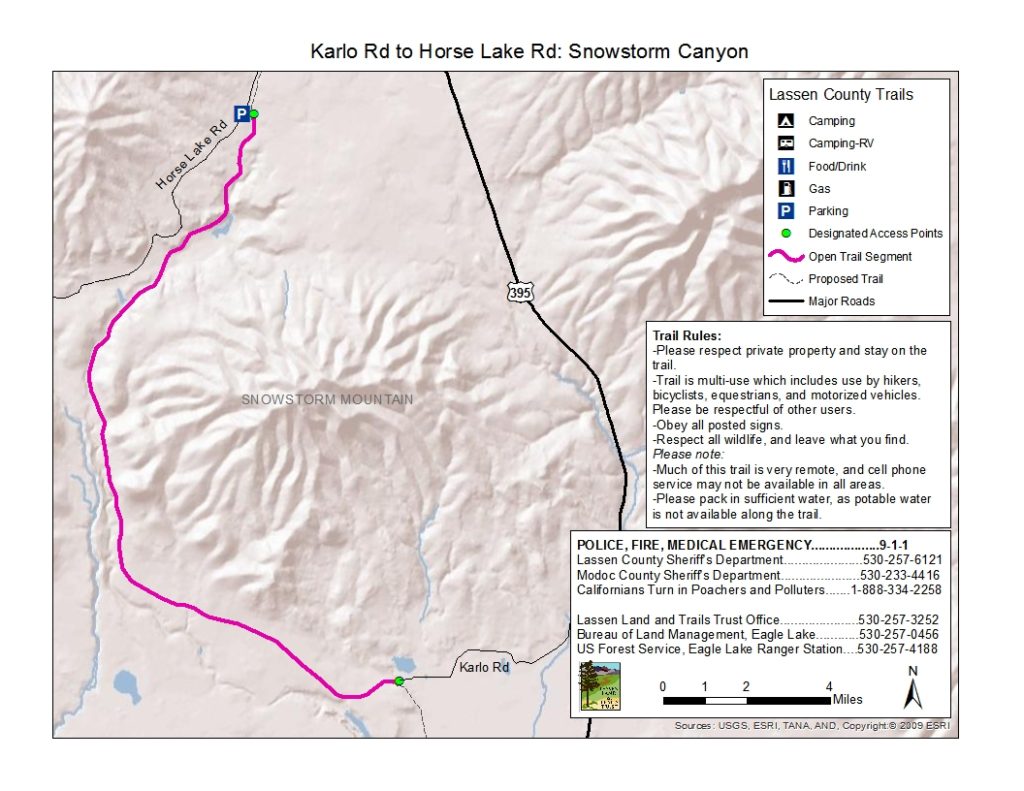
Map showing the route from Karlo to Horse Lake Road.
Personally, I prefer the segment from Karlo, Secret Valley to Horse Lake Road. While, I do not have a preference which way to approach, I think its best to travel it each way, since doing so one sees different perspectives of the area.
Foundation remains of the Horse Lake Siding, is one of many sites to see. January 27, 2019. Courtesy of Anna Stewart
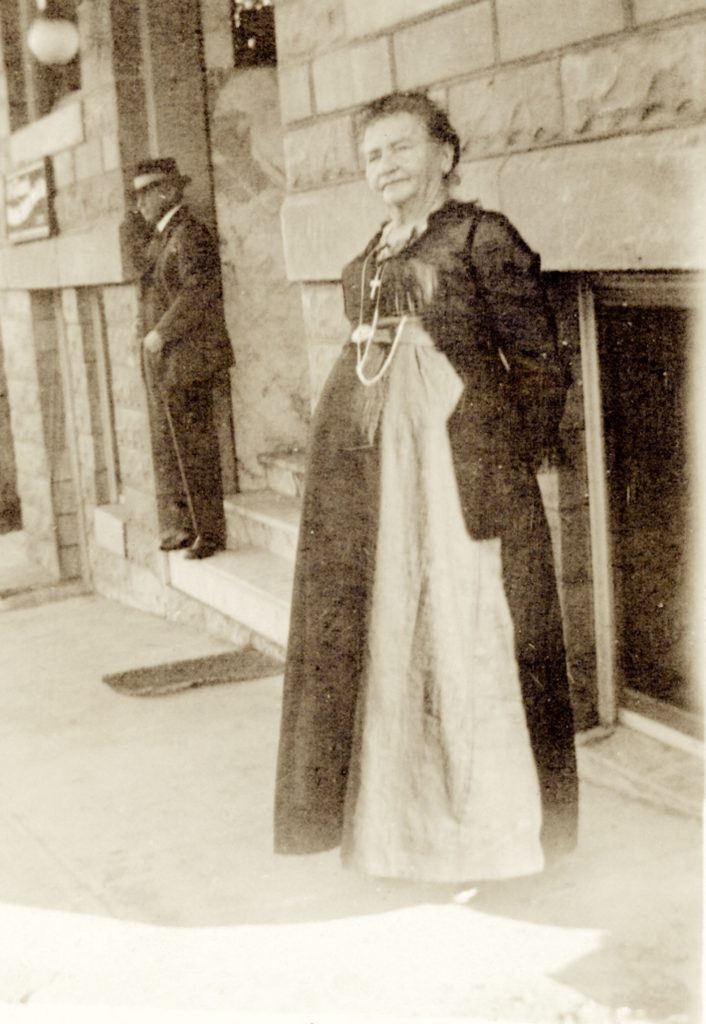
Franceska Murrer Neuhaus, 1916—Leona Jackson Byars
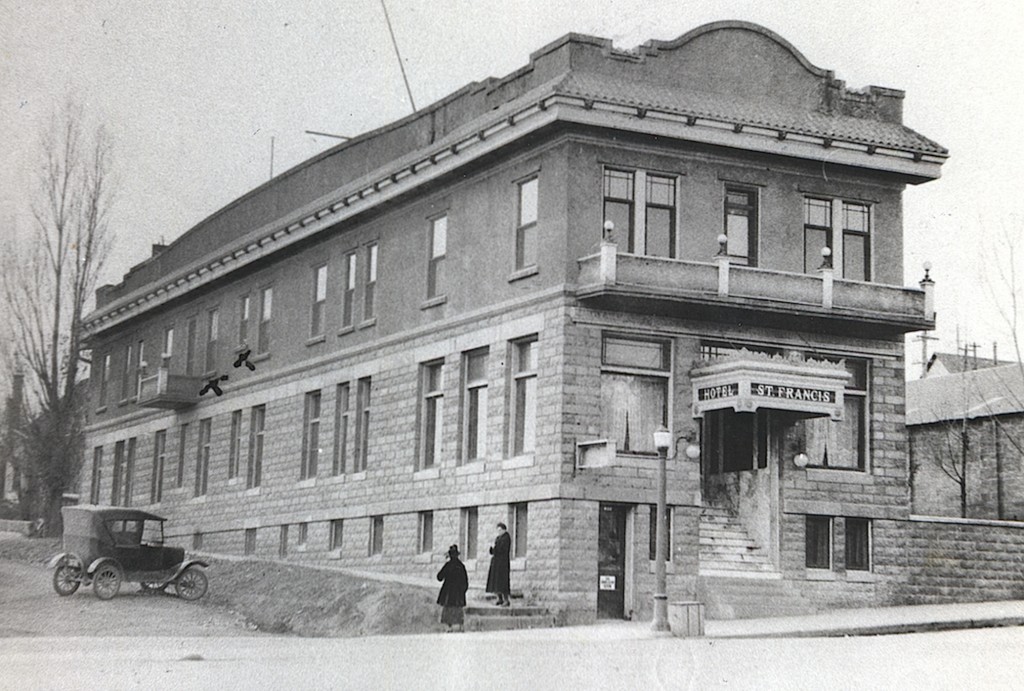
In October 1916, Franceska Neuhaus placed a small 2×2 inch display advertisement in the Lassen Advocate that for sale was the Commercial Hotel on the corner of Main and Union Streets, Susanville. She also offered 80 acres of timberland two miles from Susanville. Innocent enough? The hotel that she offered was named the St. Francis Hotel., after all there was the Commercial Hotel a block away on South Weatherlow Street. As to the timber property she did not own any.
St. Francis Hotel, 1922. Courtesy of Art Almeda
This alarmed Leona Jackson, a granddaughter of Franceska. She went to court to file guardianship papers for her grandmother. Of course, a notice is required to be sent to all relatives. It turned into one of those proverbial “all hell broke loose.” Other relatives filed their own petitions seeking to be Franceska’a guardian. Most of 1917 was tied up in litigation over Franceska’a guardianship, until finally the court appointed, Franceska’s son, W.H. “Bill” Neuhaus her guardian. The following year, 1918, Franceska passed away, a victim of the Spanish Influenza.
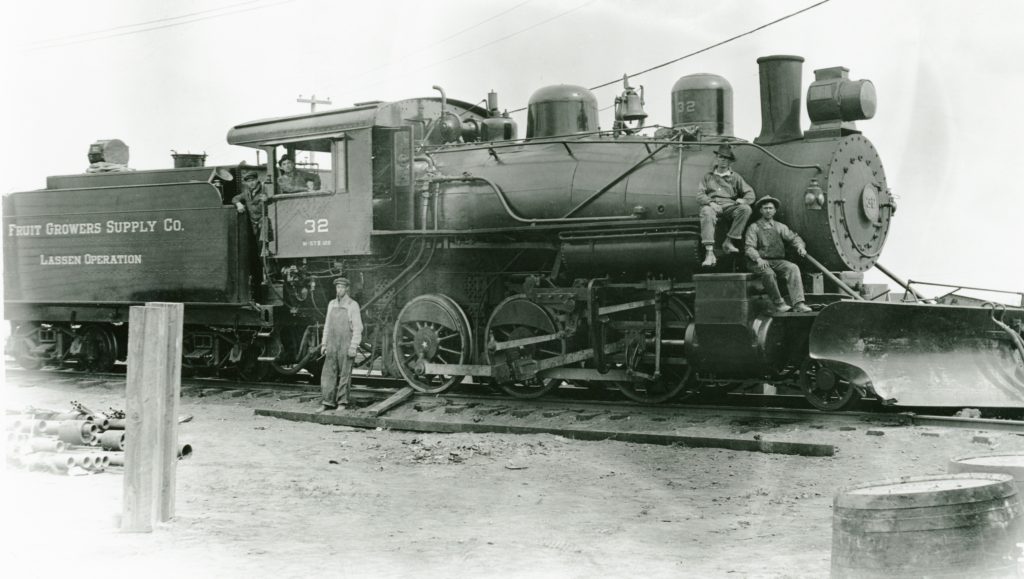
In 1919/20 when Fruit Growers Supply Company established its Susanville operation, they of course needed locomotives for its railroad logging operations west of Eagle Lake. They purchased this Baldwin locomotive from the Ocean Shore Railroad that operated a line along the Pacific Coast from San Francisco to Santa Cruz.* Fruit Growers ownership of the No. 32 was brief and they sold it in 1924 to the Red River Lumber Company. In 1944, Fruit Growers reacquired it when they purchased Red River’s Westwood operation. In 1953 the locomotive was scrapped.
*The Ocean Shore Railroad, was not completed with a gap in the middle.
Spread the word, and encourage a friend to subscribe
In 1920, the Christie Brothers—John and James—dissolved their partnership in a general mercantile store in Janesville. John, better known as Burt, had already launched a new career when he purchased the Eagle Lake Resort. For his brother, Jim, he was not quite sure what path to take. In 1921, he opened Christie Furniture at 903 Weatherlow Street, Susanville and continued until his death in 1936.
Eventually, the store moved to 608 Main Street. For several decades it was owned and operated by S.R. “Carl” and Ferne Carlomagno. Christie Furniture store, along with the Murray Insurance were destroyed by a fire on March 20, 1982. The Christie store was never rebuilt, and remains a vacant lot.
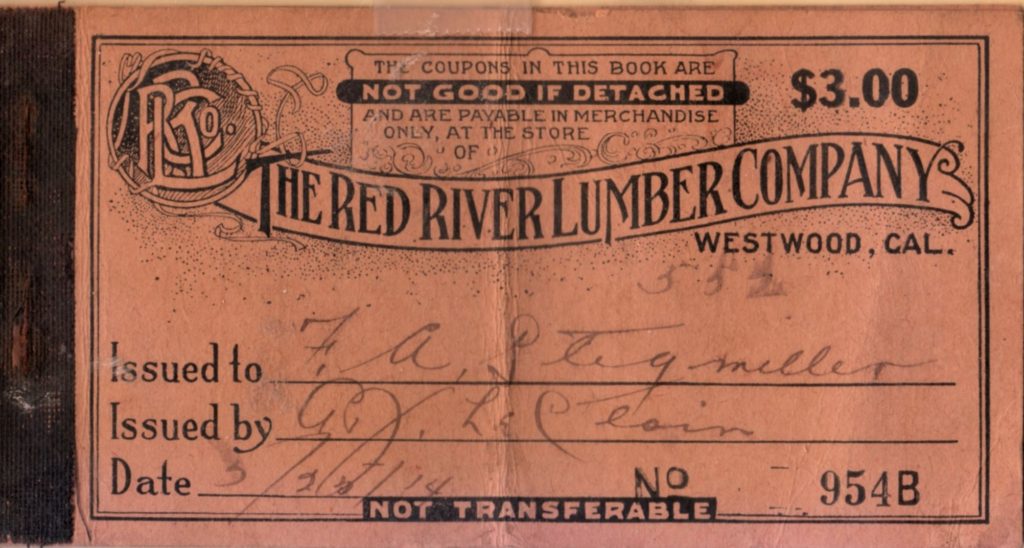
Red River Lumber Company like so many other company towns issued scrip—a form of company currency utilized when an employee received an advance on wages. When an employee received scrip, the amount was deducted from his wages. It was basically worthless as it could only be redeemed in company stores. The usage of scrip declined when employees were issued badges. With an employee badge number, the employee or a member of his family could charge anything they wanted from the company store using that number. Those charges were then deducted from the employee’s paycheck.
In November 1923, John Thomas of the Oakland Tribune wrote a complete description of Red River’s operations at Westwood. As to the company scrip he noted, “The company runs a general merchandise and department store, covering a whole block. Here you can buy anything from a paper of pins to a threshing machine.
“All the employees of the big mill trade here, also dad, grandma, auntie and the kids related to the employees. This is the only store in town. The strange part of it is you don’t need money in this store. You use scrip or paper money—not Uncle Sam’s brand of currency, the kind the banks hand out. You procure books of scrip tickets from the office. These scrip books contain five, ten, twenty-five and fifty cent checks, or tickets, and are good in the big store, also the movie show, newsstands and clubroom. I never tried putting scrip in the plate of the church, as I did not attend.
“These scrip books are transferable to members of the immediate family, that is to pa, ma and the kiddies. Grandma buys her darning cotton, uncle buys his chewing and smoking, sis buys her new slippers and the kiddies their candy and chewing gum all with scrip.”
Spread the word, and encourage a friend to subscribe
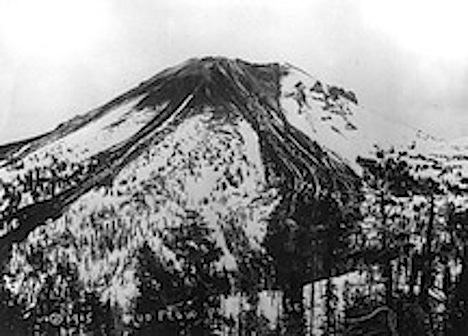
On the night of May 19, 1915 lava overflowed from crater of Lassen Peak. It was most acute on the northeast side. The lava in turn melted snow, causing a cascade of water, that was soon transformed of a stream of mud and debris headed towards Hat and Lost Creeks.
Around 11 o’clock that night, Harvey Wilcox who had a cabin on upper Hat Creek was first person to witness the catastrophic event. He was awakened by the sounds of horses running past his cabin. He ventured out to see what happened, and in the nick of time barely escaped the mudflow, only to watch his cabin swallowed up by the mud flow. His neighbor, Elmer Sorahan was awakened by his barking dog. He, too, escaped and alerted the Hall family downstream.
This was just a preview of things to come. On May 22, 1915 witnessed Lassen Peak’s greatest eruption.
Spread the word, and encourage a friend to subscribe
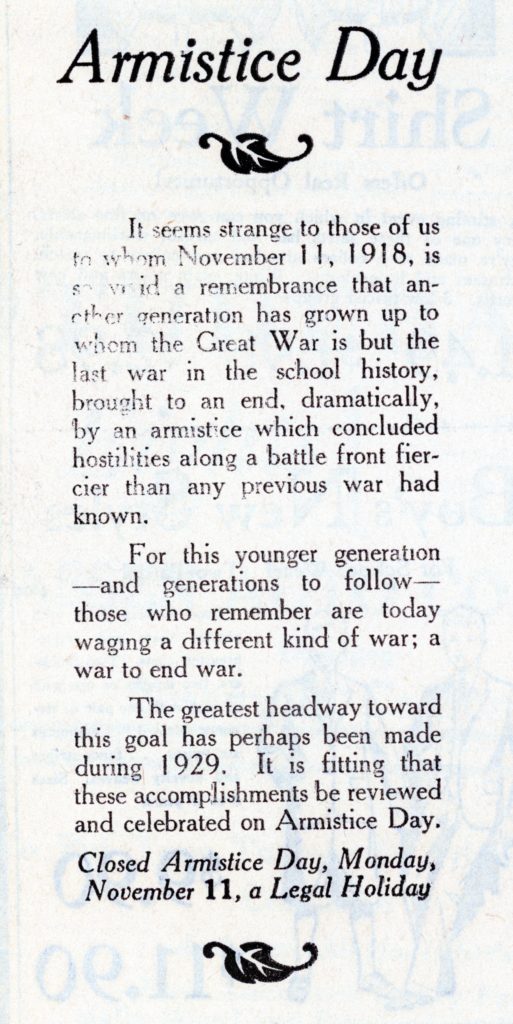
The above was an advertisement placed by the Bank of Lassen County. Using lingo from the newspaper writers of the past, for those of the younger set, Armistice Day is now known as Veteran’s Day. What caught my particular attention of this ad, it had only been eleven years since the ending of what was then referred to as the Great War (World War I) and they raised concern that a younger generation were unaware of it, and the sacrifices made.
Great Northern’s Tracklayer entering Big Valley, 1931. Courtesy of Orville Watkins
Yesterday, we explored the Paul Bunyan Prosperity Special. As mentioned everything revolved around the Golden Spike Ceremony at Bieber connecting the Western Pacific & Great Northern Railroads. In all, it was a successful event, though it was dampened by some extremely bitter cold weather.
After the crowds dispersed, tragedy struck. It should be noted, for a portion of the population it was just another work day and this was especially true for those employed by A.B. Guthrie, the construction contractor for the Great Northern Railroad. At approximately 5:30p.m. a railroad work crew were returning to NuBieber. Six men were riding on a flat bed trailer. Out of nowhere came a speeding touring car, which sideswiped the trailer, knocking two men off it—Dan Rogish and Charles McMahon. Rogish was dragged by the car and died from his injuries. The driver who hit the two men, sped away, it was estimated the driver was going 70 miles per hour and was not apprehended.
On November 10, 1931 was a historic day in many ways. A golden spike ceremony was held at Bieber to mark the completion of the Highline/Northern California Extension of the Western Pacific and the Great Northern Railroads.
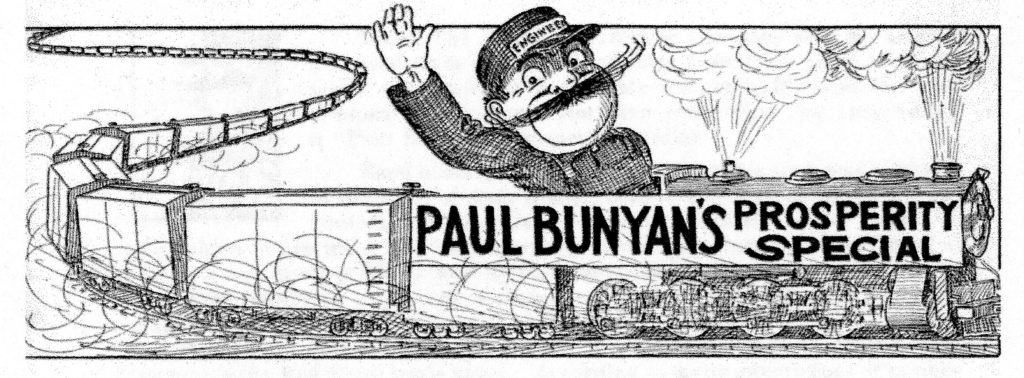
The next morning at Westwood the festive mood from the day before continued. Red River unveiled its impressive Paul Bunyan Prosperity Special train. This was no ordinary train for it consisted of 171 carloads of manufactured lumber, along with six locomotives and a caboose. The Prosperity Special measured 8,325 feet long—one and six-tenths miles. It was, one of the longest, if not the longest string, of loaded cars ever handled in one train movement at the time. Equally impressive, it was the single largest shipment of lumber products ever made and that came from one plant—Red River. The train contained 4,350,000 board feet of lumber, box shook, plywood, sash & doors, etc.
There was a tremendous amount of logistics involved to make the event happen. Red River had to coordinate with its customers to place their orders at the same time and they had to agree on a specific date. This was a challenge since winter was fast approaching and the demand for lumber would decrease. Yet, their customers supported the effort, and orders came from twenty-one states—ranging from Arizona to Tennessee to New Hampshire. As Arthur Curtis James, Chairman of the Board of the Western Pacific proclaimed, “There never was a train like this before in all the world.” Willis Walker stated: “The movement of this unusual volume of lumber products at this time demonstrates confidence on the part of consumers and indicates that conditions have stabilized and that a considerable volume of building hitherto postponed, will now proceed.”
Three weeks later the train pulled into Castle Rock, Colorado, its final destination. However, when the train arrived in Denver, most of the railroad cars were split up and went to a multitude of destinations.
Spread the word, and encourage a friend to subscribe
The Hog Flat and McCoy Flat reservoirs were constructed in 1889. It was part of a plan engineered by Benjamin Leavitt, who built his first reservoir on the Susan River watershed in 1875, known today as Leavitt Lake. These three reservoirs are owned and operated by Lassen Irrigation District.
Spread the word, and encourage a friend to subscribe