The Lassen Townsite was a massive subdivision created in 1912 encompassing everything from Richmond Road to present day Johnstonville Road.
The first housing development occurred in 1918 on property south of the railroad encompassing the streets of Modoc, Orchard, Plumas, Shasta and Sierra. These homes were built by the Lassen Lumber & Box Company for their employees.
Shasta Street, April 15, 2020
A word of caution, the crossing over the above intersection can be hazardous to your car’s health and your mental health. As I proceeded across, a major dip in my Triumph it removed the exhaust system from it.
Susanville’s second Bank of America building was a short-lived affair of the 1970s. When it opened in 1972, it introduced area residents with a new venue—a drive-up teller. It did not turn out so well. The problem was the Main Street entrance. Cars would be backed up into the right hand lane. Finally, it was not until the summer of 1978 when the bank corrected problem where customers would use an entrance from North Gay Street.
The experiment was short-lived. In 1979 Bank of America made preparations to replace that building with a new bank on the corner of North Gay and Nevada Streets. In 2017, Bank of America closed its Susanville branch.
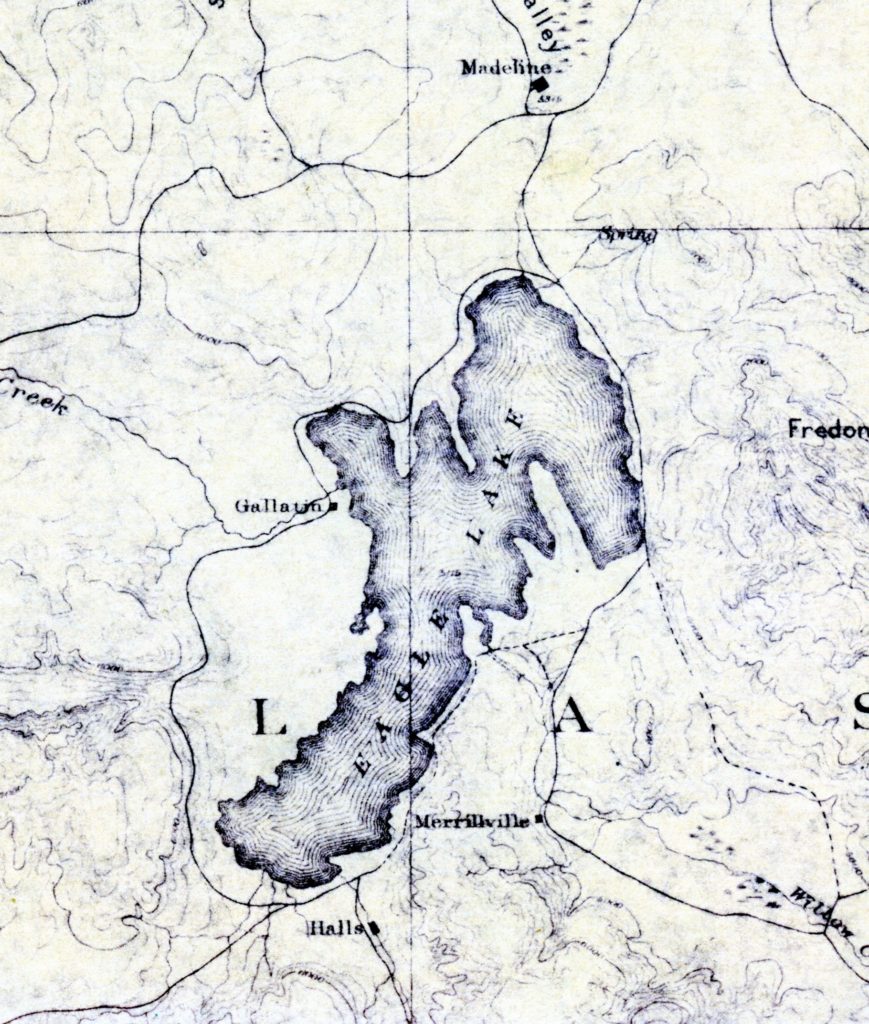
The original map has color, the reprint of the book does not.
In 1882 saw the publication of one of the first histories of the area—Farris & Smith’s History of Plumas, Lassen & Sierra Counties. It was subsidized by selling biographical sketches for $75 to be included in the book. It should be noted the Lassen County segment was done by E.R. Dodge. Dodge remained in the area after the publication and even obtained a law degree. He was a major figure in the Eagle Lake Land & Irrigation Company of the early 1890s, that among other things was successful to pump water out of Eagle Lake and flowed all way to Amedee on the east side of Honey Lake.
Anyhow, I thought some might enjoy the map that appeared in the book. Of course, a lot of changes have occurred and notice the absence of man-made lakes such as Lake Almanor.
A view looking east from the head of Susanville’s Main Street, 1938.
When the State of California took over Susanville’s Main Street, in 1933, which is a part of Highway 36, everyone was at the mercy of the State who dictated how the thoroughfare would operate. For a long time it was not an issue.
In the 1940s, there were changes on the horizon. There was a great deal of traffic congestion in the uptown area. In 1947, the City proposed two stop lights—one at Lassen and the other at Weatherlow. When the State Division of Highways learned of this, they objected, citing it did not meet the requirement of 100 cars per hour at those intersections. The State wanted to discontinue angle parking for parallel. The merchants howled. The change would eliminate parking by fifty percent.
The issue turned ugly when the state approved the change. The city adopted a parallel parking ordinance at their July1950 meeting. The city was concerned if they did not enforce it, the State would with hold the city’s apportionment of gasoline tax money. Lowell Hardy of the Golden Rule store, suggested the city did not need such wide sidewalks—they could be narrowed on each side and there would be ample room for four lanes and angle parking. It remained a contentious through 1952, which by that time parallel parking was here to stay.
This was a unique piece of legislation, that in certain ways attempted to correct the problem of the Timber & Stone Act of 1878. It was designed specifically for the U.S. Forest Service to consolidate holdings due to the fact that many of the forest service lands were intermingled with private holdings, most of which were held by lumber companies. Once the timber was harvested by the lumber companies, those lands in their opinion, along with the county tax assessor were deemed worthless. To provide a way for the forest service to obtain them, they could offer timber land, and in many cases, rights to timber for a purportedly equal value. This process created the Lassen National Forest we know today. In the future, we will examine some interesting exchanges, one of which is why the south shore of Eagle Lake is public, not private land.
Spread the word, and encourage a friend to subscribe.
A Red River Lumber Company timber cruiser—Hank Martinez
Most of the timberlands in Lassen and Modoc Counties were acquired by a federal land patent known as the Timber & Stone Act of 1878. This Congressional Act allowed individuals to purchase up to 160 acres at a minimum of $2.50 per-acre without being subjected to preemption and homestead laws.It was designed to prevent timber companies and speculators from obtaining large tracts of timberlands, it had, in reality, exactly the opposite effect.
In 1902, the United States Government Land Office created a land rush when it offered Northern California timberlands for sale on the open market. Newspapers in Northern California featured stories how “timber grabbers get all they want.” As the Portland Oregonian wrote: “It is also evident to most people that the present methods of handling our timberland will soon result in putting them all in possession of the lumbering corporations or speculators.”
In 1903, 88,000 acres—primarily timberland—had been added to the Lassen County tax roll. In the spring of that year D.G. Curtis and T.D. Collins of Pennsylvania were buying individual 160-acre timber tracts west of Eagle Lake. By the end of May they owned 41,461 acres of timberland at a cost at $189,410. The property became known as the Collins Tract which was transferred to the Pennsylvania Lumber Company, which had no immediate plans for it, other than speculation.
First of all, some readers might have missed this post from last month, due to technical issues. You can read that post here. In summation, the mountain was named for the Shaffer Brothers—Peter J.and Uriah. When they departed the Honey Lake Valley in 1868 there whereabouts were unknown. It should be duly noted, in many instances, then and even today, former residents passing are chronicled in the local press. That was not the case with the Shaffers. Thanks to David Zoller he did some sleuthing and found that the two men by 1880 became fruit growers in Los Angeles County where they both died in the early 1900s.
While national news headlines occur nearly daily about the removal of statutes commemorating Confederate leaders, I thought I would provide a brief glimpse of some Civil War matters that occurred locally in the 1860s.
The Honey Lake Justice Court case files provides an interesting glimpse. There were three note worthy cases that appeared on the docket. The first involved Charles Mulkey. On November 9, 1863, Mulkey was noted for his open and boisterous cheering on the streets of Susanville for Jefferson Davis, President of the Confederate States. Criminal charges were filed against him. He pled guilty and was fined $25.
Meanwhile down in the Tule Confederacy, now better known as the Standish district, matters became a bit more turbulent. The region was experiencing quite an influx of settlers, causing boundary disputes and claim jumpers. DeWitt Chandler had his problems with these skirmishes with his neighbors George and John Purcell. The first incident occurred on December 22, 1863 when George Purcell was burning tules when the fire spread and destroyed one of Chandler’s haystacks. It was Chandler’s contention that the fire was intentional and related to Purcell’s loyalty to the Confederate States. Purcell was arrested and brought to trial where a jury found him not guilty. The following spring John Purcell set fire to Chandler’s house, claiming it a victory for the Confederate States. However, there is no record of the results of the charges of the incident. Yet, there is an irony in the tale and that is in August 1864 John Purcell lodged a complaint with the District Attorney seeking the arrest of John H. Harbin who publicly denounced the United States and proclaimed allegiance to the Confederate States.
Spread the word, and encourage a friend to subscribe
One never knows what lurks in the archive files. I thought some might be interested in the above bill. It should be noted what we might refer to as a grocery store today, was better known as a mercantile store. Most carried “dry goods” and very little perishables, as this was before refrigeration. Neil’s Mercantile at Standish and Heard’s Market in Litchfield were among the last of its kind. However, there is Winje’s Emporium in Doyle that in its century old building has that rustic charm. Let’s not forget, when you are headed north stop in at Adin Supply.
Since this is Sunday of the Fourth of July weekend, I will keep things light. The Lucky Land of Lassen slogan was developed for the Panama Pacific Exposition held in San Francisco during 1915. The above was the reverse of H.R.T. Coffins business card that he more than freely handed out in the California Building of the Exposition. Coffin was the official representative for Lassen County. It was a clever way to highlight some interesting facets of Lassen County.