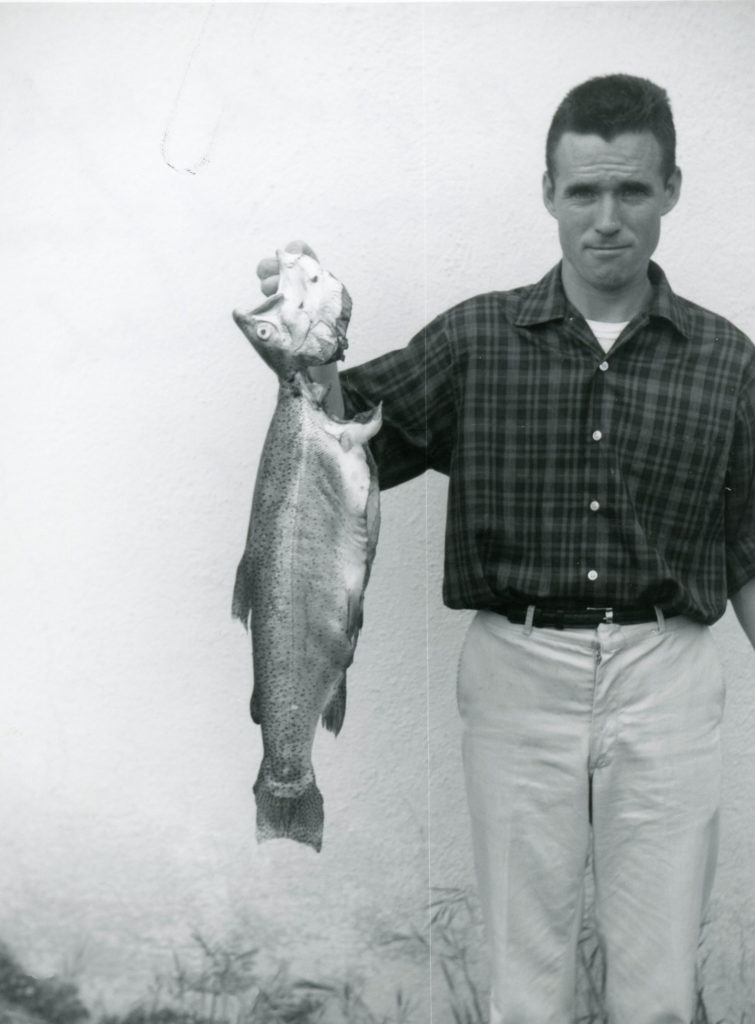
James Stokes holding “Old Lady of the Lake, a 8 pound Eagle Lake Trout caught in 1961.
On May 2, 1961, California Department of Fish and Game personnel located an unusual female Eagle Lake trout, that they dubbed Our Lady of the Lake. One reason that it was unique was its age–eleven years! The fish had been trapped twice and taken to Crystal Lake Hatchery to be spawned. Another interesting antidote was Fish and Game reported that this fish had been reared and fed in captivity for seven years, and then it was able to adapt itself to the natural environment of the lake. When it was first caught the fish weighed one and one-half pounds and was 18 inches in length and when they released finally released the fish back into the lake, the fish measured 26 inches and weighed eight pounds.
Goodrich crossing and reservoir in 1914. Minnesota Historical Society
The winter of 1923-24 was extremely dry. By the spring of 1924, Westwood’s water supply was in peril. In May, Duck Lake, the main water source for Goodrich Creek, which was Westwood’s water supply went dry. On May 10, Fletcher Walker the resident manager of the company town wrote “The water supply for the Town is failing us quite rapidly and it is now a race to get water from Clint’s Camping Ground Spring [Clear Creek] before the Goodrich Ditch water fails us. We are running the Town on meal hours so every one can get water for their meals and then closing it off. To do this requires water taken from the millpond. We are sure up against a real dry season as indicated by the Buck Brush and Manzanita leaves curling up and turning black. Springs that have heretofore been dependable are failing.”*
*As Walter Luff Jr., recalled during the 1924 drought they used the millpond water to bathe with and he stated the water tasted like turpentine. Relief came in the summer, when a pipeline was placed to bring water from Clear Creek to Westwood.
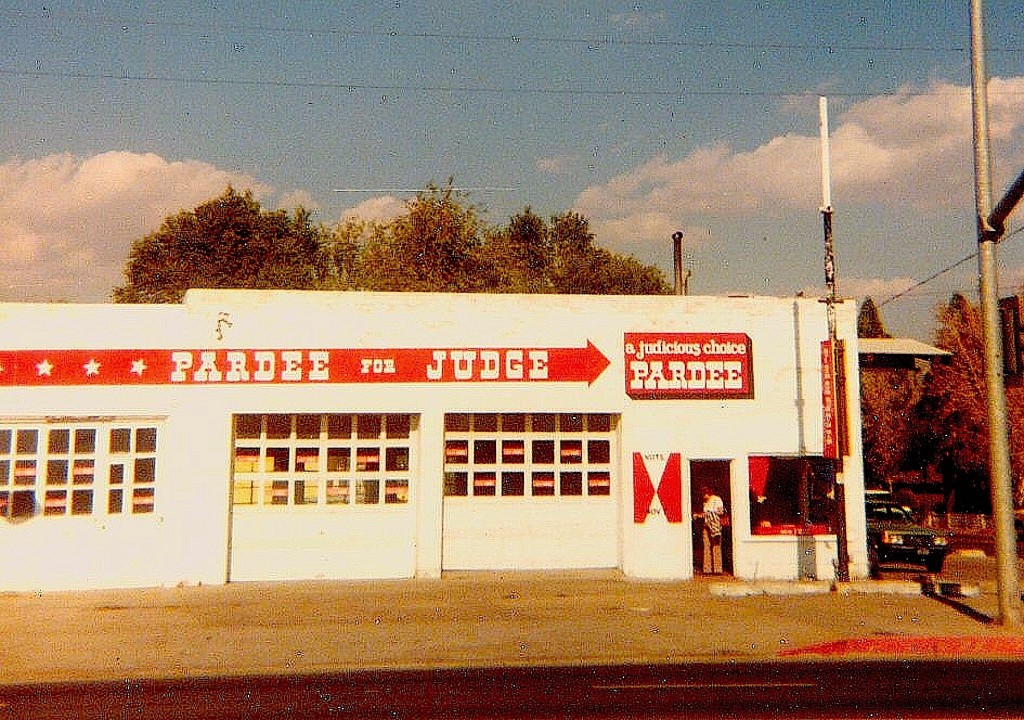
Pardee campaign headquarters, Main & Ash Streets, Susanville, October 1978
On April 28, 2015 the first hurdle of the permit process was made for the construction of a 17,400 square foot Rite Aid store. The store, along with the parking lot would encompass the entire of north side of 1600 block of Main Street. Of course, this site was the former home of Potter’s Maternity Home on the corner of Main and Park. In 1966, United California Bank took over this location and constructed their bank, which held an open house of February 27, 1967. It has housed a number of financial institutions since then. Of course, on the corner of Main and Ash was Baxter’s Flying “A” Service Station. After it closed, for a brief time in 1978 it housed Jim Pardee’s campaign headquarters for Lassen County Superior Court Judge, and then was subsequently torn down and now a part of the Rite Aid parking lot.
The Rite Aid was short-lived and and closed it doors not quite ten years of operation.
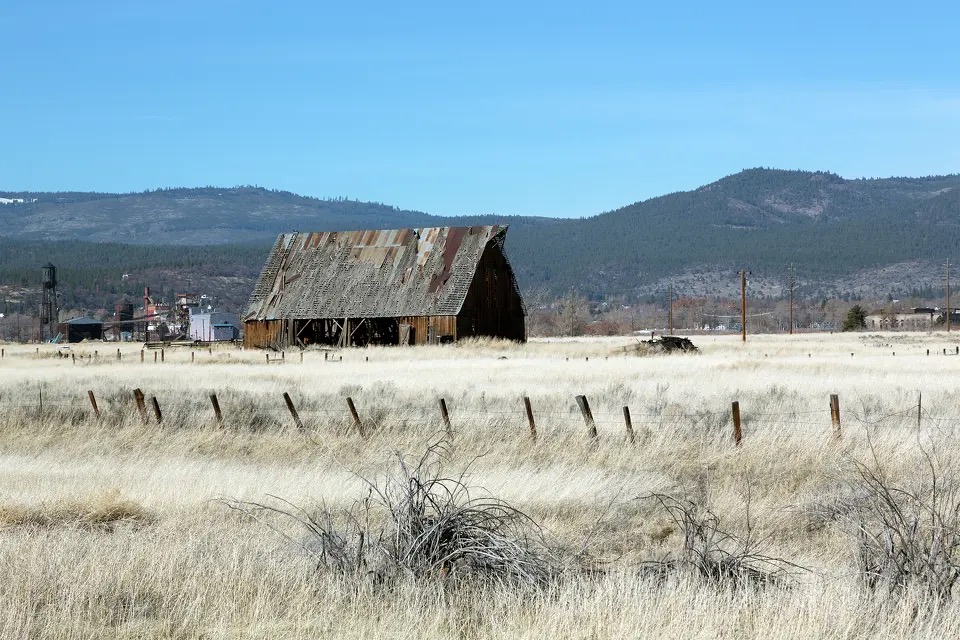
Recently, the SF Gate [San Francisco] published this photograph of the old Fruit Growers barn on east edge of Susanville. It was accompanied by an article ab out the return drought conditions for California. It should be noted the barn was destroyed by fire in June 2015. It is my understanding, and some one may correct me on this, but is the current site of the proposed Love’s Truck Stop.
Fruit Growers’ Susanville mill.
My adventures on my Reno stay have been memorable for on the wrong reasons. If all goes well, by next Sunday, May 3, I will have returned to Susanville in a new living arrangement and new neighborhood.Next Sunday, I should have more information.
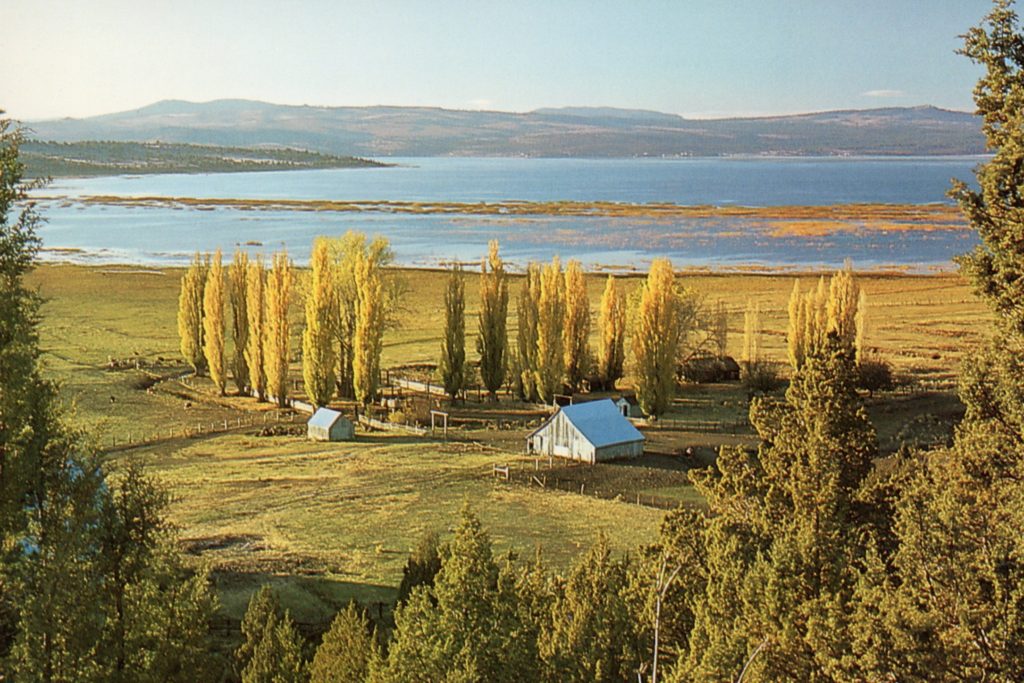
The Stone Ranch at Eagle Lake is one of the best known ranches in the basin. However, in a different era, it was better known as the Troxel Ranch. In the mid-1880s on the northeast side of the lake, featured a lot of new residents and area was dubbed the Butte Colony, as these folks came from Butte County, California. The Troxel family was a part of this enclave. On December 12, 1888, William H. Troxel purchased William S. Davis’ 430-acre ranch on the northeast shore of Eagle Lake for $3,000. In 1918, William and Rosanna Troxel, who where in their mid-sixties, opted for retirement and moved to San Diego. They subsequently leased the ranch and on February 15, 1926, they sold the ranch to Coit and Laura Stone.
In 1926, W.H. Troxel sold his ranch on the north shore of Eagle Lake to Coit and Laura Stone.
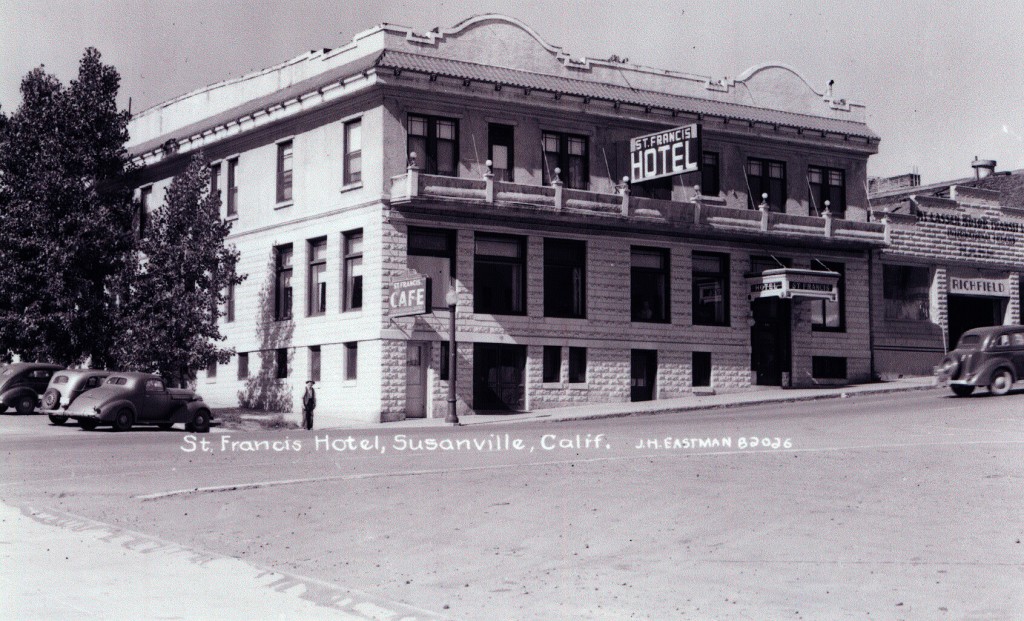
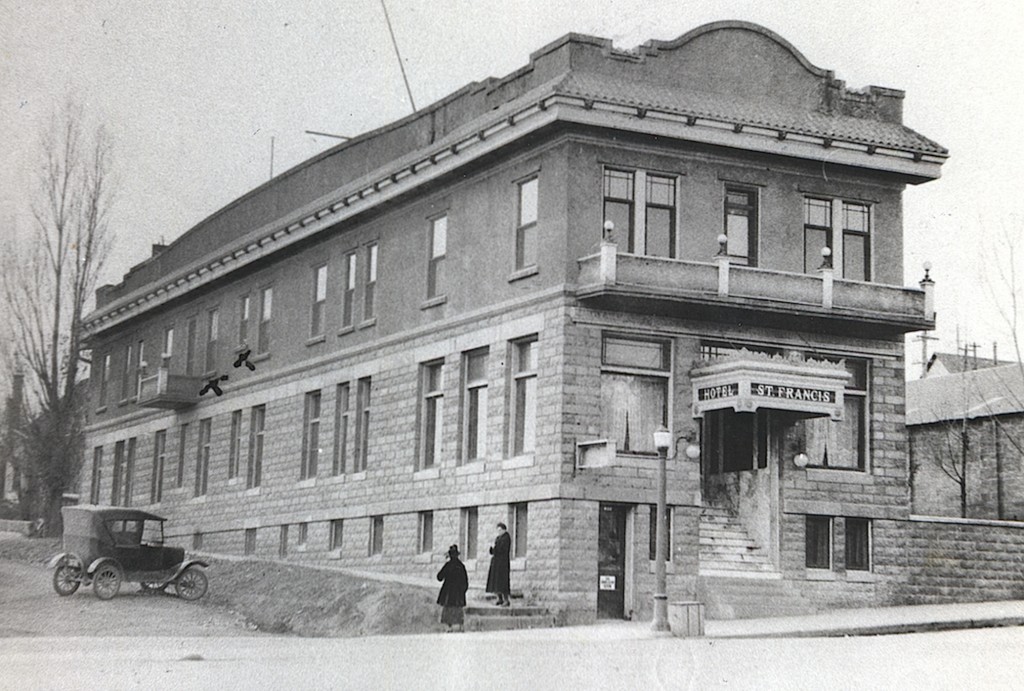
In 1914, Franceska Neuhaus commissioned the construction of the St. Francis Hotel on the corner of Main and Union Streets. After her passing in 1918, her son and daughter-in-law, Bill and Flora Neuhaus took over ownership.
St. Francis Hotel, circa 1919. Courtesy of Art Almeda
During the 1920s, Susanville’s population nearly tripled. Hotel accommodations were scarce, especially after the Emerson Hotel was destroyed in a 1915. In August 1925, the St. Francis Hotel announced its intention to construct a three-story addition. While it added only an additional nine rooms, it allowed for the lobby to be enlarged, as well as the restaurant facilities. The $25,000 project was constructed by the firm Woodward & Grebe, It should be noted that noted Nevada architect, Frederick deLonghamps designed the original hotel, as well as the addition.
The Belfast District, 1898. It was to be the center piece of Merrill’s reclamation project.
In the early 1870s, when Captain Charles A. Merrill proposed to tap Eagle Lake, he found it necessary to have Congress pass a homestead act that focused on arid lands, as nothing existed. Thus, on March 3, 1875, Congress approved the Lassen County Desert Land Act. Under the Act, an individual could claim up to 640 acres of government land. They had two years to reclaim the land by irrigation, and then could purchase the land from the government for $1.25 per acre. Residence on the land was not a requirement. It proved so popular that in 1877, Congress approved the Desert Land Act, which covered all arid lands in the western United States. The latter Act has had a lasting impact, and is still one of very few homestead acts in existence. In the 1980s when Franklin Jeans proposed his water export scheme of the groundwater on the Nevada side of the Honey Lake Valley, he used the Desert Land Act to increase his holdings and to put more wells to accomplish that goal.
Antelope Grade first came into existence in 1867 when a crude wagon road was constructed. Crude was a very appropriate term. With the increased population growth in Big Valley, the traveling public clamored for improvements to the grade. In the fall of 1878, the Lassen County Board of Supervisors sent a survey crew to plot a new road on the mountain. The county estimated the cost of the new grade at $1,000. Of that amount individuals had already contributed $300 to the cause. The county budgeted $300. The county stated the balance would have come from donations. A campaign to raise the funds from Big Valley and Hayden Hill provided the balance. By the summer of 1879, most of the work was completed, with volunteer labor making up the workforce.
While new grade was superior to the original one, it was still a narrow, treacherous road. Of course, accidents were a rather common occurrence. In November 1890, for instance, Lewis Knudson was returning to his Willow Creek home accompanied by Dave Thomas. Half way up the grade, they encountered William Brockman’s freight team. Knudson pulled his brand new spring wagon over to the edge of road as safely as possible. As Brockman’s team passed by, it spooked one of Knudson’s horses where the animal bolted and jumped off the grade, dragging the other horse and wagon down the mountain. The sudden jolt, threw Knudson out of the wagon, but fortunately he did not sustain any injuries. However, Dave Thomas was not as lucky. It was not until the wagon crashed into a large boulder that it came to an abrupt stop. At the point of impact, Thomas was thrown from the wagon, his left shoulder struck a rock and was dislocated.
In the mid-1880s, the grade received its first impromptu rest stop. About three-quarters up the grade, after road goes through a narrow canyon passage, dubbed “The Spires” is small level area containing a spring. A water trough was constructed and it provided a nice respite for the traveler and more importantly for their horses.
However, it would not be until the 1940s, when the current grade was built, and stayed tuned for that post.
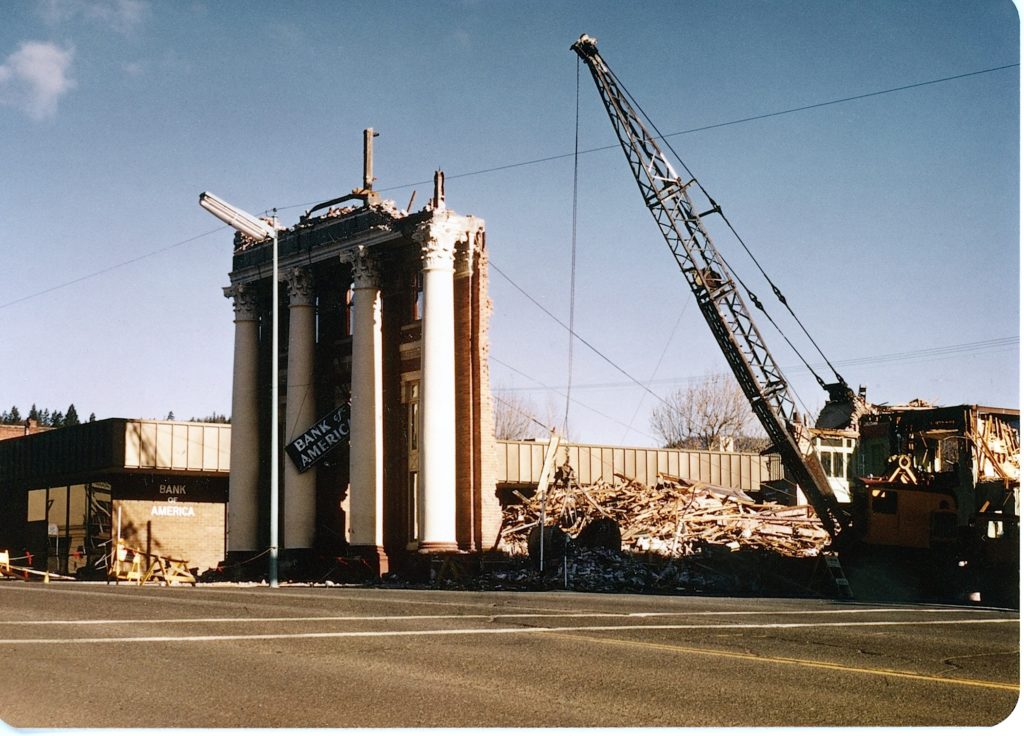
Seasoned residents of the Susanville region will recall the spring of 1971, when the Bank of America building at Main and North Gay Street was demolished. Many in the community had not recovered from the demolition of another iconic building the original Lassen High School, which was torn down in June 1968 for the current campus buildings.
Lassen County Courthouse and Hall of Records, 1907. Courtesy of Gil Morrill
In 1915, when voters approved a bond measure to build a new county courthouse, no time was wasted to construct the same. The new courthouse would be built on the site of the existing one. However, when James McCaughlin’s bid was accepted to construct the courthouse, that detail was omitted.
George Sellon, the architect was brought in as a mediator. It should be noted that old courthouse would still be used, until the new one was constructed. Sellon drew up the specifics and cost to move the old courthouse to the east along South Lassen Street. The cost $350.00. At the September 1915 meeting of the County Board of Supervisors the matter was approved. With that issue resolved, work began on the new courthouse.