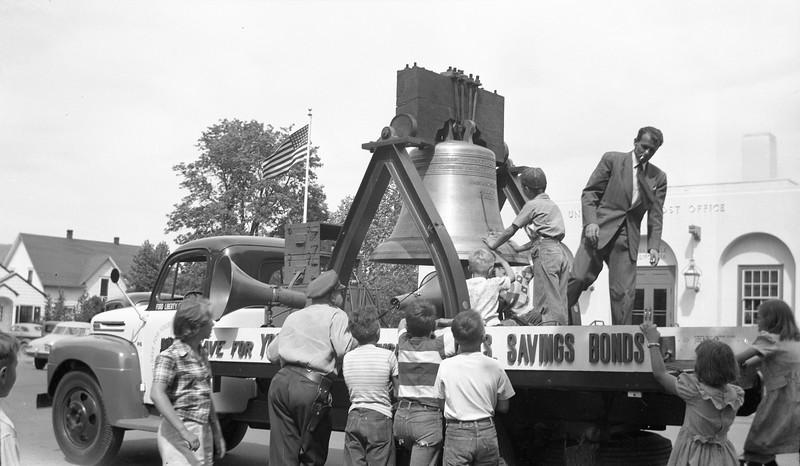
A Liberty Bond Float, Lassen County Fair Parade, 1944 – Margaret Purdy
Happy Veterans Day to all the veterans out there. I came across this Lassen County Fair parade float for the purchase of Liberty Bonds during World WarII. My maternal grandmother Lola (Murrer) Tanner (1899-1973) purchased the Liberty Bonds every month during that War.She never redeemed them. It was a nice windfall for her three daughters, as the bonds paid for the inheritance taxes for the ranch estates. That is not typo on estates. My grandmother was a savvy businesswoman, but she never finalized my grandfather’s John Tanner estate who died in 1945.
This may be somewhat of a public service announcement, but do you have a will or trust, and a obituary? Your heirs will thank you if took care of business.
The Charles Hartson ranch house, circa 1915. Courtesy of Dorothy Stone
The Hartson Slough is man made, named after Charles Hartson. In 1881, Hartson filed on 160 acres of sagebrush land near Honey Lake, in the Tule District. However, Hartson needed more water to not only reclaim this parcel but to expand. In 1889, Hartson worked as the construction superintendent of the Ward Lakes Reservoir. Hartson made a deal with the Balls Canyon Reservoir Company, the company behind the project, that, for a portion of his services, they would give him a share of water rights. This gave Hartson the water he sought to reclaim his land. He built the slough to convey the water to his ranch. By 1901, Hartson owned 1,500 acres of land, half of which was planted in alfalfa. In that same year, Hartson & Sons ranch was one of the first in Lassen County to incorporate..The incorporation document is unique that normally a town designated as the principal place of business. Hartson & Sons stated “that the business to be transacted shall be at the farm headquarters on the lands owned by this corporation near the shores of Honey Lake.”
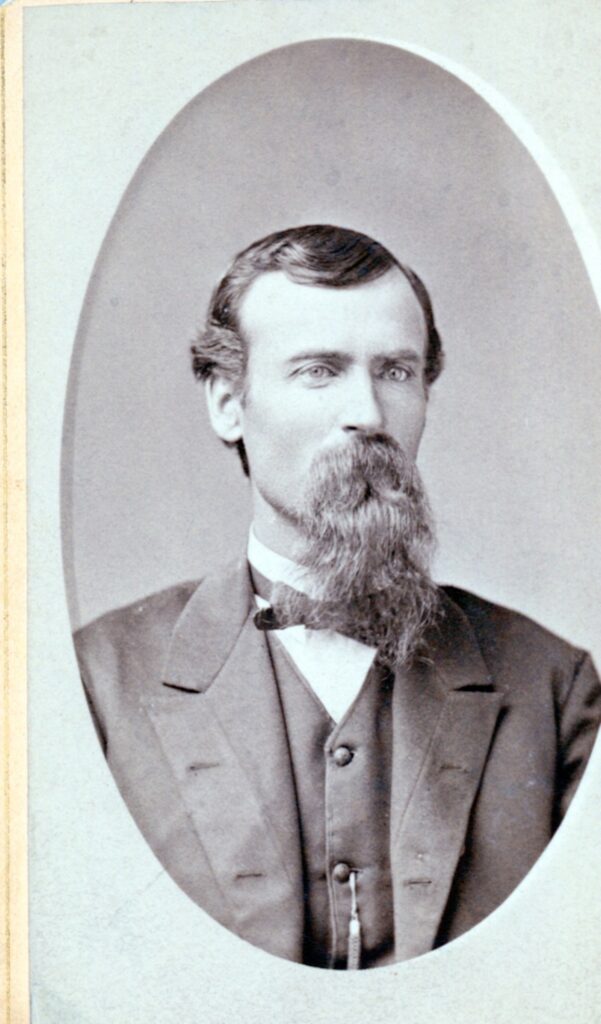
Hartson Barn, July 26, 2019
It was Honey Lake that resulted in the downfall of Hartson Ranches. In 1909, they were heavily invested in the Standish Water Company.That company built a pumping plant on Honey Lake with miles of irrigation canals. The patriarch Charles Hartson retired in 1910 and moved to Susanville. He turned the main ranch over to his son, Frank Hartson. Frank Hartson sold out Frank Wood in 1926. The house was destroyed by fire on May 4, 1935.
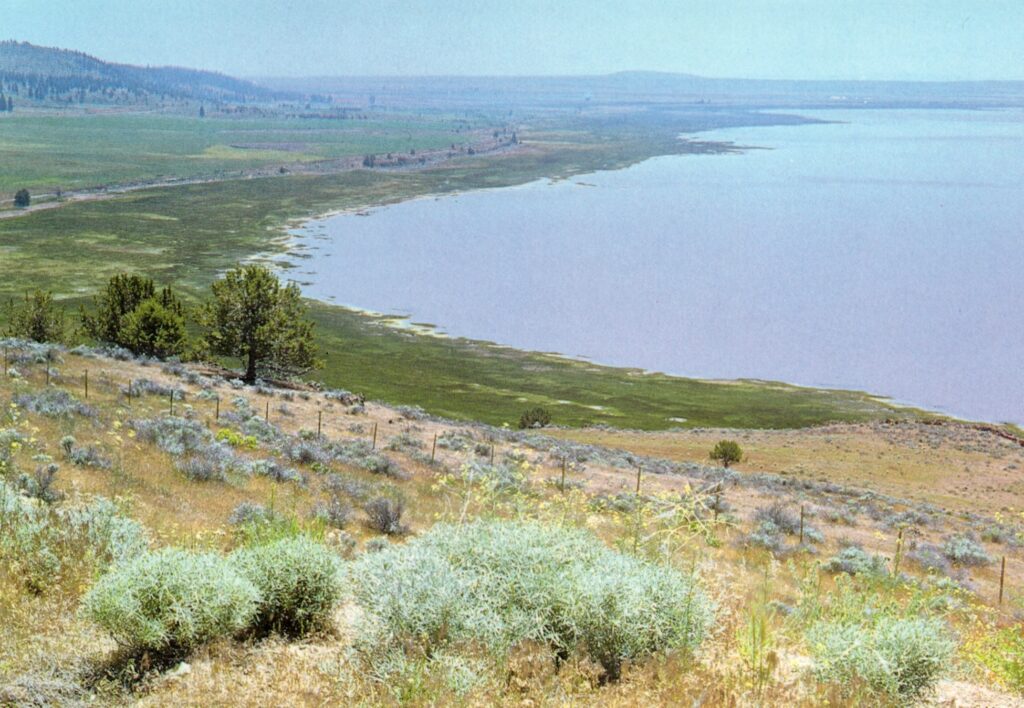
Goose Lake which straddles the California and Oregon border could be consider Honey Lake’s distant cousin, thrice removed. It was not all that long ago, that it was finally declared a closed basin. That reference that the lake has no outlet. However, it had an outlet at one time, and when it overflowed to the North Fork of the Pit River. Some records indicate that the last time it happened was in 1881.
In the late 1860s, when settlement began in the Goose Lake Valley, water was diverted for irrigation never reaching the lake. The lake is shallow, having a maximum depth of twenty-four feet, similar to Honey Lake. In times of drought the lake dries up.
Just like Honey Lake, Goose Lake had its own ferry boat the Lakeview. It was launched in 1909, in part of the promotion of the Oregon Valley Land Company, which is an interesting tale in itself. The ferry ceased to exist in 1924, when the lake went dry.
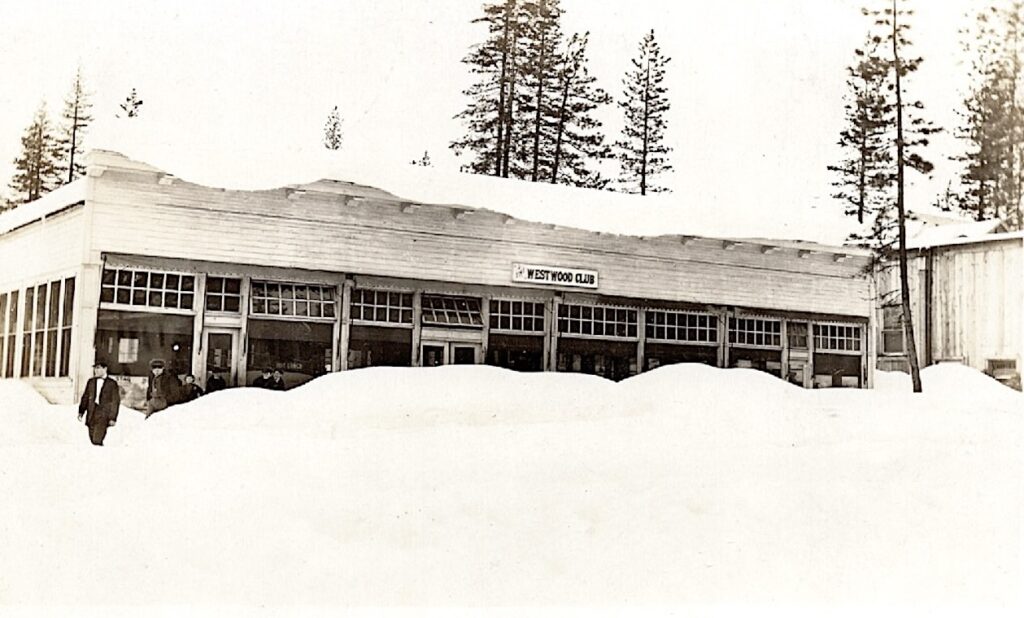
Company town’s such as Red River Lumber Company’s Westwood, in a rural setting had its challenges. To prevent labor turnovers, recreational outlets needed to be provided. However, this one amenity was not a cure all. In the 1920s, with affordable automobiles and improved highways laborers had an upper-hand in mobility. One of Red River’s earliest endeavors in its newly constructed town of Westwood, was aptly the named the Westwood Club. This institution included a restaurant, lunch counter, soda fountain, cigar and newsstand, a barbershop, reading room and a billiard room. While many enjoyed the Club, it did prevent Red River’s high turnover rate with employees, or with management. If there was a bright aspect, that due to high volume of high traffic in and out of Westwood assisted in the construction of Highway 36 between Red Bluff and Susanville. It would also be catalyst to establish Highway 32 to Chico. The Westwood Club was destroyed by fire on March 31, 1944, the cause was never determined.
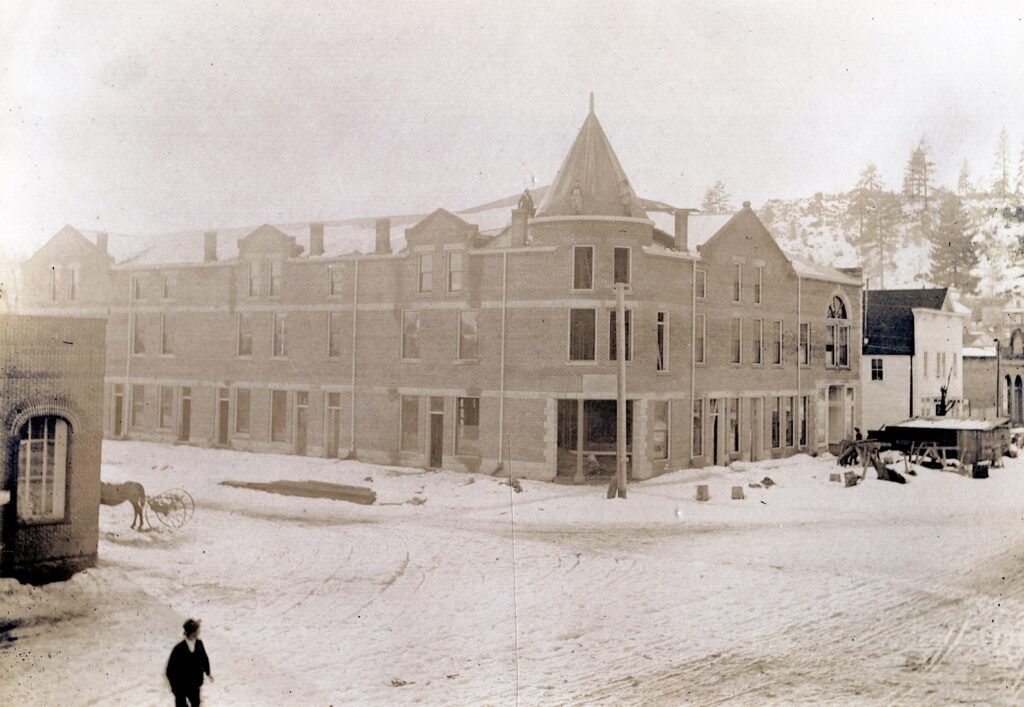
Emerson Notel under construction at Main and Lassen Street, Susanville, 1901-Mary Deal Folsom
I rescanned this photograph in hopes the new scanner features would be an improvement. I think it was a toss up. On the the other hand, newer readers might be interested about the Emerson Hotel, which would be later replaced by the Hotel Mt. Lassen.
In the late 1800s, one of Susanville’s prime property in its business district ,was the corner of Main and South Lassen Streets, that was never developed for its full potential. In June 1900, the Susanville business district consisting of south side of Main Street from Roop to Union Streets was wiped out by fire. It was a clean slate for rebuilding. Susanville entrepreneur, Charlie Emerson had a grandiose plan for the Main and Lassen Street location.
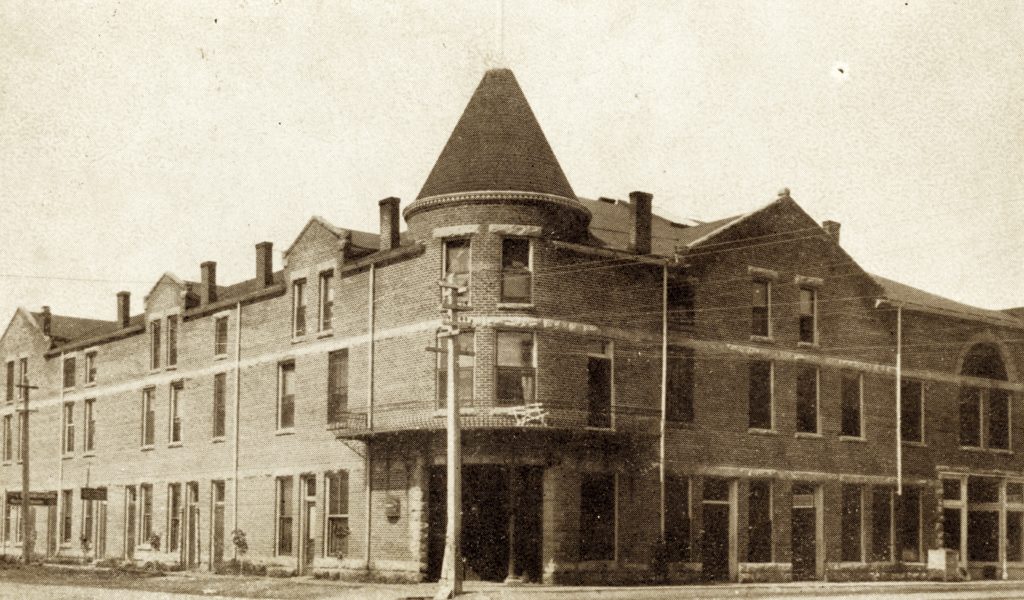
The Emerson Hotel located at Main & Lassen Streets, the current site of the Hotel Mt. Lassen.
On July 31, 1900 groundbreaking ceremonies were held for the largest most expensive building to be constructed in town to date. It was Emerson’s three-story hotel, encompassing a quarter of a block on the corner of Main and Lassen Streets. Emerson invested some $300,000 to construct and furnish the brick building that contained 27,576 square feet. The ground floor was devoted to commercial and the upper two floors contained 76 guest rooms. A grand opening was held on June 3, 1901, and The Emerson became the town’s premiere social hub.
Mark Arnold’s life was cut short. In late April 1898, he had an attack of appendicitis at Hayden Hill. He never recovered and passed away in Susanville on May 7, at the age of seventeen. A native of Susanville, and a grandson of the town’s founder, Isaac Roop, he was born on October 17, 1881 to Alex and Susan Arnold. He was laid to rest in the Susanville Cemetery, but there is no marker for his grave.
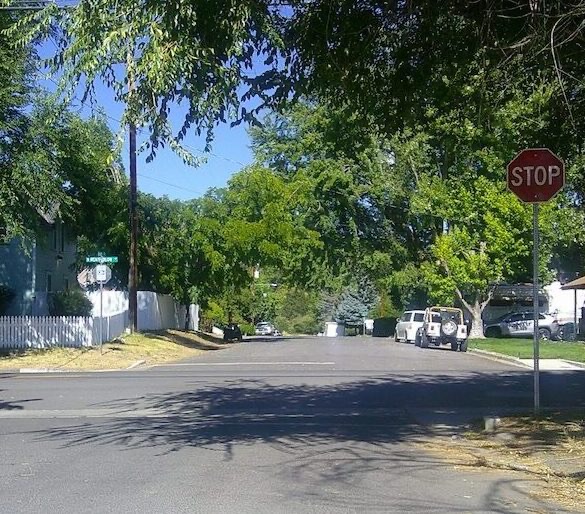
His family did finally remember him. In 1920. the Arnold family created two subdivisions just north of present day Memorial Park. There was Arnold Orchard Tract and the Arnold Addition. Separating the two, was one block long street between Grand Avenue to the east and North Weatherow. They named it Mark Street, in honor of Mark Arnold.
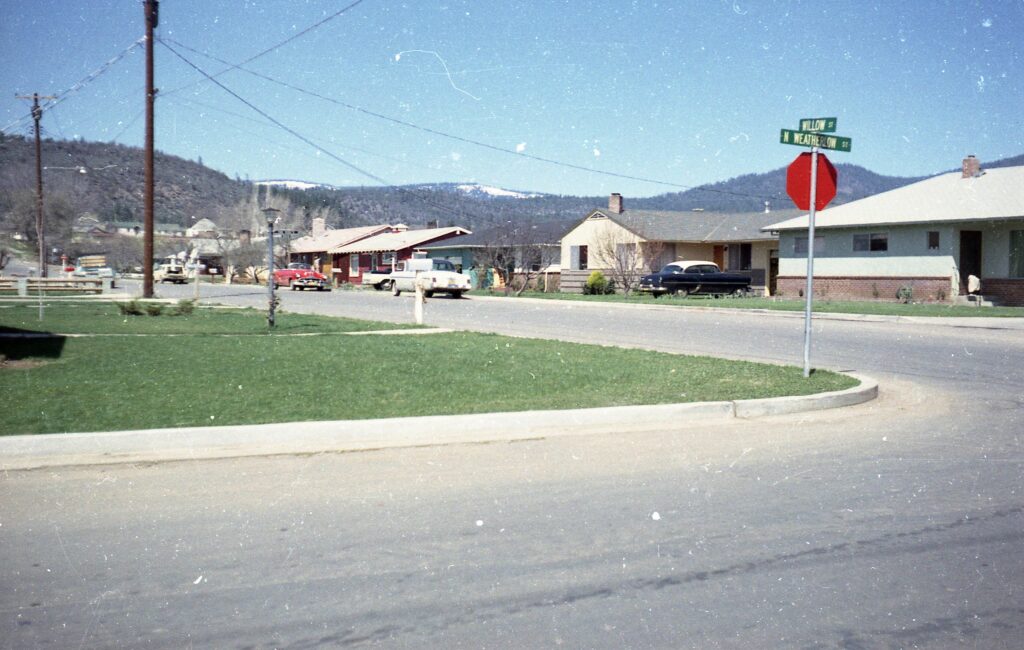
The intersection of North Weatherlow and Willow Streets, Susanville, 1960.
The street would double in length when on July 6, 1952, the City of Susanville approved the Compton Orchard Subdivision. The new subdivision created 51 building lots. Mark Street was extended by one block to connect with Parkdale Avenue. Other streets were extended as well, Arnold, Parkdale and Willow. A new street was created–Vista. Construction of the streets began in the fall of 1952.
In January 1899, the Nevada-California-Oregon Railway (NCO) after a decade of stalled construction announced its intention to construct northward. Of course, the rumor mill went into overdrive as to whether that route would include Susanville. The NCO stated it was to build onward to the Madeline Plains.
This event coincided with the recently organized Citizens Improvement Club of Susanville. E.V.Spencer and L.C. Stiles were appointed to negotiate with the management of the NCO, or in the instance the canterkous, Erasmus Gest, the general manager. They reported the meeting to be cordial, though the NCO was not going to extend any other assistance than what it had done in the past–nothing. The bottom line if the people of Susanville wanted to construct a feeder line to connect with NCO they would have to do it themselves. It was estimated that to build and equip the line would cost $100,000.
During the remainder of 1899, Spencer worked diligently for a railroad branch from Hot Springs (Wendel) to Susanville. Spencer consulted with the affected property owners along the proposed route to seek right-of-way. Spencer proposed that the line would not stop at Susanville but continue west into the timber region. He said this would create thousands of jobs in the lumber manufacturing business, and that everyone’s investment for the railroad would rapidly pay for itself. But it was a futile attempt. After all, the community could not even raise $450 for a town hall, let alone a $100,000..
With the upcoming holiday season, food plays a central role among the festivities. This advertisement from 1931 of Susanville’s Golden Rule store might be of interest to modern day grocery store shoppers.
The grave of Charles Gardner, Westwood Cemetery, 2013.
In August 2013, I conducted a Westwood Cemetery Tour. Since Westwood began as a company town of the Red River Lumber everyone worked together in a common goal.
With that in mind, in every operation, everyone plays an important role, as one cannot exist without the other. But before you can build a mill, first you need timber. That is where Charles Gardner, along with brother Irvine, better known as “Ippy.” The Gardner brothers, along with E.G. Scammon were part of the early California timber cruisers working under T.B. and Clinton Walker to not only examine timberlands, but also had the tedious jobs of going to a variety of county courthouses to examine land titles, so see who owned what parcel, values, taxes, etc. In a relatively short time frame of just over a decade Red River owned nearly 800,000 acres timberland in California making it the third largest landowner in California, only behind the railroads, who received their land for free from the government. Even after the Red River assembled its timberland, there was still plenty of work for the timber cruisers to do. Chief among them, was to plot out every year which sections of land that would be logged.
As it was in the past, timber is still part of Red River’s heritage, as certain heirs of T.B. Walker have retained their share of the timberland. It is now operating under Red River Forests, which is managed by Beaty & Associates.
Years ago, California counties each had several townships and they had a Justice of Peace and Constable. The justice court, then, presided over many cases such as minor infractions of the law. They also performed many marriage ceremonies and even presided coroner’s inquests when necessary.
On the November 3, 1914 ballot, there were seven candidates of Justice of Peace of Township No. 2 and they were: Clinton DeForest; Granville Pullen, T.T. Gross, R.R. McMurphy, Guy P. Thomas, Frank Alexander and Gilbert DeForest. The Lassen County townships, it should be noted did not have the same boundaries as the County Supervisorial Districts. Township No. 2 at that time included Janesville, Johnstonville and Secret Valley.
Clinton DeForest won election with 102 votes. Granville Pullen garnered 54 votes. When Pullen filed his expense account he paid $2.00 for candidate cards and $1.00 for Auto hire. In the total he put “$3.00 Fun”. Out nothing, got nothing. He stated that he had much fun on the campaign trail.
A final footnote. The salary then for the Justice of Peace was $25. a month and the Lassen County Superior Court Judge was $4,000 annually.


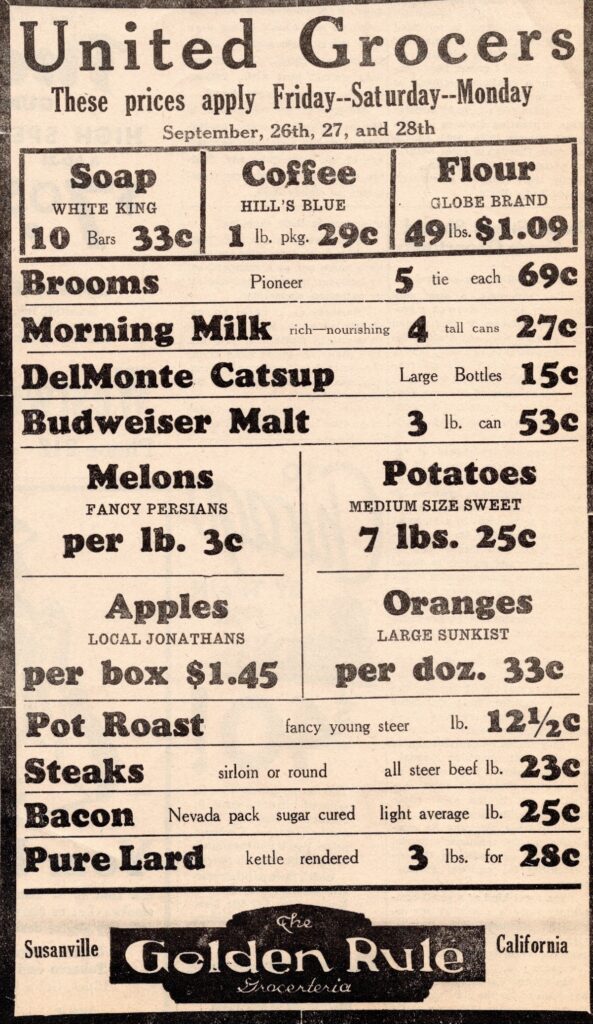 With the upcoming holiday season, food plays a central role among the festivities. This advertisement from 1931 of Susanville’s Golden Rule store might be of interest to modern day grocery store shoppers.