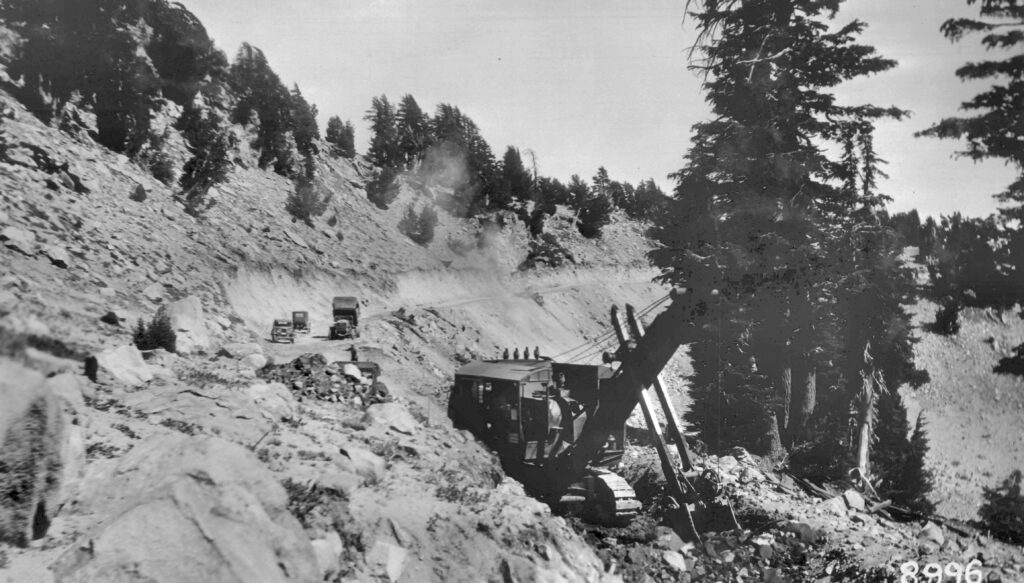
Construction of the park highway, 1930–National Park Service
California State Highway 89 is a bit of an odd creature in itself. One there are a number of segments wherein it is blended into other state highways. A perfect example is Highway 36 & 89 share the same roadway from just west of Chester to Mineral. While Highway 36 continues to Red Bluff, at Morgan Summit, just before Mineral, Highway 89 veers north through Lassen Park. The highway’s official designation through the park is US 1. Just as at the south entrance, when 89 leaves the park at the north entrance, it shares the same roadway with Highway 44. Just past the junction near Old Station, Highway 89 once again retains its own identity heading north towards Mount Shasta.
Of course, Highway 89 has this same quirky nature with shared highways on the southern end on the way to Quincy and beyond. A bit of road trivia for those road warriors over Memorial Day Weekend.
In February I received a request from Mark Hakvoort of Hollands Kroon, in the Netherlands. Their goal is to remember the
aircraft and crews perished there during World War II. You can learn more from their website here
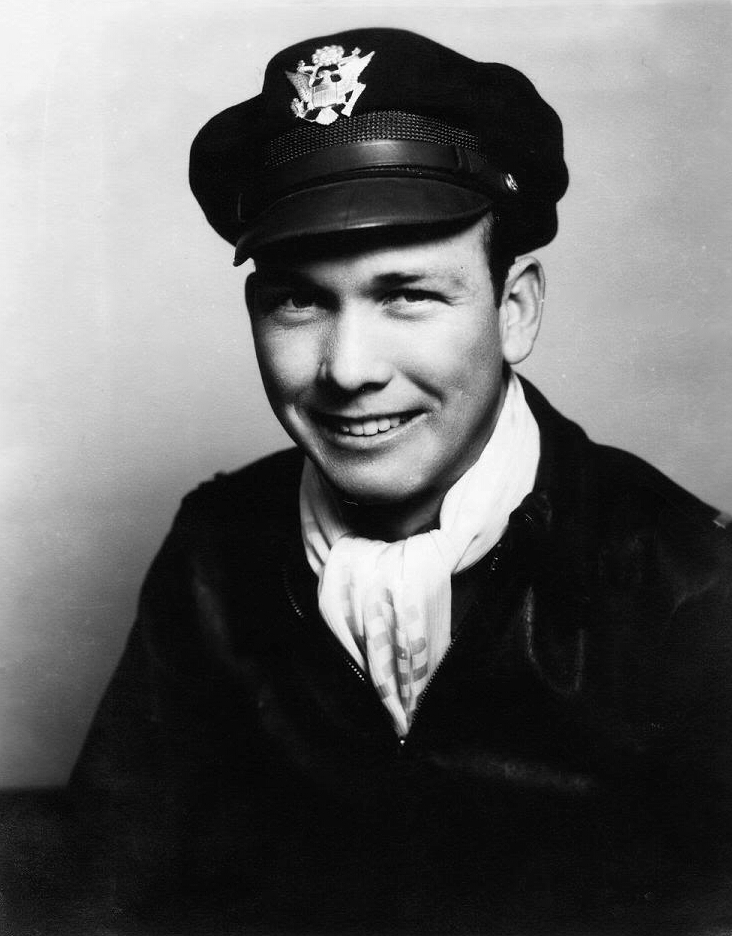
Hakvoort wrote: “We are searching for the grave of the USAAF pilot and his family at the Lassen Cemetery. B.A. Pollard was killed in action on 9 April 1944 in the Wadden Sea. His aircraft crashed / ditched in the cold sea water. The body of Pollard was washed ashore near the village of Hippolytischoef. His plane was the P-51B Mustang code 43-6761 C3-R. In the war he was buried at the “Zandburen Cemetery”. After the war his body was moved to the US assembly cemetery in Margraten. And later again moved back to the USA and re-buried at the Lassen Cemetery in Susanville.”
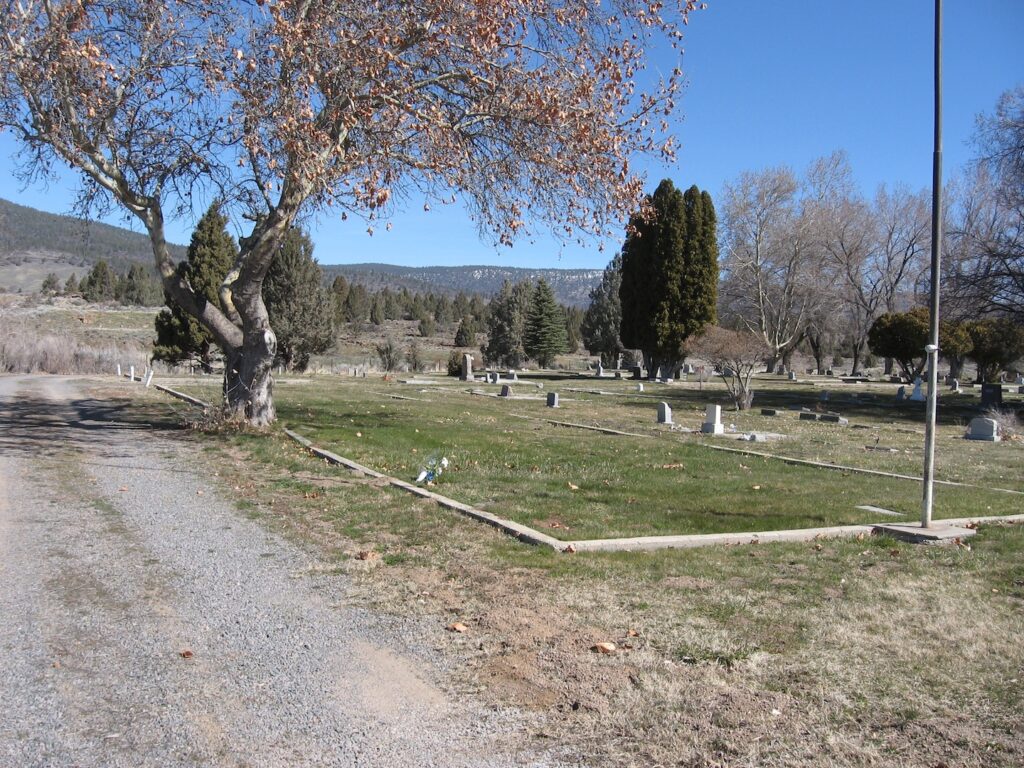
The Veterans of Foreign Wars plot at Lassen Cemetery where Pollard is buried. Match 17, 2024
Benjamin Pollard was one of eight children born to Silas and Frances Pollard. The family appears to moved around a lot and Benjamin graduated from high school at Beesville, Texas. By 1941 the family had located in Lassen County. Their daughter, Thelma graduated from Lassen Union High School in 1942. When Silas Pollard received notification of his son’s death in August 1944, the family was residing at Herlong. Silas passed away in 1955 in Susanville and the family purchased several plots at the Lassen Cemetery near the VFW Section. Buried there are Silas, Frances, their son Martin and daughter Thelma. One family member, Arabelle Lauren resided in Susanville for a number of years. If anyone has information about the family, Mark and I would like to hear from you. The foundation plans to hold a memorial for Benjamin Pollard in October.
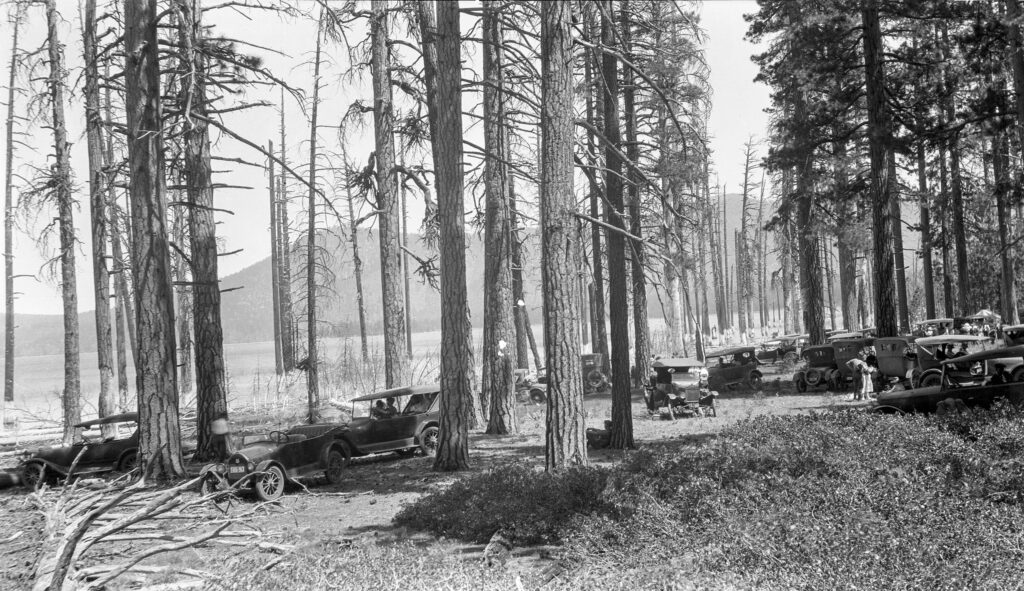
South shore, Eagle Lake during the 1921 water carnival—Ed Standard
During the 1920s, in the summer months the south shore of Eagle Lake was a busy place. It was not unusual for some events to attract two thousand visitors whether it be the lumber companies water carnivals or the local Elks lodge barbecue. This was long before campgrounds, so one setup camp wherever. At that time most of the property was owned by Malvena Gallatin—the forest service did not acquire these lands until 1947.
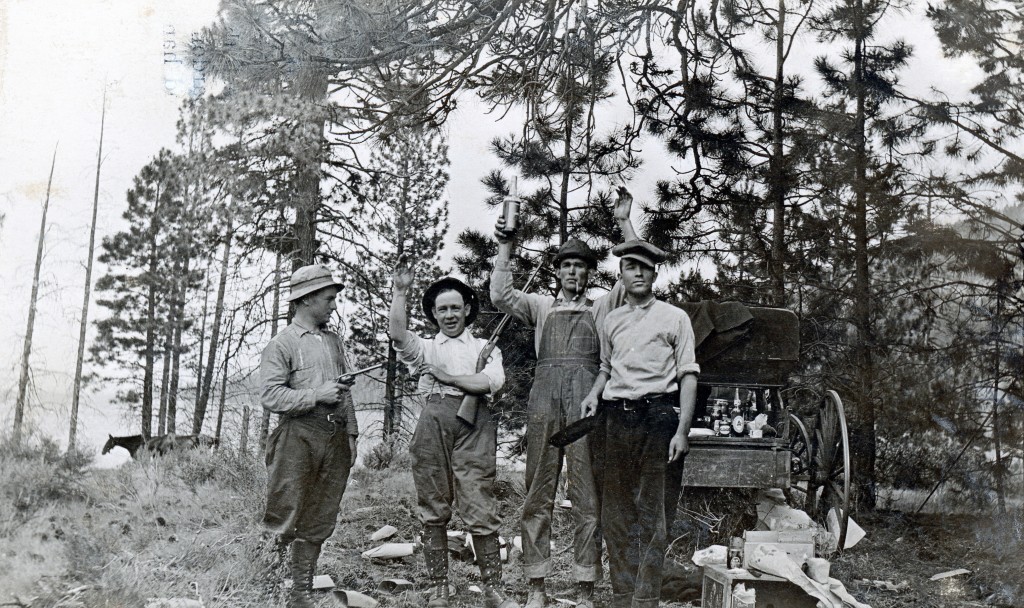
Happy campers at Eagle Lake, 1914.
In a 1924 letter Malvena Gallatin wrote: “It has always been my desire to preserve this beauty spot. It is well known that the public receives vastly more benefit and use of this shoreline property than I do. The public have been allowed access to these lands for camping, boating and fishing at all times. The Gallatin Beach and a large part of the shoreline property has been used for years by the public. It might be called a public playground, subject only to very mild restrictions.”
Recently, I have been in receipt of some photographs taken Harold Frodsham (1879-1958). Frodsham came to Westwood in the spring of 1920, while working for General Electric. Red River Lumber Company was retrofitting its powerhouse and building its Hamilton Branch hydro plant. Red River hired Frodsham originally as its efficiency expert, and was later transferred to various management positions, Frodsham did among other things was a lot of photography work for Red River at Westwood.
In the near future, these will be featured along with stories about the scenes in particular such as the Westwood Rod & Gun Club.
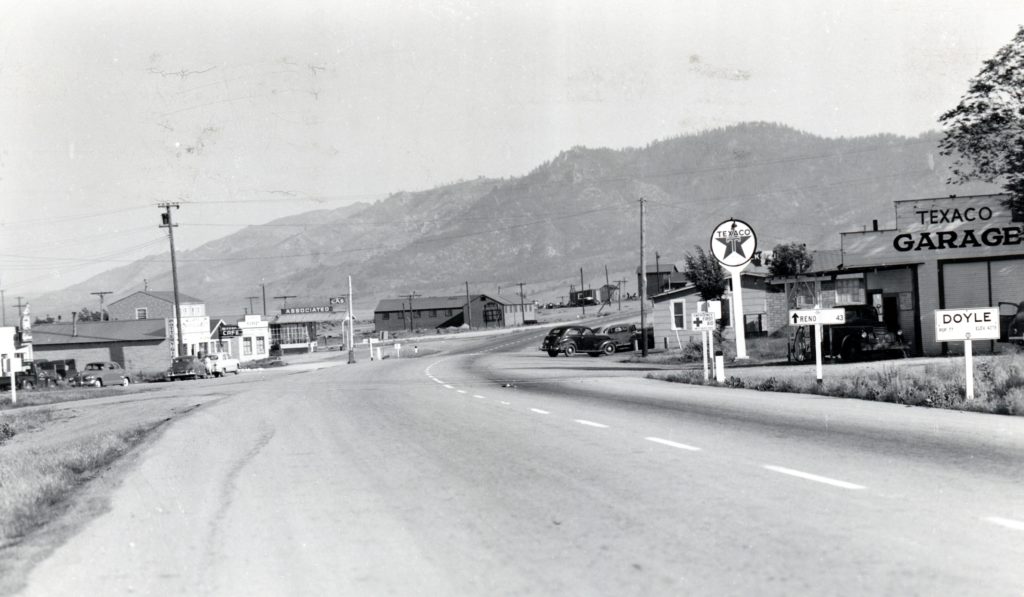
Doyle one of the many communities along U.S. Highway 395. Courtesy of Marie H. Gould\
With the approaching Memorial Day Weekend, heralds increased summer road traffic. Some driving behaviors never change. Today’s above title post came from the Lassen Mail of November 15, 1935, which all these years is still relevant. Note the speed limits, and the speeders of the day.
”Lassen County traffic officers at this time are apparently having a difficult time with numerous drivers in this area in regards to the confusion which exists over California’s speed limit.
”To clarify the situation and to save automobile operators from future trouble, it would be well to point out at this time that anyone driving more than forty-five miles per hour on the highway is liable to arrest.
””Many drivers are under the sincere impression that it devolves upon the arresting officer to prove that they were operating their car in a reckless or negligent manner, thereby endangering others. The case is really the exact opposite. It becomes necessary for the driver to prove that he was operating his car safely.
”While it is possible that in some cases a driver could successfully avoid punishment from the court, yet it is wise. to recall that few road or diving conditions warrant such speeds as sixty five, seventy or seventy five miles an hour.
”The proper attitude for any driver to take is to place safety before speed and common sense before horse power. In driving at excessive speeds and in even a slightly negligible and doubling the difficulties of the traffic officer who is trying to keep the roads safe for you.
“Why. not help everyone out by applying the rule of common sense rather than legal technicalities:”
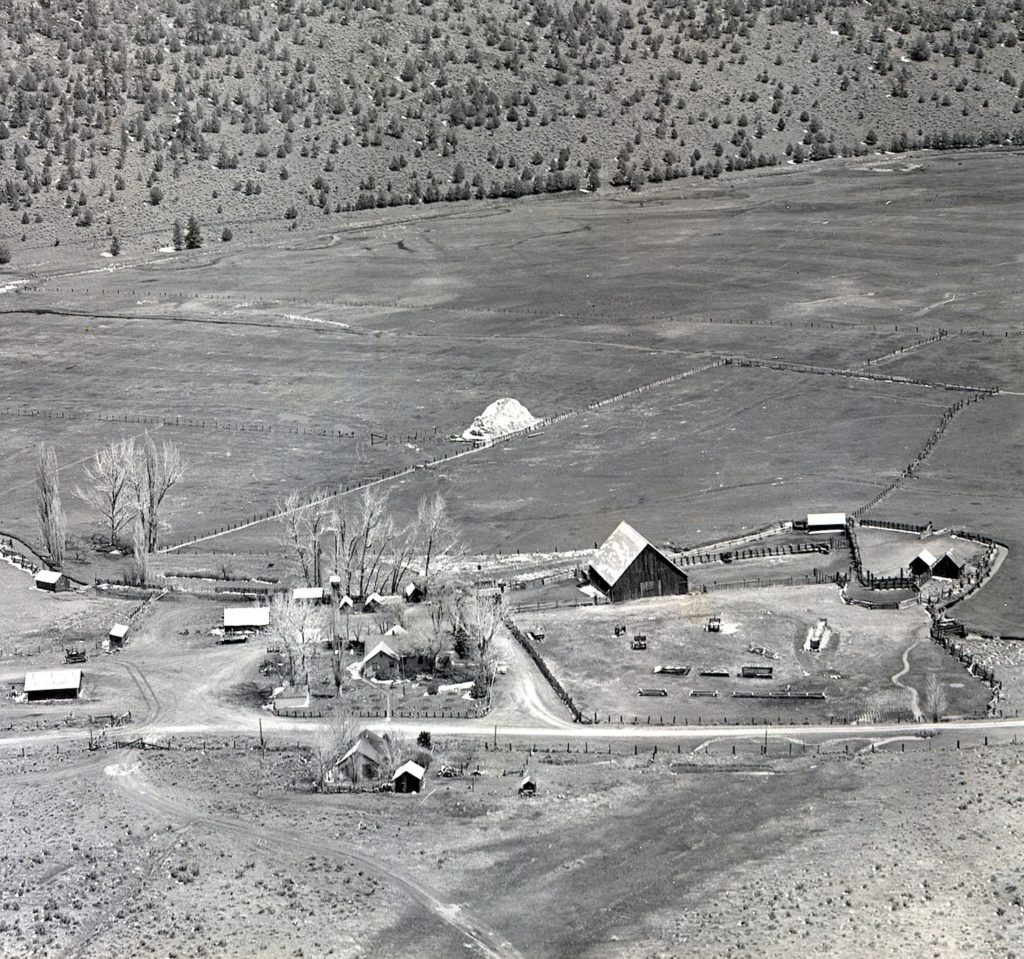
Leesburg was not much of a settlement. It was located at the western end of Willow Creek Valley. Not much is known about the particulars. In the summer of 1863 the Lee family located there and built several cabins providing the nucleus of the community. While Leesburg’s existence was brief, the County of Lassen recognized the settlement. In 1864, the county created its initial voting precincts. One of which was the Willow Creek precinct and Leesburg was the designated polling place. In the fall of 1865, German immigrant Ben Neuhaus located at the abandoned community of Leesburg. Neuhaus remained there until 1902, when he retired to Susanville.
Centennials are important milestones. It was on Saturday May 21, 1924 that the Susanville Lodge #1487 of BPOE, better known as the Elks, received its charter. It was, by the way, a big day in Susanville.
It was a full day of merriment beginning at sunrise and lasting until the wee hours of Sunday morning. One hundred thirty eight members were initiated that evening. At 12:30 p.m. a special passenger train arrived bringing Elk delegates from the San Francisco Bay Area. Upon. arrival a excited procession picked them at the depot and proceeded to the lodge at the west end of Main Street.
Lassen Industrial Bank built this Susanville landmark in 1922. Some fifty years later Bank of America tore it down.
The most unusual event was that of Professor Stillman Taylor who was to do a high dive off the top of the Lassen Industrial Bank building, into a three foot deep bathtub of water. It was reported that after Taylor said his prayers a dummy was substituted for the dive.
Oh that dreaded jury duty summons. However, I will get on my soap box to stress how important jury duty is. Of course, I have a legal background having worked for both the courts and in the legal community. Shucks, one time I had to sub in for the jury commissioner who was on vacation.* A lot of people’s lives are affected by the juror’s verdict for better or worse. One day you, a family member or friend may find this themselves in this situation and I doubt you would not a want juror’s serving without an attitude?
Anyhow, I came across this old letter written to Judge F.A. Kelley seeking to be excused. While the scanned image appears at the top, some may have find it difficult to read. After all, penmanship, is what it is, some excel and others do not.
On April 23, 1904, Milford resident J. W. Hurlbut wrote: “Dear Sir. Since the summons was served on me to act as juryman on the 25th of April my business has been awful so that I have a dairy on my hands and it will be impossible for me to attend. Please excuse me and oblige. Yours truly J.W. Hurlbut.”
Not sure what the out come was. Of course, there was the issue whether the letter would actually be received on time.
Tim
*The excuses people make to get out of jury duty boggles the mind. Let’s just say there are some real creative types out there!
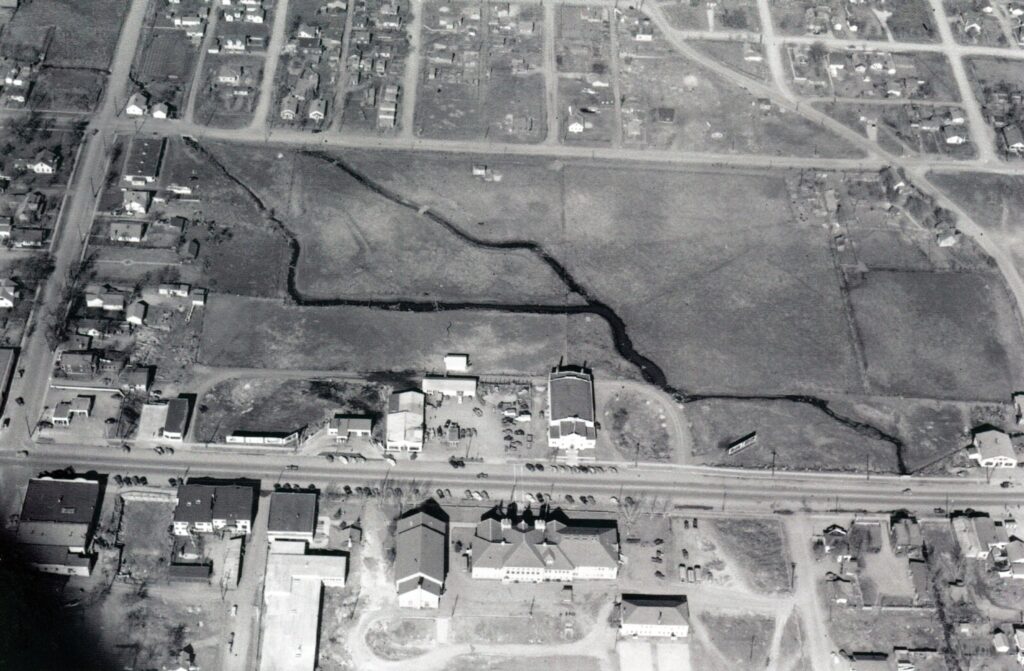
Folsom/Houghton property, 1946–Special Collections, U.C. Davis
By the 1880s, the village of Susanville desired a public park. Then a township, its governing body was the Lassen County Board of Supervisors. That board balked at the idea.
In 1900, the City of Susanville became its own separate entity, but a city park was low priority. In the spring of 1928, the Rotary Club got on the park bandwagon. It set its sights on the Folsom property behind the American Legion Hall on North Street. M.O. Folsom offered the property at $6,000, with $750 down and $750 per year at six percent interest. The Rotary Club enlisted the aid of J.W. Gregg, a landscape architect with the University of California and paid for his expenses to visit Susanville. Gregg volunteered his time to design plans for a park on the Folsom property. The plans and his offer were then presented to the City. The City, while impressed, took the matter under consideration.
The Rotary Club continued with its efforts. In 1929, it put together a 10-year strategy plan for a park, and sought support from other civic organizations. At a park meeting on September 23, 1929, Frank Cady offered to donate $4,500 to purchase the Folsom property for a park. Folsom reduced his askig price to $3,500 as long as it was used as a park.Another $1,000 was needed to purchase an adjacent parcel from Med Arnold.
The wheels were set in motion. The Rotary Club approached the City Council which was agreeable to accepting the donation of the property should Cady purchase it for theCity. The Council agreed to move forward to implement Gregg’s plans. There was one slight problem—the property was located outside the city limits. The Council stated it would be necessary to form a park district. That would allow an venue for assessment fees for construction and maintenance.
The park district issue was presented to the Lassen County Board of Supervisors, as the proposed district fell under their jurisdiction and the Board agreed. The procedure called for a public hearing and setting of an election date. On December 2, the public hearing was held. The adjacent property owners were against it. The Board decided against the district. It was the Board’s opinion that Susanville residents would receive more benefits from the park, but the county would have the greatest burden of costs. The County vetoed the park district, and city decided to place the matter on hold.
P.S. – In the1920s, Folsom allowed this property to be flooded for ice skating.
A Fruit Growers railroad logging crew with iies and a Clyde tracklayer, 1932 in Pine Creek Valley
A subscriber inquired from the Ask Tim post of April about railroad logging/grades west of Eagle Lake. I have been slow to post, as I have been experiencing technical issues with scanning, however on a bright note that will soon be resolved.. Of course, to properly address this topic will take several posts. However, I wanted to begin the series with these two illustrations.
A Fruit Growers Clyde tracklayer in operation near Camp Harvey, 1947
The top one is an excellent photograph depicting everything needed, workers, railroad ties and a Clyde tracklayer machine. Fruit Growers initial railroad logging began just north of present day Highway 44, and a little southeast of McCoy Flat Reservoir in 1920. The Susanville mill was still under construction, so only a small volume of logs were needed. The following year, witnessed large scale railroad logging activity and the establishment of two large logging camps Camp B & C.
Stay tuned more to follow.,including a map showing all the lines and spurs.