First of all, I hope everyone has relaxing Labor Day.. Some one posted this comment about the 1927 Milford Rabbit Drive: “Is there is going to be a 100 year anniversary run for this event.” This I thought is an interesting concept for a centennial event and with some creativity’s some intersting potential. Anyone, up to challenge to organize it? I would be willing to assist where I can.
For those interested, I am working on the John Jay Casey article. It may be awhile, since my future post pile has a way increasing day by day.
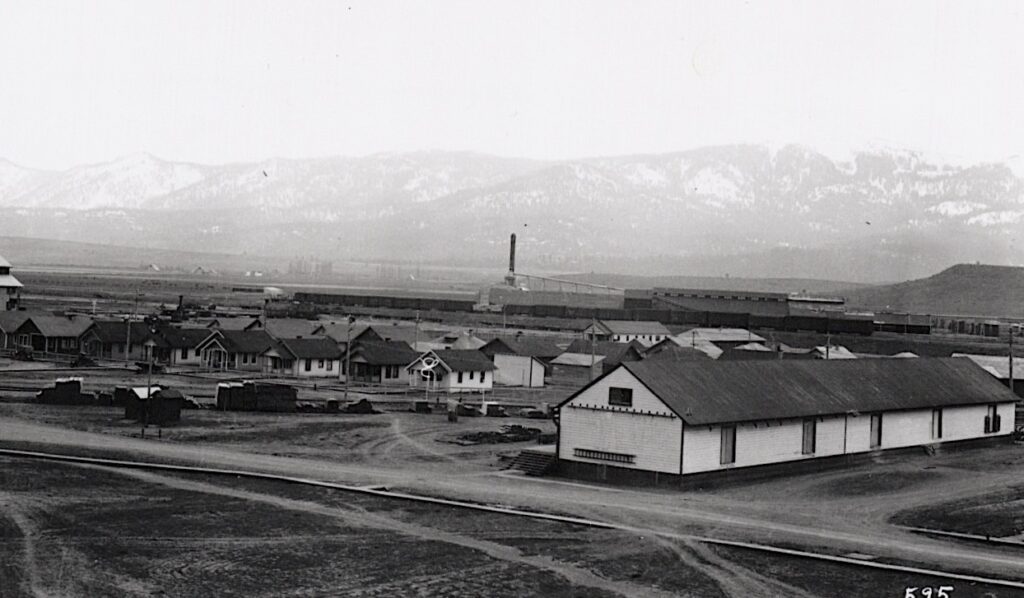
Pine Creek, circa 1914. It sholuld be noted that John Spalding’s original homestead was on the north side of Pine Creek. Courtesy of Wyn Wachhorst
In 1919, Fruit Growers Supply Company purchased the Collins Tract west of Eagle Lake the contained an estimated a billion board feet of timber. Lassen National Forest officials suggested a mill site on Pine Creek near Eagle. Lake. Fruit Growers examined two sites, in the region what is known as Spalding Tract. They were informed that Eagle Lake had dropped from 3 to 4 feet during 1917-18. There was also the uncertainty where Leon Bly had obtained water rights to the lake for irrigation in the Honey Lake Valley. It was suggested that Fruit Growers place a dam at the Pine Creek estuary for a millpond and in the worst case scenario drill wells for a water supply. After a short debate Fruit Growers decided to locate the sawmill at Susanville.
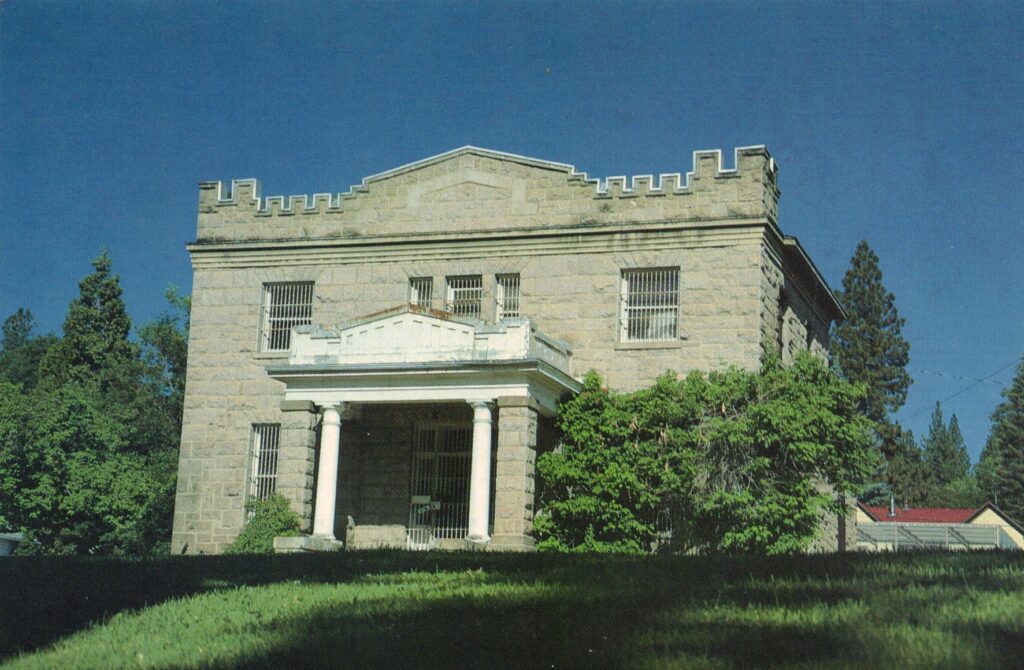
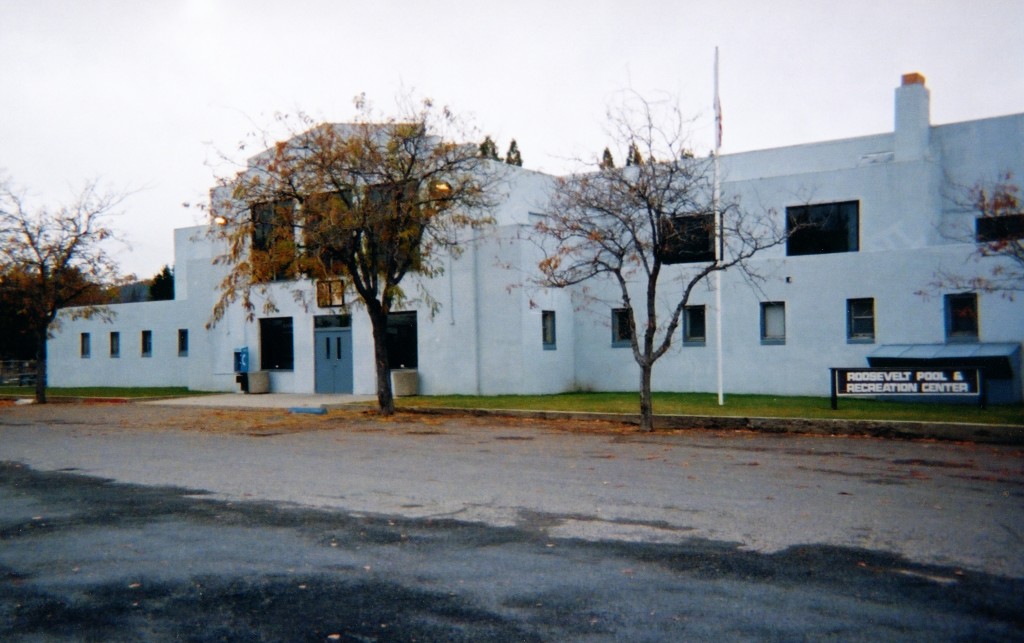
Yesterday, we explored this building’s counterpart, the Lassen County Courthouse. The old Lassen County Jail was built in 1911 at a cost of $30,000. Noted architect Frederick deLongchamp designed the building. It should noted deLongchamp was the architect of the St. Francis Hotel, now a thing the past and the original Susanville City Hall. One of my favorite deLongchamp buildings is the Modoc County Courthouse.
This jail closed its doors in 1971, when a new jail was constructed behind it. That jail no longer exists and that’s another story. The old jail has been nearly vacant as long as it was in use. The roof of the building has partially collapsed, so how much long will it stand remains to be seen. In the future we will explore one proposal to restore it.
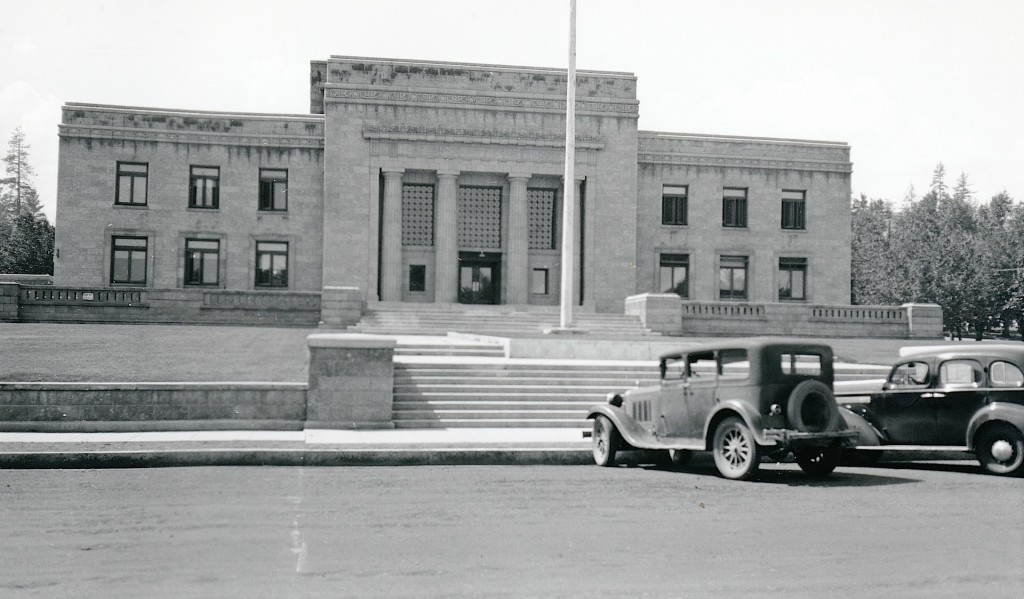
Lassen County Courthouse, 1938. Courtesy of Jere Baker
Certain published accounts attribute that Susanville’s founder, Isaac Roop, donated to the Lassen County the block that occupier the courthouse. Not so. Truth be known Roop was not the benevolent type that folklore has it.
The actual construction cost of the present courthouse, completed in 1917, is somewhat muddled. In 1915 the voters approved a $125,000 bond measure to construct a new courthouse and a new hospital. The cost of the courthouse was $80,000.
Many will consider this rather mundane, yet the daily goings on whether past or present have their cycles, some dull and others dramatic. On the same token, a century ago left remarkable paper trail. In this digital era future historians will not have the luxury of sifting through paper documents.
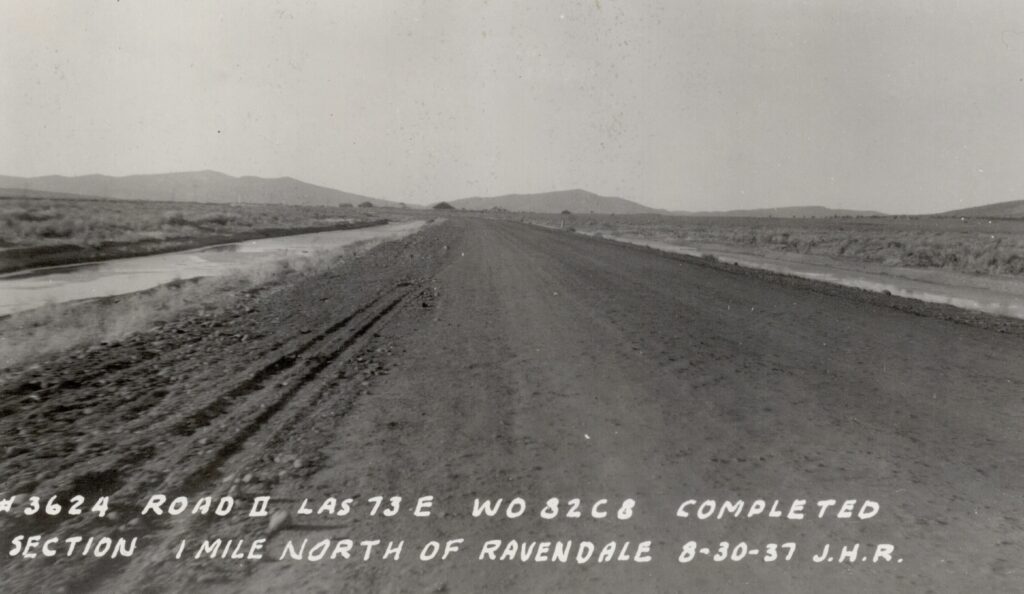
While sorting through records I came this 1937 report from the California Division Highways pertaining of road work on Highway 395 between Termo and Ravendale, photographs included. The cost of widening the shoulders gravel and oil base was $23,100.
While it can expected in urban areas to ethic enclaves such as a typical Chinatown a there was a little northern California community that a neighborhood was dubbed Little Susanville. This community was Hilt, Siskiyou County, near the Oregon border. It just happen to be a company townof Fruit Growers Supply Company.
The Great Depression of the 1930s wreaked havoc on the lumber mills and numerous mills along the Pacific Cost region were shut down. The Lassen County mills were somewhat spared, but there were cutbacks in operations and lay offs. Fruit Growers valued its employees.. They understood how valuable a well trained workforce meant for smooth operations. Fruit Growers at its Susanville Operation transferred a small number of its employees and their families to Hilt. Thus origin of Little Susanville by locals at Hilt. By the late 1930s, when lumber activity rebounded, Fruit Growers easily met the demands, as well trained work force was intact. Fruit Growers General Manager A.E. Barnes was very pleased by this decision and that it paid off.
When I launched this website back in February 2015 I did a daily historical seven days a week. After five years scaled back six days a week, Tuesday being the dark day. From time to time I would do a Tuesday Tidbit. Tomorrow happens to be September 1st and it is also a Tuesday. So Tuesdays during September there will be no posts. Hopefully, this will allow more time to unpack and sort the archives so I can resume a regular routine.
An upcoming feature of Tuesday Tidbit is I posses via the late Wendell Laughed, a 1950s binder , that includes photographs, of local real estate listings
Why Tuesday? According to StatCounter it is the day that readership is the slowest day of the week. However, if you have a question or a topic that you would like to learn about, please drop me a line.
The commotion about Fruit Growers commissary did not end smoothly. The disgruntled merchants also had a complaint with the Nataqua Mercantile Company that opened its door on February 14,1921 in the Milwood district. The fact that the principle investors in the mercantile company were Fruit Growers employees aroused the suspicion of some local merchants, even the the three, J.W. Schooner, Henry Neunaber and J.C.Pery, invested solely as individuals.
Facts, however, did not stop the rumors, many of them started by the “peeved merchants,” who even went so far as to hire a phony investigator to stir up matters. With the mill nearing completion, these rumors, even though false, could have profound effect.
Fruit Growers hired their own private investigator to find out exactly how the community felt. W.A. Mundell (aka Jules Gamage) posed as an investor. interested in opening a summer resort at Eagle Lake. So good was his disguise that he was invited to join a poker game (during which he lost) at the Pioneer Saloon with a group of the town’s most influential citizens. The week-long investigation uncovered no animosity between the residents of Susanville and Fruit Growers. If anything the citizens were glad for the competition.
Fruit Grwers’ Commissary, 1921 Courtesy og Ed Standard
In 1919 when Fruit Growers decided to construct its mill in Susanville there was “Gentlemen’s Agreement” with the Susanville business community. In essence, Fruit Growers would not open any retail stores. Yet, on other hand was that the Susanville’s merchants had broken that agreement by refusing to maintain fair prices.
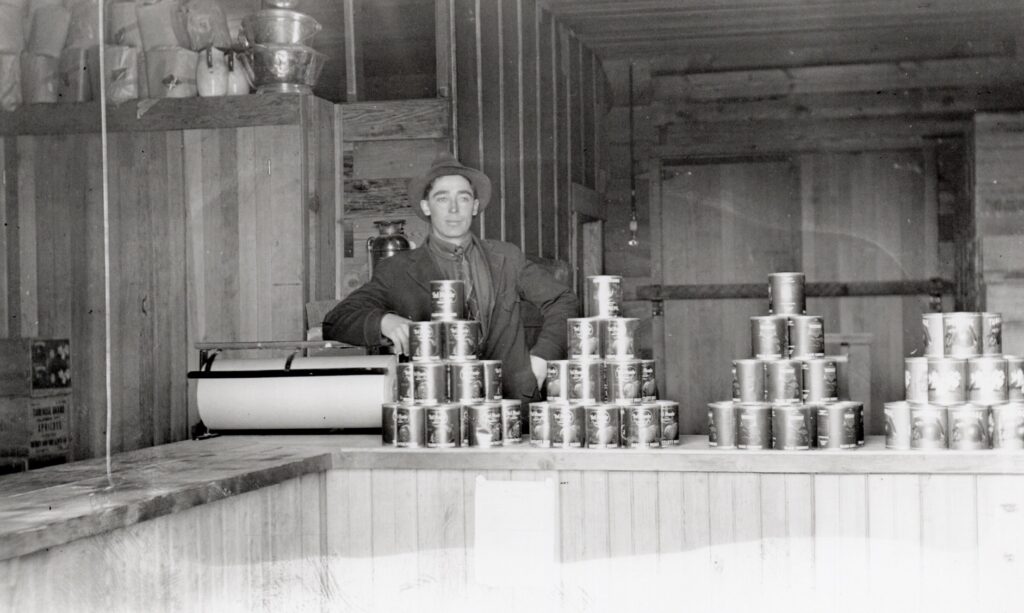
On December 12, 1920, Fruit Growers resident manager, S.M. Bump wired Fruit Growers President, Frank Hutchens: “Merchants can exploit they want. Started commissary this morning, already citizens desire to purchase from us because of the high prices. My answers to citizens absolutely selling to employees”*
Interior of the commissary, 1921 Courtesy Ed Standard
According to Russell Brownell of Susanville, wrote Hutchens: “The consensus of opinion of the citizens of Susanville outside a few merchants is as follows that it is well known fact that retail prices are higher here than any other locality with excessive profits are being and have been exacted that living costs must come down with.wages that your company’s demands for reasonable profits must be met If men maintain their families on scale of wages. This not only of great benefit to your employees, but to every citizen in Susanville and the Honey Lake Valley and be assured that your Susanville manager will have the backing of 95% our people. The Fruit Growers Supply Company are to be congratulated for having a man at the head of their Susanville operation who has the interest of its employees at heart and the back bone to go to bat for them.”
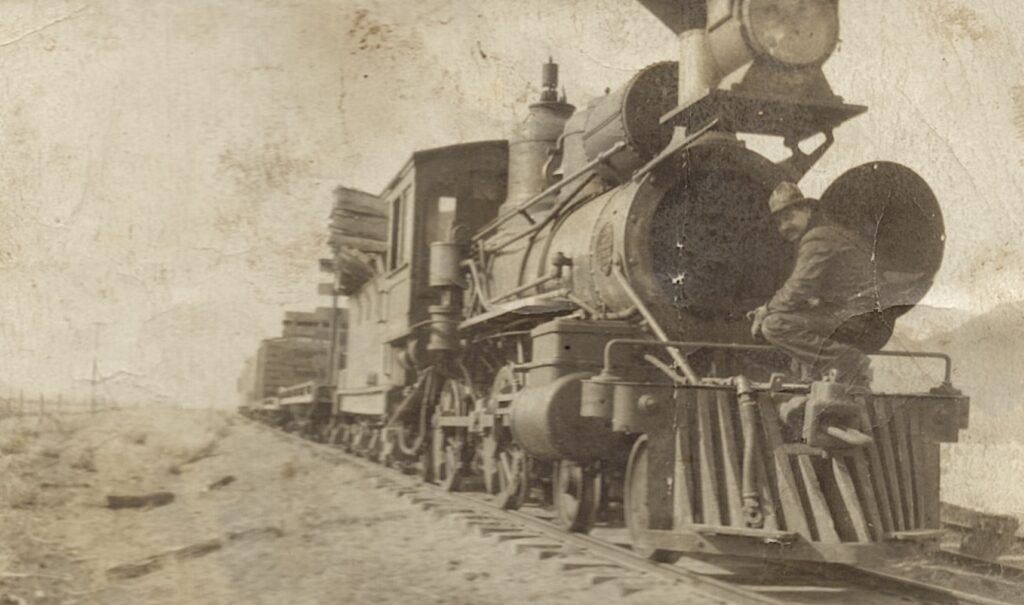
Ever since I was young, I possessed inquisitive nature. It has served me well all these years. I am not bashful to ask a question or two, because is not showing my ignorance, but I want to learn more to enhance my knowledge. Several readers have a vast knowledge of the railroads, so hopefully one of them can give insight to above the photograph.
The photograph was in my grandmother’s Lola Murrer Tanner’s (1899-1973) photograph albums. Normally, she would label her photographs. But, alas, not this one. She was born and raised in Willow Creek Valley, so she was not around trains that much.
There appears to be problem with the locomotive as the smoke box door ( believe ) is open. My knowledge locomotives is limited, I would appreciate that some one could enlighten me/us.