An Early Research Endeavor

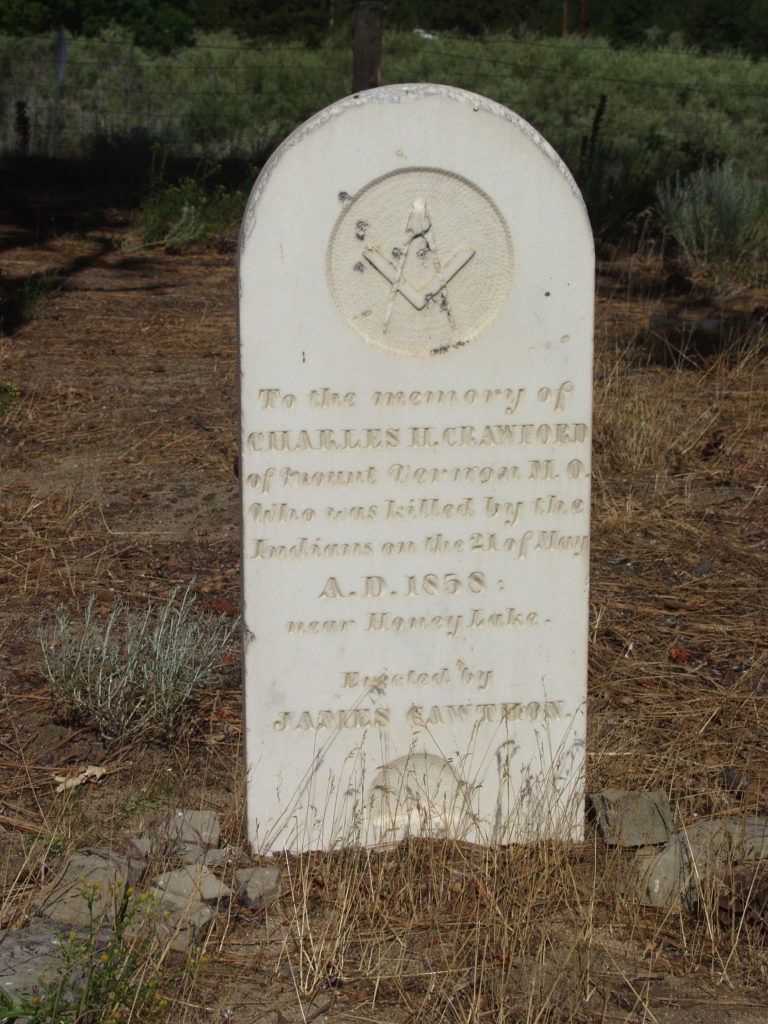
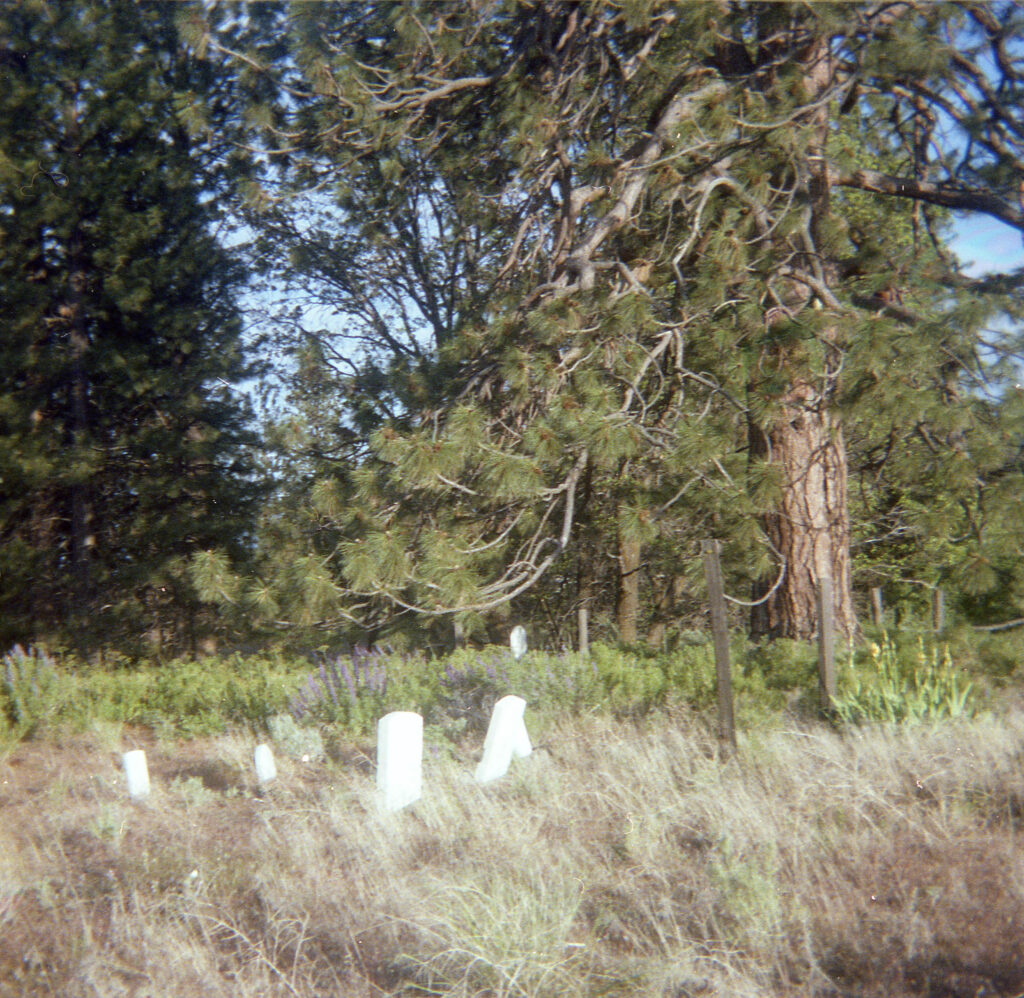
The grave of David Boyer, Susanville Cemetery, 1978

One of my favorite No Trespassing Signs was the Baccala’s at Soldiers Meadows, Plumas County.  It succinctly though I might not remember it verbatim, but it you get the drift: “If we see hanging you see around  hanging today, you will be hanging tomorrow,” and poster was illustrated with a hangman’s noose.

When I began my research I was at “hanging” a lot at the Lassen County Courthouse. Needless to say, while they did the courthouse staff did not threaten my fate to the gallows, they put me work instead. From to time to time either County Clerk or County Recorder would receive a letter from individual doing genealogy.  They would give me the letter to answer.

One of those early request came from Callie Quint seeking information about her grandfather David Boyer who died in 1883 at Mountain Meadows and buried at Susanville. Boyer, a Pennsylvania native, migrated to California in search elusive of proverbial pot of gold. Like so many others before and after him it was elusive and resulted in a hardscrabble existence. In 1875, he briefly operated a saloon at Prattville, Plumas County. The town catered to tourist trade that escaped the heat of the Sacramento Valley in the  summer to what is now known as Lake Almanor. Boyer feeling pinched, pulled up stakes that winter and moved to Susanville. He soon learned the grass was not greener on the other side. He leased a boarding house, but that it did work out. An opportunity at operating a saloon at Janesville seemed promising, but it was not. Back to Susanville. His endeavors as an innkeeper or a bar keep just was not was in the cards to sustain liveliehood was not forthcoming. The paper trail disappeared. In the spring of 1883 he moved his family to Mountain Meadows, though what he did there is not that known. On July 2, 1883, David Boyer died of heart attack at the age of 53. He left a widow and four small children destitute. Amanda moved her family to Susanville did odd jobs, including a bakery to sustain her family. She left Susanville in 1885.

On a final footnote. This one instance helped me to develop my research and writing skills. For a time in the late 1970s, I penned a weekly history column for the Lassen County Times, and I wrote about Boyer.  This caught Lassen College instructor Bob Middleton’s attention. Bob urged to me to get a teaching credential in history, and I did. In the mid-1980s I taught a course of research techniques on local history at Lassen College.

Tim

An 1892 Bold Prediction

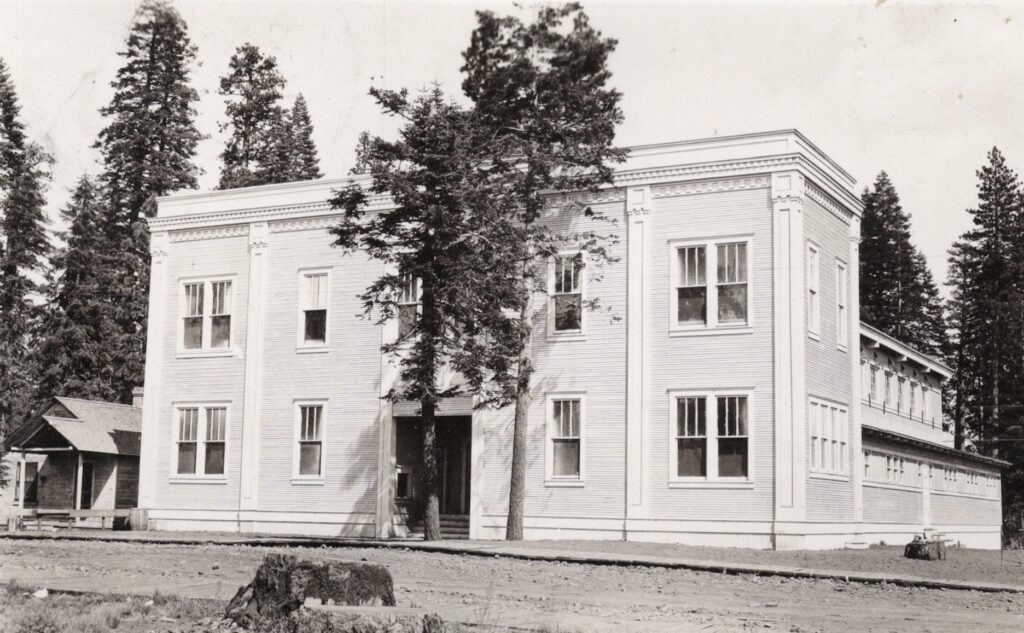
Lassen County Courthouse and Hall of Records, 1907. Courtesy of Gil Morrill

In the spring of 1892, Amedee was in its glory as a boomtown craze escalated. The regional newspapers proclaimed that Amedee would “kill” Susanville and that county seat would be moved to Amedee. It should be noted that many leading merchants of Susanville had opened stores in Amedee.

By fall, the talk of moving county seat had somewhat subsided. That would change. On July 18, 1893, the worst fire in Susanville’s history occurred. The entire business district had been reduced rubble. Certain segments of the population pondered whether to rebuild, and let Amedee prevail by moving county seat there. Of course it did not happen. While Susanville was slow to rebuild Amedee’s shine would fade. This was especially true in 1899, when the NCO Railroad began construction of extending the line to Madeline Plains, and Amedee was no longer was terminus.

Tim

A Sawmill’s Friend

LLB
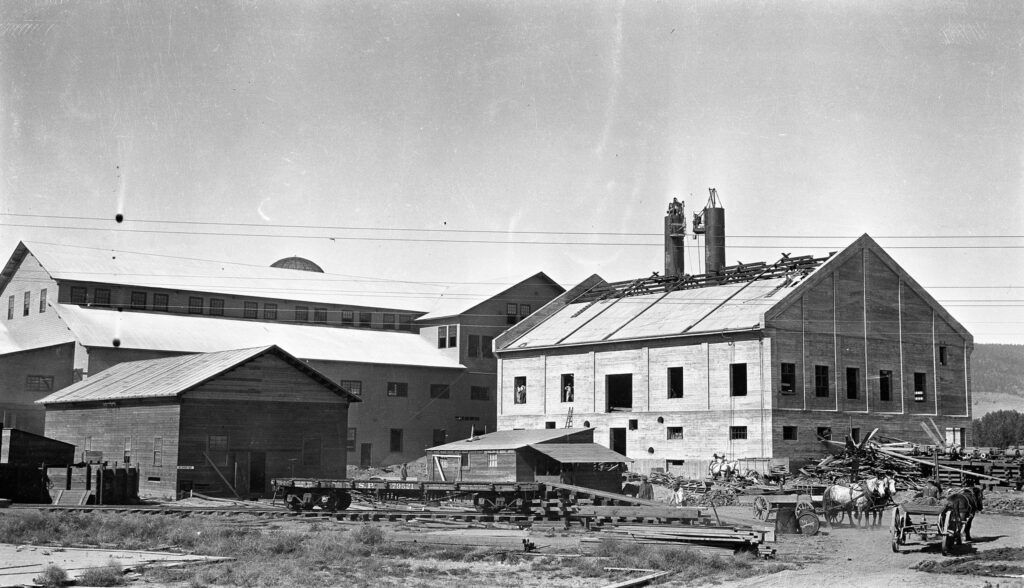
A 1930s view of Lassen Lumber & Box Company

I had hoped by now to have completed the tale of M.O. Folsom, a rancher turned capitalist. His story has been a challenging. While the Folsom name is not well known by many today, Folsom played a key role in Susanville’s development. Here is a bit a trivia, to go along, for many decades Hobo Camp on Susanville was known as Folsom Park and he also owned what is known as Memorial Park.

In October 1917, M.O. Folsom met Charles McGowan, R.D.Baker and C.E. Cotton. The men had inspected a timber sale proposed by the Lassen National Forest in the vicinity of Peg-Leg Mountain some twenty miles north and west of Susanville. They contacted Folsom for possible mill site. Folsom had rallied the Susanville business community A committee was formed, after was at stake was a sawmill and box factory that would initially employ 250 men. The community proposed to offer a 40-acre tract with water rights adjacent to the railroad and east of the Susanville depot,  along with a  $8,000 cash bonus. McGowan and Company accepted and they named their new enterprise the Lassen Lumber & Company.

Bunnell siding, circa 1921. Courtesy of Lenala Martin

In 1919, James McNeen a Colorado lumberman contacted Folsom to assist a sawmill site west of Susanville. Folsom presented a site west of Devil’s Corral, along the railroad, and opposite the Bunnell Ranch. A deal was reached and McNeed built a sawmill with  average daily output of 30,000 board feet of lumber.  In that same year, Folsom was a member of Susanville’s Citizen Committee, and they secured Fruit Growers Supply Company to build its mill north of the railroad from tracks from Lassen Lumber.

Clear Creek
Clear Creek as it appeared in 1899, Mary Dale Folsom

Folsom had influence with the Red River Lumber Company. In 1892, Folsom’s father, Orman, had purchased Clear Creek from Hank Lands for an undisclosed amount. In 1909, M.O. Folsom sold it to Red River’s founder, T.B. Walker, for $6,500. At the same time, Walker acquired some 7,000 acres at Mountain Meadows, the remnants of the Goodrich Estate. Those acquisitions would result in Red River’s to establish their company town of Westwood.

Support by subscribing.

Tuesday Tidbit-Dixon’s

Doyle, 1931—Mary Dixon

Last Saturday, I wrote about how Doyle evolved. At the conclusion I included a photograph one of the town’s landmark building now known as Winje’s, but for decades was known as Dixon’s. Some time around the late 1970s or early 1980s Winje’s purchased the building from Mary Dixon. Some time around 2021, Winje’s closed its doors. May be a reader might have some knowledge .

Winje’s Emporium, Doyle—January 25, 2020

Whenever my Dad, was in Doyle he would  stop by to see June Dixon. They would swap stories about prospecting on Fort Sage Mountain. In 1910, Orlando McNabb did extensive traipsing on Fort Sage looking for gold. From there on, it has attracted prospectors.

Tim

A Railroad With Many Names

NCO Freight Depot, Reno, 1905-Marie Gould

The Nevada-California-Oregon Railway (NCO) initially had several names. A reader chastised that an article I wrote and labeled it the NCO, though when in fact it was known as Nevada & Oregon. While guilty as charged, for simplicity I just refer to the railroad as the NCO.

To set the record straight here is origins of the multiple names and nicknames of the said railroad.  Established in 1879, its original name was the Nevada & Oregon Railroad Company. In 1885, the name was changed to the Nevada & California. In 1888, the name was changed to the Nevada-California-Oregon Railway. The former names were still; valid due to unpaid bonds under those names. On January 1, 1893 the Nevada-California-Oregon  (N-C-O) was officially adopted for the railroad properties.

These initials N-C-O became target for criticism of the railroad’s poor service. The N-C-O received such dreadful titles as the Narrow Crooked & Ornery, the Northern California Outrage, Never Comes Over and the Nevada-California Occasional. One of my favorites was peened the J.M. Tremain editor/publisher of Susanville newspaper the Lassen Weekly Mail. Tremain called the N-CO a tri-weekly. “It goes Reno one week and tries to return the next.”

Support by subscribing.

How the Sierra Army Depot Came To Be

Sierra Army Depot. Courtesy of Donna Perez

The Lassen County business community courted the military over the years. During World War I attempts were made to establish a military training camp at Hackstaff, while that failed that location was not forgotten. In 1926, the Lake Denmark Naval Ammunition Depot in New Jersey was destroyed, the cause of a lightning strike. Twenty-one people were killed, and the damage in today’s dollars about a billion.

This changed everything when the government sought a location for a munitions depot in the west.  The two important criteria was it to be an isolated location, but have railroad access.  The top three sites examined were in the western Great Basin, and two were in close proximity of each other–Secret Valley, Flanigan and Hawthorne.  In 1928, Hawthorne, Nevada was the victor. When World War II came along, saw the need for another Army Depot, and they selected Hackstaff in the Honey Lake Valley and it was subsequently renamed Herlong, after the first Ordnance officer killed in World War I.

Never miss a story, click here to subscribe and support.

The Origins of Doyle, California

The Western Pacific Depot, Doyle, 1915. Courtesy of Suzanne Pratt

It was slow as molasses, for the evolution of Doyle proper. In 1859, John W. Doyle settled approximately two miles of the town that would eventually named him. He did not lived to see it, as he died in 1892.

In what would be considered Doyle proper, it  was the stage stop known as Willow Ranch dating back to the 1870s. On June 6, 1888 the troubled the NCO Railway reached Willow Ranch and established a station called Long Valley. Nothing unusual, since John Doyle operated the Long Valley Post Office.

John W. Doyle (1832-1892). Courtesy of the Nevada Historical Society

Another railroad, namely the Western Pacific, was the catalyst of the development of the town.  When that railroad passed through they named their station Doyle. On January 28, 1909, the Doyle Post Office was established. It was not until 1911, that the townsite was surveyed.

Winje’s Emporium, Doyle—January 25, 2020

Tim

Secret Creek, Lassen County

Secret Creek, 1936-C.H. Bennett Collection

Secret Creek is a small desert stream of approximately forty miles that originates from Shinn Peaks in eastern Lassen County.  While spring run-off of snow melt from Shinn Peaks at times can be substanial, it is the  numerous springs of the upper watershed that sustain the creek. When the stream departs Secret Valley, it enters Balls Canyon and near Belfast empties into Willow Creek.

Secret Creek, as seen from the lower end of Secret Valley.

In 1889, a diversion of the creek was built after it leaves Balls Canyon. The sole purpose was to collect spring run-off to store at Ward Lakes Reservoir, for irrigation. There were actually two reservoirs, hence the plural of its name. The upper reservoir was significally smaller..

In 1889, the Balls Canyon Reservoir Company was formed to build a dam on Secret Creek where it enters the Honey Lake Valley, about five miles west of Litchfield. The company employed surveyor, Frank Gates Ward (1857-1895), to survey a dam and reservoir site.  In 1889-90, the first reservoir was constructed. In February 1890, a flood washed out that dam. As one observer noted, the waters of Secret Creek began rising at a rate of two feet an hour and within three hours the 27 foot high structure, that measured 150 feet in length, was swept away. The company planned to rebuild but never did. In 1895, Edward T. Purser took over the project and a new reservoir was constructed, along with a twenty-mile ditch to his property near Wendel.

Support by subscribing.

A Recipe For A Desert Boomtown

Amedee, 1893-Nevada Historical Society

By the spring 1892, the Amedee Boomtown was in its full glory. In the fall of 1891, Erasmus Gest invited investors and speculators  to Amedee to promote and a develop the town. On March 30, 1892, the Truckee Republican had story about Amedee.  It stated: “These conditions are needed for a desert boomtown- 1) A live man 2) A railroad and 3) Water.”

1) On January 9, 1892, S.N. Griffith a Fresno, California capitalist entered to an agreement with Erasmus Gest to develop and promote   Amedee. The contract contained specific requirements for Griffith to undertake. Griffith agreed to construct a hotel, bath house and livery stable from plans submitted by Gest. A townsite needed to be plotted and surveyed and the  contract even designated A.J. Chalmers as the surveyor for the work. The necessary projects had a deadline of six months. Gest was under no obligations or responsebility for this promotional venture. The boomtown began.

2) A railroad. The NCO Railroad arrived ion November 1890 on the east side of Honey Lake.

3) Water. There were several reclamation projects in the works. The Eagle Lake Land & Irrigation Company focused on the Amedee region. In fact Eagle Lake water flowed to Amedee in the fall of 1892.

Subscribe


Zimmerman’s Calling Card

Zimmerman’s business card, circa 1905.

Business cards in this electronic age are becoming obsolete. Over a century there was a standard size card. However, there were individuals that were creative types who did not follow standard norms. Such was the case of Susanville businessman Ben Zimmerman. His card was twice size of a normal one, and not only that it was printed on both sides.

The other side of Zimmerman’s card, featuring his saloon.

Zimmerman came to Susanville in 1874, at the age of 14. The first trade he learned was making harnesses. The next thing, he has graduated to saloon operator. This he soon discovered was a very lucrative business. All was well, until 1919 and the Volstead Act, better known as prohibition put an end to his business and so he opened a restaurant. Zimmerman died in 1943 in Susanville.  

Tim

Exploring Lassen County's Past