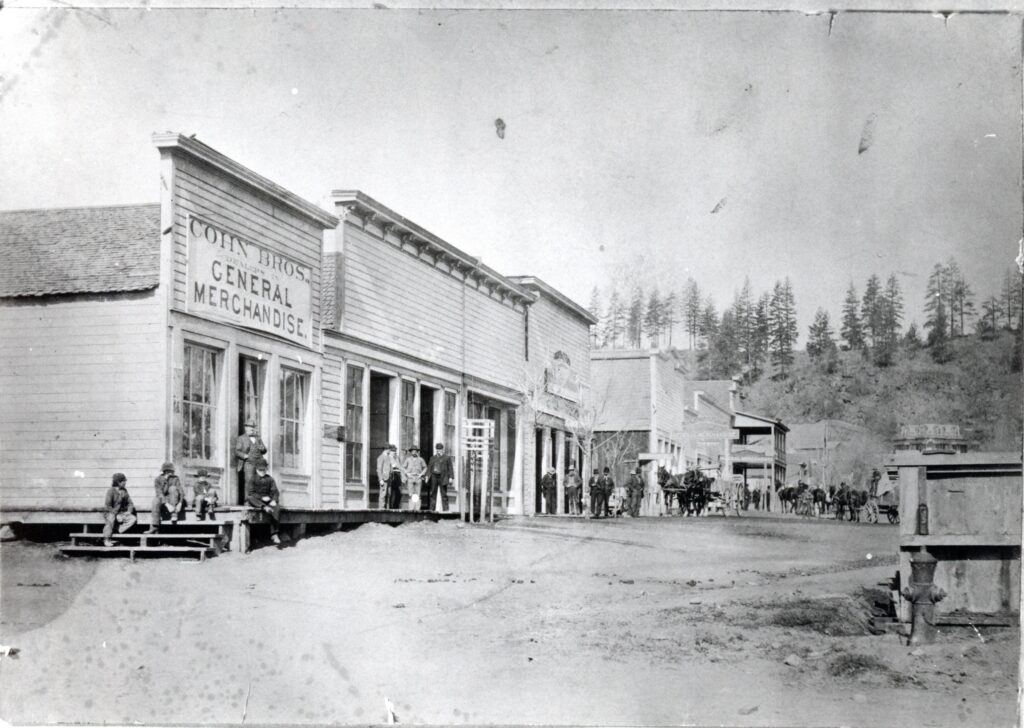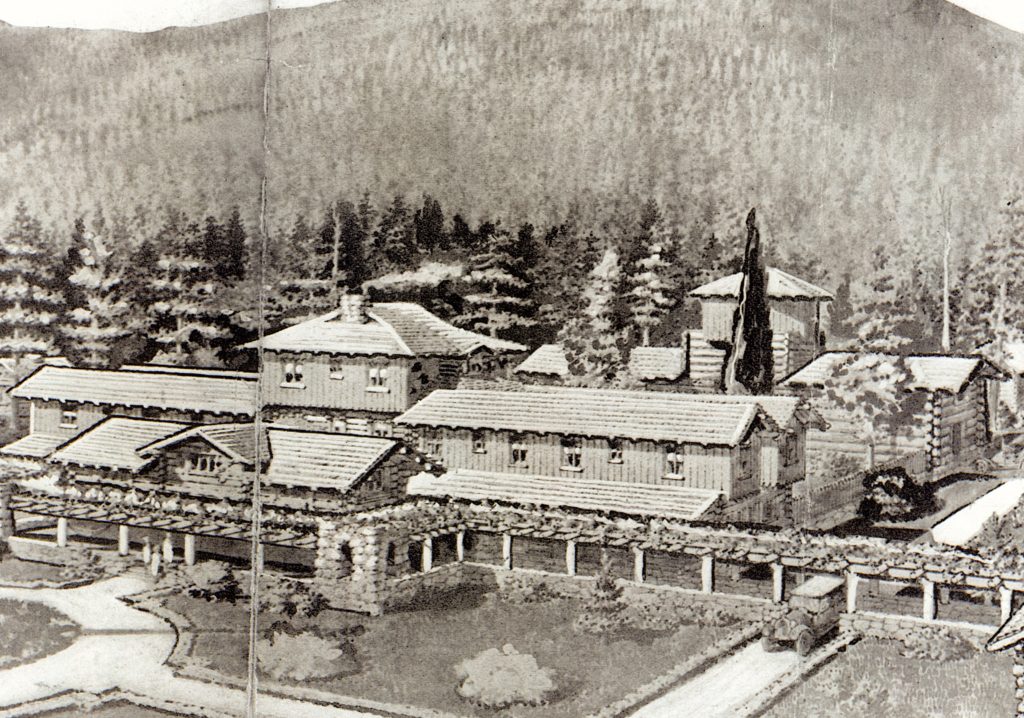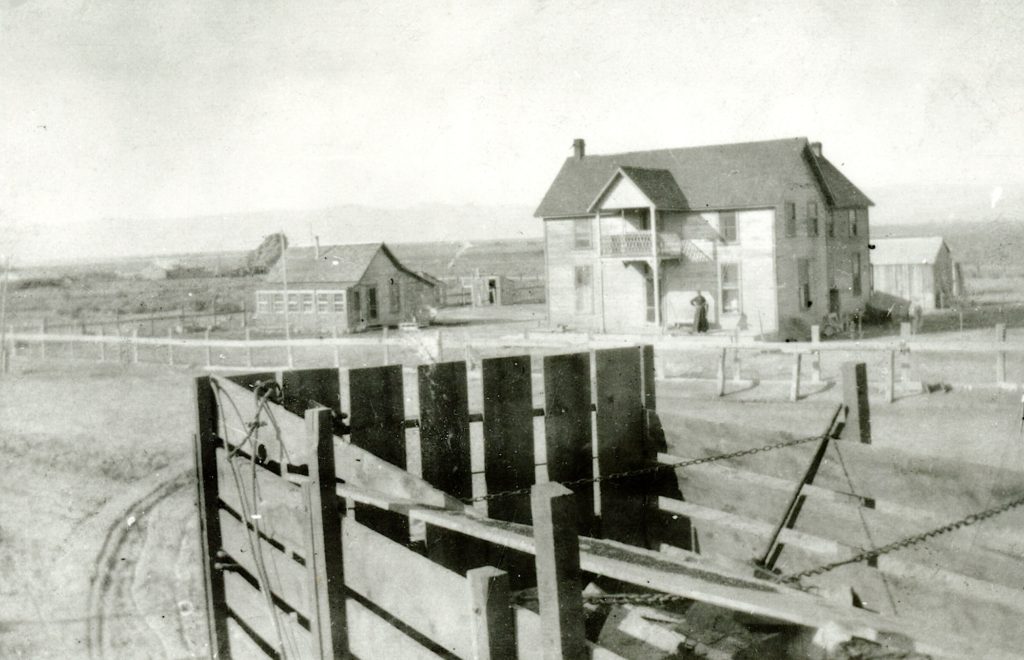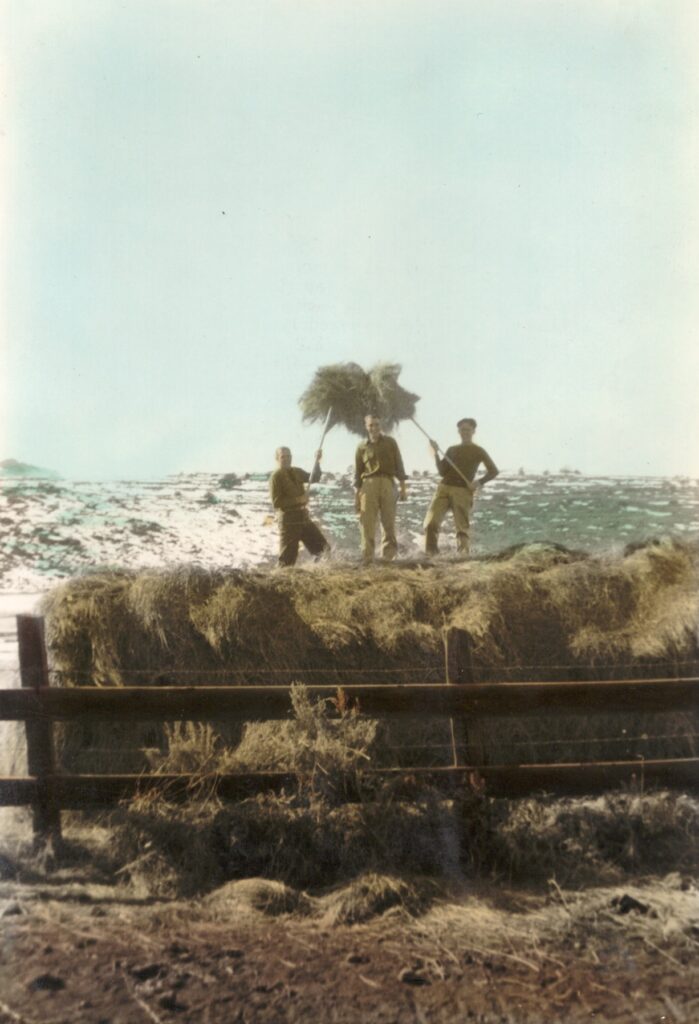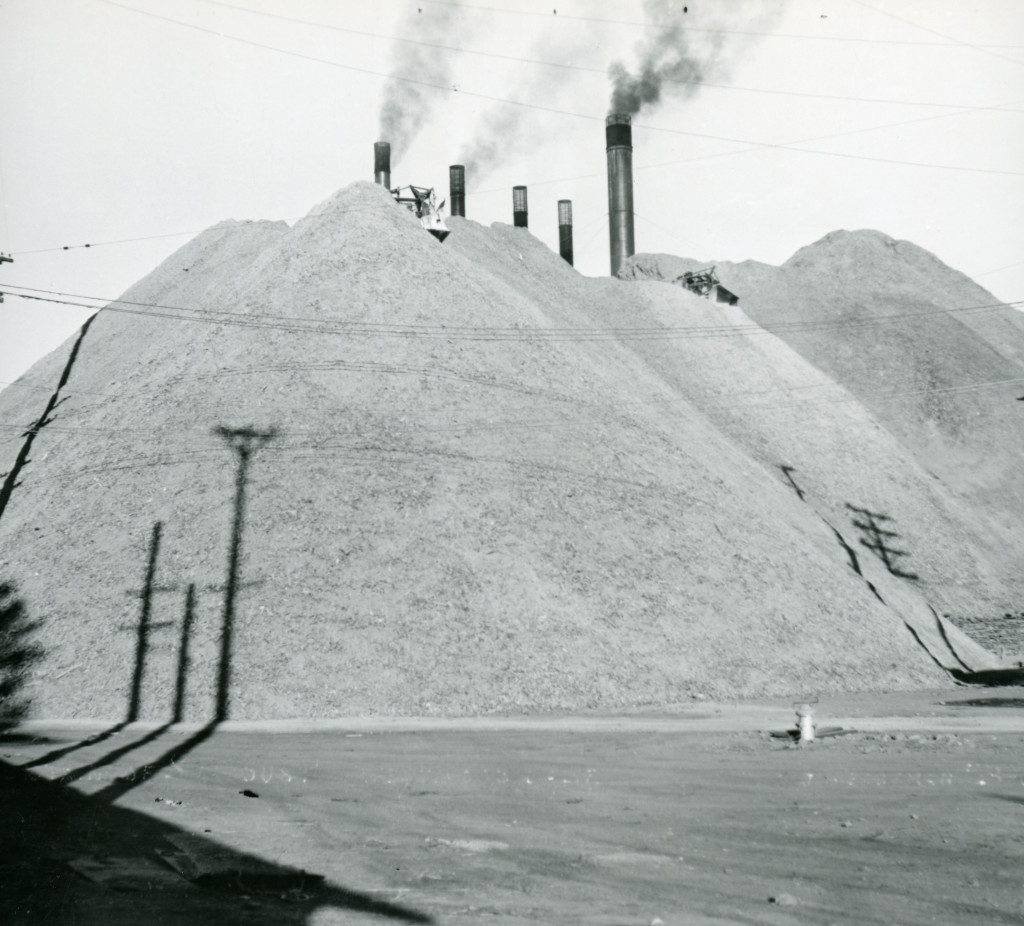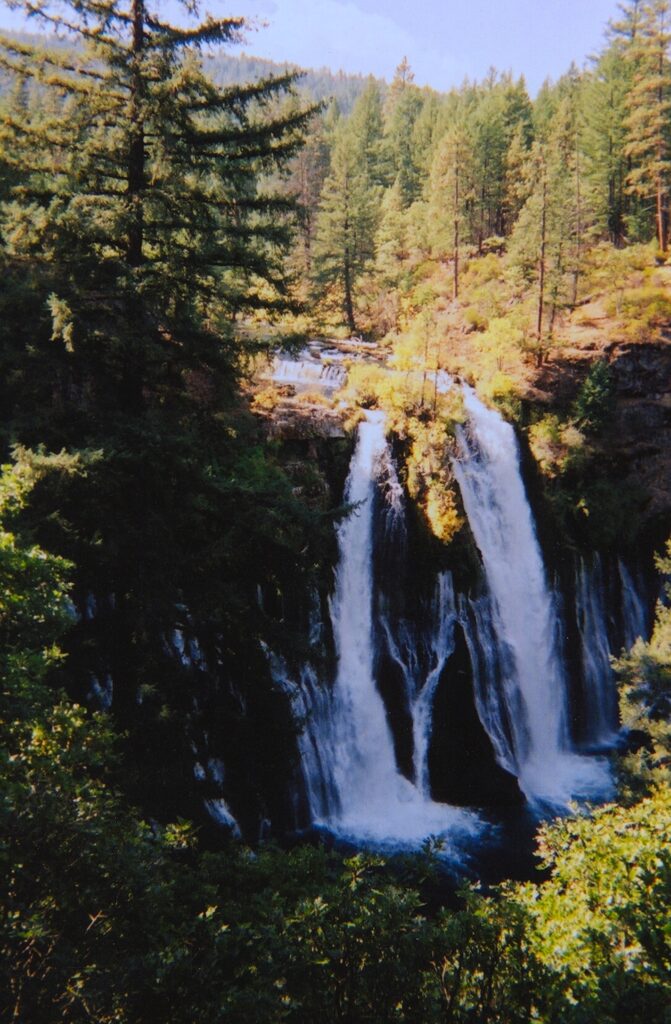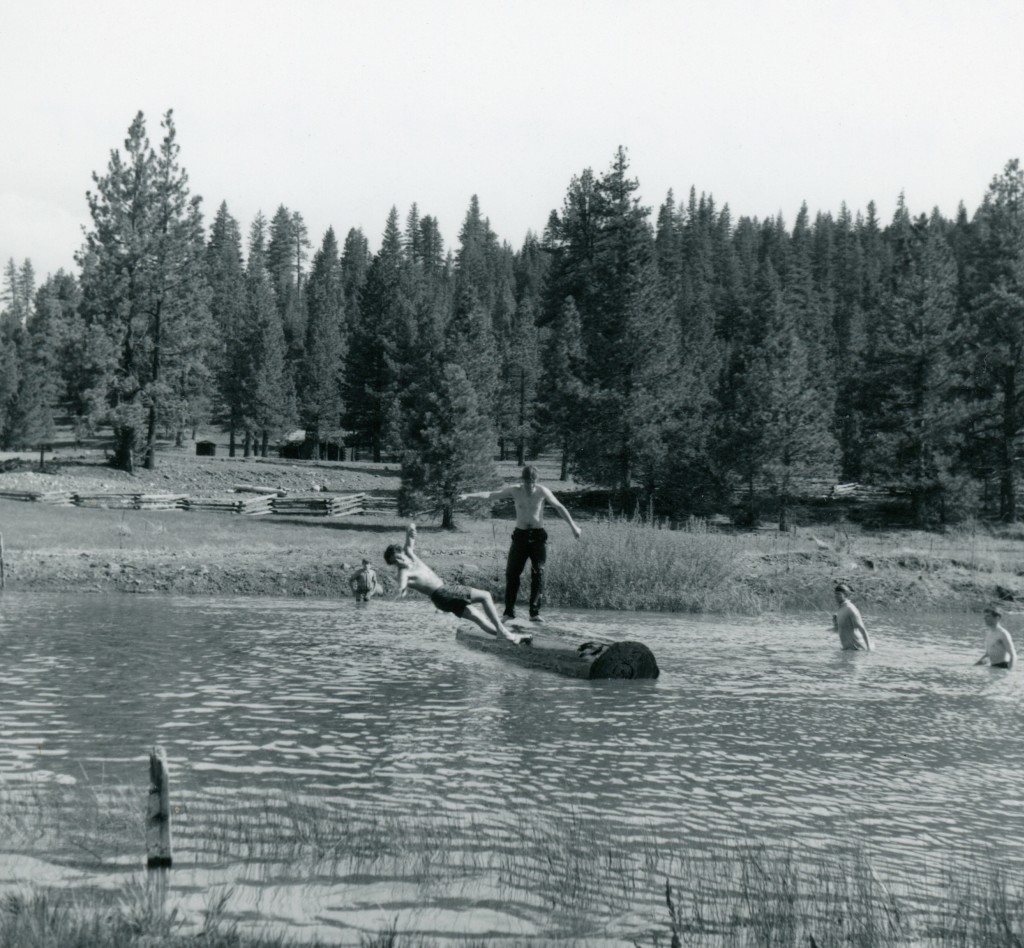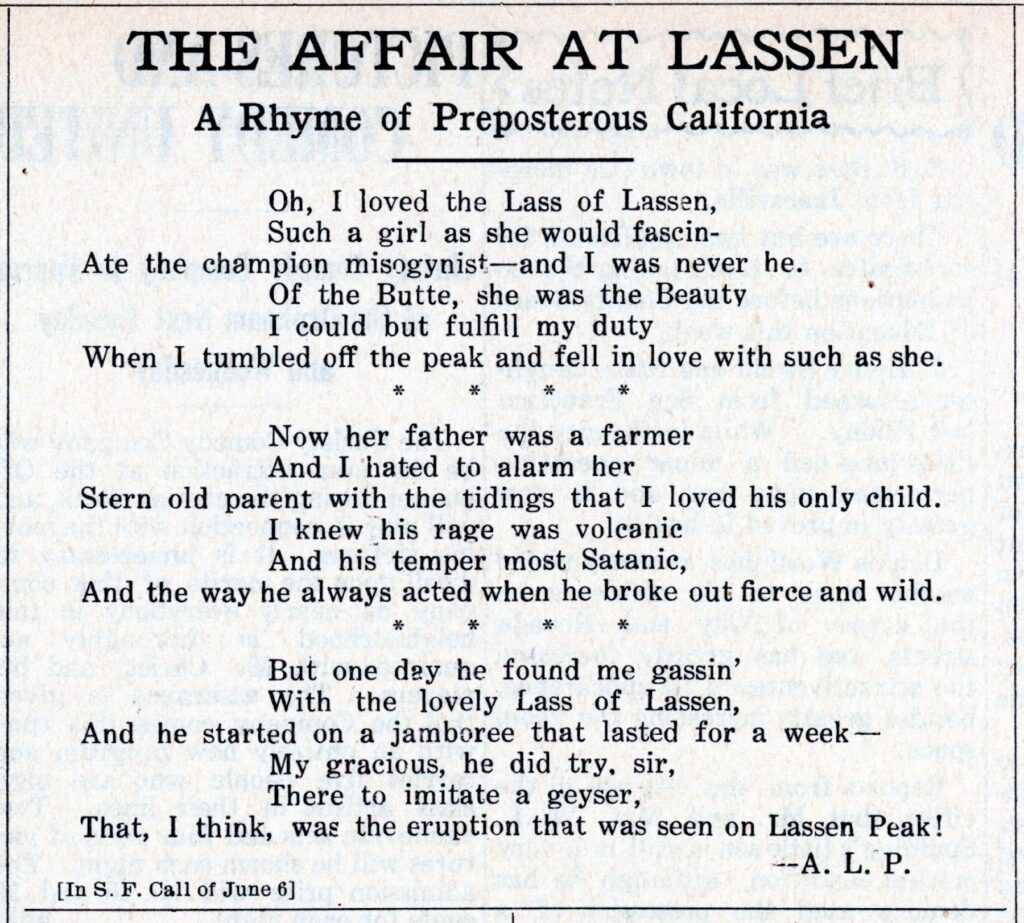
First, I happen to like this photograph taken at the south shore of Eagle Lake. Second, I do not have any knowledge about the picture. Third, in June I had a bought an Epson V39II Scanner. Last week a forced myself to use it. It has been a challenge, but slowly and surely I shall overcome the learning obstacles. Anyhow, to make a long story short, the above was the first scan.
Caudle & Warden drilling a well for the Western Pacific at Calneva.-C.R. Cudle Collection
Calneva was located in the eastern Honey Lake Valley with a close proximity of the California and Nevada border, approximately six miles east of Herlong. In 1910, the Western Pacific Railroad established the Calneva Station. During the 1910s, this area experienced a great deal of homestead activity. Individuals were lured there by a promise of water from the South Lassen Irrigation District, that planned to divert water from the Little Truckee River via Long Valley Creek to irrigate the desert lands of eastern Honey Lake Valley. Those and other proposals never materialized.
Calneva Station-Courtesy of Russell Umbraco
In 1921, the Western Pacific Railroad received permission from the California Railroad Commission to abandon the station. They cited in 1920, only 61 passenger tickets were sold and freight revenue was $435.01–the station’s total profit for that year $117.27.
Members of the Honey Lake Valley Colonial Club assembled in front of the Honey Lake School, at Datura, 1897. Courtesy of Betty Barry Deal.
In 1898, was the groundbreaking moment for planned utopian community of Standish. Its founder, William Smythe envisioned it based on the religious beliefs of Myles Standish and economic structure promoted LDS leader Brigham Young. Smythe believed that people desired to escape the industrial cities of the East, for a more simple life in the West. Water was to needed to irrigate the land. so the Standish Colony purchased the Susan River irrigation system, which would be its downfall. The colony did entice a few New England transplants to Standish who introduced a new plant to the region, which is enjoyed by many each spring for its fragrant blossoms–lilacs.
A distant view of the Kirmess-Courtesy of Dolores Gasperoni
One of the more disastrous fires in Susanville occurred in August 1915, when a large portion of the block containing the Emerson Hotel, the Hyer House Hotel and the Methodist Church were destroyed. The losses were heavy, none of the buildings were fully covered by insurance.
Members of the Methodist Church were determined to rebuild their church that was constructed in 1901. The skeletal walls were deemed fit for re-use. While insurance covered a large percentage of costs to rebuild, more funds were needed. It was decided to hold a Kirmess Festival. Those not familiar with the term, is of Dutch origins. While it has several meanings one is that it involves an outdoor fair/festival for charitable causes, usually affiliated with a church.
In early March 1916, members of the church announced a four day Kirmess festival to raise funds to rebuild their church. The kirmess was scheduled for March 28-31. On the first day, it took on air of Mardi Gras with a parade that included the majority of the community. Entertainment was held every night at the Orpheum Theater. On Thursday night Guy P. Johnson won the election and was crowned Kirmess King. A good time was had by all and nearly $1,000 was raised for the Methodist Church.
In 1912, F.T. Cromwell, a land speculator arrived in the Honey Lake Valley. Using other people’s money he laid out a town where the Western Pacific and NCO Railroads crossing. The site is the current town of Herlong. Amidst all the hoopla, there was a drama to be found. The construction of the Cromwell Hotel and other improvements had to be abandoned as the unpaid workers clamored for payments.
Court judgements started accruing. The finale was on February 7, 1914, a court auction was held at Cromwell. Nearby Stacy resident, Ferdinand Zarbock reported that everything tangible to the townsite of Cromwell was sold under the hammer on that date. The frame of 40 x 70 ft. hotel building, some loose windows and doors and lumber all went for $100 to C.W. McQueen. Some eight inch well casing sold for $5 to F. Zarbock. The proceeds barely covered the cost of the auction.
In the late 1870s ,the California Fish & Game Commission began experimental fish plantings in Northeastern California. One of these so-called exotic species, or non-native, was catfish. They thrived. Below is account from the Reno Evening Gazette of January 10, 1883: “The Susanville correspondent relates the following regarding the catfish that were planted in Lassen County waters three years ago. M. Marstellar caught a fine string of catfish in the Susan River, the largest of which weighed 12 pounds. These fish, or their progenitors were planted in the Susan River by the State Fish Commission, four years ago. His deputy T.B. Sanders, has planted fish in the waters of Eagle Lake, Willow Creek, Honey Lake and Piute Creek, on several different occasions during the past three years. Sanders recently a caught a catfish which was stranded on a sand bar in Piute Creek, that weight 14 pounds.”
Thomas B. Sanders. Courtesy of Gilbert Morrill
While the catfish thrived in Honey Lake, the fish would subjected to harsh conditions. Herewith is an account from the Lassen Weekly Mail of 3 January 1913 – It is said that thousands of catfish have died in Honey Lake recently, the dead fish in some places covering the shore to a depth of five and six inches. Some ascribe the mortality to the fact that the lake has been frozen over in several instances.”
Golden Eagle Mine, Hayden Hill, 1909. Courtesy of Dallas & Joyce Snider
It was ten years ago when I launched this site. My book sales had dwindled and the last three tanked, leaving me in the red. I decided to take a chance on the internet and thus this web site was born. Learning how to post and maintain it came with learning difficulties, and to some extent it still does. I am one of those technology challenged people.
The Belfast Sunrise Chamber. summer solstice, 2025
A few weeks ago, a reader complimented me for not only the website’s content, but that it was advertising free and no annoying pop ups. While I have been approached to sell add space, I reluctantly declined. While they were quality offers and would help with the rising costs associated with the site, I just felt it was not a good fit.
Therefore, it should be noted. that I am so grateful to volunteer subscribers, that if was not your support, the site would have ceased to exist. Thank you.
The Lassen Municipal Utility District (LMUD) that we know, came into existence in 1986. The original LMUD was created in 1931 on the premise to lower electric rates. Susanville residents complained that their electric rates then were exorbitant–some of the highest rates in the state. A revolt was born to form a municipal utility district to reign in the rates. When the voters approved it, the next order of business was to take over the Republic Electric Company and the battle lines were drawn. The takeover failed. LMUD’s board of directors decided to build its own power plant and transmission lines. They were unable to convince the voters to pass a bond measure to proceed. Many cited the area just too small to support two electric companies. In 1937, the original LMUD was dissolved.
Mahogany Lake is a small twenty-acre shallow body of water, more or less, that is situated on Mahogany Ridge east of Eagle Lake. Since it has no inlet or outlet it is susceptible of going dry. When that it occurs it appears to be a grassy meadow.
Papoose Meadows, with Mahogany Ridge in the background October 13, 2017
The lake was originally named Walters. after George William Walters (1865-1923). Walters was a one-time employee of Albert Gallatin who used Eagle Lake for summer livestock grazing. In 1887, Walters sold the 40 acre parcel that encompassed the lake to Gallatin for $300. The property remained in the Gallatin family’possession for decades. In 1947, the Lassen National Forest Service acquired the Gallatin property. It is quite possible that forest service changed the lake’s name.
This goes under of not quite Dumpster Dive Tales While searching through archives I spotted this file. it is Lassen County District Docket of 1865. In 1869, it surfaced at a Reno, Nevada yard sale The person who bought it, knew Eslie Cann, who at the time worked at the Nevada Historical Society. Eslie alerted me, and she passed on small docket me for safe keeping. It should be noted that the voters of California in 1879, adopted a new state constitution. The District Court system was replaced with the Superior Court system we have today. Anyhow, the moral story is one never knows how records were dispersed and when they may appear again.
As a researcher court docket books and court minute books, while they are a relic past, can provide much information. This especially true when the court file does not exist, as it has been transferred to another county due to other circumstances. Whether the Lassen County Superior Court when it moved into its current facility retained these records I do not know.