Some ranches retain their original name, after the owner is long gone. A perfect is the Bare Ranch in Surprise Valley. In 1864, Thomas Bare established the ranch, sold it in 1880, and it is still known over a century later as the Bare Ranch.
The Lonkey Ranch is not one of those ranches. It was originally known as the San Francisco Ranch, the owners from that city. Lonkey was in the middle, followed by Five Dot. For those not familiar, this ranch is located approximately twelve miles north of Susanville in the Willow Creek Valley. Continue reading Lonkey Ranch→
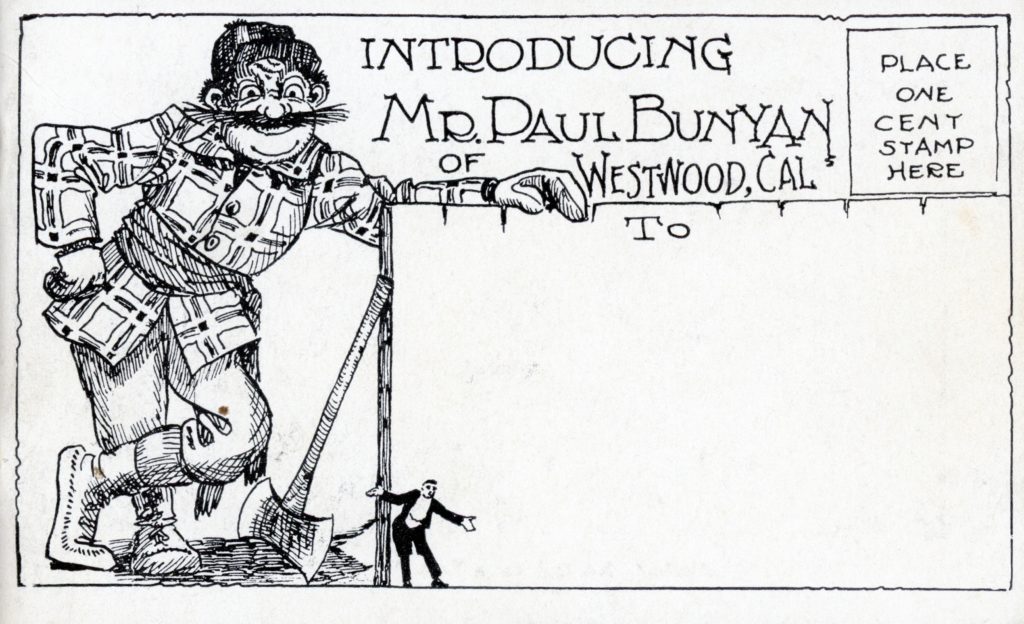
During Red River Lumber Company’s expansion to California, they had number of hurdles to overcome. Since they would be using a different species of pine, than what they had previously used in Minnesota, they had to monumental task to educate their customers. Part of the duty fell to Archie Walker in Minneapolis, and he contacted his cousin, W.B. “Bill” Laughead, who was doing some free-lance advertising work to assist him. At this time, Paul Bunyan was a little known folklore, associated with loggers. The two came up with the idea of Paul Bunyan, and prior to this no one had rendered a drawing of the mythical logger. Continue reading Introducing Paul Bunyan→
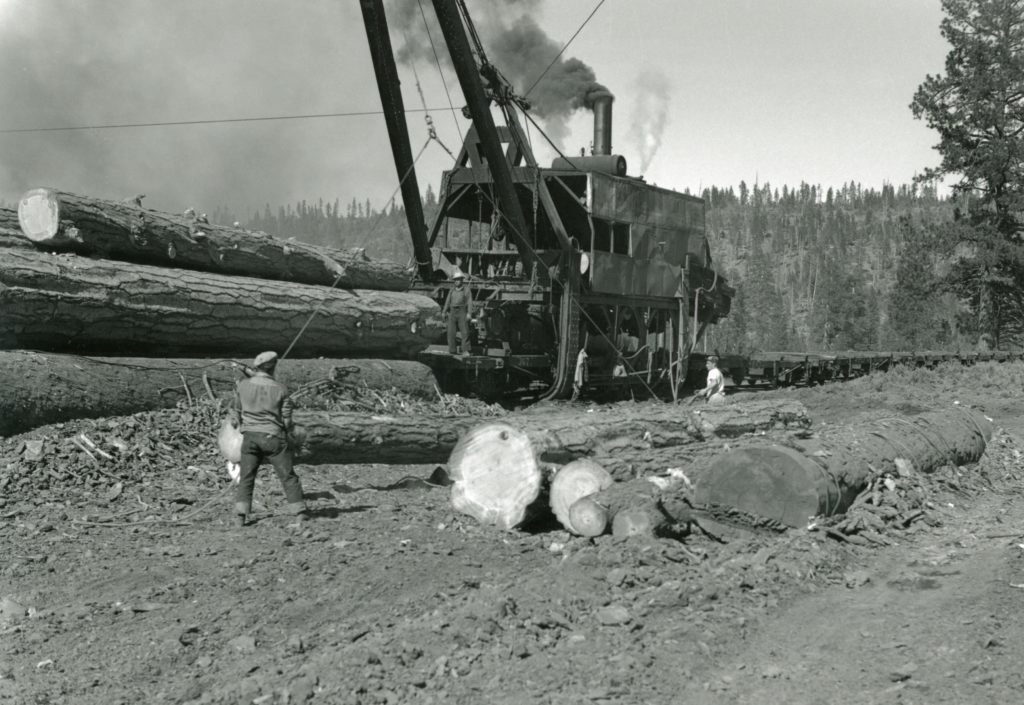
Loading logs with a McGiffert, at McCoy Flat, 1952.
While many are familiar with McCoy Flat Reservoir along Highway 44, there is another McCoy Flat in Lassen County, This too, was named for another Tehama rancher, Leo Lewis McCoy (1850-1936) who used this area for summer pasture from 1874 to 1913. When he retired in 1913, he sold his ranch of 27,000 acres to Alden Anderson for $150,000.
For the record, this McCoy Flat is located along Pine Creek, just east of Eagle Lake. In 1952, it was the scene of the last of the railroad logging operations of the Fruit Growers Supply Company.
Unfortunately, time had a way passing by, and to date, I had not put together the East Side Honey Lake Tour. Many expressed when I first posted about the proposed tour, that a self guided one, seems best suited to meet everyone’s schedule.
Before you know it, winter will be here, so I will put together a Self Guided East Side Honey Lake Tour. Many may not be aware, but the Eagle Lake Ditch built in 1892, extends all the way to Amedee, so I want to put all these items into the guide. This will allow me plenty of time to give additional contemplation, and I just may make a run on my own to give it a test.
In addition, if there another self guided tour you would like to see developed, let me know.
Time & Location: 1 p.m. the main entrance to the Susanville Cemetery at Pine and Court Streets.
Each of the German immigrant graves we will visit has a unique story, just as individuals we have our own identity. Take for instance that of Daniel Cramer. He was a Civil War veteran, a former Lassen County Supervisor, who was a resident of Modoc County when he passed away. His sister was Effie Jensen, another family that will be discussed, among others. Hope to see you then.
Note: For non-subscribers there is a five-dollar fee.
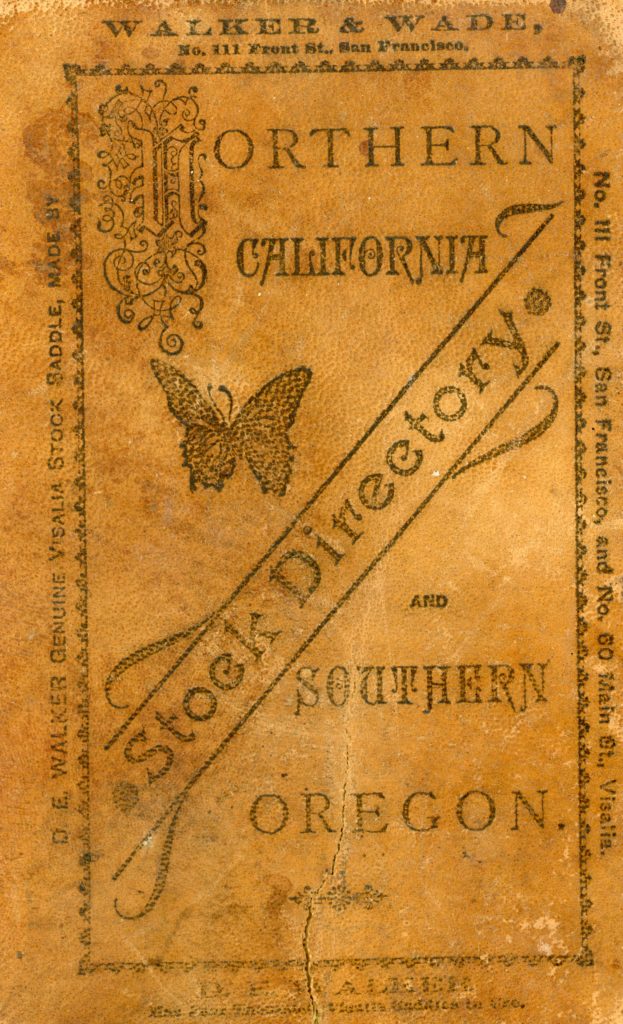
In 1887, two Modoc ranchers, Frank C. Dean and Wilson S. Bayley published a comprehensive 371-page brand directory entitled the Northern California and Southern Oregon Stock Directory. It was an admirable job and in the introduction, they wrote: “All Stockmen are aware that each winter, in every small section of the country, a number of stock remain unclaimed, and on the other hand a number are unfound.Continue reading 1887 Brand Directory→
Postmaster Elmer Winchell with Ben Curler at the inagural airmail flight at the Susanville airport on May 19, 1938.
In the mid-1920s an impromptu airstrip was developed at the north end of Spring Street. At first Red River Lumber Company, owner of the property had no objections. That changed with their intentions of the proposed Piute railroad logging line. Continue reading Susanville Airport→
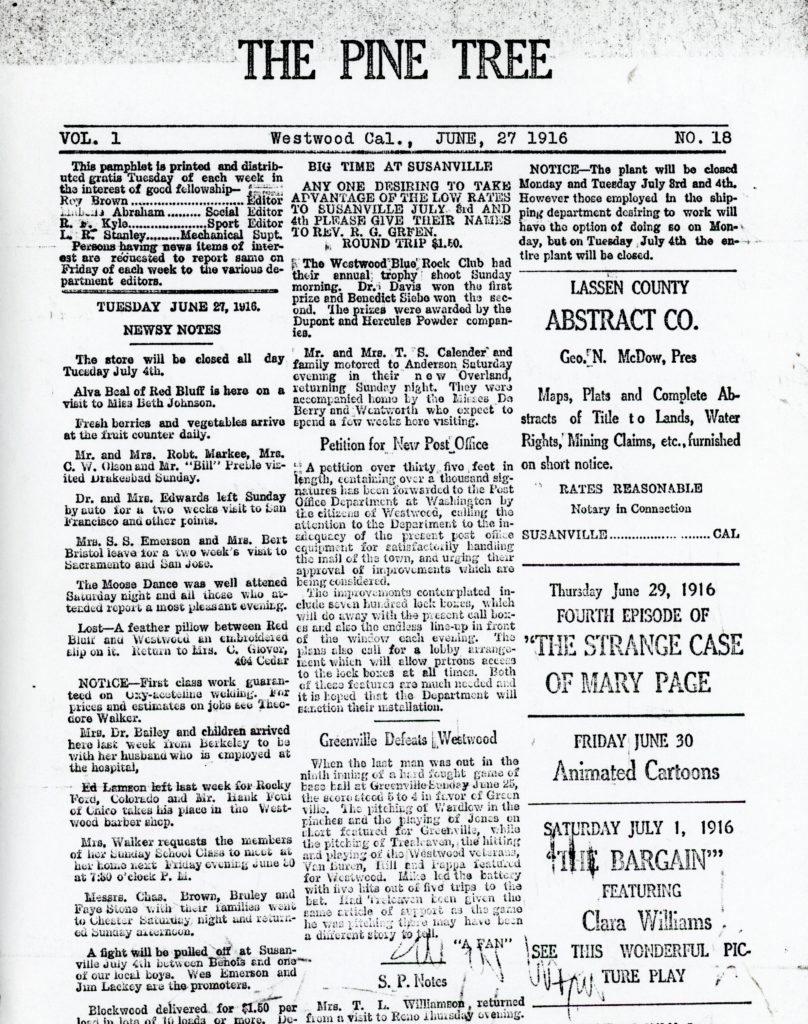
A portion of the front page, and only known copy that was found in the T.B. Walker papers at the Minnesota Historical Society. As a reminder, you can click to enlarge the image.
On March 21, 1916, Westwood’s first newspaper The Pine Tree made its debut. It was a weekly paper that was distributed for free. Leon R. Stanley who was in charge of production, had a background with newspapers in Modoc County. Very little is known about the paper and when it ceased publication.
On August 17, 1917, The Westwood Independent succeeded The Pine Tree. This paper under the helm of G.B. Morrow, who also served as the justice of the peace remained in operation for three years. Stanley again was in the forefront when The Westwood Sugar Pine which eventually became known was Sugar Pine Press succeeded The Westwood Independent.
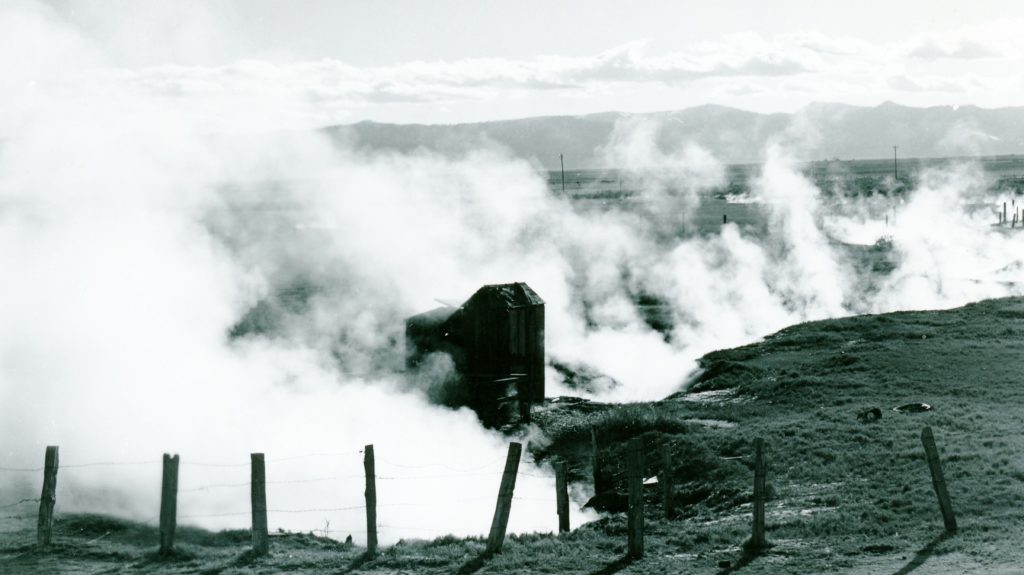
Wendel has had many names over the years. In the 1860s, it was referred to as Upper Hot Springs to distinguish from the Lower Hot Springs. In 1890, when the Nevada-California-Oregon Railroad (NCO) extended its line to Amedee, the Lower Hot Springs took on the name of town established next to it. Upper Hot Springs simply became known as Hot Springs. In 1899, the NCO extended its line further north and at Hot Springs established a new station named Boyd. When T.F. Dunaway became General Manager of the NCO in 1900, he renamed the Boyd station to Smithon. Two months later, in January 1901, he again renamed it to Hot Springs. It would be another fourteen years before the place became known as Wendel.