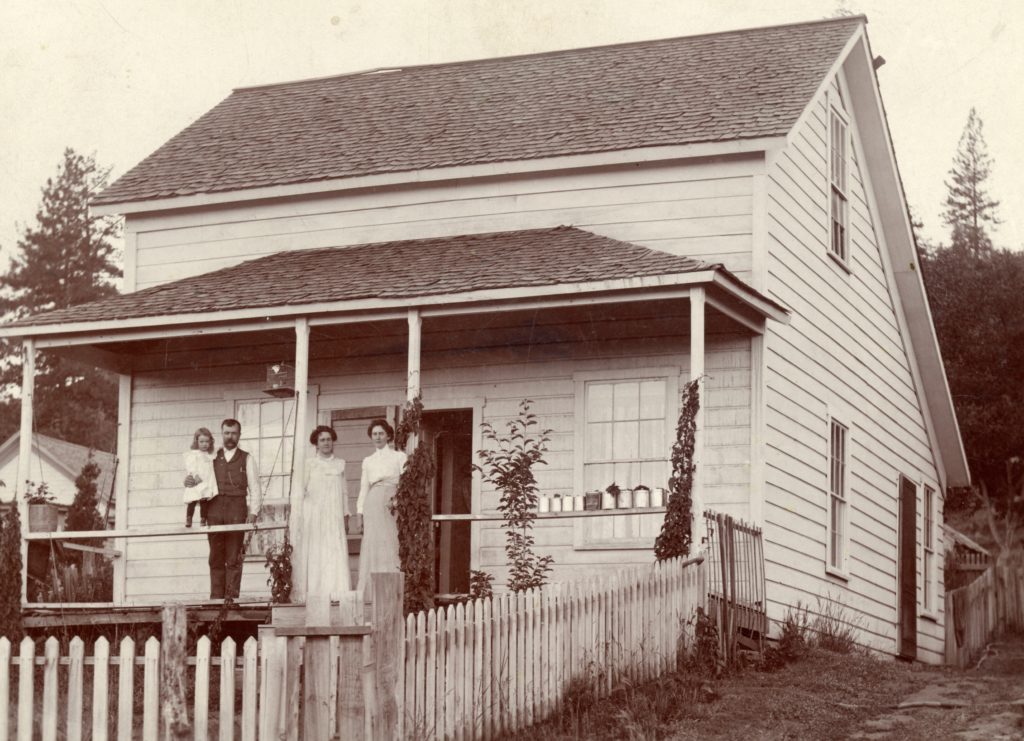
B.R. Zimmerman residence, 45 South Pine Street, circa 1890. Courtesy of B.R. Zimmerman Collection
One of Susanville’s original streets, when the town was surveyed in 1863 it was the most western street. So named for the pine trees that are on the western edge of town. An odd thing about Pine Street, it initially went from Main south to the Susanville Cemetery. What is known as North Pine Street did not come into existence for a number years, and even then it only extended to North Street. For years it was known as Prattville Road, and this was route out of town, and the next town then in existence was Prattville, which the original town no longer exists as it demolished to make way for Lake Almanor in 1914.
North Pine Street, January 1916. Courtesy of Dolores Gasperoni
Pat O’Dea, Courtesy of the University of Wisconsin
In 1919, Charles J. Mitchell arrived in Westwood like so many before and after him seeking employment. The Red River Lumber Company had high turnover in its workforce and always had openings. Little did Red River know their new hire was a famous football player. Then again, Mitchell used an alias. After all this was in an era, where few people carried any type of identification, and Social Security numbers were non-existent. Continue reading Pat O’Dea – The Kangaroo Kicker→
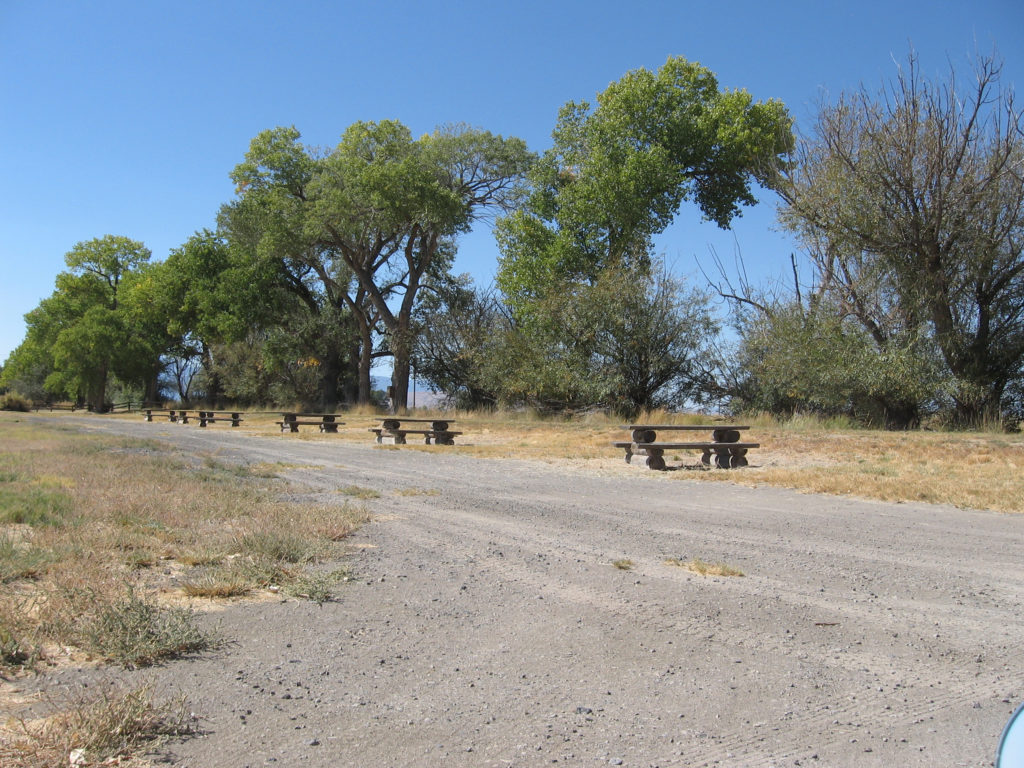
A clue: It is one of my favorite picnic spots. Hopefully, this will not be as difficult as Coleman Lake. Remember, Go Exploring. The answer and story will appear a week from today.
While T.B. Walker and his Red River Lumber Company had a profound impact on Lassen County, Leon Bly and his Eagle Lake irrigation plan ranks right up there with Walker.
The Lassen Industrial Bank was established in the spring of 1912. It met with such success that in 1914 they opened a branch at Bieber and in 1917 another branch at Fall River Mills.
With tremendous growth caused by the lumber industry, the bank built a $100,000 two-story building at the corner of Main and Gay Streets. But the good times did not last long. The bank had nearly over extended itself with loans to the farmers of Bly’s irrigation project, that had failed shortly after the tunnel was completed in 1923. This caused, the bank to start foreclosures on those farmers, and many of those properties were worthless without water. By the summer of 1928, the rumor on the streets of Susanville was in full blast, that either the bank was going to be sold, and worse yet go into bankruptcy. In early August 1928, A.P. Giannini of the Bank of America came to the aid with a $100,000 cash bail out, in which on December 1, 1928, officially took over the Lassen Industrial Bank.
Spread the word, and encourage a friend to subscribe.
Ox teams at Amedee, 1907. Courtesy of Lola L. Tanner
Oxen, it should be duly noted, played a major role in the westward expansion of the United States. Many may have heard or read accounts of people crossing the plains and using ox teams. While oxen are not known for their speed, they can haul heavy loads of freight in difficult terrain. Locally, during the late 1800s oxen were primarily used in logging.
The last major use of ox teams in the Honey Lake Valley occurred in 1907, when the Lassen Mill & Lumber Company had major contracts for lumber for Nevada mines. Ox teams were used to haul the lumber from the sawmills near Janesville to the boat dock on Honey Lake near Buntingville. They were also used at Amedee from the boat dock to the NCO railroad station and shipped to Nevada. Thede French, Bill Wilson and Charles Randrup handled the ox teams. The oxen were needed because the ground near the boat docks was too soft for horses.
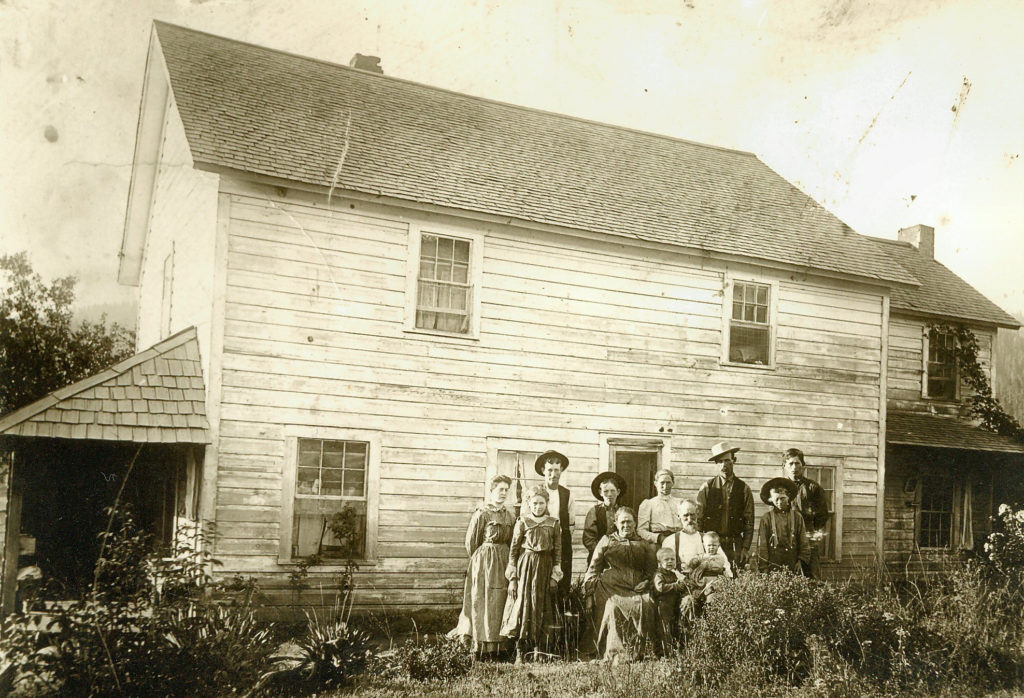
The Scottini Ranch house after their departure, circa 1901. The Robert Blair family leased it from 1895 to 1907. Left to right: Grace Wilson, Sadie Blair, Frank Blair, Bob Blair, Brina Blair Marr, George Marr, Charlie Blair, Willie Blair, Grandma Blair, Grandad Blair and the two Marr children. The house was torn down in the mid-1980s. Courtesy of Florence Stampfli
The Scottini’s were part of the earliest wave of Swiss Italians to arrive in Lassen County. In 1882, Innocenti Scottini purchased a 300 acre ranch on Gold Run from Otis Johnson for $4,000. Scottini, along with his brother, John, operated a dairy and a few mining ventures, the latter scheduled for a future post, in about a week’s time or so.
Things were not so content for Innocenti. On December 21, 1886, he filed for divorce from his wife, Nora on the grounds of adultery. He accused her of having an affair with his brother, John. Innocenti was given custody to his daughter, Mamie, and Nora of their one year old son, John. Shortly after this episode, John Scottini along with Nora and infant John left Gold Run and relocated to Butte, Montana.
In April 1889, the Scottini ranch house burned down. By May he started work on a two-story house, that remained on the property for nearly 100 years. On April 6, 1894, Scottini borrowed $6,000 from John Maxwell who secured the loan by a mortgage on the property. Shortly thereafter Scottini disappeared and in 1895 Maxwell foreclosed on the property. Many residents will know this property as the Satica Ranch.
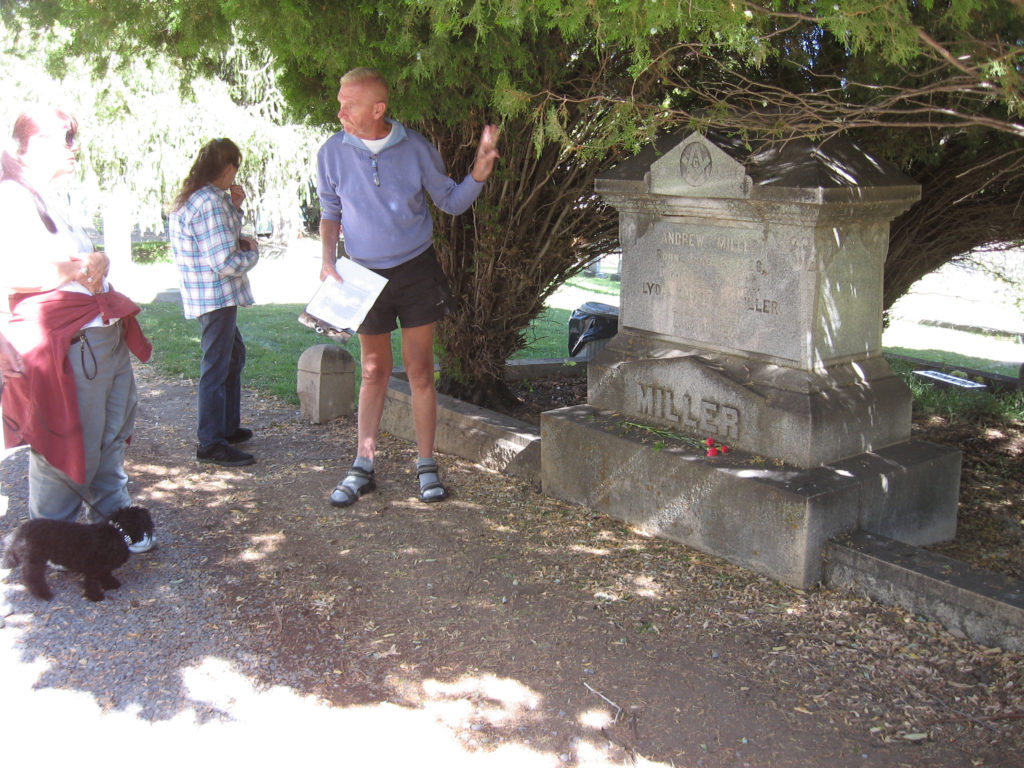
The grave of Andrew Miller was the last stop on the tour. October 1, 2016
Hope those that attended had a good time, and for others hope you enjoyed the narrative. We ended up with ideal weather conditions. In addition, Jim Chapman informed those in attendance of the work being done to replace the old archway entrance that was destroyed in the February 5, 2015 windstorm when two trees were toppled and demolished the old entrance. Continue reading Oktoberfest Cemetery Tour→
Tis’ that time of year for calendars. This is a bit of deviation from past years. In 1977, I supplied vintage photographs for the Lassen High School’s Graphic Arts calendar. I did that until 2000 when the program was cancelled. In 2011 I resurrected the calendars for the Lassen High Alumni Association, though there interest has gone by the wayside. However, many individuals have expressed interest and so the calendars continue as a solo endeavor.
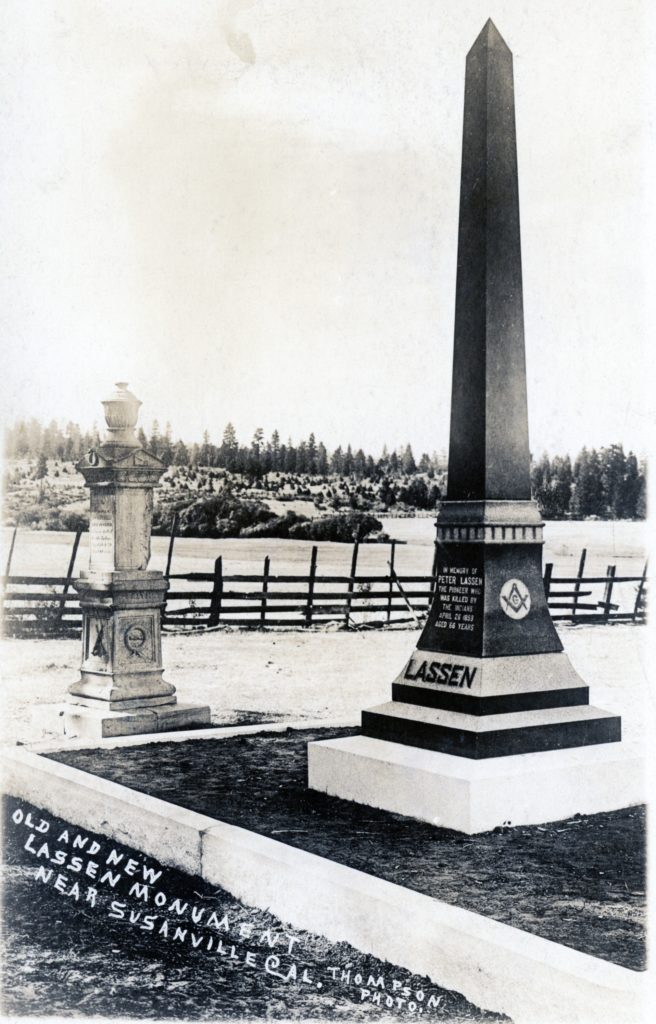
As always, there is a great line-up historic photographs. Some scenes include the Columbia float in the 4th of July parade of 1906, the 1891 log slide in the Susan River Canyon, Drakesbad 1920s, Gallatin Beach, 1960, Camp Lasco, 1923, the Lassen Monuments, 1920, the Big Store, 1915 and more.
To order click here, or those in Susanville can purchase them at Margie’s Book Nook.
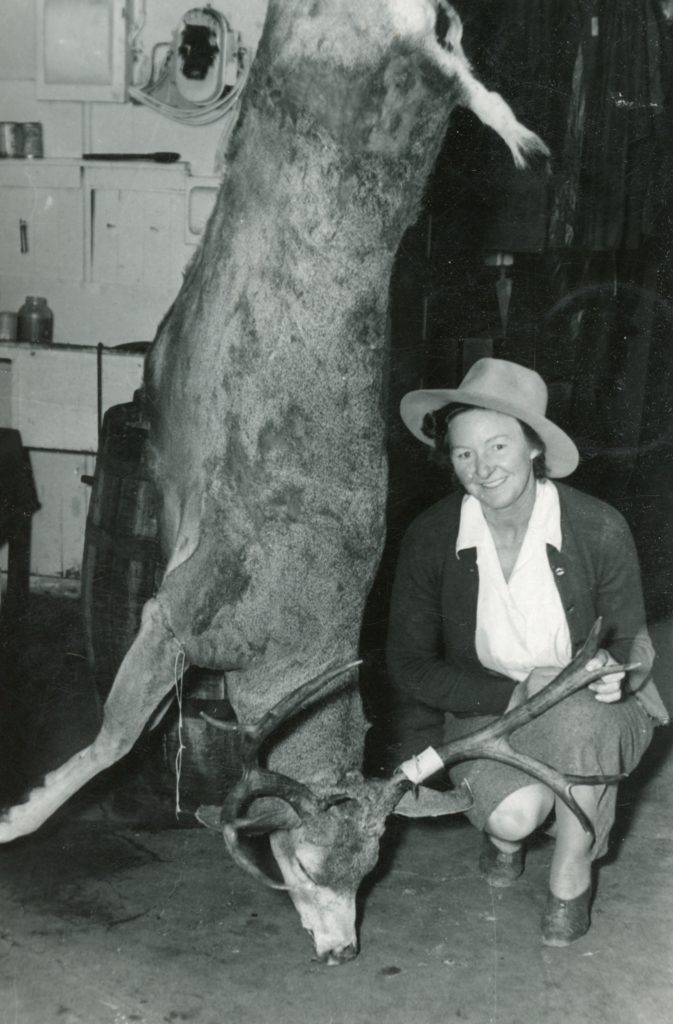
Margaret Purdy with her trophy buck 211 pounds dressed, September 24, 1947.
Once upon a time, a person was not confined to deer hunting in a particular zone. By the 1940s with significant improvements to highways and automobiles opened a lot of territory to hunters, once the domain of locals.
The Fruit Growers Supply Company operated lumber mills in Hilt, Susanville and Westwood. While researching its history, I always came across some interesting material. Fruit Growers’ Annual Reports are a wealth of information. Before you think I am losing my sanity writing first about deer hunting and then lumber mills, there is a common thread.
The following is a most interesting excerpt from Fruit Growers’ 1946 Annual Report:
“Much of the country in which Company timber is located is considered to have good deer hunting, and the deer season opens at a time when the woods are in the driest conditions and when the fire hazard is the greatest. The handling of the large influx of people into the general Northern California area during the deer hunting season constitutes a very serious problems to all owners and agencies interested in timberlands. In 1946, hunters and their parties were registered as they entered Lassen County area, and during one week’s time, close to 5,000 automobiles and 13,000 individuals registered as potential deer hunters. Thus more hunters were checked into Lassen County than its normal population. Despite this, the Company was fortunate in its 1946 experience with forest fires.”
Subscribe and support this site for little as $4.17 a month.
In February, I inaugurated a book-of-the-month, that featured Sagebrush Reflections. After all proceeds from book sales not only help support operations, but help finance future publications, in this case the stories behind the brands of the Pioneer.
Untold Stories will surprise you with a line-up of interesting authors with stories you never heard about. The collection includes tales of buried treasure, hot springs hanky-panky, murder, divorce and more! A variety of untold facets of Lassen County comes to life whether it be Zamboni Hot Springs or Lassen’s Monuments, but not the man. Milford takes center stage during the early 1950s with fire, flood, and snow. In the 1930s, the Army used Honey Lake for aerial training. Military might of the late 20th century comes to light with an ode to the bombing detonations of Sierra Army Depot. In other developments don’t miss Doctor Compton’s failed mineral spring resort for Susanville and Chauncey Smith’s Elixir Springs legacy.