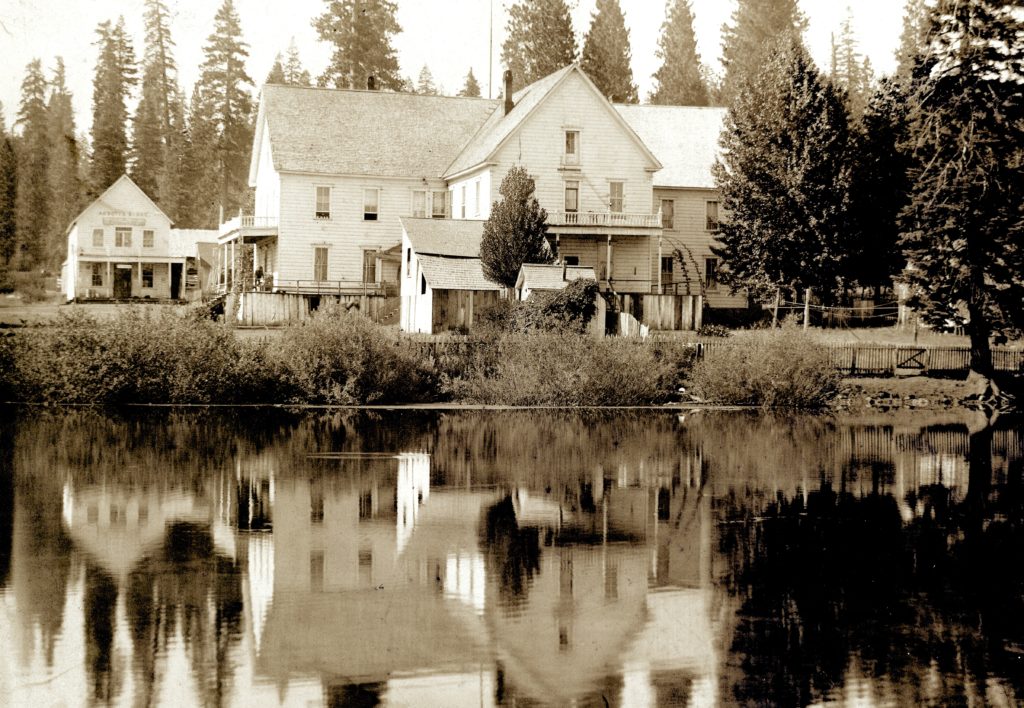
The parade, August 10, 1917. D.M. Durst Collection
For a certain segment of the population when they hear Lassen Grizzlies, the first thought that comes to mind is Lassen High School’s football team and mascot. It should be noted it was not until 1929 that Lassen High adopted the Grizzly as the school’s mascot. Continue reading The original Lassen Grizzlies→
One hundred years ago today, President Woodrow Wilson signed Congressman John E. Raker’s bill to create Lassen Volcanic National Park. There were a lot of obstacles on the journey to make Lassen Peak and its surroundings a national park.
One of the first movements to create a Lassen Park began in 1904, but it was a fleeting moment. It would not be until the fall of 1910, when Modoc County Superior Court Judge, John E. Raker was elected to California’s First Congressional District seat, that the park movement was truly put into motion. One of the first bills Raker introduced called for the creation of a Redwood National Park, but it failed. On February 23, 1912, Raker introduced a bill, H.R. 19557, to establish Peter Lassen National Park. The proposed park encompassed 80,505 acres that included two national monuments–Lassen Peak and Cinder Cone that were designated as such in 1907. Since the lands were under the jurisdiction of the forest service, a report from that agency was required. The agency neither endorsed nor opposed the park. The bill never made it out of committee. Continue reading Lassen Volcanic National Park→
In the fall of 1915, Robert Strahorn brought new life to the project. Strahorn had a reputation for developing these type of projects. One of the biggest changes was the line would start at Flanigan, Nevada, on the eastern edge of the Honey Lake Valley and its terminus at Cedarville, California. By the spring of 1916, it appeared real progress had been made with right-of-ways secured from the Department of Interior and many of the landowners. In addition, it was announced that Lakeview, Oregon would be the new terminus. For those familiar with the country the railroad now had the daunting task to to cross the Warner Mountains at Fandango Pass. First a grandiose three-mile tunnel was proposed, but was reduced to a 4,820-foot tunnel, which still alleviated 700 difference from the top of the summit. Continue reading Surprise Valley Railroad – Part II→
Sand Pass, Washoe County, Nevada, looking north at the Smoke Creek Desert, 2008.
In 1903, the Western Pacific Railway was incorporated with its main goal to build a 810 mile line from the San Francisco Bay Area to Salt Lake City. They were successful in one aspect. On November 1, 1909, the last spike was driven on Western Pacific’s line at Spanish Creek Bridge near Quincy, California. When the railroad was incorporated, it proposed to build twelve branch lines. These “feeder” lines were extremely important to generate rail traffic, which would provide necessary revenue for the fledging railroad. One of these proposed lines called for a Surprise Valley Railroad. Continue reading Surprise Valley Railroad – Part I→
The water carnival at the Sunkist Lodge, 1921. Courtesy of Ed Standard
For two years, 1921 and 1922, the big three lumber companies, Fruit Growers Supply Company, Lassen Lumber & Box Company, and the Red River Lumber Company held a competitive swimming meet between their respective employees. Continue reading Eagle Lake’s Water Carnival→
Shortly after midnight on August 5, 1915, a fire was discovered in Emerson’s warehouse on Cottage Street, adjacent to the Methodist Church. The warehouse, it should be noted, was originally the Congregational Church built in 1875. By the time the fire was spotted the building was totally engulfed in flames. The fire spread rapidly due to west winds, sending embers across the alley and igniting the Emerson Hotel, located on the corner of Main and South Lassen Streets. Two adjacent buildings facing on Lassen Street–The Hyer Hotel and the Methodist Church–also caught on fire. When it was realized that it was futile to try and save the buildings, all efforts were focused on keeping it contained. The losses were staggering, estimated at over $250,000.
Years later, Charlie Emerson’s daughter Mae, recalled the tragic event: “I was home for summer vacation from college when the hotel burned on my father’s birthday and stood with his arm around me in the middle of the street and watched it go with all our worldly possessions and Dad’s business records of years destroyed.”
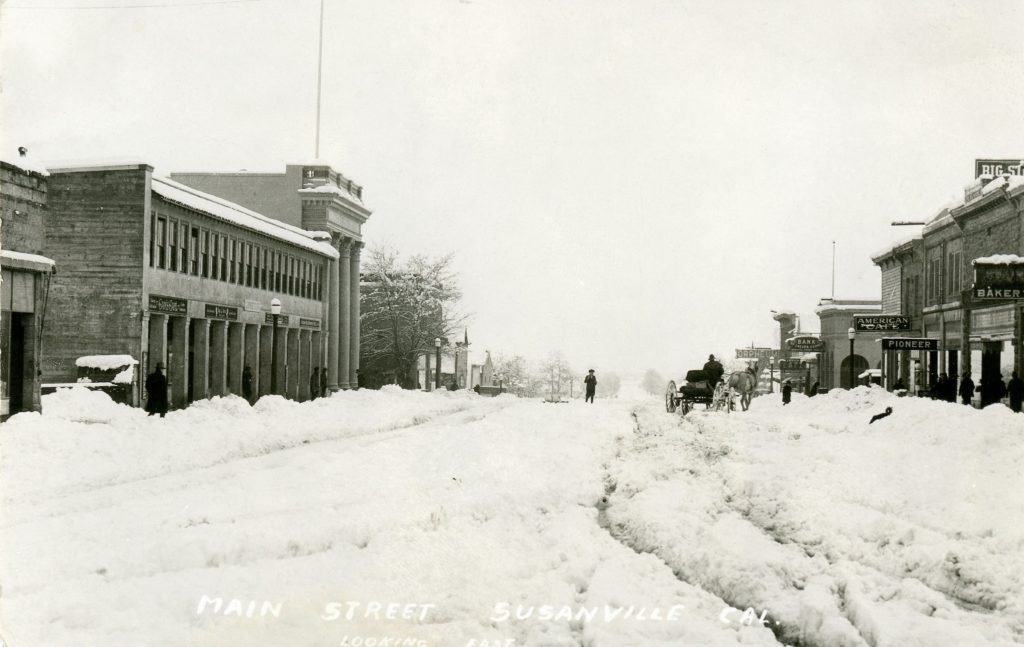
On August 4, 1984 some 500 members of the fraternal organization known as E Clampus Vitus descended upon Susanville. The occasion was the chartering of the Neversweat Chapter #1863 of the E Clampus Vitus and the dedication of the Pioneer, the oldest establishment in Northeastern California. The organization has been around since days of the California gold rush, and was a spoof on the more refined fraternal organizations of the day. In the 1930s it went through a revival and focused on marking historical sites and having a good time while doing so. The Neversweat Chapter was not the first for Susanville, as a lodge existed in 1868. In the early 1880s there were several lodges in Modoc County.
Back to that day at hand, the Lassen Advocate summed it by reporting, “By 7:30 a.m. most area residents were awakening for breakfast and routine Saturday tasks, the revelry at the Pioneer was already in full swing. Clampers were 3 to 4 deep at the bar, the beer was flowing and festive mood in the air. The celebrants began arriving at 6:00 a.m. and spilled from the sidewalk into the eastbound lanes of Main Street. Traffic was undoubtedly light during the early morning celebration.”
Never miss a story, click here to support and subscribe.
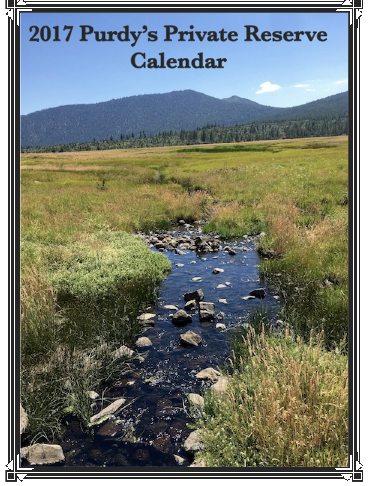
August is a house cleaning month for me. It is also, when I do a lot of work to catalog photographs and other material, as well put away files that I have pulled but neglected to put them back in their proper place. There is a lot of flat surface area on top of those file cabinets, if you get my drift. The winner receives a 2017 Purdy ‘s Private Reserve Calendar.
The flooded dairy, April 1938. Courtesy of Betty Barry Deal
In 1909, Cy Houghton arrived in Lassen County. After the establishment of Westwood, Cy went to work for the Red River Lumber Company. In 1934, he located to Susanville and opened a dairy, which is now Memorial Park. In 1938, the dairy received extensive damage from the Piute Creek flood. At one point he considered abandoning the dairy, but changed his mind. In 1942, Cy’s Dairy closed for business. Not one to be idle, Cy later went to work for Sierra Army Depot and retired from the place in 1957.
Another view. Most people know this site today as Susanville Supermarket. Courtesy of Betty Barry Deal