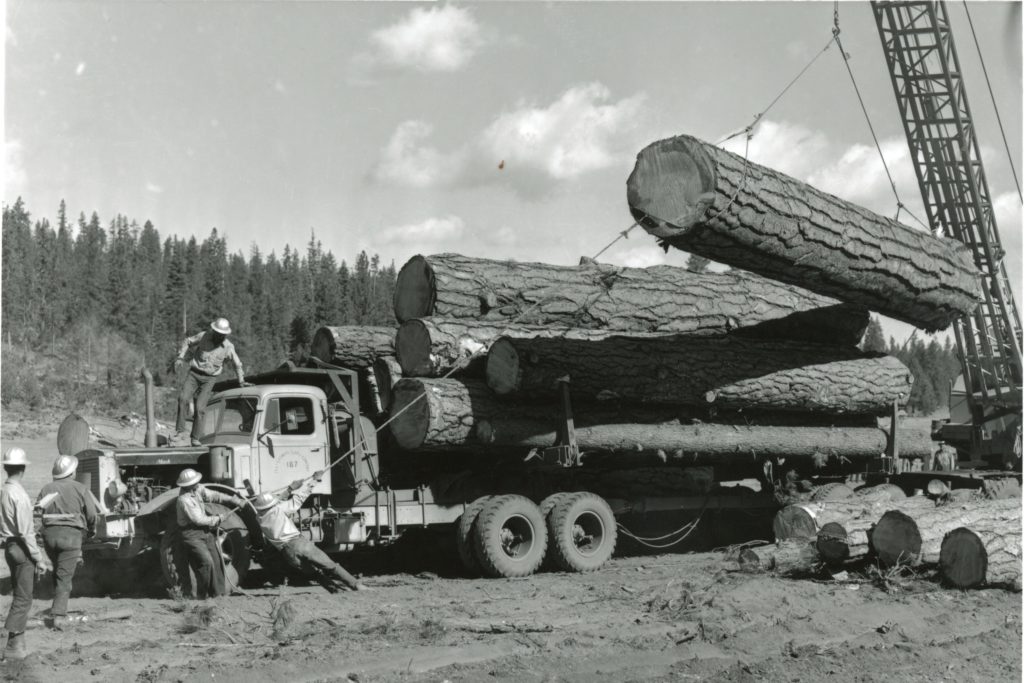
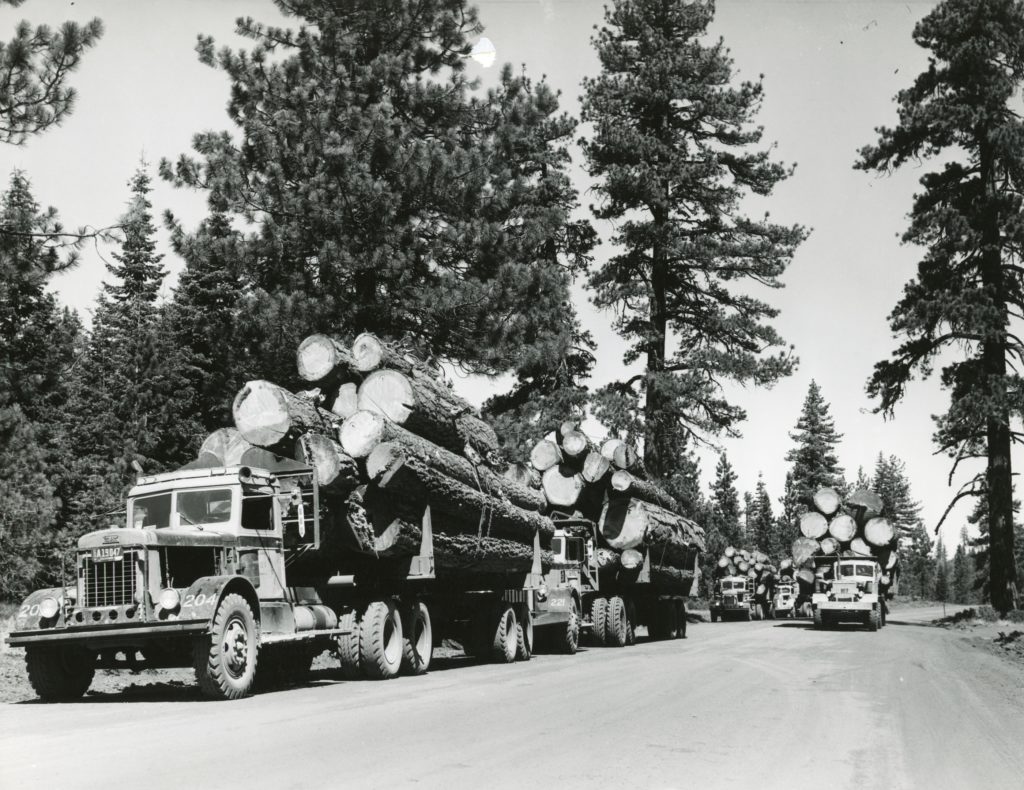
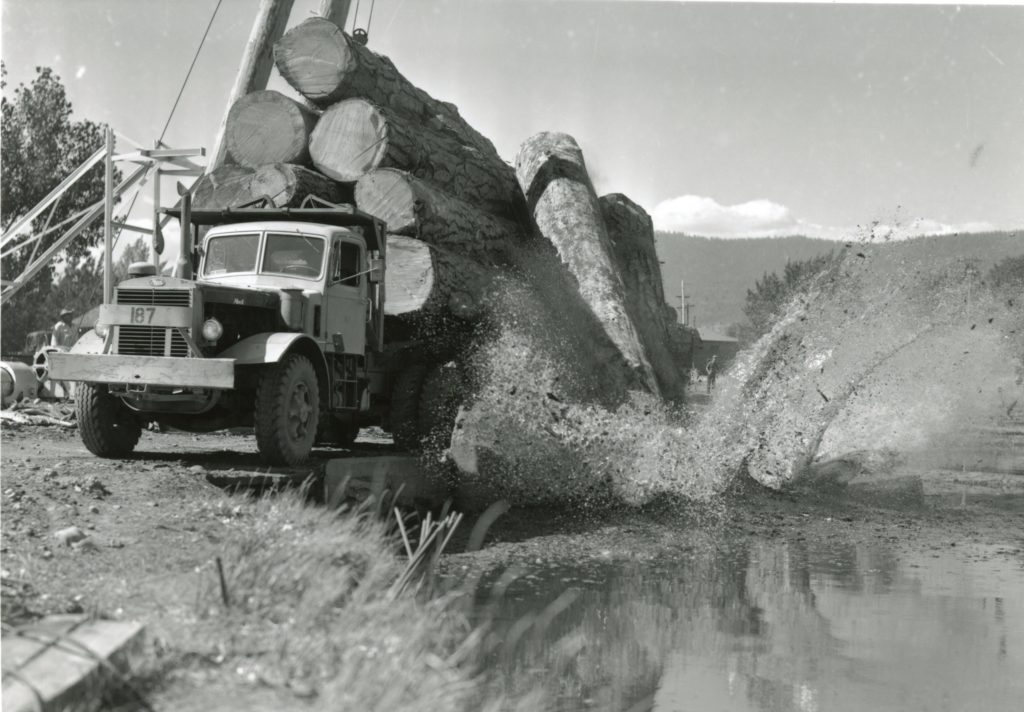
Log landing at Coyote Hole, August 21, 1953. Courtesy of Hank Martinez
In 1940, Fruit Growers purchased its first fleet of logging trucks for the Lassen Operation (Susanville). Initially, the trucks hauled logs where it was impractical to construct a railroad logging spur. With improvements with trucks and a system of private logging roads, it was just a matter of time, when the logging trucks would make railroad logging obsolete. In 1952, the event happened, and saw the last year of railroad logging of Fruit Growers and Lassen County.
Lunch time at Dow Butte, August 21, 1953. Courtesy of Hank MartinezThe record load of 26,860 board feet being unloaded at the Fruit Growers millpond, Susanville, August 21, 1953. Courtesy of Hank Martinez
Incorporated in 1890, the Honey Lake Valley Land & Water Company proposed the construction of a dam on Long Valley Creek to reclaim the desert lands of the eastern Honey Lake Valley. The dam and reservoir site was situated on lands adjacent to that of Long Valley pioneer George Greeno (1817-1902). In the summer of 1892, work began on the dam—90 feet high, spanning a 1,000 feet with a 500-foot wide base. It was estimated that the reservoir would have a storage capacity of 1,281 acres, at an average depth of 14 feet. The project had its skeptics, especially with the regional dam failures of 1890—those of Ward Lake and Skedaddle. The Lassen Advocate noted in October 1892: “The great interest centers in the permanency and holding capacity of the storage reservoir. Will it withstand the winter torrents and the rush of spring freshets? Will it successfully defy the incursions of insidious rodents and stand firm against the pressure of the floods? When the location of the dam is taken into consideration, the scientific, practical and thorough nature of its construction gives conclusive evidence that it will prove permanent.” The Advocate concluded “It has been filled little at a time by fine quality of clay, water poured upon it and then puddle by means of horses, which renders it impervious to water.” The region experienced an unusual amount of heavy fall rains that added a considerable amount of water to the nearly completed reservoir—a delight to many. In late November 1892, the area was hit a deluge, an estimated seven and half inches of rain fell at the dam site alone! The floods from Long Valley Creek breached the dam and left a gaping hole 100 feet wide. The damage was estimated at $50,000. The Company had invested over $175,000 in the project and never recovered from that loss. The Company’s manager, president and owner Fred Lake remained committed to the project until his death in 1942.
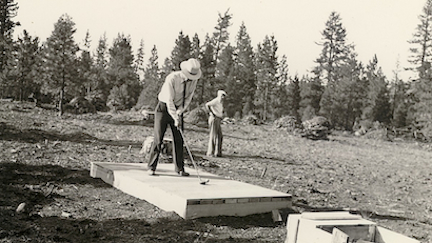
One would not normally associate the sport of golf in a community composed mainly of lumberjacks and sawmill workers like Westwood. However by 1920, the golfing phenomenon swept through Northern California and this lumber town was no exception.
The “divot diggers” as they were affectionaly known then took a little longer to take hold at Westwood. By the early 1920s, Susanville could boast three golf courses, albeit crude by modern day standards. Even Chester, then just a mere hamlet, had a golf course.
As early as 1921, Westwood’s golfing enthusiasts began the debate to establish a golf course. Yet, they just could not generate enough momentum to pull it off. This all changed in 1929 when Westwood’s golfing community organized a club. Those original duffers consisted of Ross Morehouse, Gene Huggins, Bob Pullman, F.W. Koerner, F.M. Jayne, Bill Corbett, Dan Taylor and C.C. Baptie. Continue reading The Westwood Golf Course→
Thompson Peak, 1911. It should be noted that Thompson Peak, and the Diamond Mountain Range is a part of the Honey Lake Fault Zone.
Some may recall that back in January I wrote about Sylvester Daniels. For a brief refresher Daniels arrived from Iowa in the spring of 1874 and spent time with his sister, Polly Parks, who resided just east of Buntingville. He kept a journal of his experiences that he wrote specifically for his daughter, Viroqua and the rest of his family who remained in Iowa. The following is his account of the first earthquake he experienced.
“Sunday, January 24, 1875 – Well, we are all alive yet. Now, I will tell you why I started as I did. You have heard of earthquakes I suppose. Well, I will tell on the sly that there was a live one came along here this morning early about 4 o’clock. It awoke me very suddenly, then such a crash. I thought the house was all breaking to pieces and it seemed to roll back and forth in bed. At any rate it shook things up pretty lively, while it lasted. But it was not near as long as I have written about. It seemed to roll back and forth and jar terribly. It seemed to pass towards the Mountain from the Valley.
The hens flew and cackled and the pigs squealed. Polly Parks said it shook every bottle and everything in the house. She said the cream was disturbed on every pan. So you see there was quite a commotion for a time. All the damage that I have heard of as of yet, is some chimneys are slightly rent and some were frightened. I have not heard anyone express themselves to wish it repeated. Polly and Elisha Parks say they are not as near as afraid of them as they used to be of thunderstorms and tornadoes in the East.”
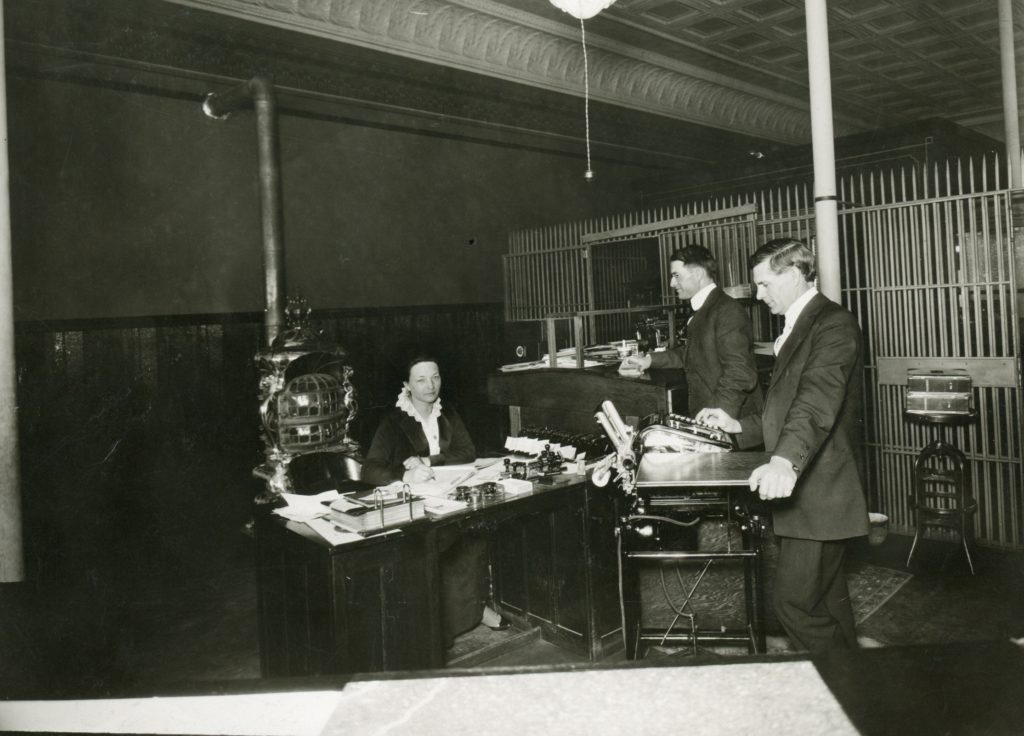
Standish Branch of the Bank of Lassen County inside the Wrede Hotel
For a time, Standish was a very prosperous community in the Honey Lake Valley. Not only did it have numerous businesses, but a hotel, and a creamery, too. Everything was so good, in fact, that it even had its own financial institution.
In 1892, the Bank of Lassen County was established in Susanville, the first of its kind in Lassen County. In the spring of 1915, the bank announced it was going to open its first branch in Standish. However, it encountered some delays, especially with the installation of big safe, inside the Wrede Hotel, where the branch office would be located. On August 30, 1915, the branch opened with W.H. “Wally” Fulton, as the manager. Fulton had a long association with the financial institution, and equally important was well-known in the Standish region, having been married to Kathryn Mapes. The Standish Branch operated for ten years, closing its doors on December 31, 1925.
Wally Fulton later moved to Susanville and in 1933 became the City’s Treasurer. He remained in that position until his untimely death in 1941 by suicide. He used a gun in the city vault, and waited until the noon whistle from the Fruit Growers mill to mute the sound of the gun shot.
Never miss a story, click here to support and subscribe.
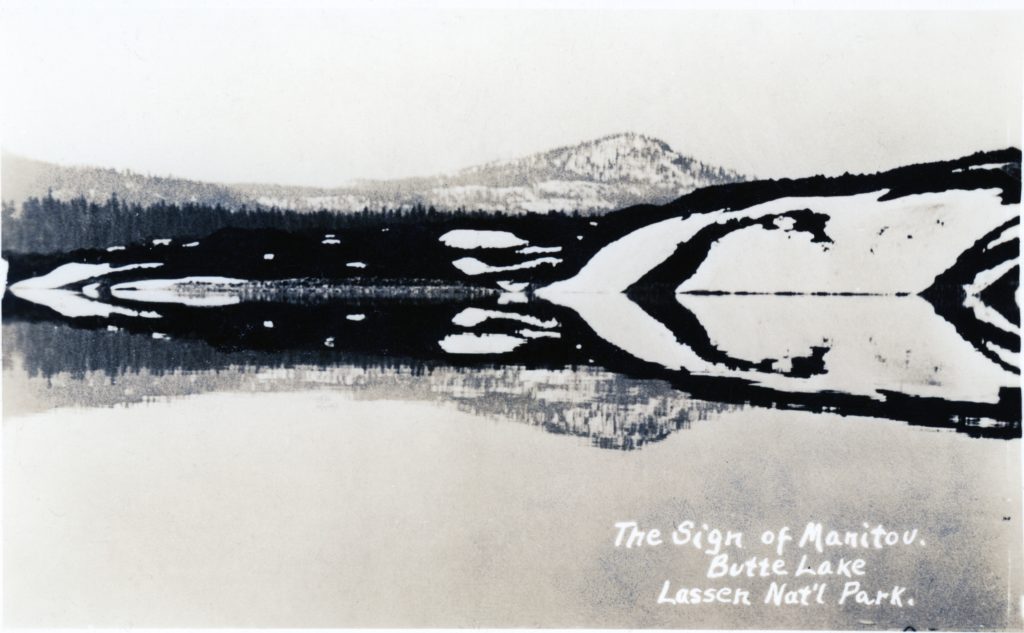
Butte Lake, circa 1920. Roy Sifford, of Drakesbad fame wrote: “The sign of the Manitou which means the sign of God. The shadows in the water made a long arrows which the Indians thought that was a sign of the Great Spirit (Manitou) or God gave them. Courtesy of the Sifford Collection.
This lake in the northeast portion of Lassen Park was originally referred as Black Butte Lake and Lake Bidwell. J.S. Diller named it Lake Bidwell in honor of General John Bidwell who came to California in 1841 and founded the town of Chico. The official name dates back to 1883 and no doubt received its name from two surrounding landmarks, Cinder Butte and Black Butte.
The French Canadian trappers of the Hudson Bay Company introduced the term “butte” to Western Americana. It was used to designate a landmark for an isolated peak, but not high or large enough to be a mountain.
Never miss a story, click here to subscribe for as little as five dollars a month.
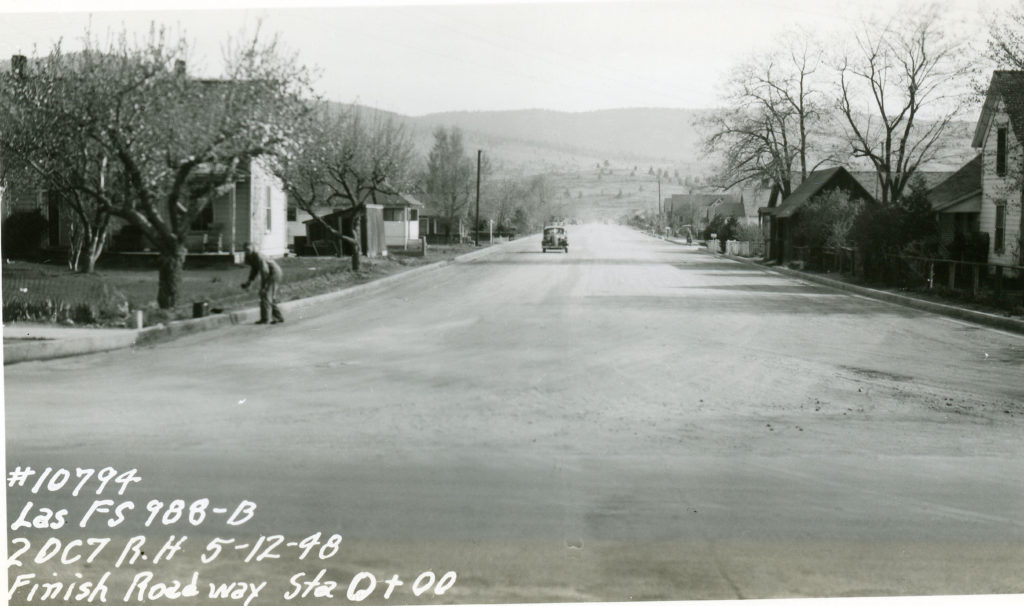
On January 16, 1911 M.O. Folsom unveiled his East Addition to Susanville subdivision containing 300 lots. Many of its north/south streets were named for trees, i.e., Ash, Cedar, Fir, Spruce. The east/west were numbered, i.e, First, Second, Third, Fourth and Fifth.
Ash Street, initially ended at Fifth Street. Travelers headed north either used Hall Street or Weatherlow Street to Chestnut. In 1947, Ash Street was incorporated into the Lassen-Modoc Joint Highway #14, the pre-cursor to State Highway 139. Ash Street was extended to connect the highway making for a straight route into Susanville.
Never miss story, click here to support and subscribe.
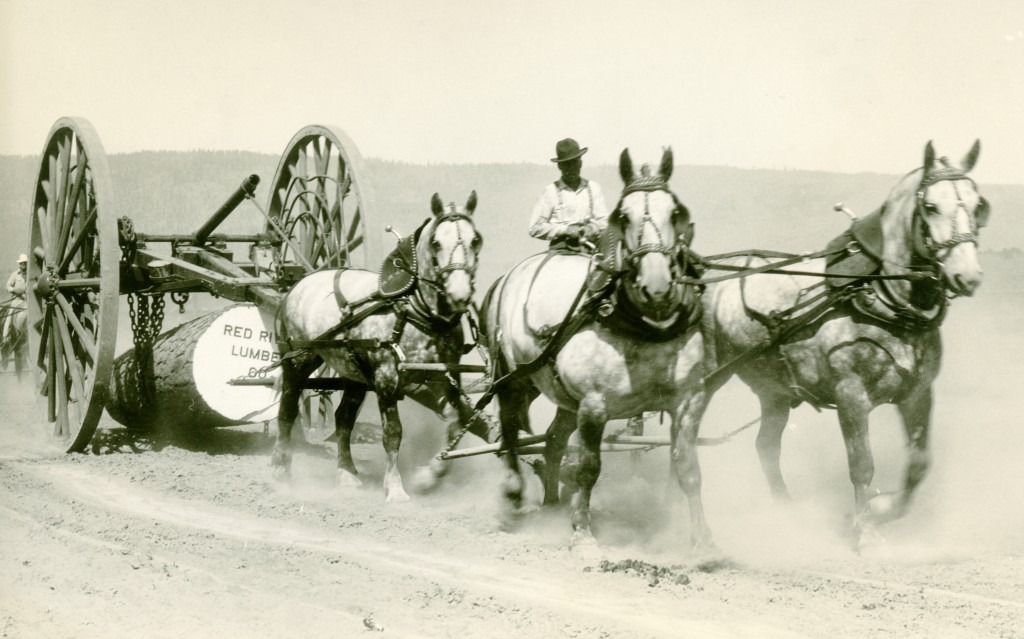
Red River Lumber Company’s 16 foot big wheels and team with a 2 1/2 ton log at the 1923 Lassen County Fair.
This being Lassen County Fair week, it is only fitting to have an article about the fair. The first fair was held in 1878, a regional one that comprised the residents of Lassen, Modoc and Plumas Counties. While it was desirous to make it an annual event it was fraught with financial problems.
What we consider the current Lassen County Fair was established in 1922, with five men who organized it. At that time major changes had taken place in the county with the establishment of three large lumber mills–Fruit Growers Supply Company, Lassen Lumber & Box Company and the Red River Lumber Company. Lumber was now king in Lassen County. Besides the traditional horse racing and such, a new feature was added to reflect the community at large, the logging shows. This was a big attraction for the Lassen County Fair for over seventy years, though with the dwindling decline of the lumber industry, this feature was eventually cancelled.
However, in 1923, the first logging exhibition at the Lassen County Fair was certainly noteworthy. For many attendees it was the first time they were able to witness the current logging methods of the “big wheels.” The Fruit Growers Supply Company won top honors in this category. It should be noted by 1927, the lumber companies began phasing out the “big wheels” for the motorized Caterpillar traction engines.
A full story how the Lassen County Fair has evolved since 1878 can be found in the latest issue of the California Traveler.
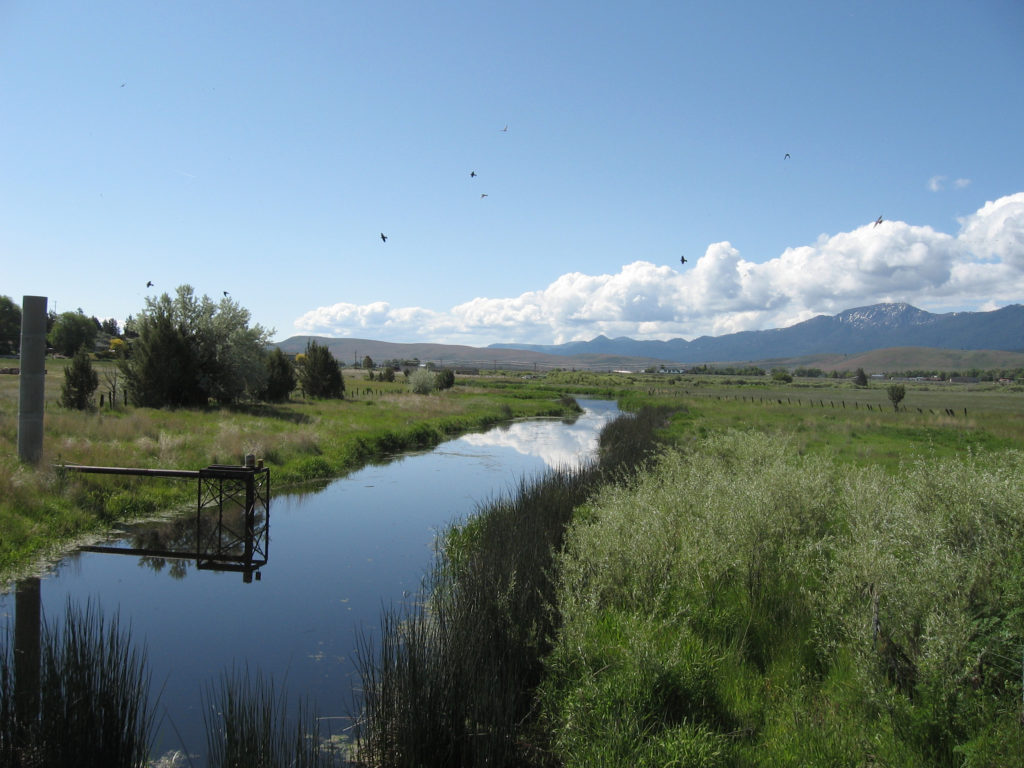
Brockman and Jensen Sloughs are man made irrigation ditches originating from Susan River, at the east end of Susanville, with the diversion point of Woodstock Dam. The dam was constructed in 1861 by Loyal Woodstock and Luther Spencer, and constructed a small irrigation ditch on their adjacent land. It was in that same year, that Woodstock planted the first crop of alfalfa in the Honey Lake Valley.
Woodstock’s downstream neighbors liked his irrigation system. On May 4, 1875, W.W. Scholl, John Cahlan, William Brockman, Jurgen Jensen and Fred Hines extended Woodstock’s irrigation ditch and about a mile from the original diversion, the original ditch was split into two, the northern one became known as Jensen Slough and the southern Brockman Slough.
Never miss a story, click here to support and subscribe.
Chester, California, 1914. Courtesy of Dolores Gasperoni
On April 26, 1894, the Chester Post Office was established at Burwell Johnson’s establishment, which included a saloon plus rooms for travelers. Johnson’s was located at the base known today as Johnson Grade on Highway 36, approximately where the causeway begins. The post office was named after Chester, Vermont, former home of the Jonathan Martin family, Johnson’s neighbors, who were instrumental in the development of Chester.
In the early 1900s, the Great Western Power Company began acquisitions of properties of Big Meadows, which it was their intent to construct a reservoir for hydro power development. This they did, and known today as Lake Almanor. The Martin and Olsen families sold their properties to Great Western Power, retaining everything about 4500 elevation contour. In 1911, Edith Martin hired Everett M. Cameron to survey and subdivide her property and thus, the town of Chester was born.